Roadmap to full-stack: How to become a full-stack developer
Starting your tech career can be very challenging at times. There are many paths and opportunities, and it’s easy to get confused and distracted. That’s why it’s crucial to conduct thorough research, set some goals, and have a complete roadmap ready before starting your journey.
If you’re interested in tech or planning to accelerate your career in the industry, you’ve likely heard a lot about full-stack development. Full-stack developers are always in high demand (and they’re not going out of fashion anytime soon) in not just the tech industry but in many other fields as well. If you’re planning to start your career as a full-stack developer or switch to full-stack development, this guide is just for you.
However, full-stack developers need in-depth skills in multiple technologies, making it difficult to get started.
Today, we’ll introduce you to full-stack development and outline the next steps for your full-stack web developer journey.
Here’s what we’ll cover today:
Build the foundation of your full-stack career.
Master HTML, CSS, and JavaScript for building your own functional websites.
If you want to get into full stack web development, then you’re in the right place. This course is for anyone who wants to learn how to build a complete web application from front to back while avoiding the endless debates about product X versus product Y. Through this course you'll work with some of the most fundamental tools that full stack developers use everyday such as: React, Flask, SQL, creating APIs, testing, and more. Beyond that, you'll learn how to design an application from scratch, build the data model, and how to deploy it. By the end of this course, you'll have the skills necessary to create an application from scratch as well as a nice new project to add to your portfolio. Needless to say, this is your one-stop-shop to becoming a modern full stack developer!
What is a full-stack developer?#
Full-stack developers are people who know how to work on a product from both client and server-side. This means they’re familiar with frontend technologies, like JS or frontend frameworks (React, Angular. Vue etc), web development technologies and backend technologies like mySQL, MongoDB, and Node.js.
Full-stack developers have skills in three areas:
-
Browser technologies (JavaScript, front-end frameworks)
-
Server-side technologies (ASP, Node.js)
-
Database technologies (SQL vs. noSQL, MongoDB)
Full-stack developers are like a jack of all trades; they’re likely not as experienced with any particular technology as a dedicated front/backend developer, but they have invaluable versatility and oversight of the whole process.
Advantages of being a full stack developer#
The advantages of being a full-stack developer are:
-
Faster Prototypes: You can develop a product from conception to completion with just your own skillset. Reduces time lost from miscommunication or passing responsibilities.
-
Valuable: Your uniquely broad skillset allows the company to hire fewer programmers for a given project. This means you’re hard to replace and therefore will be well compensated.
-
Diverse Work You can shift from working on frontend development teams to backend teams depending on where help is needed. What you focus on can vary each day and lets you work on a variety of problems.
-
Easier upskilling: More experience with previous technologies makes it easier for you to pick up newer ones. Your broad understanding of different branches of development allows you to quickly see the advantages of new technologies and how they can fit into your projects.
-
Unique input: Your collection of skills give you a unique and valuable insight when evaluating the next steps. Employers value this insight and will allow you to have more input in decision-making than the standard developer.
Disadvantages of being a full-stack developer#
Full-stack developers are at the cutting edge of both front- and backend technologies, meaning you’re required to do a lot of learning up front and continue learning new technologies as they develop.
More so than other developer positions, your ability to adapt to rapidly changing technologies is essential to being a valuable full-stack developer.
Unfortunately, most companies do devote resources or time to the extensive continued education effort required by full-stack developers. Instead, you will be expected to find your own learning materials and continue your education in your free time.
This cycle of rigorous continued learning can be too much for some developers.
Full-stack developer roadmap#
Front-end development#
Front-end development means creating and maintaining the part of the website with which the user interacts. The interface is an important aspect of user experience, and that’s why it’s important to master front-end technologies and stacks. To begin your journey, start with learning HTML, CSS, and JavaScript. These languages help you build the foundation of front-end development. To advance your abilities, you can eventually move on to REACT, Rails, and VUE.js as well.
Front-end web developers are proficient in HTML, CSS, and JavaScript, and their primary role is to create web applications so users can view and interact with websites. Front-end developers are in high demand as tech companies are always looking to improve the visuals and interactivity of their applications. This path gives a comprehensive insight into the fundamental components of web development. You’ll start with the fundamentals of web development and get an overview of the complete process. Moving ahead, you’ll cover the basics of HTML, CSS, and JavaScript from scratch, which are essential for web development. You’ll also get hands-on practice adding interactivity to websites, including creating a drop-down menu, tooltip, auto-validation form, and an infinitely scrolling list. Finally, you’ll get a comprehensive step-by-step description of how to launch a website on the internet. By the end of this path, you'll have gained the skills to create functional websites and web applications.
Back-end development#
Backend development is responsible for handling, managing, and maintaining the storage and processing part of the website. Basically, it focuses on how the website works, ensuring that it works properly. Without a scalable and efficient backend system, it’s impossible to have an interactive and user-friendly website. That’s why it’s important to have a strong foundation in backend development and to upgrade your skills gradually.
In order to build your backend development skills, you can start learning Python, JavaScript, or Java. These are the three most efficient and widely used backend programming languages, and they can help you create a stable backend environment.
Backend developers are responsible for the server side of web applications. According to a survey of recruiters, backend developers top the list of in-demand tech jobs. This Skill Path is designed for individuals who are interested in becoming backend developers but don't have any programming background. You will learn how to design and build efficient, scalable, and secure backend systems using Python and Django framework. By the end of this Skill Path, you’ll have a strong understanding of backend development concepts and the ability to build and deploy your web applications. Get ready to dive into the exciting world of backend development!
Database management#
Full-stack developers must be adept at handling databases, which includes creating, reading, updating, and deleting data. This can involve working with Structured Query Language (SQL) databases like MySQL and PostgreSQL for NoSQL databases like MongoDB.
SQL is a query language used for managing data in a relational database system. It is key to roles like data scientist, software engineer, and data engineer. This path will teach you essential SQL queries, including SELECT, WHERE, DISTINCT, GROUP BY, and ORDER BY, along with advanced concepts like joins, subqueries, and aggregate functions. By mastering these skills, you'll be prepared for the software industry with a strong foundation in SQL.
Version control#
Lastly, if you plan on becoming a full-stack developer, you must be an all-rounder and have in-depth knowledge of version control.
This expertise is not just about knowing how to use tools like Git but also about understanding best practices for maintaining a clean and manageable codebase. Effective version control allows multiple developers to work on the same project without conflicts and facilitates the tracking of changes and bug fixes, making it essential for any form of collaborative coding effort.
This comprehensive course is your ultimate guide to learning Git and version control. You’ll start with the basics of Git version control, such as setting up your Git config and running basic terminal commands like the echo command. Then, you’ll explore GitHub as a development platform and understand Git snapshots. You’ll advance your skills by creating and managing Git commits, undoing changes with Git undo commit, and reviewing your project’s history using Git logs. You’ll also tackle branching—learn how to rename or delete branches and confidently resolve Git merge conflicts. Additionally, you’ll master repository management with Git commands and organize changes using Git checkout, Git stash, and more. After completing this course, you’ll be ready to use Git commands in your projects—a career-boosting skill for every software developer.
Choose your full-stack path: Which roadmap is right for you?#
One of the biggest misconceptions about becoming a full-stack developer is that there is a single roadmap everyone should follow. In reality, there are many successful paths into full-stack development, and the best one depends on your interests, career goals, and the types of products you want to build.
A startup building a SaaS application may use an entirely different stack than a bank, healthcare provider, or AI company. That's why trying to learn every framework and language at once often leads to frustration and burnout. Instead, focus on building expertise in one ecosystem and expand your skills over time.
The good news is that all full-stack roadmaps share the same foundation: frontend development, backend development, databases, APIs, and version control. Once you understand these fundamentals, switching between technologies becomes much easier.
Full-stack career paths at a glance#
Goal | Recommended Stack | Why |
Startup developer | MERN | Fast development and strong hiring demand |
Enterprise developer | Java + Spring Boot + React | Common in large organizations |
Python developer | Django/FastAPI + React | Popular, versatile, and beginner-friendly |
AI application builder | FastAPI + React | Strong AI and machine learning ecosystem |
Freelance developer | MERN or Django | Flexible for a wide variety of projects |
Path 1: Modern JavaScript full-stack developer#
This is often the most popular path for beginners because JavaScript can be used across the entire stack.
Typical technologies:
React
Node.js
Express
MongoDB
This combination is commonly known as the MERN stack.
Why developers choose this path:
One language across frontend and backend
Large ecosystem and community support
Strong startup adoption
Huge number of tutorials and learning resources
High demand for React developers
A typical learning progression looks like:
HTML + CSS↓JavaScript↓React↓Node.js + Express↓MongoDB↓Full-stack applications
If your goal is to build web applications quickly and maximize job opportunities, this is often the simplest path to start with.
Path 2: Python full-stack developer#
Python has become one of the most versatile programming languages in modern software development.
Typical technologies:
Django or FastAPI
PostgreSQL
React
This path is especially attractive because Python is widely used beyond web development, including:
Data science
Machine learning
Automation
Cloud services
AI applications
Django is ideal if you want a batteries-included framework with authentication, ORM support, and administrative tools.
FastAPI is ideal if you're interested in APIs, cloud-native systems, and AI-powered applications.
Why developers choose this path:
Beginner-friendly syntax
Strong career flexibility
Growing demand for AI-integrated applications
Excellent backend development experience
Path 3: Enterprise full-stack developer#
Many large organizations rely on mature enterprise technology stacks.
Typical technologies:
Java
Spring Boot
PostgreSQL or Oracle
React
This path is commonly found in industries such as:
Banking
Healthcare
Insurance
Government
Large enterprise software
Why developers choose this path:
Strong demand in large organizations
Excellent long-term career opportunities
Exposure to large-scale systems
High focus on architecture and reliability
Enterprise environments often prioritize stability, scalability, and maintainability over rapid experimentation.
Path 4: AI and modern application developer#
The rapid growth of AI applications has created demand for developers who can combine traditional web development with machine learning capabilities.
Typical technologies:
Python
FastAPI
React
Vector databases
Common project types include:
AI assistants
Chat applications
Recommendation systems
Search platforms
Retrieval-augmented generation (RAG) systems
AI-powered SaaS products
Why developers choose this path:
Rapidly growing job market
Strong intersection of software engineering and AI
Modern cloud-native architectures
High demand across startups and enterprises
As more products integrate AI capabilities, this path is becoming increasingly valuable for full-stack developers.
Which path should beginners choose?#
The right roadmap depends less on what's popular and more on what excites you.
If you want the simplest path:
→ Choose the JavaScript full-stack route (MERN).
You'll use one language throughout the stack and find an enormous amount of learning material.
If you're interested in AI and machine learning:
→ Choose the Python full-stack route.
Python opens doors to web development, automation, data science, and AI.
If you want enterprise opportunities:
→ Choose Java and Spring Boot.
This path is common in large organizations and often leads to long-term career growth.
If you're unsure:
→ Start with HTML, CSS, and JavaScript.
These technologies form the foundation of modern web development regardless of which stack you eventually choose.
Quick decision guide#
Build startup products | MERN |
Become a web developer quickly | MERN |
Work with AI applications | FastAPI + React |
Learn Python professionally | Django/FastAPI + React |
Join a large enterprise | Java + Spring Boot + React |
Keep your options open | HTML, CSS, JavaScript first |
There is no universally correct full-stack roadmap. Different companies, industries, and teams use different technologies, and successful developers often follow very different learning paths.
More importantly, employers rarely hire generic "full-stack developers." They typically hire developers who have expertise within a specific ecosystem, whether that's JavaScript, Python, Java, or modern AI-focused stacks.
Choosing a direction early helps reduce overwhelm, gives you a clearer learning path, and allows you to build practical projects faster. Once you've mastered one ecosystem, expanding into others becomes much easier.
What’s the job market like?#
Demand for full-stack developers is rising quickly. What was a niche position only a few years ago is now projected to rise steeply into the coming decade, with a 35% increase since 2015 according to LinkedIn’s 2020 jobs report.
This growth will continue to accelerate at a near exponential pace, with a projected increase from 170,000 jobs in 2020 to 850,000 by 2024 according to the U.S. Department of Labor Statistics.
Countries across the world are realizing the value full-stack developers can bring to their teams and are offering large salaries to get them.
In the United States, the average annual salary for a full-stack developer is $105,000 according to Glassdoor. This is well above other comparable jobs, with frontend and backend developers only making $75,000 and $72,000 respectively.
Most of these jobs will be either at large tech companies, like Amazon, Facebook, and Google, or in emerging startups that want to leverage an agile development setup.
In short, full-stack developers are well rewarded for the extra studying they have to do to gain such a wide skillset.
Most common tech stacks#
Full-stack developers usually specialize in a particular tech stack, a collection of technologies that work well together. Each technology in a stack is chosen to meet a specific need, like React to build user interfaces or Apache to create a web server.
Each stack has at least four components:
-
Database
-
Web framework
-
Frontend Framework
-
Server-side environment
There are many different types of tech stack that you can work with based on what tools you know. Most full-stack developers choose to focus on learning the tools in one stack-based on which is used by their target company.
The 3 most used stacks are:
LAMP Stack
-
Linux
-
Apache
-
mSQL
-
PHP
MEAN Stack
-
MongoDB
-
Express
-
Angular.js
-
Node.js
MERN Stack
-
MongoDB
-
Express
-
React
-
Node.js
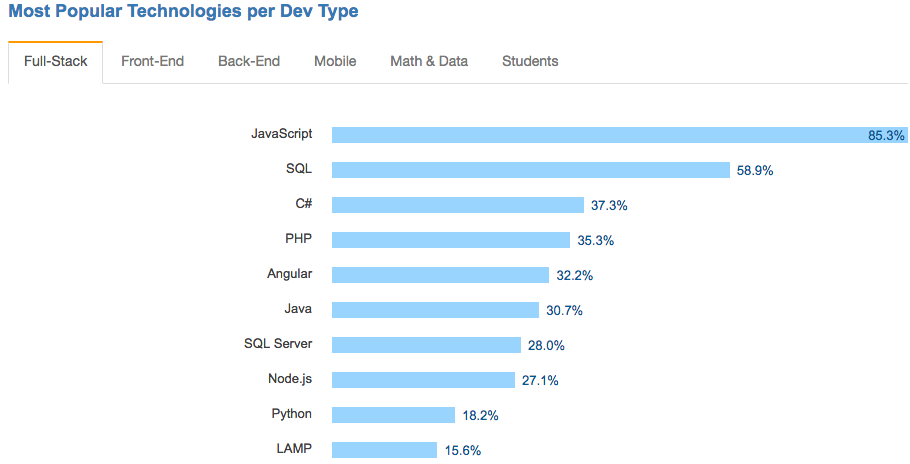
All stacks use JavaScript in some facet, meaning it’s a must-have for any aspiring full-stack developer.
Why use JavaScript?#
Thanks to tools like Node.js, developers are enjoying JavaScript not just in your web browser, but on the server-side, too.
It’s easy to see why many dev teams prefer using JavaScript as the single programming language for their web applications:
-
Projects are easier to understand if all parts are written in the same language.
-
You can save time by reusing and sharing the same code, libraries, templates, and models on both the front end and back end. No need to worry about learning JavaScript utility equivalents in Python or Ruby. Just use the same utility on the server and in the browser.
-
Tools like Node.js are lightweight and built for speed, unlike a lot of other commonly used backend technologies. This can result in a faster web app.
-
It’s a lot easier to find a skilled JavaScript engineer to work on your back end, due to the popularity of the language.
Full-stack JavaScript is evolving quickly and already has a strong following.
The full-stack JavaScript developer checklist#
To be a fully functional full-stack JavaScript developer, you’ll need to understand:
-
JavaScript basics, preferably ES6, the most recent version of the language. You’ll need a strong foundation to take full advantage of each tool.
-
HTML and CSS: All frontend tools will require HTML and CSS skills in some way. They along with JS will form the foundation for your skills.
-
1 or more client-side frameworks, like Angular, React, or Vue.js. Most modern-day JavaScript devs are using JavaScript frameworks extensively.
-
A knowledge of web browsers The browser is your runtime environment for JavaScript. It pays to know all the development tools available inside your browser.
-
Understand databases and query languages Full-stack developers of any kind need to know how data is stored and manipulated. Learn the differences between SQL or noSQL and popular database manipulation tools like mySQL or MongoDB.
-
Node.js. It’s the first, and arguably most preferred, JavaScript runtime environment on the server-side. Even if you don’t use it for your main server app, you can still use its tools to improve the development process.
-
Pick a stack: While you can learn multiple stacks, it’s best to start with one and check your way down each tool. This ensures you’re focusing on each equally and continue to conceptualize them as a single unit rather than individual technologies.
Additional steps
-
Stay informed: With a huge development community and support from both Facebook and Google, staying up to date on JavaScript can be tough on your own. Subscribe to a resource like the DailyJS, or JavaScript Weekly.
-
Build something: To really understand how both sides work together — and bring focus to your JavaScript learning — it helps to have a project to tinker with.
Next steps#
The Become a Front End Developer is the perfect place to start your journey as a frontend developer. With no prior knowledge needed, you will gain a mastery of HTML, CSS, and JavaScript, allowing you to put together beautiful, functional websites and web apps yourself.
By the end, you’ll have the foundational skills you’ll need to start your full-stack web development journey.
Happy learning!
