What is Athena in AWS?
Learn what is Athena in AWS and master serverless data analytics without managing infrastructure. If you want to improve your AWS skills or prepare for interviews, Athena is a must-know service for modern cloud engineers.
When you start working with data in AWS, one of the first challenges you encounter is how to query large datasets without setting up complex infrastructure. I remember working on a project where we had terabytes of logs sitting in S3, and the idea of provisioning databases just to analyze them felt unnecessarily heavy. That was the moment I first discovered Athena, and it completely changed how I approached data analysis in the cloud.
Understanding what is Athena in AWS is essential if you are preparing for cloud interviews or building data-driven applications. It introduces a powerful concept where you can run SQL queries directly on data stored in S3 without managing servers, which makes it both efficient and highly scalable.
Learn the A to Z of Amazon Web Services (AWS)

Learn about the core AWS's services like compute, storage, networking services and how they work with other services like Identity, Mobile, Routing, and Security. This course provides you with a good grasp an all you need to know of AWS services. This course has been designed by three AWS Solution Certified Architects who have a combined industry experience of 17 years. We aim to provide you with just the right depth of knowledge you need to have.
What Does Athena Do In AWS?#
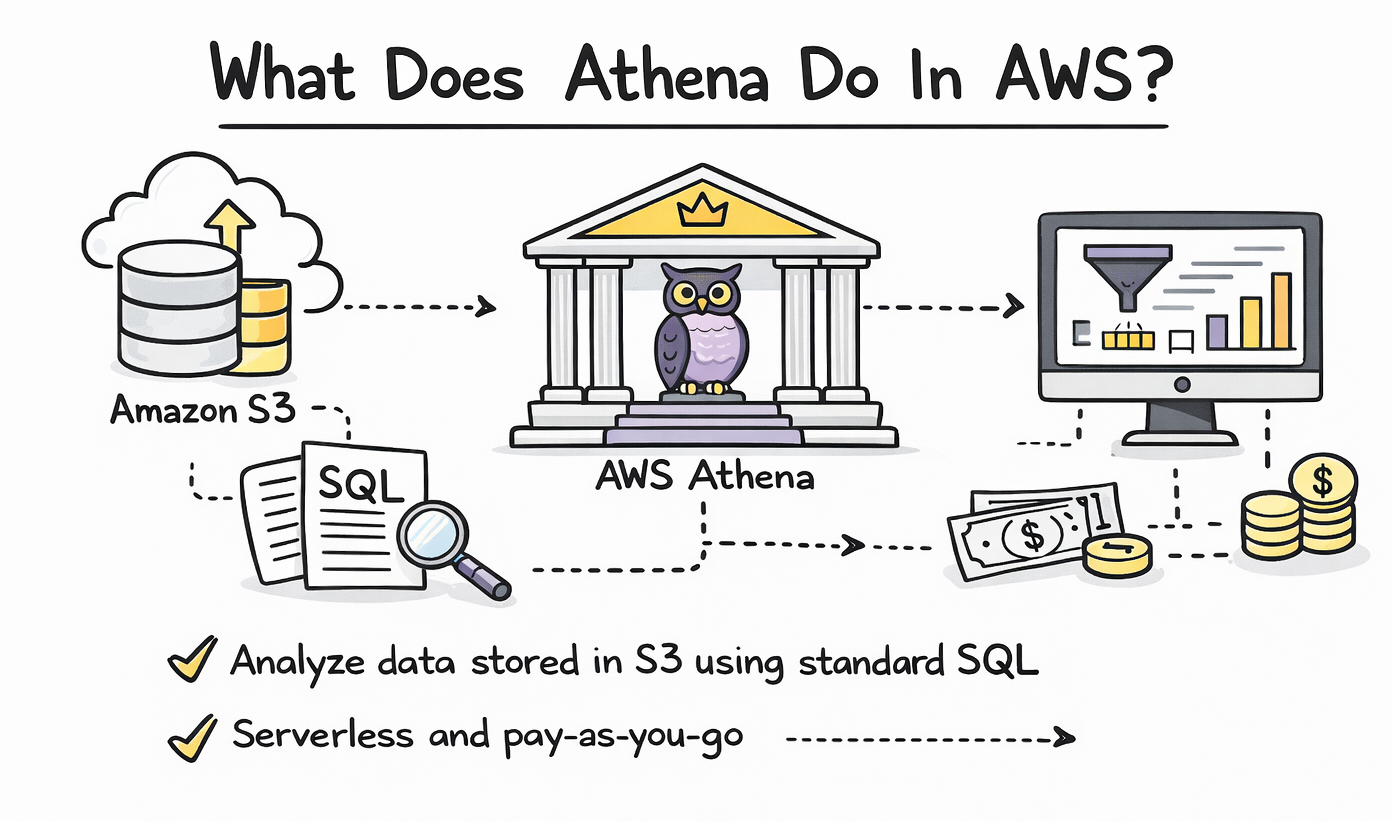
Athena is a serverless interactive query service that allows you to analyze data stored in Amazon S3 using standard SQL. Instead of moving your data into a database, Athena brings the query engine to your data, which simplifies architecture and reduces operational overhead.
This means you can run complex queries on structured or semi-structured data without provisioning or managing infrastructure. For learning and interview preparation, this concept is important because it reflects a broader AWS philosophy of serverless computing and pay-as-you-go models.
The Detailed Workings of AWS S3

This is a beginner-friendly course covering the basics of cloud computing, AWS S3 services, buckets, objects, AWS Identity Access Management, Cross-region replication, advantages of AWS S3, S3 storage classes and a lot more. You will be covering everything related to AWS S3 along with practical demonstrations on 'How to create bucket', 'How to upload objects in the bucket', 'How to download objects from bucket', 'How to delete objects', 'How to delete bucket' and 'How to create an IAM user'. By the time you finish this course, you will be able to confidently work with AWS S3, a great skill for any developer.
Why Athena Is Important For AWS Learners#
If you are exploring what is Athena in AWS, it helps to understand why it exists in the first place. Traditional data processing often involves setting up databases, clusters, and pipelines, which adds both cost and complexity.
Athena eliminates much of that overhead by allowing you to query data directly where it lives. This makes it particularly useful for analytics, debugging, and ad hoc querying, which are common scenarios in both real-world projects and interview discussions.
Fundamentals of AWS

Amazon Web Services (AWS) is one of the front-runners in modern-day Cloud Computing. It provides users a one-stop-shop for all their cloud computing needs and resources. In recent years, Cloud Computing resources have taken over the industry, with use cases in multiple domains, ranging from Web Development to Machine Learning. This path will help you learn the fundamentals of AWS and be prepared to tackle real-world applications in AWS. By the end of this path, you will be comfortable with deploying applications on the platform.
How Athena Works In AWS#
Athena is built on top of Presto, which is a distributed SQL query engine designed for high-performance analytics. When you submit a query in Athena, it scans the data stored in S3, processes it using a distributed system, and returns the results without requiring any infrastructure setup.
The workflow is straightforward but powerful, as shown in the table below:
Step | Description |
Query Submission | You write a SQL query in Athena console or API |
Data Access | Athena reads data directly from S3 |
Processing | Presto engine processes the query in a distributed manner |
Results Storage | Query results are stored back in S3 |
Output | Results are returned to the user |
This process highlights why Athena is often described as serverless, since all the heavy lifting is handled behind the scenes by AWS.
Key Components Of Athena Architecture#
To fully understand what is Athena in AWS, you need to look at the components that make it work. Athena is not a standalone service but rather part of a broader ecosystem that includes S3, Glue, and SQL engines.
Amazon S3 As The Data Source#
Athena relies entirely on Amazon S3 for storing data, which means your datasets must reside there. This design allows it to scale effortlessly because S3 itself is highly scalable and durable.
AWS Glue Data Catalog#
The Glue Data Catalog acts as a metadata repository that stores information about your data such as schema and table definitions. Athena uses this catalog to understand how to interpret and query your data.
Query Engine#
Athena uses a distributed query engine based on Presto, which allows it to execute queries efficiently across large datasets. This is what enables fast performance even when dealing with massive volumes of data.
Supported Data Formats In Athena#
One of the strengths of Athena is its ability to work with a variety of data formats. This flexibility is particularly useful when dealing with logs, analytics data, or data pipelines.
Data Format | Description |
CSV | Simple text-based format commonly used for logs |
JSON | Semi-structured format widely used in APIs |
Parquet | Columnar format optimized for analytics |
ORC | Highly optimized format for big data processing |
Avro | Row-based format with schema support |
Choosing the right format can significantly impact query performance and cost, which is an important consideration both in practice and during interviews.
Benefits Of Using Athena In AWS#
Athena offers several advantages that make it a popular choice for developers and data engineers. These benefits are often discussed in interviews to assess your understanding of serverless analytics.
One of the biggest advantages is that Athena is fully serverless, which means you do not need to manage infrastructure. Another key benefit is its cost model, where you only pay for the data scanned by your queries rather than for idle resources.
Athena also integrates seamlessly with other AWS services, making it easy to build end-to-end data pipelines. This combination of simplicity, scalability, and integration is what makes Athena stand out.
Pricing Model Of Athena#
Understanding pricing is crucial when learning what is Athena in AWS, especially since it directly impacts architectural decisions. Athena uses a pay-per-query model, which is based on the amount of data scanned during query execution.
Pricing Factor | Explanation |
Data Scanned | Charges are based on the amount of data read by the query |
Storage | Data stored in S3 incurs standard S3 charges |
Compression | Using compressed formats reduces cost by scanning less data |
Partitioning | Efficient partitioning reduces the amount of data scanned |
This pricing model encourages efficient data organization, which is an important concept to understand for both learning and interviews.
Use Cases Of Athena In AWS#
Athena is widely used across different industries because of its simplicity and flexibility. When preparing for interviews, it helps to connect the service to real-world scenarios.
Athena is commonly used for log analysis, where developers query application logs stored in S3 to debug issues or monitor performance. It is also used for data exploration, allowing analysts to quickly run queries without setting up databases.
Another important use case is business intelligence, where Athena integrates with tools like QuickSight to generate reports and dashboards. These practical applications make it easier to explain Athena in an interview setting.
Athena Vs Traditional Databases#
To deepen your understanding of what is Athena in AWS, it is helpful to compare it with traditional database systems. This comparison often comes up in interviews to test conceptual clarity.
Feature | Athena | Traditional Database |
Infrastructure | Serverless | Requires setup and maintenance |
Data Storage | S3 | Internal storage |
Query Model | SQL | SQL |
Cost Model | Pay per query | Pay for provisioned resources |
Scalability | Automatic | Manual scaling |
This comparison highlights why Athena is ideal for analytics workloads but may not replace transactional databases.
Limitations Of Athena#
While Athena is powerful, it is not suitable for every use case. Understanding its limitations is just as important as knowing its strengths.
Athena is not designed for real-time transactional workloads, which means it is not suitable for applications requiring frequent updates. It also has performance dependencies on data format and structure, which can impact query speed.
Recognizing these limitations demonstrates a mature understanding of AWS services, which is valuable during interviews.
Best Practices For Using Athena#
As you gain experience with Athena, you will realize that performance and cost optimization go hand in hand. Structuring your data correctly can make a significant difference in both query speed and cost.
Using columnar formats like Parquet or ORC can improve performance, while partitioning data can reduce the amount of data scanned. These practices are commonly expected knowledge in interviews focused on AWS analytics.
Athena In Real-World Projects#
In real-world applications, Athena is often used as part of a larger data pipeline. For example, logs generated by applications may be stored in S3, cataloged using Glue, and then queried using Athena.
This setup allows teams to analyze data quickly without maintaining infrastructure, which is especially useful for startups and large-scale systems alike. Understanding this workflow helps you connect theory with practical implementation.
How Athena Helps In Interview Preparation#
When preparing for AWS interviews, knowing what is Athena in AWS gives you an edge in discussions around data analytics and serverless architecture. Interviewers often look for candidates who understand when to use Athena versus other services.
Being able to explain its architecture, use cases, and limitations shows that you can make informed decisions in real-world scenarios. This level of understanding goes beyond memorization and reflects practical knowledge.
Final Thoughts#
Athena represents a shift in how we think about data processing in the cloud, moving away from infrastructure-heavy solutions to lightweight, serverless approaches. It allows you to query massive datasets with minimal setup, which is both powerful and efficient.
If you invest time in understanding what is Athena in AWS, you will not only improve your technical knowledge but also enhance your ability to design scalable data solutions. Over time, it becomes a natural tool in your AWS toolkit.