What is AWS S3?
Learn what is AWS S3 and master cloud storage for scalable applications, backups, and data systems. Build real-world skills, improve system design knowledge, and prepare confidently for AWS interviews and cloud engineering roles.
If you are starting your journey in cloud computing or preparing for system design interviews, one of the most fundamental services you need to understand is what is AWS S3. It is one of the most widely used services in AWS and forms the backbone of storage for countless applications across industries.
In my experience working with developers and mentoring candidates preparing for cloud roles, AWS S3 is often the first service that truly demonstrates the power of cloud storage. Once you understand what AWS S3 is, you begin to see how modern systems handle massive amounts of data reliably, efficiently, and at a global scale.
The Detailed Workings of AWS S3
This is a beginner-friendly course covering the basics of cloud computing, AWS S3 services, buckets, objects, AWS Identity Access Management, Cross-region replication, advantages of AWS S3, S3 storage classes and a lot more. You will be covering everything related to AWS S3 along with practical demonstrations on 'How to create bucket', 'How to upload objects in the bucket', 'How to download objects from bucket', 'How to delete objects', 'How to delete bucket' and 'How to create an IAM user'. By the time you finish this course, you will be able to confidently work with AWS S3, a great skill for any developer.
Understanding AWS S3#
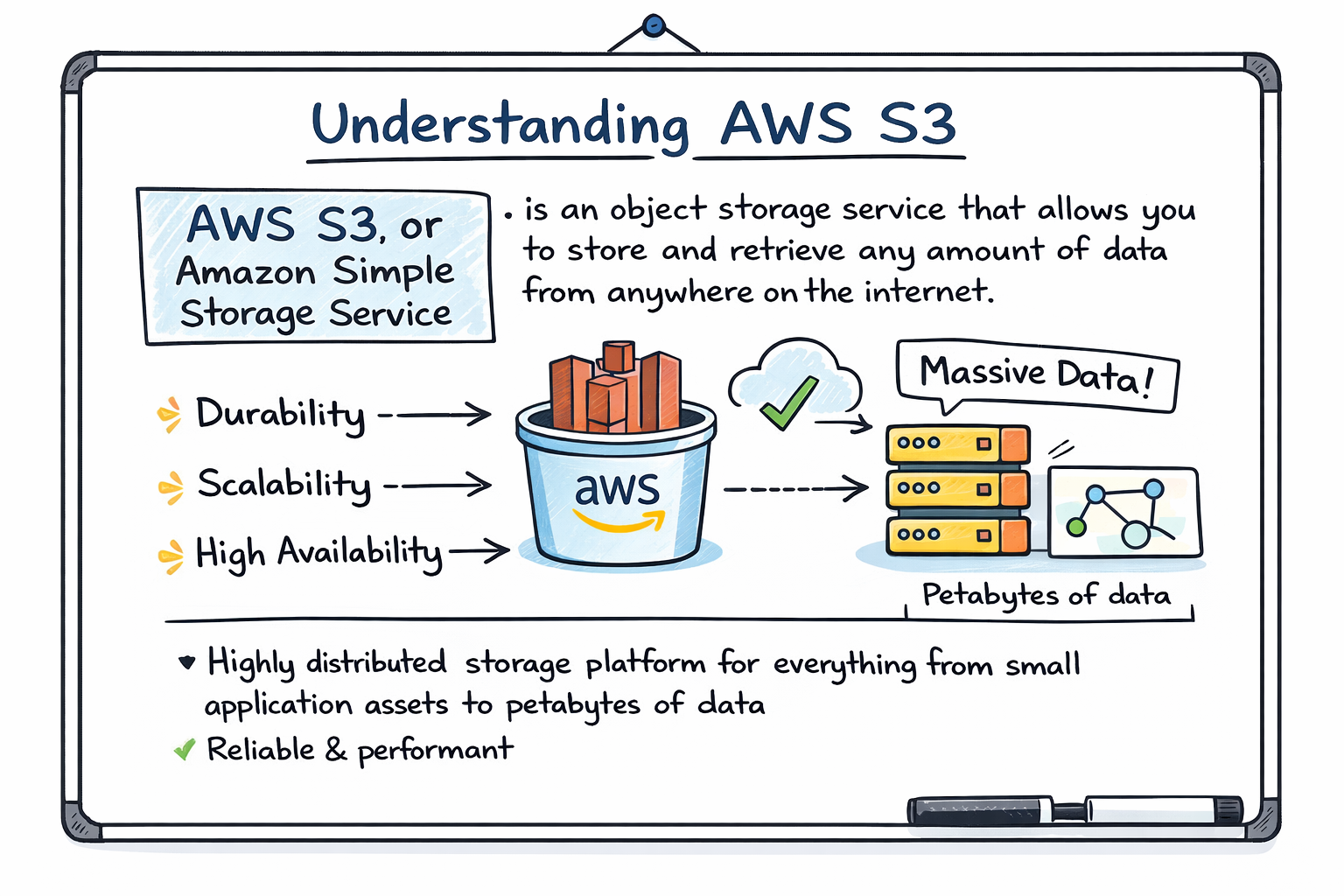
AWS S3, or Amazon Simple Storage Service, is an object storage service that allows you to store and retrieve any amount of data from anywhere on the internet. It is designed for durability, scalability, and high availability, making it suitable for a wide range of use cases.
Understanding what AWS S3 is means recognizing that it is not just a file storage system. It is a highly distributed storage platform that can handle everything from small application assets to petabytes of data, all while maintaining reliability and performance.
Why AWS S3 Is Important#
AWS S3 is important because it solves one of the most critical problems in computing, which is reliable data storage at scale. Traditional storage systems often struggle with scalability and availability, but S3 is designed to handle these challenges seamlessly.
From a practical perspective, understanding what AWS S3 is allows you to build systems that can store data securely and retrieve it quickly, regardless of the size or complexity of your application. This is why S3 is frequently used in system design and appears in many interview scenarios.
A Programmer’s Guide to AWS S3
Amazon Web Services (AWS) is the leading provider of cloud computing services and hosting solutions. Among the vast number of services offered by AWS, the Simple Storage Service (S3) is one of the mostly widely used. This storage service offers high reliability, durability, scalability, and availability when compared to any other storage service. In this course, you’ll learn about AWS S3 and its features in detail. Not only will you learn how AWS S3 works, you’ll also get hands-on experience with AWS’ security features and how to monitor and manage an AWS-hosted storage solution. By the end of this course, you will be able to use the console and command-line interface (CLI) to perform complex operations and host a static website using S3.
How AWS S3 Works#
At a high level, AWS S3 works by storing data as objects within buckets. A bucket is a container for objects, and each object consists of data, metadata, and a unique identifier.
When you upload a file to S3, it is stored across multiple devices in different locations to ensure durability. This distributed architecture ensures that your data remains safe even in the event of hardware failures.
Core Components Of AWS S3#
To fully understand what is AWS S3, you need to be familiar with its core components, which define how data is stored and accessed.
AWS S3 Components Overview#
Component | Description |
Bucket | Container that holds objects |
Object | The actual data stored in S3 |
Key | Unique identifier for each object |
Metadata | Information about the object |
Region | Geographic location where data is stored |
Storage Class | Use Case Description |
Standard | Frequently accessed data |
Intelligent-Tiering | Automatically optimizes cost based on access patterns |
Standard-IA | Infrequently accessed data |
Glacier | Long-term archival storage |
Glacier Deep Archive | Rarely accessed data with lowest cost |
Understanding these storage classes is essential for designing cost-effective systems.
AWS S3 Architecture#
AWS S3 is built on a distributed architecture that ensures high durability and availability. Data is replicated across multiple availability zones within a region, which protects against data loss.
This architecture is one of the reasons why S3 is considered highly reliable. It is designed to provide durability of 99.999999999 percent, which is often referred to as eleven nines.
Data Durability And Availability#
Durability and availability are key concepts when learning what is AWS S3. Durability refers to the likelihood that your data will not be lost, while availability refers to how accessible your data is.
S3 achieves high durability by replicating data across multiple locations. Availability is ensured through redundant systems that allow data to be accessed even if some components fail.
Security Features In AWS S3#
Security is a critical aspect of AWS S3, as it often stores sensitive data. AWS provides multiple layers of security, including access control, encryption, and monitoring.
Access to S3 objects can be controlled using IAM policies and bucket policies. Encryption can be applied both at rest and in transit, ensuring that data remains secure.
AWS S3 Pricing Model#
AWS S3 uses a pay-as-you-go pricing model, which allows you to pay only for the storage and operations you use. This makes it cost-effective for both small and large applications.
AWS S3 Pricing Factors#
Pricing Factor | Description |
Storage | Cost based on the amount of data stored |
Requests | Charges for operations like PUT and GET |
Data Transfer | Cost for transferring data out of S3 |
Use Case | Description |
Backup And Recovery | Storing backups and snapshots |
Static Website Hosting | Hosting static websites |
Data Lakes | Storing large datasets for analytics |
Media Storage | Storing images, videos, and audio files |
These use cases highlight how S3 can be applied in different scenarios.
AWS S3 In System Design#
S3 plays a central role in system design, as it is often used to store data that needs to be accessed by multiple services. In interviews, you may be asked to design systems that use S3 for storage.
For example, a file upload system might use S3 to store user files, with additional services handling processing and delivery. Understanding these patterns is essential for designing scalable systems.
AWS S3 Vs Traditional Storage#
Comparing S3 with traditional storage systems helps highlight its advantages.
AWS S3 Vs Traditional Storage#
Feature | AWS S3 | Traditional Storage |
Scalability | Virtually unlimited | Limited by hardware |
Durability | Extremely high | Depends on infrastructure |
Cost Model | Pay-as-you-go | High upfront cost |
Management | Fully managed | Requires manual management |
AWS S3 Integration With Other Services#
AWS S3 integrates with many other AWS services, making it a key component in cloud architectures. For example, it can be used with Lambda for event-driven processing or with CloudFront for content delivery.
These integrations allow you to build complex systems that are both scalable and efficient.
Best Practices For Using AWS S3#
To effectively use AWS S3, it is important to follow best practices such as organizing data properly, managing access control, and optimizing storage classes.
In my experience, understanding these best practices not only improves system performance but also helps you design better architectures in interviews.
Challenges And Limitations#
While AWS S3 is highly powerful, it is not suitable for all use cases. For example, it is not designed for low-latency file systems or applications requiring frequent updates to small portions of data.
Understanding these limitations is important for making informed design decisions.
How To Start Learning AWS S3#
If you are new to AWS S3, start by creating buckets and uploading files. This hands-on approach helps you understand how the service works and how it can be used in real-world scenarios.
Over time, explore advanced features such as lifecycle policies, versioning, and event notifications to deepen your understanding.
Real-World Perspective On AWS S3#
From a practical standpoint, what is AWS S3 is not just a storage service but a foundational component of modern cloud architectures. Engineers use it to store data, manage backups, and support large-scale applications.
In my own experience, working with S3 has been essential for building scalable systems and understanding cloud storage concepts.
Final Thoughts #
Understanding what is AWS S3 is a critical step in mastering cloud computing. It provides the foundation for storing and managing data in the cloud and enables you to build scalable and reliable systems.
As you continue your learning journey, focus on hands-on practice and real-world applications. This approach will help you develop a deeper understanding and prepare you for both interviews and practical work.
