What is Reasoning in LLMs
Curious how AI “thinks”? Discover what reasoning in LLMs really means, how models solve complex problems step by step, and the techniques powering smarter AI systems. Start understanding modern AI beyond text generation today.
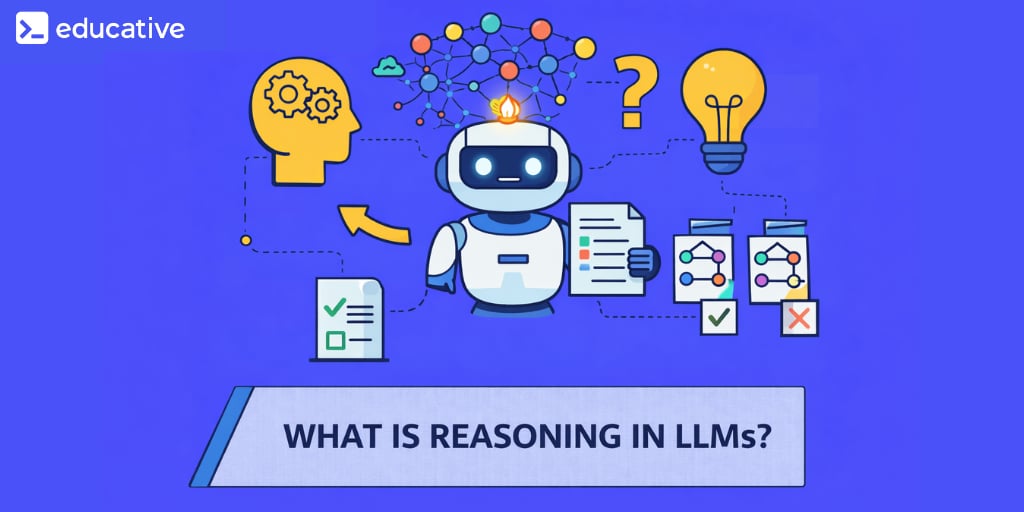
Large language models have become widely used for tasks such as writing code, answering questions, summarizing documents, assisting with research, and generating explanations for complex topics. These systems are often associated with natural language generation, but their capabilities extend far beyond producing fluent text. Many advanced applications require the model to analyze information, connect ideas, and produce logical conclusions.
This leads many developers and AI learners to ask what is reasoning in LLMs and how these systems appear to solve complex problems. While language models are fundamentally statistical systems trained on large datasets, they can generate responses that resemble structured reasoning.
Reasoning in large language models refers to the model’s ability to process information across multiple steps, analyze relationships between pieces of data, and produce logically consistent outputs. Although these models do not reason in the same way humans do, their training enables them to simulate reasoning patterns that allow them to solve problems involving multiple steps.
Essentials of Large Language Models: A Beginner’s Journey
Large language models (LLMs) are at the core of today’s AI transformation, powering everything from conversational agents to code generation and enterprise automation. As adoption accelerates, understanding how LLMs actually work, and how to use them effectively in real systems, is no longer optional for developers and data professionals. I built this course from my work in neural networks and intelligent systems, where LLMs represent a shift from traditional modeling to probabilistic reasoning at scale. A recurring pattern I observed was that many practitioners could use APIs but lacked a clear mental model of how LLMs process language, make decisions, and fail in edge cases. This course is designed to bridge that gap with a systems-level perspective. You’ll learn LLM fundamentals from first principles, covering architecture, tokenization, embeddings, attention, and training dynamics, before moving into practical workflows like prompting, retrieval-augmented generation (RAG), and tool integration. Each concept is tied to how LLMs are actually deployed in production systems. Engineers and researchers are already building on these foundations to create real-world AI applications. If you want to go beyond surface-level usage of LLMs, this is where you begin.
Understanding how these capabilities emerge requires exploring how language models work and how they can perform reasoning-like tasks.
LLM fundamentals#
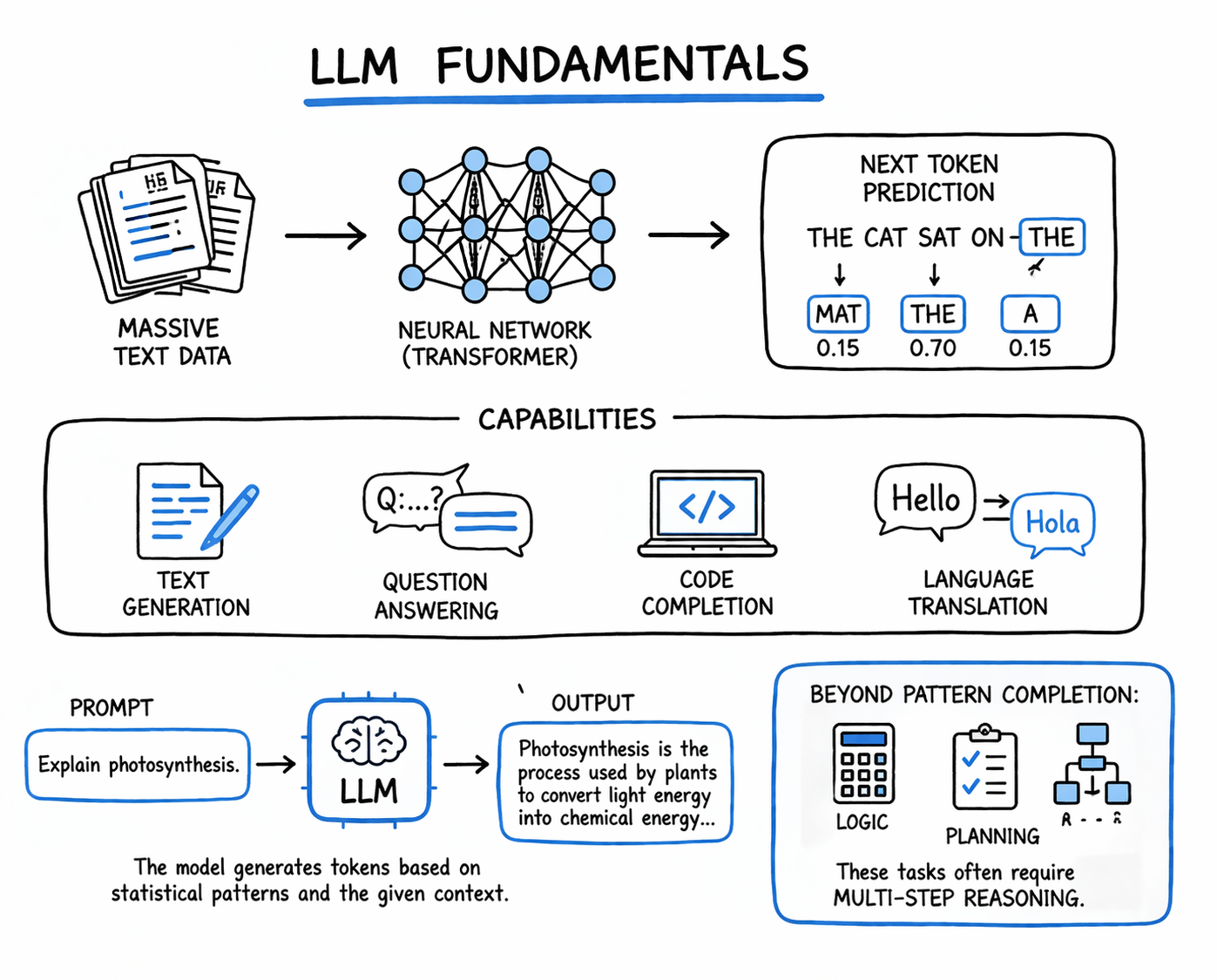
Large language models are trained on massive collections of text data. These models use deep learning architectures, most commonly transformer networks, to learn patterns in language.
During training, the model repeatedly predicts the next token in a sequence of text. A token may represent a word, part of a word, or a punctuation symbol. By performing this prediction task billions of times across large datasets, the model learns complex relationships between words, phrases, and concepts.
Because of this training process, LLMs can perform many natural language tasks, including:
Text generation
Question answering
Code completion
Language translation
These capabilities arise from the model’s ability to capture statistical patterns in training data. When the model receives a prompt, it generates output by predicting which tokens are most likely to follow based on the context.
However, many real-world problems require more than simple pattern completion. Tasks involving logic, mathematics, or planning require the model to process information in multiple steps, which introduces the concept of reasoning.
Become an LLM Engineer
Generative AI is transforming industries, revolutionizing how we interact with technology, automate tasks, and build intelligent systems. With large language models (LLMs) at the core of this transformation, there is a growing demand for engineers who can harness their full potential. This Skill Path will equip you with the knowledge and hands-on experience needed to become an LLM engineer. You’ll start with the generative AI and prompt engineering to communicate with AI models. Then you’ll learn to interact with AI models, store and retrieve information using vector databases, and build AI-powered workflows with LangChain. Next, you’ll learn to enhance AI responses with retrieval-augmented generation (RAG), fine-tune models using LoRA and QLoRA, and develop AI agents with CrewAI to automate complex tasks. By the end, you’ll have the expertise to design, optimize, and deploy LLM-powered solutions, positioning yourself at the forefront of AI innovation.
Reasoning explanation#
To understand what is reasoning in LLMs, it is helpful to consider how reasoning works in human problem-solving. When people encounter a complex question, they rarely jump directly to the answer. Instead, they break the problem into smaller steps, evaluate each step, and combine the results to reach a conclusion.
Large language models can simulate a similar process. Rather than producing an immediate answer, the model may generate intermediate reasoning steps that gradually lead to a final solution.
Reasoning in language models often involves several key elements:
Breaking a problem into smaller components
Identifying relationships between pieces of information
Producing intermediate conclusions
Combining those conclusions into a final answer
This step-by-step reasoning process allows language models to handle tasks that would otherwise be difficult using direct pattern prediction alone.
Pattern recognition vs reasoning#
Although language models are fundamentally pattern recognition systems, they can produce outputs that resemble reasoning when guided appropriately.
Capability | Pattern Recognition | Reasoning |
Task type | Predict next token based on patterns | Analyze relationships and steps |
Output generation | Direct response | Multi-step logical explanation |
Complexity | Simple tasks | Complex problem solving |
Pattern recognition allows the model to generate fluent text and answer many common questions. However, tasks that require structured analysis often benefit from reasoning-style responses.
In these cases, the model produces intermediate steps that organize the solution logically. These steps help the system arrive at a more accurate answer.
Example of reasoning in an LLM#
A simple example can illustrate how reasoning appears in language model outputs.
Problem#
A company sells a product for $20 and applies a 10% discount. What is the final price?
Direct answer approach#
A language model might simply output the answer:
$18
While this answer may be correct, the reasoning process is not visible.
Reasoning-based approach#
A reasoning process might look like this:
Identify the original price of the product, which is $20.
Calculate the discount amount by taking 10% of $20, which equals $2.
Subtract the discount from the original price.
The final price after the discount is $18.
By generating intermediate steps, the model organizes the problem more clearly and reduces the likelihood of mistakes.
This type of structured explanation illustrates how what is reasoning in LLMs becomes visible in practical problem-solving tasks.
Techniques that enable reasoning in LLMs#
Several techniques help improve reasoning performance in large language models. These techniques guide the model toward generating intermediate reasoning steps rather than producing immediate answers.
Chain-of-thought prompting encourages the model to explain its reasoning step by step. By asking the model to think through the problem before answering, developers can often improve accuracy.
Self-consistency reasoning involves generating multiple reasoning paths and selecting the most consistent answer among them. This method helps reduce errors that arise from incorrect reasoning chains.
Tool-assisted reasoning allows language models to interact with external tools such as calculators, databases, or search engines. These tools help the model handle tasks that require precise calculations or factual verification.
Reinforcement learning from human feedback can also improve reasoning behavior. During training, human reviewers evaluate model responses and guide the system toward more accurate and helpful reasoning patterns.
These methods demonstrate how developers and researchers actively explore what is reasoning in LLMs and how it can be improved.
Applications section#
Reasoning capabilities enable language models to support more advanced applications across many fields.
Mathematical problem solving is one of the most visible examples. Language models can break down arithmetic or algebraic problems into intermediate steps, allowing them to solve problems that require multiple calculations.
Software debugging also benefits from reasoning capabilities. Models can analyze code, identify potential errors, and explain the logic behind suggested fixes.
Scientific research assistance represents another important application. Language models can analyze research papers, summarize complex findings, and help researchers explore relationships between ideas.
Complex question answering systems also rely on reasoning abilities. When a question requires combining information from multiple sources, the model must analyze relationships between different pieces of data before generating a response.
These applications illustrate why reasoning capabilities are becoming increasingly important in modern AI systems.
Challenges of reasoning in language models#
Despite recent progress, reasoning in large language models remains an active area of research.
One challenge involves logical consistency across reasoning steps. If the model makes an incorrect assumption early in the reasoning chain, subsequent steps may propagate that error.
Another challenge involves hallucinated reasoning. Sometimes the model generates intermediate steps that appear plausible but do not correspond to correct logical reasoning.
Handling extremely complex problems also remains difficult. While models can solve many structured problems, tasks requiring deep domain expertise or very long reasoning chains can still lead to errors.
Researchers are developing improved architectures, training strategies, and evaluation methods to address these limitations.
FAQ#
Do large language models truly reason like humans?#
Large language models do not reason in the same way humans do. Instead, they simulate reasoning by generating patterns of text that resemble logical analysis. Their reasoning ability emerges from training on large datasets that contain examples of structured explanations and problem-solving processes.
What techniques improve reasoning in AI systems?#
Several techniques improve reasoning performance, including chain-of-thought prompting, self-consistency reasoning, tool-assisted reasoning, and reinforcement learning from human feedback. These methods encourage models to generate intermediate reasoning steps before producing final answers.
Why do reasoning prompts sometimes produce better answers?#
Prompts that encourage reasoning guide the model toward generating intermediate steps. These steps help organize the problem-solving process and reduce the likelihood that the model will skip important parts of the analysis.
Are reasoning models different from standard LLMs?#
Many reasoning models are built on top of standard language model architectures. The difference lies in how they are trained and used. Reasoning models emphasize structured problem solving and intermediate reasoning steps rather than direct answer generation.
Conclusion#
Large language models have transformed the way developers interact with artificial intelligence systems. While these models are often associated with text generation, their capabilities extend into structured problem solving and analytical reasoning.
Understanding what is reasoning in LLMs helps developers and AI learners appreciate how modern language models simulate logical analysis through multi-step reasoning processes. As research continues to advance, improvements in reasoning techniques will play a crucial role in enabling AI systems to solve increasingly complex problems.
Happy learning!
