Is Lua or Python the better language for game development?
This blog shows that Lua is better for engine scripting and performance in game development, while Python is better for learning and prototyping in game development.
You’ve decided to get into game development, and that decision alone already puts you ahead of many who only think about it. Maybe you’ve spent years playing games and wondering how they’re built, or maybe you’re simply curious about interactive systems and want to explore something creative. Naturally, your next step is to figure out what tools and languages you should start with. That’s when things start to get confusing.
As soon as you begin researching, you’re hit with conflicting advice. One article highlights Lua as a language used inside real game engines, emphasizing its efficiency and industry relevance. Another insists that Python is the better choice because it’s beginner-friendly and easier to understand. Forums, blogs, and videos all seem to have strong opinions, but very little consensus. Instead of clarity, you end up with more uncertainty than when you started.
This is where the question naturally emerges: Which language is better for game development: Lua or Python? It sounds like a straightforward comparison, but the answer is not about picking a “winner.” It’s about understanding how each language fits into different parts of game development, and how your goals shape which one makes more sense for you.

Python is one of the favorite programming languages among developers and data scientists due to its intuitive syntax and advanced functionality. These properties arguably also make Python the most in-demand programming language in the world today. Python libraries make things easier and help reduce the time and effort required to solve big problems. This path will help you use your programming experience to quickly adapt Python to your programming requirements. You'll also go through a few brain teasers to test your understanding. By the end, you'll have advanced knowledge to confidently use Python in your next project.
Understanding the role of programming languages in game development#
Before you can meaningfully compare Lua and Python, you need to understand how programming languages are actually used in game development. A common misconception is that a game is written entirely in a single language, but in reality, modern games are layered systems. Each layer serves a different purpose, and different languages are chosen based on what that layer needs to accomplish.
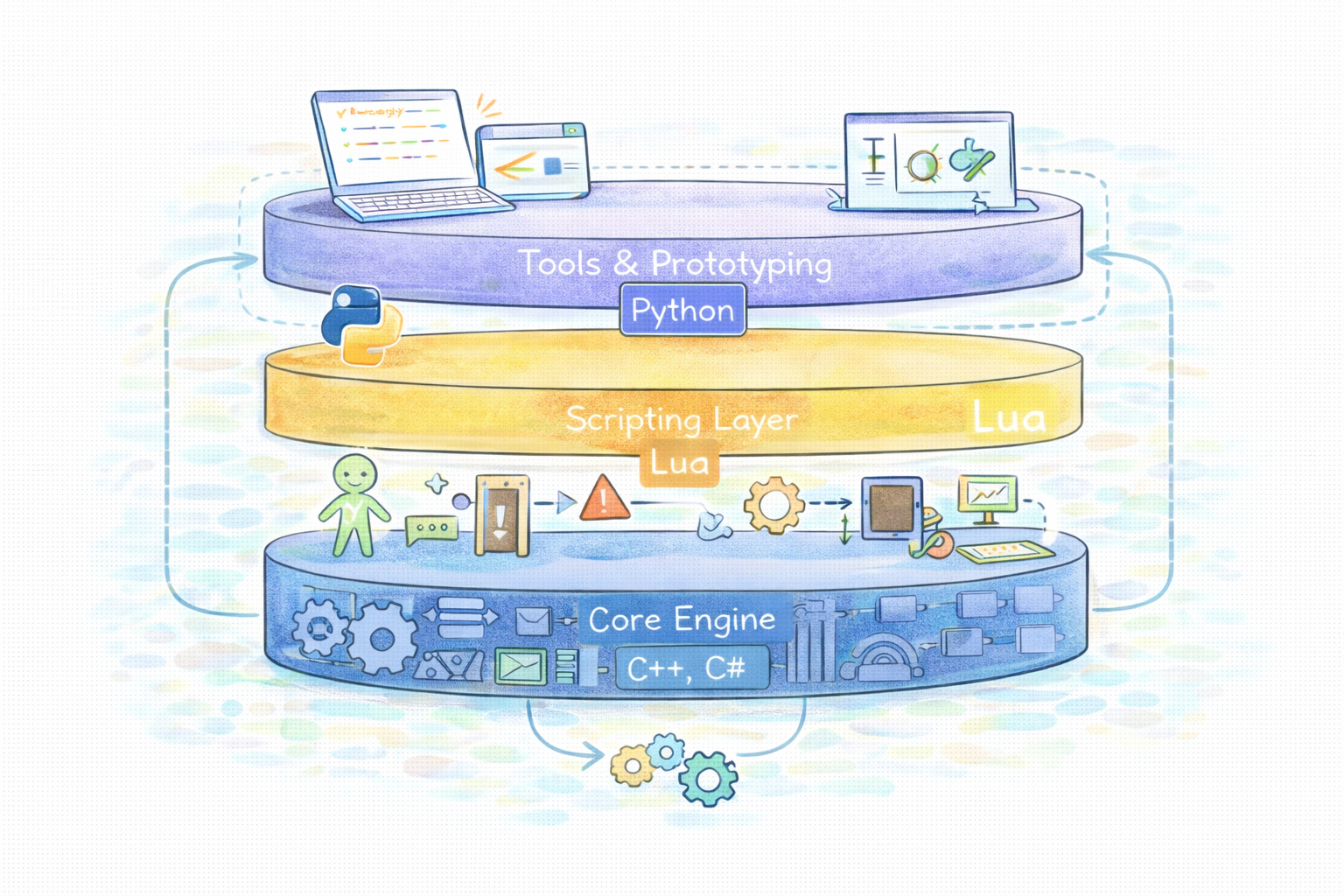
At the core of most commercial games, you’ll find performance-critical systems written in languages like C++ or C#. These handle rendering, physics calculations, memory management, and real-time updates. These systems require precise control over hardware and execution speed, which is why lower-level or compiled languages are preferred. On top of this foundation, scripting layers are often introduced to handle gameplay logic, events, and interactions in a more flexible way.
This is where the distinction between Lua and Python begins to make sense. Lua is frequently embedded into engines as a scripting layer, allowing developers to define behavior without modifying core systems. Python, on the other hand, is rarely used inside high-performance engines but is widely used for learning, prototyping, and building tools around game development. Understanding this layered architecture helps you see that the comparison is not about replacing one with the other, but about how each language fits into the bigger picture.
Overview of Lua in game development#
Lua is a lightweight scripting language designed with embedding in mind. This means it was built to integrate into larger systems rather than operate as a standalone environment. In game development, this makes Lua particularly valuable because it allows developers to extend and control engine behavior without compromising performance.
In practice, Lua is often used to define gameplay mechanics such as character behavior, AI logic, or scripted events.
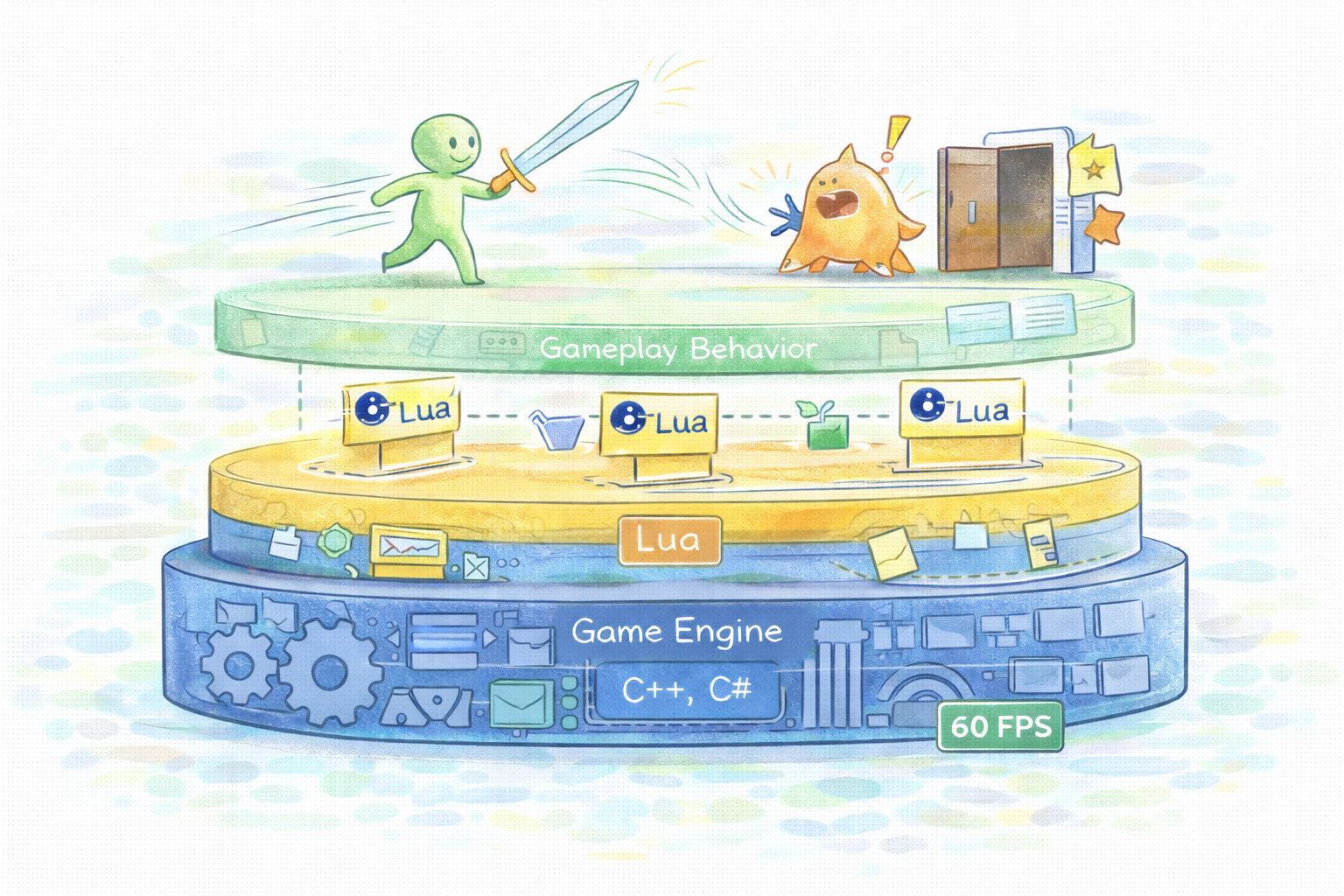
For example, a game engine might handle physics and rendering in C++, while Lua scripts define how an enemy reacts to player input or how a quest progresses. This separation allows teams to iterate quickly on gameplay without touching the more complex and sensitive parts of the engine.
Another important aspect of Lua is its efficiency. Because it is lightweight and introduces minimal overhead, it can run frequently executed scripts without significantly affecting performance. This is crucial in games, where even small inefficiencies can accumulate and impact frame rates. Lua’s design makes it particularly well-suited for environments where responsiveness and speed are essential, which is why it continues to be used in both commercial engines and smaller frameworks like Love2D.
Overview of Python in game development#
Python occupies a very different position in the game development landscape. It is not typically embedded into game engines in the same way Lua is, but it plays a strong role in learning, experimentation, and tool development. Its biggest strength lies in its simplicity and readability, which make it highly accessible to beginners.
Frameworks such as Pygame provide a structured way to build simple games while learning core programming concepts. These frameworks abstract away much of the complexity found in full-scale engines, allowing you to focus on logic, interaction, and basic rendering. This makes Python an excellent choice for understanding how games work at a conceptual level without being overwhelmed by engine internals.
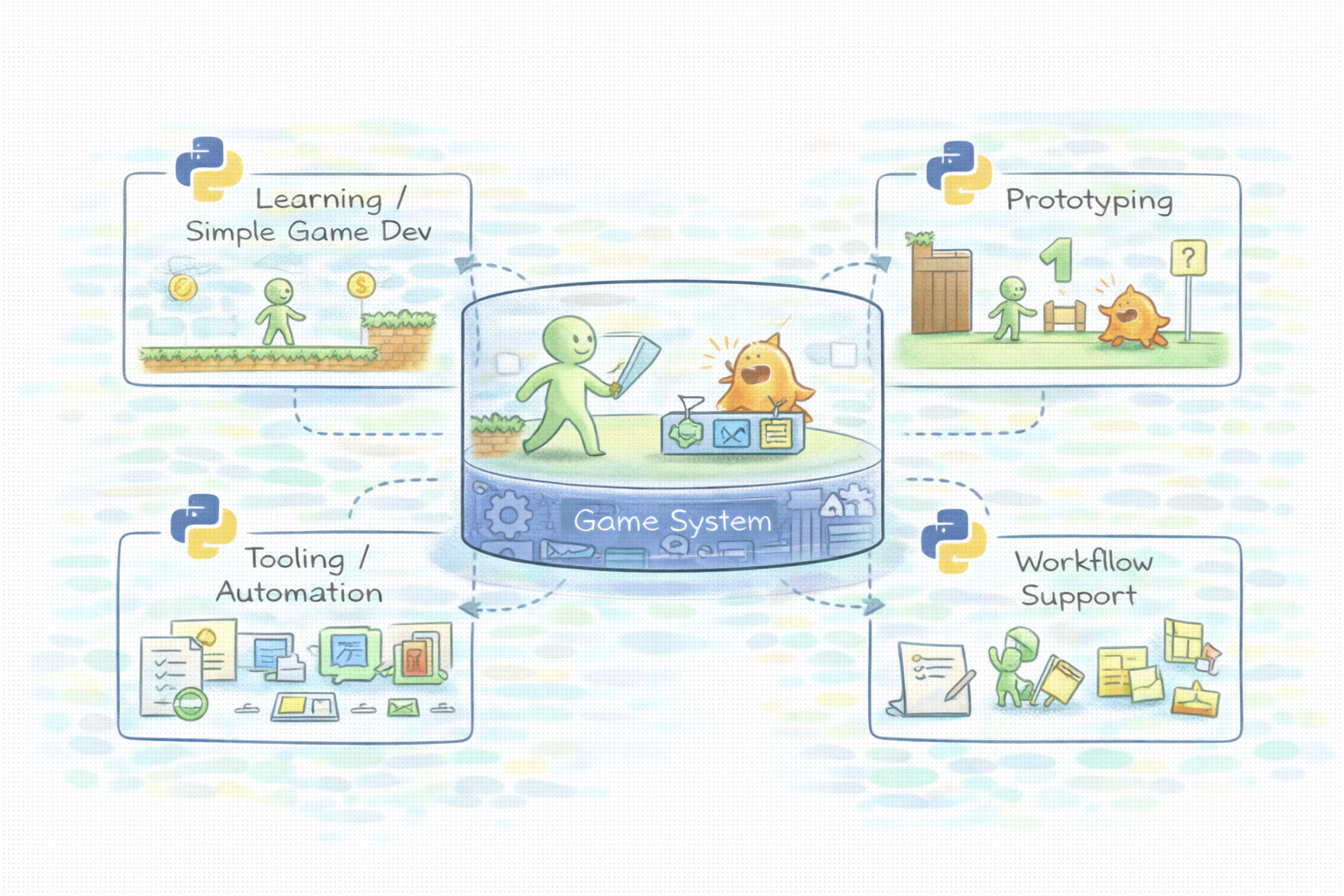
Beyond building small games, Python is also widely used for supporting tasks in game development. Developers often use it for scripting tools, automating workflows, or processing assets.
For example, a developer might write a Python script to batch-convert textures or generate level data. While Python may not power the core gameplay loop in commercial games, its versatility makes it a valuable tool in the broader development process.
Which language is better for game development: Lua or Python?#
When you revisit the question which language is better for game development: Lua or Python, it becomes clear that the answer depends entirely on context. You are not just choosing a language—you are choosing an approach to learning and building.
If your goal is to align closely with how games are built in professional environments, Lua offers a more direct path. It introduces you to the concept of scripting within an engine, which is a common pattern in real-world development. You learn how logic is separated from core systems and how performance considerations influence design decisions. This perspective is valuable if you want to understand production workflows.
On the other hand, if your focus is on learning programming fundamentals and building confidence, Python provides a smoother entry point. Its syntax is easier to read and write, which reduces the cognitive load for beginners. You can start building projects quickly, experiment freely, and focus on understanding logic rather than dealing with engine complexity. This makes Python particularly effective for early-stage learning and rapid prototyping.
Comparison table#
Feature | Lua | Python |
Performance | High, lightweight execution | Slower, higher runtime overhead |
Learning curve | Moderate, minimalistic design | Beginner-friendly and intuitive |
Ecosystem | Focused on embedded scripting | Broad, multi-domain ecosystem |
Typical use case | Engine scripting and gameplay logic | Learning, prototyping, tooling |
Real-world usage | Widely used in game engines | Limited in production gameplay systems |
This table highlights an important distinction that often gets overlooked. Lua is specialized for a specific role within game development, while Python is designed as a general-purpose language with applications across many domains. This difference influences not only how you use each language, but also how you learn with it.
Understanding this comparison requires looking beyond the surface. For example, Python’s slower performance is not necessarily a problem in early-stage projects, but it becomes a limitation in real-time systems. Similarly, Lua’s focused ecosystem may seem restrictive at first, but it becomes a strength when working within a game engine. These trade-offs are not about superiority—they are about alignment with your goals.
Performance and real-world constraints#
Performance is one of the defining constraints in game development. Games operate in real time, often requiring updates to occur dozens or even hundreds of times per second. This means that every piece of code must execute efficiently to maintain smooth gameplay. Even small inefficiencies can lead to noticeable issues such as frame drops or input lag.
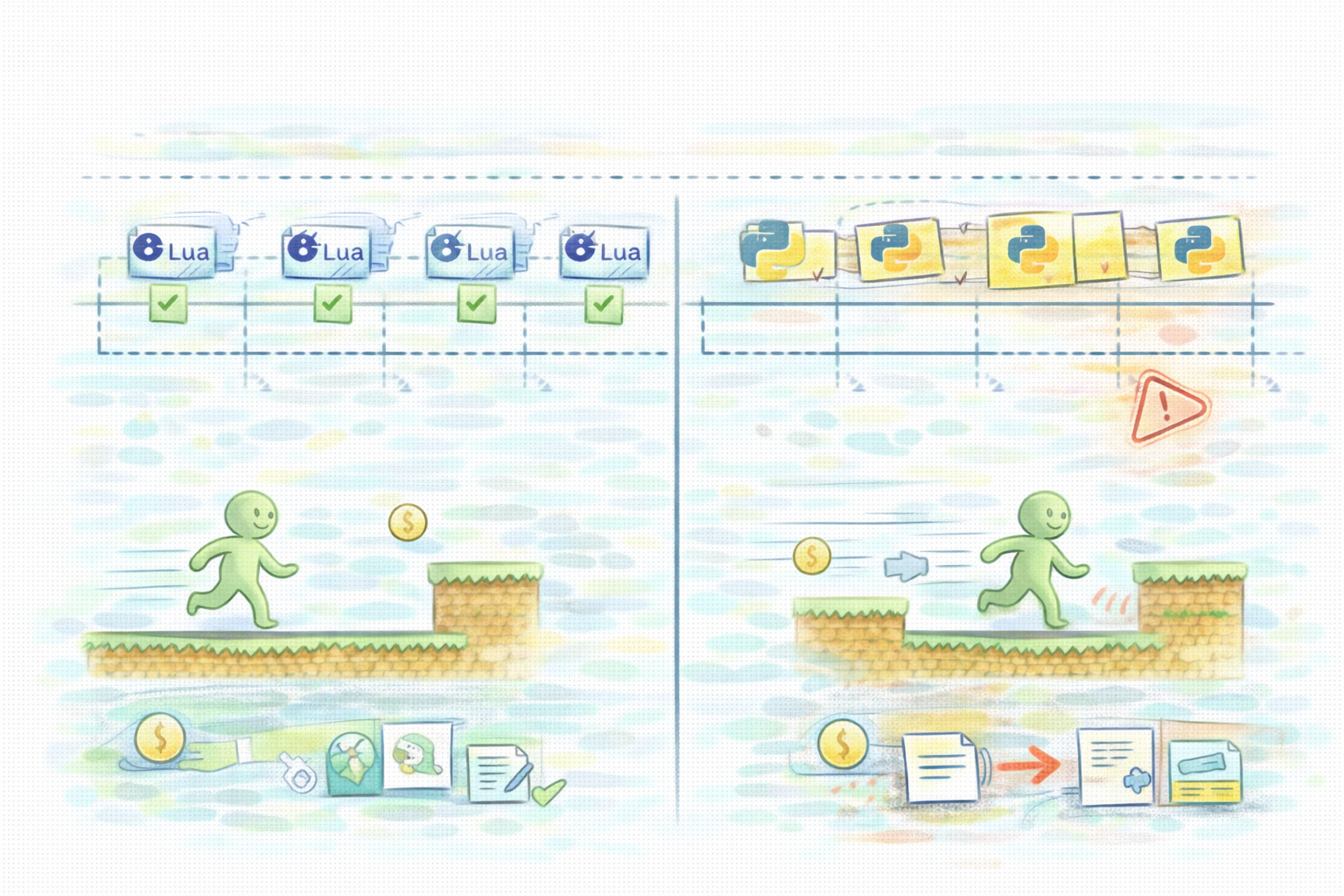
Lua is designed to operate within these constraints. Its lightweight nature allows it to execute scripts quickly, especially when embedded in a larger system that handles heavy processing. Because Lua scripts are typically used for logic rather than computation-heavy tasks, they can run frequently without becoming a bottleneck. This makes Lua a natural fit for scripting layers in performance-sensitive environments.
Python, by contrast, introduces more overhead due to its interpreter and dynamic nature. While this overhead is negligible in many applications, it becomes significant in real-time systems. For simple games or prototypes, this may not matter, but as complexity increases, performance limitations become more apparent. This is why Python is rarely used for core gameplay loops in commercial games, even though it remains valuable for other aspects of development.
Learning curve and beginner experience#
From a learning perspective, Python is widely regarded as one of the most accessible programming languages. Its syntax is clean and readable, allowing you to focus on understanding programming concepts rather than memorizing complex rules. This makes it particularly appealing for beginners who are just starting their journey.
Lua, while not overly complex, presents a different kind of learning experience. Its minimalistic design means it provides fewer built-in abstractions, which can make certain tasks feel less guided. However, this simplicity also encourages you to understand how things work at a deeper level. You are not relying on a large standard library—you are building understanding through direct interaction with the language.
Consider two learners starting at the same time. One uses Python and quickly builds small games, gaining confidence through visible results. The other uses Lua and learns how scripting integrates into a larger system. Both approaches are valid, but they emphasize different aspects of learning. Python prioritizes accessibility, while Lua introduces system-level thinking earlier.
Ecosystem and tools#
The ecosystem surrounding a language significantly shapes your development experience. Python has one of the largest ecosystems in programming, spanning web development, data science, automation, and more. This breadth makes it a versatile choice, especially if you are still exploring your interests beyond game development.
In the context of games, Python’s ecosystem is more limited but still useful. Frameworks like Pygame provide a controlled environment for experimentation, allowing you to build interactive applications without dealing with complex engine architectures. This makes it easier to focus on learning and creativity.
Lua’s ecosystem is more focused and tightly coupled with specific engines and frameworks. Its strength lies in its integration rather than its standalone capabilities. When you use Lua, you are often working within a particular engine or system, which means your experience is shaped by that environment. While this reduces flexibility, it increases relevance within game development contexts.
When Lua is the better choice#
Lua becomes the better choice when your goal is to understand how scripting works within real game engines. If you are interested in modding games, working with engines that support Lua, or building systems that require embedded scripting, Lua provides a direct and practical pathway.
It is also the better option when performance is a priority. Because Lua is lightweight and efficient, it allows you to build systems that can scale without introducing significant overhead. This is particularly important in scenarios where scripts need to run frequently, such as controlling AI behavior or handling in-game events.
In these situations, Lua is not just a learning tool—it is a production-ready language that reflects real-world workflows. Choosing Lua in this context aligns your learning with industry practices.
When Python is the better choice#
Python is the better choice when your primary goal is to learn programming and explore game development concepts without being overwhelmed by complexity. Its simplicity allows you to focus on logic, problem-solving, and building confidence, which are essential in the early stages of learning.
It is also highly effective for prototyping. If you have an idea for a game and want to test it quickly, Python allows you to do so with minimal setup. You can experiment with mechanics, iterate on ideas, and see results without worrying about performance constraints or engine architecture.
Additionally, Python’s broader ecosystem means that learning it opens doors beyond game development. This makes it a valuable investment if you are still exploring your long-term interests and want a language that applies across multiple domains.
How to decide based on your goals#
Choosing between Lua and Python ultimately comes down to understanding your goals and aligning your learning with them. If you are looking for a gentle introduction to programming and want to build projects quickly, Python provides a more accessible starting point. It allows you to focus on core concepts and gradually build confidence.
If, however, you are more interested in how games are actually built and want to work within engine-based systems, Lua offers a more relevant path. It introduces you to scripting within a larger architecture, which is a key aspect of professional game development.
Instead of treating the decision as a binary choice, think of it as part of your learning journey. You might start with Python to build foundational skills and later explore Lua to understand real-world systems. The path is not fixed—it evolves as your goals and interests develop.
Final words#
So, which language is better for game development: Lua or Python?
The answer depends on what you’re trying to achieve and how you want to learn. Lua aligns closely with real-world game development workflows, especially in performance-sensitive and engine-based environments. Python, on the other hand, provides a more accessible entry point for learning, prototyping, and building foundational skills.
Neither choice is inherently better. What matters is that you start building, stay consistent, and focus on understanding how systems work. Over time, your experience will shape your preferences and guide you toward the tools that best fit your goals.
Happy learning!