A Guide to Acing the Wise System Design Interview
Preparing for the Wise System Design interview? Learn what Wise really tests, the fintech design problems you’ll face, and a senior-level framework to explain secure, compliant, and scalable money systems with confidence.
The Wise System Design interview evaluates whether candidates can design secure, consistent, and auditable financial systems that handle cross-border money movement at scale. Interviewers test domain-specific knowledge across areas like double-entry bookkeeping, idempotency, KYC/AML compliance, and fault-tolerant architecture rather than generic distributed systems theory.
Core principles
- Financial correctness first: Every design must demonstrate ACID guarantees, atomic ledger updates, idempotent operations, and reconciliation processes to prevent double-spends and data inconsistency.
- Compliance and auditability: Strong answers acknowledge immutable transaction records, audit logging, data locality requirements, and KYC/AML checks as architectural constraints that shape system structure.
- Structured answer framework: Wise rewards candidates who clarify requirements, estimate scale, propose modular architecture, deep dive into critical components, and reason through failure scenarios before discussing trade-offs.
- Pragmatic engineering over complexity: Wise's engineering culture favors evolutionary architecture and justified decisions, so overengineering with unnecessary components will lower your score more than a simpler, well-reasoned design.
- Common design topics: Expect problems centered on international money transfer flows, multi-currency account systems, real-time FX rate services, fraud detection pipelines, and event-driven notification systems.
Preparing for the Wise System Design interview can feel intimidating at first, especially because Wise (formerly TransferWise) operates one of the most complex and regulated global financial platforms in the world. Behind every transfer, currency conversion, and multi-currency account lies a deeply engineered System Designed for speed, transparency, compliance, and cost efficiency on a global scale.
Wise’s architecture is not just about scaling traffic; it’s about handling money movement across borders, managing liquidity, respecting regulations, and ensuring security across dozens of jurisdictions. This means the Wise System Design interview extends beyond high-level diagrams or generic knowledge of distributed systems. It tests whether you understand real-world fintech challenges, how to build fault-tolerant systems, and how to make pragmatic engineering decisions.
Grokking Modern System Design Interview

For a decade, when developers talked about how to prepare for System Design Interviews, the answer was always Grokking System Design. This is that course — updated for the current tech landscape. As AI handles more of the routine work, engineers at every level are expected to operate with the architectural fluency that used to belong to Staff engineers. That's why System Design Interviews still determine starting level and compensation, and the bar keeps rising. I built this course from my experience building global-scale distributed systems at Microsoft and Meta — and from interviewing hundreds of candidates at both companies. The failure pattern I kept seeing wasn't a lack of technical knowledge. Even strong coders would hit a wall, because System Design Interviews don't test what you can build; they test whether you can reason through an ambiguous problem, communicate ideas clearly, and defend trade-offs in real time (all skills that matter ore than never now in the AI era). RESHADED is the framework I developed to fix that: a repeatable 45-minute roadmap through any open-ended System Design problem. The course covers the distributed systems fundamentals that appear in every interview – databases, caches, load balancers, CDNs, messaging queues, and more – then applies them across 13+ real-world case studies: YouTube, WhatsApp, Uber, Twitter, Google Maps, and modern systems like ChatGPT and AI/ML infrastructure. Then put your knowledge to the test with AI Mock Interviews designed to simulate the real interview experience. Hundreds of thousands of candidates have already used this course to land SWE, TPM, and EM roles at top companies. If you're serious about acing your next System Design Interview, this is the best place to start.
This guide walks you through what the Wise System Design interview evaluates, the types of design problems you can expect, and the exact frameworks you should use to structure your answer like a senior engineer.
What the Wise System Design interview is actually testing#
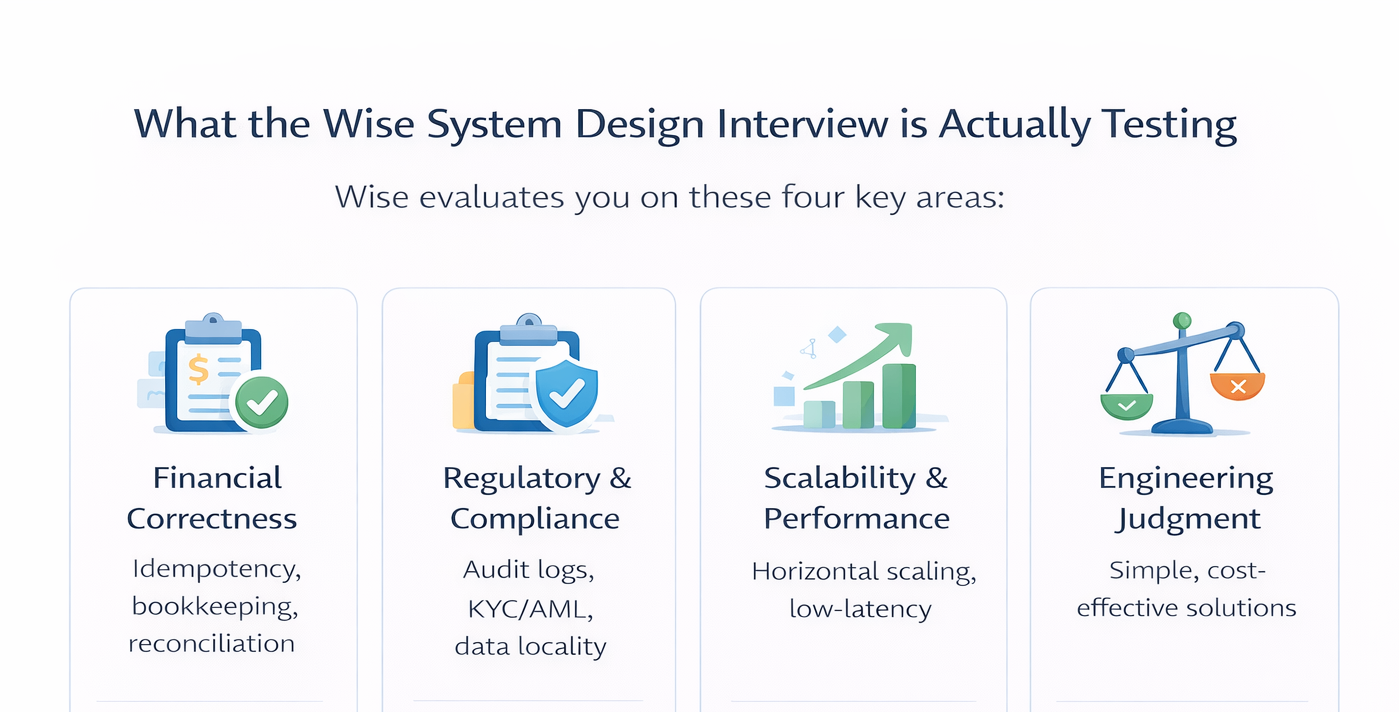
Wise expects engineers to design systems that are secure, consistent, auditable, and resilient. They want to see that you can balance product thinking with engineering judgment, especially in a domain where mistakes cost money and compliance violations can shut down entire markets.
Here’s what Wise evaluates most:
1. Strong understanding of financial correctness#
Money movement requires strict guarantees. Wise expects you to show clarity on:
Idempotent financial operations
Double-entry bookkeeping
ACID transactions
Preventing double-spends
Reconciliation processes
If you overlook consistency or financial correctness, it’s a red flag.
2. Regulatory and compliance awareness#
Wise operates in dozens of markets. Compliance constraints heavily affect their System Design.
You should demonstrate awareness of:
Audit logs
Immutable transaction records
KYC/AML checks
Data locality (e.g., maintaining records in specific regions)
Even high-level acknowledgment of these constraints signals maturity.
3. Scalability with predictable performance#
Wise processes millions of transfers every day. They expect designs that scale horizontally, reduce latency across continents, and avoid single points of failure.
4. Realistic engineering decisions#
Wise’s engineering culture values simplicity and clarity. Overengineering or proposing unnecessary components (like adding Kafka everywhere) can hurt your score. They prefer evolutionary architecture over academic complexity.
The structure of the Wise System Design interview#
Most candidates face a 45–60 minute session where they’re asked to design a feature or system core to Wise’s operations.
A typical format looks like:
Clarifying requirements
Identifying risks and constraints
Proposing a high-level architecture
Deep-diving into core components: transfer engine, ledger, notifications, fraud checks, etc.
Discussing data models and consistency
Scaling and resiliency strategies
Trade-offs and future improvements
Wise likes engineers who take a structured, narrative-driven approach when discussing System Design rather than diving straight into components.
Common Wise System Design interview topics#
Wise System Design interviews closely mirror the company’s real-world engineering challenges. Most questions center around moving money safely across borders, managing balances in multiple currencies, enforcing regulatory compliance, and maintaining security at scale. Interviewers want to see whether you understand how these constraints shape system architecture in practice.
Designing a money transfer service#
The most common Wise System Design interview problem involves designing an international money transfer system. You may be asked how users send money from one country to another, from the moment a transfer is initiated to the point funds are settled with a payout partner.
Strong answers focus first on financial correctness. You should walk through the full flow, starting from user authentication and bank account linkage, moving through compliance checks such as KYC and AML, and then into the currency conversion pipeline. This typically includes a rate lookup service, rate locking, and a double-entry ledger that records debits and credits atomically.
Interviewers also expect you to explain transaction lifecycle states, fraud checks, and how the system integrates with external payout networks. Asynchronous callbacks from partner banks are a critical part of this discussion, especially when reasoning about retries, idempotency, and reconciliation. Throughout the design, correctness and auditability matter more than raw throughput.
Multi-currency account system#
Wise’s multi-currency account model is another frequent interview topic. In this problem, you’re asked to design a system that allows users to hold, convert, and move money across many currencies within a single account.
A strong design treats each currency balance as a distinct wallet while maintaining a unified user experience. Interviewers expect you to discuss atomic balance updates, immutable transaction histories, and batch reconciliation processes that ensure balances remain accurate over time. FX conversion logic should clearly explain how rates are fetched, cached, and locked during conversions to avoid inconsistencies.
You may also touch on liquidity management, especially when scaling to high transfer volumes across multiple markets.
Real-time exchange rate service#
Wise displays live exchange rates that update frequently throughout the day, making exchange rate services a common System Design topic. Interviewers want to understand how you ingest rates from external providers, normalize and validate them, and expose them efficiently to downstream services.
Good answers describe caching strategies that support fast reads while respecting rate expiration rules. You should also explain fallback mechanisms in case a rate provider fails and discuss observability practices that help detect stale or incorrect rates before they impact users.
Fraud detection and risk scoring#
Fraud detection is central to any fintech platform, and Wise expects thoughtful answers here. Interviewers look for layered designs that combine real-time checks with offline analysis.
You might describe rules-based scoring for immediate decisions, machine-learning models for deeper risk assessment, and asynchronous pipelines that continuously evaluate behavior patterns. Velocity checks, device fingerprinting, and anomaly detection often appear in strong answers. The key signal is understanding that fraud systems evolve over time and must balance safety with user experience.
Notifications and transaction lifecycle updates#
Finally, Wise often tests how you design notification systems that track transaction progress. Users expect timely email, SMS, and push notifications as transfers move through different states.
Strong answers explain how event-driven architectures and message queues decouple notifications from core financial flows. You should mention idempotency, retry strategies, dead-letter queues, and localization requirements. Regulatory constraints around messaging content and delivery reliability are also important to acknowledge.
Summary table: Wise System Design interview focus areas#
Topic | What interviewers expect you to demonstrate |
Money transfer service | Financial correctness, double-entry ledger design, compliance, and partner integrations |
Multi-currency accounts | Atomic balance updates, immutable ledgers, FX handling, and reconciliation |
Exchange rate service | Reliable rate ingestion, caching, expiration, and fallback strategies |
Fraud detection | Layered risk evaluation with real-time and offline analysis |
Notifications & lifecycle | Event-driven design, idempotency, retries, and regulatory-aware messaging |
This combination of deep domain knowledge and structured reasoning is exactly what Wise interviewers look for when evaluating senior-level System Design candidates.
How to structure your answer for the Wise System Design interview#
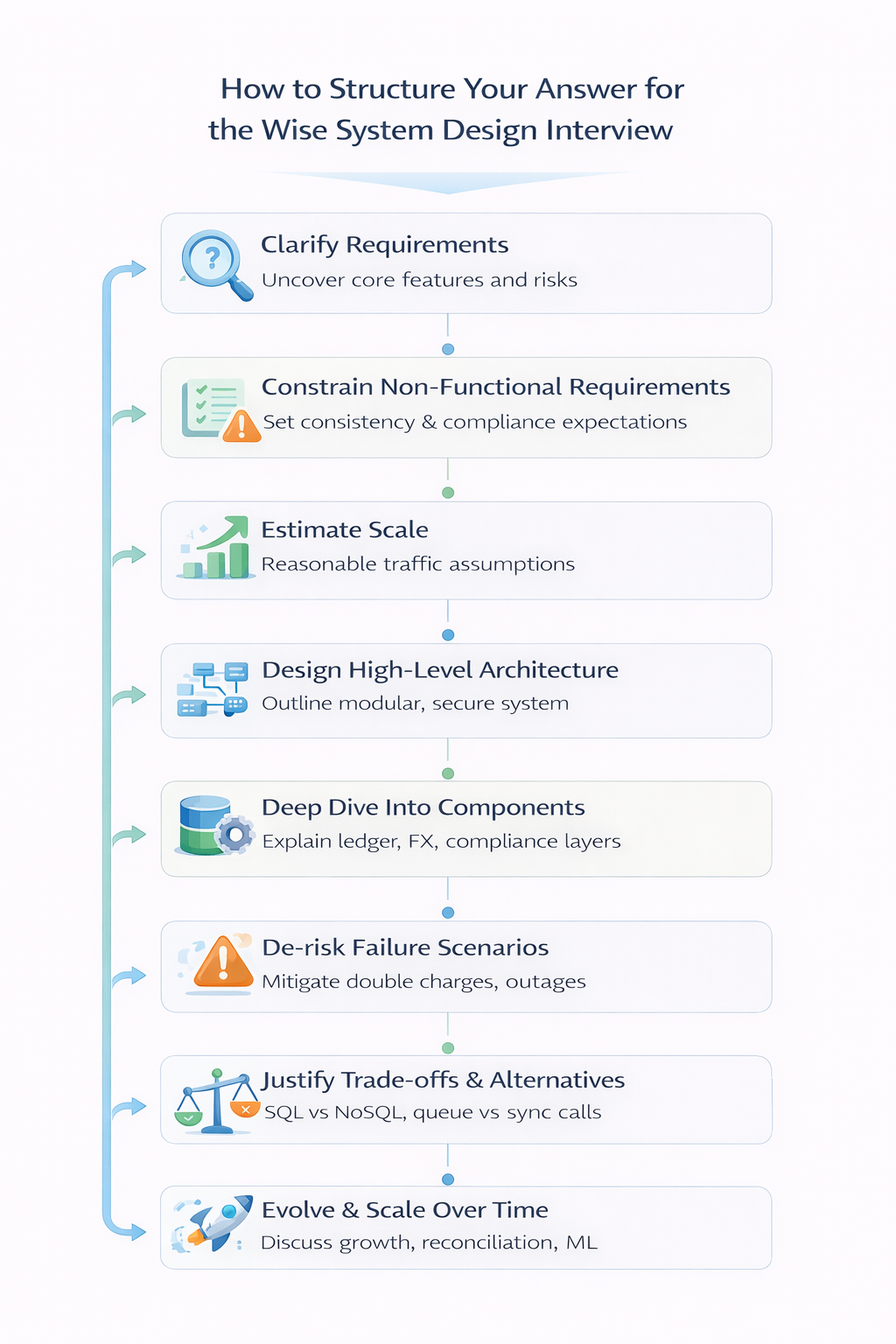
Wise System Design interviews reward candidates who think methodically. Rather than jumping straight into architecture, you’re expected to uncover constraints, reason about risk, and explain decisions with clarity. This framework helps you do exactly that.
Step 1: Clarify requirements#
Start by defining the problem space clearly. Ask whether the system supports domestic transfers, international transfers, or both, and how many currencies are involved. Clarify whether exchange rates need to be locked and what latency users expect for balance and status updates.
In fintech, missing a requirement often means missing a risk. Wise interviewers want to see that you actively surface those risks before proposing solutions.
Step 2: Identify non-functional requirements#
Once the functionality is clear, shift the conversation to constraints. Financial systems demand strong consistency, clear audit trails, and regulatory data locality. Availability matters too, especially across regions, but never at the cost of correctness.
Calling out these constraints early anchors every architectural decision that follows and signals senior-level judgment.
Step 3: Estimate scale#
Next, ground the design in a realistic scale. Talk through approximate numbers such as daily transfer volume, exchange-rate lookups per second, notification throughput, and ledger write rates.
You don’t need exact figures. Reasonable assumptions show that you can anticipate bottlenecks and design systems that scale safely.
Step 4: Propose a clear high-level architecture#
With requirements and scale established, outline a modular architecture. A strong Wise answer usually includes an API Gateway, authentication and authorization services, a transfer service, a double-entry ledger, compliance checks, FX rate services, fraud detection, partner integrations, and notifications.
On the storage side, you should clearly separate concerns: an append-only ACID ledger, balance or wallet storage, compliance audit data, and caching where appropriate. This modularity reflects how Wise builds real systems.
Step 5: Deep dive into critical components#
Depth matters more than breadth at this stage. For a money transfer system, the ledger service is the core. You should explain double-entry accounting, immutable records, transactional guarantees, atomic balance updates, idempotency keys, and timestamped audit trails.
You should also go deep on currency conversion, explaining how live rates are fetched, cached with TTLs, locked per transaction, and protected against stale usage. For compliance and fraud, distinguish between synchronous checks for high-risk actions and asynchronous analysis for deeper risk scoring.
Finally, explain how external banking APIs are integrated using webhooks, retries, reconciliation flows, and partial failure handling.
Step 6: Think through failure scenarios#
This is where strong candidates stand out. Wise expects you to explicitly discuss how the system avoids double charges, handles bank timeouts, preserves ledger integrity during retries, and recovers data safely.
Mentioning cross-region failover and controlled degradation shows that you understand financial risk, not just system uptime.
Step 7: Discuss trade-offs and alternatives#
Wise values pragmatic engineering. Compare SQL versus NoSQL for the ledger, real-time versus batch compliance checks, queue-based versus synchronous integrations, and caching versus strong consistency for balance reads.
What matters is not the choice itself, but your ability to justify it clearly.
Step 8: Describe evolution and scaling strategy#
Close by showing long-term thinking. Talk about adding new currencies, expanding into new markets, reducing latency, automating reconciliation, or introducing ML-based fraud detection over time.
Interviewers want to see that your design can evolve safely as the business grows.
Example: high-level design of a Wise-style money transfer system#
Here’s a concise version of a strong answer:
Requirements: A user sends money internationally. System must perform compliance checks, calculate FX conversion, debit the sender, credit a receiving partner, and update statuses reliably.
Architecture summary:
User request hits API Gateway → Transfer Service.
Transfer Service triggers compliance checks.
After approval, the FX service locks the exchange rate.
Ledger service performs atomic double-entry updates.
Transfer details are pushed to payout partner queues.
Partner callbacks update transfer status.
The notification service sends user updates.
Audit service logs all events for regulatory tracking.
This design covers correctness, compliance, security, and scalability; exactly what Wise interviewers look for.
Final thoughts#
The Wise System Design interview rewards clarity, pragmatism, and a strong understanding of financial systems. If you focus on correctness, compliance, scalable architecture, and real-world trade-offs, you’ll stand out from other candidates. Use the frameworks in this guide, practice explaining financial flows clearly, and anchor every decision in user impact and system safety.
