Common mistakes to avoid during the AWS Cloud Practitioner exam
Preparing for the AWS Cloud Practitioner exam? This in-depth guide breaks down the most common mistakes candidates make, why they happen, and how to avoid them—so your preparation actually leads to a confident pass.
The AWS Cloud Practitioner exam has a reputation for being “easy,” and that reputation is responsible for more failed attempts than almost any technical difficulty.
Most people don’t fail this exam because it’s hard. They fail because they misunderstand what the exam is actually testing, underestimate the level of reasoning required, or bring the wrong habits into the exam room.
If you’ve ever thought, “I know this stuff, I just need to review,” you’re already close to making one of the most common mistakes.
This article walks you through the most frequent and costly mistakes candidates make during the AWS Cloud Practitioner exam, explains why those mistakes happen, and shows you how to avoid them so your preparation actually translates into a passing score.
Cloud computing has become the foundation of modern software, and AWS continues to lead that shift. For many engineers and aspiring technologists, the AWS Certified Cloud Practitioner certification is the first step toward understanding how cloud systems are designed, managed, and scaled. The challenge is building a clear mental model of how everything fits together. I built this course around a common pattern I’ve seen: learners often approach AWS as a collection of tools rather than a system. When preparing for the AWS Certified Cloud Practitioner exam, they can recall services but struggle to explain how they work together in real scenarios. This course is designed to make those connections clear from the start. We begin with the fundamentals of cloud computing, then move into core AWS services across compute, storage, networking, and databases. From there, we explore analytics, machine learning, pricing, and billing, tying each concept back to real-world usage. You’ll also work through monitoring, security, and compliance practices, with hands-on Cloud Labs to reinforce your understanding. If you’re starting your journey as a cloud practitioner, this course gives you a structured path to pass the exam and build a strong foundation in AWS.
Mistake one: assuming “foundational” means “effortless”#
One of the biggest mistakes you can make is assuming that the word “foundational” means the exam requires little preparation.
The AWS Cloud Practitioner exam is foundational in scope, not in rigor. It covers broad concepts instead of deep technical implementation, but that doesn’t mean it’s casual.
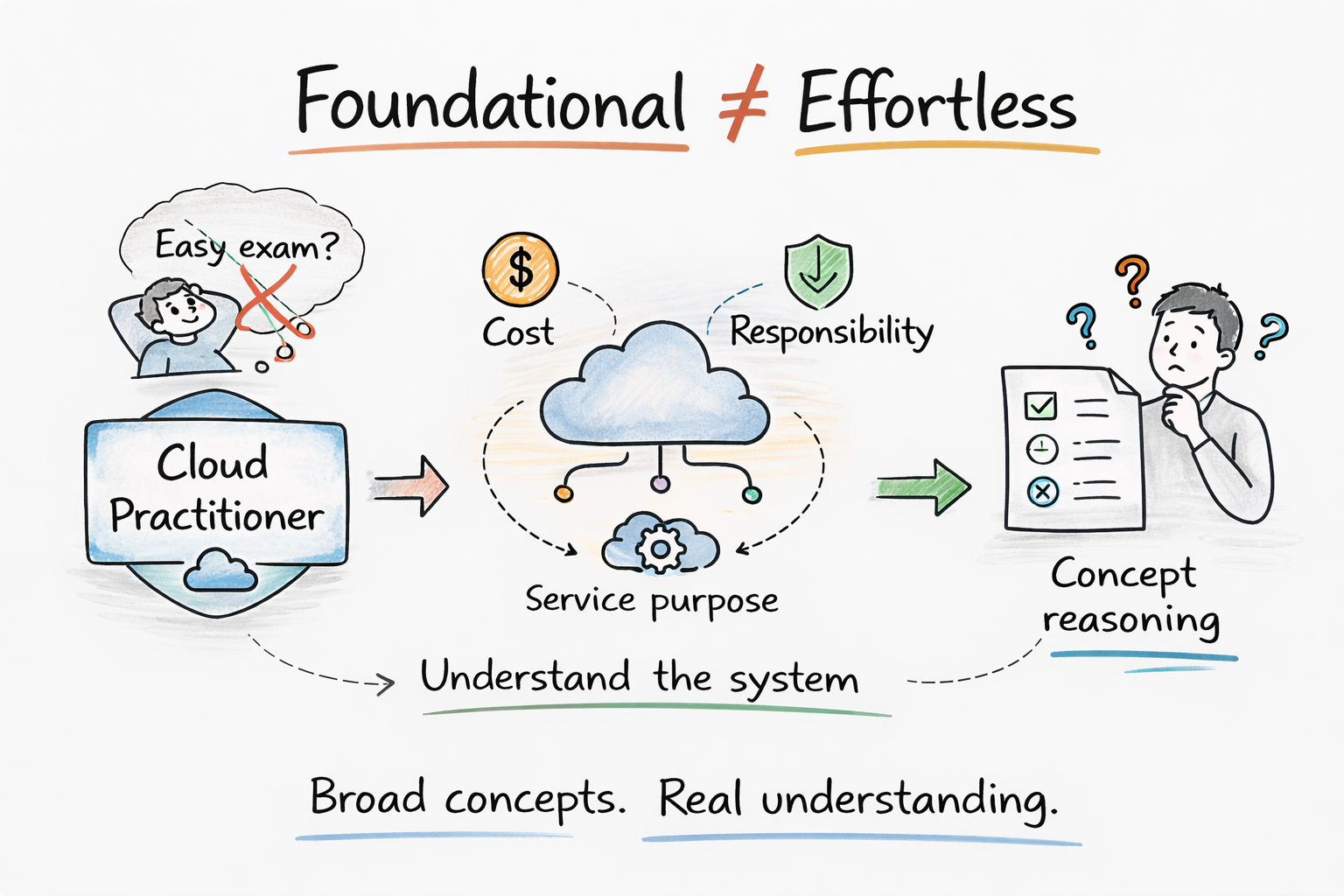
The exam expects you to understand how cloud computing works as a system. It expects you to reason about cost, responsibility, and service purpose. If you assume you can rely on surface familiarity, you’ll quickly find yourself second-guessing answers that initially seemed obvious.
Candidates who underestimate the exam often describe it as “trickier than expected.” In reality, the exam is doing exactly what it’s designed to do. It’s checking whether cloud concepts have actually clicked.
Mistake two: memorizing service names instead of understanding service purpose#
Another extremely common mistake is treating AWS services like vocabulary terms.
You might memorize that AWS S3 is storage, EC2 is compute, and RDS is a database. That level of knowledge feels productive, but it breaks down quickly in scenario-based questions.
The exam rarely asks what a service is. It asks when a service should be used and why it fits a specific requirement better than alternatives. If you don’t understand the service purpose, multiple answer choices will sound reasonable. That’s when people feel like the exam is trying to trick them.
It isn’t. It’s testing whether you understand intent, not labels.
Mistake three: ignoring the shared responsibility model#
If there is one concept that causes more wrong answers than any other, it’s the shared responsibility model.
Many candidates assume that once something is “in the cloud,” AWS handles all security. That assumption is wrong, and the exam is designed to expose it.
Security-related questions often hinge on who is responsible for a specific task. If you haven’t internalized where AWS’s responsibility ends and yours begins, these questions feel confusing and unfair.
Once you clearly understand the boundary, those same questions become predictable.
The mistake isn’t a lack of intelligence. It’s an incomplete mental model.
Mistake four: underestimating billing and pricing questions#
Billing and pricing questions make up a smaller percentage of the exam, which leads many candidates to treat them as optional.
That’s a mistake.

While there are fewer pricing questions, they often carry significant weight because they test reasoning rather than recall. You are expected to understand how AWS pricing models behave and when one approach makes more sense than another.
Candidates who avoid this domain often feel confident until exam day, when pricing questions slow them down and erode confidence. Understanding pricing logic early prevents unnecessary stress later.
Mistake five: assuming practice exam percentages predict your real score#
Many candidates rely heavily on practice exams, which is a good instinct. The mistake comes from misinterpreting the results.
Practice exams are usually scored as raw percentages. The real AWS exam uses scaled scoring. There is no clean conversion between the two. Scoring 80 percent on a practice test doesn’t guarantee a pass. Scoring 65 percent doesn’t guarantee a failure.
What matters more is how you’re answering questions. Are you guessing, or are you reasoning confidently? Do wrong answers surprise you, or do they reveal clear gaps in understanding?
Focusing only on the percentage often creates false confidence or unnecessary panic.
Mistake six: rushing through scenario-based questions#
Time pressure causes many candidates to rush, especially if they expect the exam to be easy.
AWS Cloud Practitioner questions are often subtle. A single phrase in a scenario can change what the question is actually testing. When you rush, you miss those signals. You choose an answer that sounds familiar instead of one that fits the requirement.
Candidates who slow down, read carefully, and identify the main constraint in each question consistently perform better, even if they finish with time to spare. Speed is not rewarded on this exam. Precision is.
Mistake seven: overthinking questions instead of answering what’s asked#
While rushing is a problem, overthinking is just as dangerous.
Some candidates bring deep technical experience into the exam and look for nuance that isn’t there. They imagine edge cases, implementation details, or advanced configurations.
The Cloud Practitioner exam does not care about those things.
When you add complexity that isn’t present in the question, you talk yourself out of correct answers. The exam rewards straightforward reasoning aligned with AWS best practices, not hypothetical scenarios you invent.
Mistake eight: studying advanced topics that never appear#
Another preparation mistake that shows up on exam day is wasted effort on advanced AWS topics.
You don’t need to understand VPC routing tables in depth. You don’t need to know how to tune databases. You don’t need to master serverless architecture patterns.
Studying these topics doesn’t help you answer Cloud Practitioner questions. It increases cognitive load and distracts you from core concepts. Effective preparation is about alignment, not ambition.
Mistake nine: treating the exam like a memorization test#
The Cloud Practitioner exam is not a flashcard exam. If your preparation is focused on memorizing definitions, you’ll struggle when questions ask you to apply concepts in context.
Scenario-based questions require you to identify priorities such as cost, security, scalability, or operational simplicity. Memorization alone does not prepare you for that.
Understanding relationships between concepts matters far more than recalling isolated facts.
Mistake ten: ignoring domain balance#
The exam is structured across four domains, and your final score reflects performance across all of them.
Exam domain | Approximate weight |
Cloud concepts | ~26% |
Security and compliance | ~25% |
Cloud technology and services | ~33% |
Billing, pricing, and support | ~16% |
Some candidates focus heavily on services and ignore pricing. Others understand cloud concepts but are weak on security responsibility. Imbalanced preparation is risky. Strong performance in one domain cannot fully compensate for weakness in another.
Mistake eleven: taking the exam before questions feel predictable#
Many candidates schedule the exam based on calendar pressure rather than readiness. You’re ready when questions stop feeling random. You recognize what a scenario is testing. You can explain why one answer is better than another.
If practice questions still feel like guesswork, exam day will feel stressful. Waiting a little longer to reach clarity often saves time, money, and frustration.
Mistake twelve: letting exam anxiety drive decisions#
Exam anxiety leads to rushed answers, second-guessing, and unnecessary changes.
Candidates often change correct answers because they lose confidence under pressure. This happens most when preparation relies on memorization rather than understanding. Confidence comes from clarity. When you understand why an answer is correct, anxiety has less power over your decisions.
Managing stress is part of avoiding mistakes.
Mistake thirteen: misreading multi-response questions#
Some Cloud Practitioner questions allow multiple correct answers. These questions clearly state how many answers to select. A common mistake is selecting only one option or selecting too many because you didn’t read the instructions carefully.
This isn’t a knowledge problem. It’s an attention problem. Reading the question fully before looking at answer choices prevents this entirely avoidable error.
Mistake fourteen: assuming partial understanding is enough#
Partial understanding is one of the most dangerous traps. You might understand what a service does, but not why it’s chosen over alternatives. You might know cloud benefits but not how they influence decisions.
The exam is designed to expose partial understanding. That’s why scenario-based questions feel challenging to people who “kind of” know the material. Deepening understanding even slightly often produces a disproportionate improvement in performance.
Mistake fifteen: not learning from wrong answers#
Finally, one of the biggest mistakes happens during preparation, not during the exam. Candidates often move past wrong answers without fully understanding why they were wrong. They treat mistakes as setbacks instead of feedback.
Every wrong answer points to a gap in understanding. Closing that gap is how preparation improves. Ignoring those signals almost guarantees repeated mistakes on exam day.
A summary of common mistakes and their root causes#
Mistake category | Root cause |
Underestimating the exam | Misreading “foundational” |
Memorization over understanding | Poor study strategy |
Security confusion | Weak shared responsibility model |
Pricing mistakes | Avoiding uncomfortable topics |
Rushing or overthinking | Exam anxiety |
Poor domain balance | Misaligned preparation |
Seeing these patterns makes it clear that most mistakes are preventable.
How avoiding these mistakes changes your exam experience#
Candidates who avoid these mistakes describe the exam very differently. Questions feel fair instead of tricky. Answer choices feel distinct instead of confusing. Time pressure feels manageable instead of overwhelming. The exam doesn’t change. Your approach does.
Final thoughts#
The AWS Cloud Practitioner exam is not designed to trip you up. It’s designed to confirm that cloud concepts have actually clicked.
Most mistakes come from misalignment between preparation and exam intent. When you prepare with understanding, balance, and attention, those mistakes largely disappear.
Avoiding these common pitfalls doesn’t require more study time. It requires better focus. Prepare intentionally, read carefully, and trust your reasoning. Passing becomes a natural outcome rather than a stressful gamble.