Common tools used in financial data engineering
Understanding the tools used in financial data engineering helps you build reliable pipelines, analyze market data efficiently, and support smarter financial decisions. Explore the technologies used in modern finance systems and strengthen your skills.
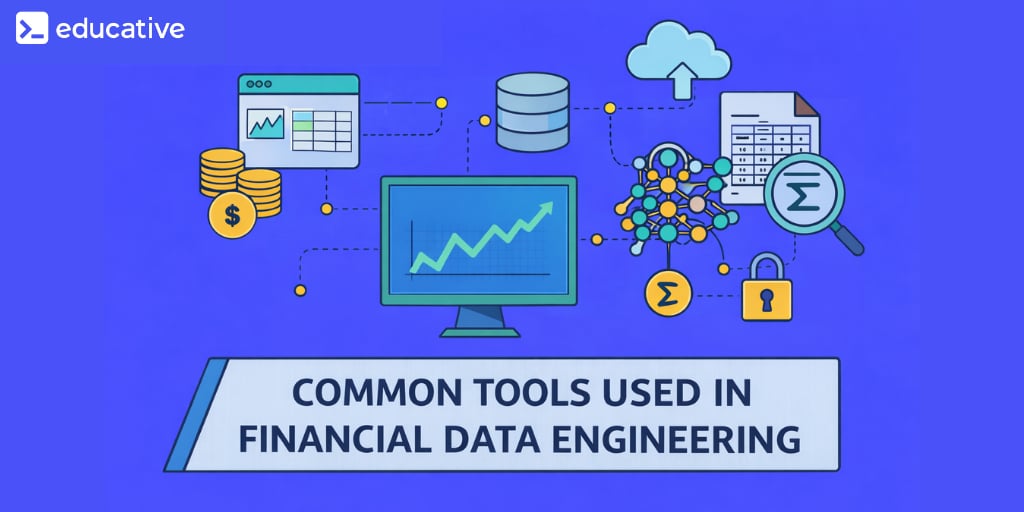
Financial institutions run on data. Every trade, payment, market signal, and regulatory report depends on reliable systems that can ingest, process, and analyze enormous volumes of financial information. Behind these systems is a specialized discipline known as financial data engineering.
If you work in finance, fintech, or analytics, you quickly realize that financial data engineering is not just about writing code or managing databases. It involves building reliable pipelines that move sensitive financial data safely and efficiently across systems. It also requires tools that can handle strict compliance requirements, high transaction volumes, and extremely low latency.
Understanding the tools used in financial data engineering helps you design better systems and make informed decisions about your technical stack. In this guide, you will explore the most common tools used across financial institutions, trading platforms, and fintech companies. By the end, you will have a clearer picture of how these technologies work together to support modern financial systems.
Learn Data Engineering

As organizations scale their use of data, the bottleneck is infrastructure. Data engineering has become the backbone of modern data systems, enabling reliable pipelines, scalable storage, and real-time processing. Yet many professionals struggle to learn data engineering beyond isolated tools. This course is designed to give you a systems-level understanding of data engineering, so you can build and reason about data platforms with confidence. I built this course from my experience working with data-intensive systems and teaching how complex architectures evolve under real-world constraints. A consistent pattern I observed was that learners could write queries or use frameworks, but lacked a clear mental model of how data flows through systems end-to-end. This course addresses that gap by focusing on how to learn data engineering as a cohesive discipline, not just a collection of technologies. You’ll start by understanding how data moves across systems and how to work with structured data using SQL and Python. From there, you’ll handle semi-structured and unstructured data with NoSQL systems like MongoDB. The course then moves into designing scalable architectures using data warehouses and lakehouses, followed by working with big data technologies such as Hadoop, Spark, and Kafka, all framed through practical system design patterns. If you want to learn data engineering in a way that prepares you to build reliable, scalable data systems, this course provides a clear and structured path forward.
Understanding Financial Data Engineering#

Before diving into the tools themselves, it helps to understand what financial data engineering actually involves.
Financial data engineering focuses on designing and maintaining systems that collect, transform, store, and analyze financial data. These systems support everything from fraud detection and algorithmic trading to portfolio management and regulatory reporting.
Financial data is different from many other types of data because it comes with strict requirements. Financial institutions must ensure accuracy, reliability, and security at every stage of the data pipeline. A small error in financial reporting can have serious consequences, ranging from incorrect investment decisions to regulatory penalties.
You also need to consider the speed at which financial data flows. Markets move in milliseconds, and trading systems often require near real-time analytics. At the same time, financial organizations must maintain historical records for auditing and compliance.
Because of these requirements, financial data engineering uses a diverse set of tools that address different stages of the data lifecycle.
Ace the APIs for Financial Data
Application programming interfaces (APIs) for financial data work with financial applications to speed up information access, exchanges, and payments. Due to the increasing popularity of such applications, financial data experts who have a complete hold on handling financial APIs are in high demand nowadays. This Skill Path will lead you to master the software application’s development with financial operations using APIs such as Square API, YH Finance API, and CoinAPI. By the end, you'll have job-ready skills in building applications integrated with finance data management and handling APIs.
Categories of Tools in Financial Data Engineering#
When you examine the technology stack used in financial data engineering, you will notice that tools typically fall into several major categories. Each category plays a specific role in moving and processing financial data.
Category | Purpose | Example Tools |
Data Ingestion Tools | Collect and import financial data from sources | Apache Kafka, Flume |
Data Processing Frameworks | Transform and process data pipelines | Apache Spark, Flink |
Data Storage Systems | Store structured and historical data | PostgreSQL, Snowflake |
Workflow Orchestration | Manage pipeline scheduling and automation | Apache Airflow |
Cloud Platforms | Provide scalable infrastructure | AWS, Azure, GCP |
Visualization and Analytics | Interpret financial insights | Tableau, Power BI |
Understanding these categories makes it easier to see how financial data flows from raw market feeds to business insights and which tools help with which specific financial data engineering concepts.
Data Engineering Foundations in Python
Data engineering is currently one of the most in-demand fields in data and technology. It intersects software engineering, DataOps, data architecture, data management, and security. Data engineers, such as analysts and data scientists, lay the foundation to serve data for consumers. In this course, you will learn the foundation of data engineering, covering different parts of the entire data life cycle: data warehouse, ingestion, transformation, orchestration, etc. You will also gain hands-on experience building data pipelines using different techniques such as Python, Kafka, PySpark, Airflow, dbt, and more. By the end of this course, you will have a holistic understanding of data engineering and be able to build your data pipelines to serve data for various consumers.
Data Ingestion Tools for Financial Systems#
Financial data originates from a variety of sources. You might receive data from stock exchanges, payment processors, banking systems, trading platforms, or regulatory feeds. Managing these incoming streams requires reliable ingestion tools that can capture data continuously.
One of the most widely used tools in financial data ingestion is Apache Kafka. Kafka functions as a distributed event streaming platform that allows systems to publish and subscribe to data streams in real time. In financial environments, Kafka often serves as the backbone for streaming transaction data and market feeds.
When you use Kafka, you can build pipelines that move financial data between systems with extremely low latency. This makes it particularly valuable in trading systems where milliseconds matter. Kafka also provides durability and fault tolerance, ensuring that data is not lost even during system failures.
Another commonly used ingestion technology is Apache Flume, which helps collect large amounts of log and event data. Financial organizations sometimes use Flume to capture application logs, transaction histories, and audit trails for downstream processing.
Together, ingestion tools form the entry point for financial data pipelines. They ensure that incoming data is captured reliably and delivered to processing systems for further analysis.
Data Processing Frameworks in Financial Data Engineering#
Once financial data has been collected, it must be transformed and processed. This stage is where data engineers clean datasets, join multiple sources, and prepare information for analytics or machine learning.
One of the most popular frameworks for large-scale financial data processing is Apache Spark. Spark allows you to process massive datasets using distributed computing, which means you can run computations across clusters of machines.
Financial institutions use Spark for a variety of tasks, including risk modeling, transaction analysis, and historical market data processing. Because Spark supports both batch processing and streaming workloads, it fits well into many financial pipelines.
Another framework that is gaining popularity in finance is Apache Flink. Flink is designed for real-time stream processing, which makes it particularly useful for applications such as fraud detection or market monitoring.
For example, if you want to detect suspicious transactions in real time, you can build a streaming pipeline with Flink that analyzes incoming payment data as it arrives. This allows financial institutions to respond quickly to potential fraud events.
Both Spark and Flink allow you to scale processing workloads across large clusters, making them ideal for financial environments where datasets can reach petabyte scale.
Data Storage Systems for Financial Data#
Financial systems generate enormous volumes of structured data. Storing this data efficiently is essential for both operational systems and historical analytics.
Relational databases remain widely used in financial environments because they offer strong consistency guarantees and structured query capabilities. PostgreSQL, for example, is commonly used in fintech applications because it provides reliability, performance, and advanced indexing features.
In addition to traditional databases, financial organizations increasingly rely on data warehouses for large-scale analytics. Cloud-based warehouses such as Snowflake allow you to store and query massive datasets without managing complex infrastructure.
Snowflake has become popular in financial data engineering because it separates storage and compute resources. This means you can scale analytics workloads independently without affecting the underlying data storage.
The following table illustrates how different storage systems are used in financial data engineering.
Storage Type | Example Tools | Use Case |
Relational Databases | PostgreSQL, MySQL | Transaction processing |
Data Warehouses | Snowflake, Redshift | Financial analytics |
Data Lakes | Amazon S3, Hadoop | Raw historical data |
NoSQL Databases | Cassandra, MongoDB | High-volume distributed data |
Each storage system serves a specific purpose within the broader financial data ecosystem.
Workflow Orchestration Tools#
Managing financial data pipelines requires coordination across many systems. Data must be collected, processed, validated, and delivered on a schedule.
This is where workflow orchestration tools become essential.
One of the most widely used orchestration platforms is Apache Airflow. Airflow allows you to define workflows as code and schedule complex data pipelines using directed acyclic graphs (DAGs).
In a financial data engineering environment, Airflow might coordinate tasks such as retrieving market data, running risk calculations, and updating analytics dashboards.
By automating these processes, you reduce the risk of manual errors and ensure that pipelines run reliably.
Airflow also provides monitoring features that allow engineers to track pipeline performance and troubleshoot failures. This visibility is particularly important in financial environments where data accuracy is critical.
Cloud Platforms in Financial Data Engineering
Many financial institutions now rely heavily on cloud infrastructure to support their data engineering workloads.
Cloud platforms provide scalable computing resources, managed databases, and integrated analytics tools. Instead of managing physical servers, you can deploy data pipelines using cloud services that scale automatically.
The three most common cloud platforms used in financial data engineering are Amazon Web Services (AWS), Microsoft Azure, and Google Cloud Platform (GCP).
These platforms offer specialized services for data pipelines, storage, and analytics. For example, AWS provides services such as Amazon S3 for data storage, AWS Glue for data integration, and Amazon Redshift for data warehousing.
Cloud platforms are particularly valuable for financial organizations that need to scale infrastructure quickly. If transaction volumes spike during market events, cloud systems can allocate additional resources automatically.
However, financial institutions must also carefully manage security and compliance when using cloud platforms. Regulatory frameworks often require strict data protection policies, especially when handling sensitive financial information.
Data Visualization and Analytics Tools#
Once financial data has been processed and stored, it must be interpreted. Analysts, portfolio managers, and executives rely on dashboards and reports to understand trends and make decisions.
Visualization tools play an important role in translating complex datasets into meaningful insights.
Two of the most widely used analytics platforms are Tableau and Microsoft Power BI. These tools allow you to connect to data warehouses and create interactive dashboards that display financial metrics.
For example, a risk management team might build dashboards that track portfolio performance, market volatility, and exposure to different asset classes.
Visualization tools also help communicate insights across organizations. Instead of reviewing raw spreadsheets, stakeholders can explore visual dashboards that highlight key trends.
The ability to present financial data clearly and accurately is an essential part of financial data engineering.
Data Governance and Compliance Tools#
Financial data engineering does not operate in a vacuum. Financial institutions must comply with strict regulatory frameworks that govern how data is stored, processed, and audited.
Data governance tools help ensure that financial data remains accurate, secure, and traceable.
These tools allow organizations to track data lineage, enforce access controls, and monitor compliance policies. By maintaining clear records of how data flows through systems, financial institutions can meet regulatory requirements and respond to audits more effectively.
In heavily regulated environments such as banking and insurance, governance tools are often integrated directly into data pipelines.
How These Tools Work Together#
Financial data engineering tools rarely operate in isolation. Instead, they form interconnected systems that move data through multiple stages of processing.
A typical financial data pipeline might look like this:
Market data feeds enter the system through Kafka.
Processing frameworks such as Spark transform the data.
Processed datasets are stored in Snowflake or PostgreSQL.
Airflow schedules and monitors the pipeline.
Analysts visualize insights using Tableau.
This layered architecture ensures that financial data flows efficiently while maintaining reliability and security.
The Future of Financial Data Engineering Tools#
Financial data engineering continues to evolve as new technologies emerge.
Artificial intelligence and machine learning are increasingly integrated into financial pipelines, enabling predictive analytics and automated decision-making.
Streaming analytics platforms are also becoming more important as financial institutions seek to analyze data in real time. Technologies like Flink and Kafka allow engineers to build systems that respond instantly to market events.
Cloud-native architectures are another major trend. Many financial organizations are transitioning from on-premise infrastructure to hybrid or fully cloud-based environments.
These developments are transforming how financial data engineering systems are designed and deployed.
Conclusion#
Financial data engineering sits at the intersection of finance, software engineering, and data science. The systems that support modern financial operations depend on reliable tools that can handle massive volumes of data while maintaining strict accuracy and security standards.
From ingestion platforms like Kafka to processing frameworks such as Spark, storage systems like Snowflake, and visualization tools like Tableau, each component plays a critical role in the financial data ecosystem.
Understanding these tools helps you design better pipelines, manage financial data more effectively, and build systems that support data-driven decision-making.
As financial technology continues to evolve, the importance of robust data engineering tools will only grow.
