Solutions Architect vs System Architect: A comparison
Confused between Solutions Architect and System Architect roles? Discover how they differ in scope, decision-making, and real-world impact, and find out which path aligns with your skills and career goals.
You’re in a design review meeting. A new platform is being proposed, and two people are leading the discussion, one is called a Solutions Architect, the other a System Architect. They both talk about architecture, both draw diagrams, and both seem to influence major decisions. Naturally, you assume they’re doing the same job.
This confusion is incredibly common, especially in cloud-first and enterprise environments where roles blur and titles evolve faster than responsibilities.
But here’s the reality: understanding what the difference is between a Solutions Architect and a System Architect is not just about job titles. It’s about how systems are conceived, designed, and delivered in the real world. If you're moving toward architecture roles, this distinction directly impacts how you think about System Design and where you fit in that process.
Master AWS Certified Solutions Architect Associate SAA-C03 Exam
Cloud architecture has become a core skill for modern engineers. Whether you're building backend systems, deploying microservices, or scaling global applications, understanding how to design on AWS is no longer optional. The challenge is that AWS is an ecosystem. Without a clear structure, it’s easy to get lost in services without understanding how to use them together to build secure, reliable systems. I built this course from my experience working on Azure’s Fabric Controller and Remote Desktop services for Windows Server. In those environments, we dealt with real-world problems around availability, fault tolerance, and large-scale system management. The pattern I’ve seen with learners is similar: they can learn individual services, but struggle to connect them into a complete architecture. This course is designed to help you think in systems, not just services. We focus on the core pillars of AWS architecture, security, reliability, performance, and cost optimization, and show how they come together in practical designs. You’ll learn how to secure accounts and resources, design for high availability using load balancing and replication, and choose the right storage and analytics services for performance. The course also includes hands-on Cloud Labs so you can deploy and interact with real AWS resources, along with practice exams aligned to the SAA-C03 certification. This approach has helped many learners build confidence in AWS and successfully prepare for certification. If you’re aiming to become an AWS Certified Solutions Architect Associate and design systems the right way, this course gives you a clear and structured path.
Why these roles are often confused#
At a glance, both roles operate in the same space: architecture. They attend similar meetings, influence technical decisions, and often collaborate on the same systems.
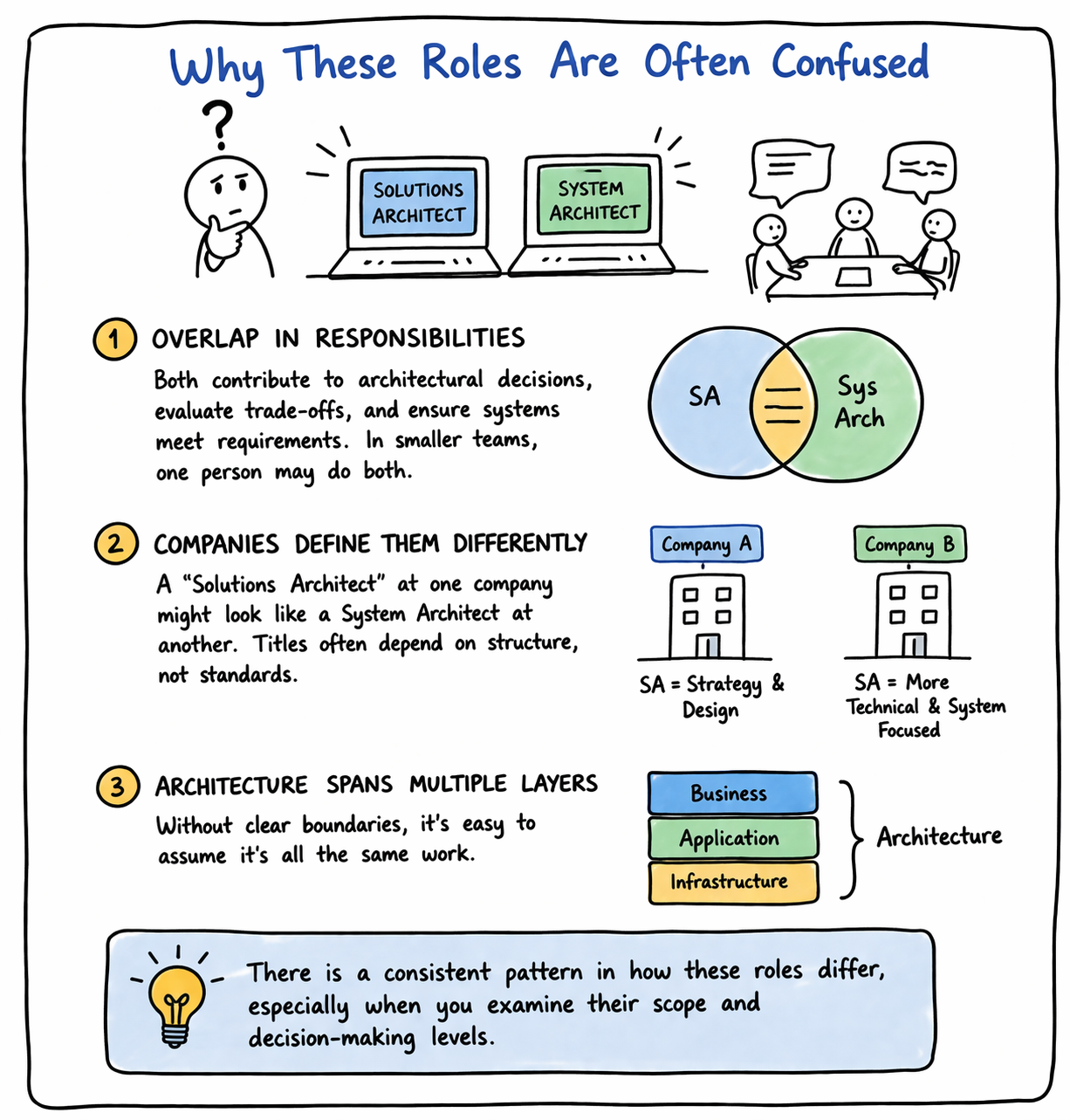
The confusion comes from three main factors.
First, there’s overlap in responsibilities. Both roles contribute to architectural decisions, evaluate trade-offs, and ensure systems meet requirements. In smaller organizations, one person may even perform both roles.
Second, companies define these roles differently. A “Solutions Architect” at one company might behave like a System Architect at another. Titles are often shaped by organizational structure rather than strict industry standards.
Third, architecture itself spans multiple layers. Without clear boundaries, it’s easy to assume that anyone working on architecture is doing the same type of work.
Despite this ambiguity, there is a consistent pattern in how these roles differ, especially when you examine their scope and decision-making levels.
What is a Solutions Architect?#
A Solutions Architect operates at the intersection of business needs and technical systems. Your primary responsibility in this role is to translate requirements into a cohesive, high-level solution.
You’re not just designing systems; you’re designing solutions to business problems.
This means you spend a significant amount of time:
Understanding business goals and constraints
Selecting appropriate technologies and cloud services
Defining system boundaries and integration points
Communicating trade-offs to stakeholders
Think of yourself as the person answering: What should we build, and how should it fit into the broader ecosystem?
Real-world example#
Imagine a company launching a global e-commerce platform.
As a Solutions Architect, you would:
Decide to use AWS or Azure based on cost, scalability, and compliance
Choose services like managed databases, CDN, and serverless compute
Define how payment systems, inventory, and user services integrate
Align the architecture with business goals like fast time-to-market
You’re shaping the overall solution, not diving into the internals of each component.
What is a System Architect?#
A System Architect operates deeper within the system. Your focus shifts from what to build to how exactly it should work under the hood.
You’re responsible for designing the internal structure of systems, components, data flows, APIs, and performance characteristics.
This role requires strong technical depth because your decisions directly affect system behavior at runtime.
You’ll typically focus on:
Designing service boundaries and communication patterns
Defining data models and consistency strategies
Optimizing performance, scalability, and fault tolerance
Making low-level infrastructure and implementation decisions
If the Solutions Architect defines the blueprint of a city, the System Architect designs the buildings, plumbing, and electrical systems.
Real-world example#
Using the same e-commerce platform:
As a System Architect, you would:
Design how the checkout service communicates with inventory and payment systems
Define API contracts and retry mechanisms
Choose between eventual consistency or strong consistency for inventory updates
Optimize database indexing and caching strategies
Your work determines whether the system performs reliably at scale.
What is the difference between a Solutions Architect and a System Architect?#
At its core, the difference lies in where each role operates in the architecture stack and how decisions are made.
A Solutions Architect works outward-facing. Your decisions are shaped by business context, user needs, and system integration. You operate at a higher level of abstraction, ensuring that the overall system aligns with organizational goals.
A System Architect works inward-facing. Your decisions are shaped by technical constraints, performance requirements, and implementation details. You operate at a lower level of abstraction, ensuring that each component functions correctly and efficiently.
In practice, this difference shows up in how you approach problems.
A Solutions Architect might ask:
“Which architecture pattern fits this use case?”
“Should we use microservices or a modular monolith?”
“How do we integrate with external systems?”
A System Architect, on the other hand, asks:
“How do these services communicate under failure conditions?”
“What data consistency model should we use?”
“How do we optimize latency and throughput?”
Both roles are making architectural decisions, but at different layers of the system.
Detailed comparison table#
Aspect | Solutions Architect | System Architect |
Focus area | Business-aligned solutions | Internal system design |
Scope | End-to-end solution across systems | Specific system or subsystem |
Level of abstraction | High-level (macro architecture) | Low-level (component architecture) |
Key responsibilities | Technology selection, system integration, stakeholder alignment | API design, data flow, performance optimization |
Stakeholder interaction | Frequent interaction with business, product, and clients | Primarily works with engineers and technical teams |
Technical depth | Broad knowledge across technologies | Deep expertise in specific systems and domains |
Decision drivers | Business goals, cost, scalability, timelines | Performance, reliability, maintainability |
Typical background | Cloud engineering, consulting, or platform design | Backend engineering, distributed systems, or infrastructure |
How both roles interact in real-world systems#
In practice, these roles are not isolated; they are tightly coupled.
A Solutions Architect defines the high-level direction. For example, choosing a microservices architecture with event-driven communication.
That decision immediately creates constraints and requirements for the System Architect, who must now:
Design event schemas
Handle message ordering and retries
Ensure system resilience under partial failures
Similarly, technical realities discovered by the System Architect can influence higher-level decisions. If a particular approach introduces unacceptable latency or complexity, the Solutions Architect may need to revise the overall design.
This feedback loop is what makes real-world System Design dynamic rather than linear.
Role of System Design in both positions#
Both roles rely heavily on System Design, but they apply it differently.
For a Solutions Architect, System Design is about structure and composition. You think in terms of:
Architectural patterns (microservices, event-driven, serverless)
Service boundaries and integrations
Scalability at the system level
For a System Architect, System Design is about behavior and execution. You focus on:
Data flow between components
Failure handling and resilience
Performance optimization and bottlenecks
Consider a streaming platform.
A Solutions Architect decides to use a distributed streaming architecture with Kafka.
A System Architect determines:
Partitioning strategy
Consumer group design
Exactly-once vs at-least-once semantics
Same system, same architecture, different layers of thinking.
Skills required for each role#
The difference in scope naturally leads to different skill emphases.
As a Solutions Architect, you need breadth. You must understand multiple technologies, cloud platforms, and integration patterns. Just as importantly, you need strong communication skills because you’re constantly aligning technical decisions with business stakeholders.
As a System Architect, you need depth. You must deeply understand distributed systems, concurrency, data modeling, and performance tuning. Your credibility comes from your ability to design systems that work reliably under real-world conditions.
Both roles require strong System Design skills, but one emphasizes coverage, while the other emphasizes precision.
Career path differences#
If you’re coming from a development background, your path into these roles will likely differ.
The Solutions Architect path often looks like this:
Developer → Senior engineer → Cloud or platform engineer → Solutions Architect: You gradually expand your scope, working closer to business requirements and cross-system integration.
The System Architect path typically looks like:
Developer → Senior backend engineer → Distributed systems specialist → System Architect: You deepen your expertise, focusing on performance, scalability, and system internals.
Neither path is inherently better; they simply reflect different interests and strengths.
Common misconceptions#
One of the biggest misconceptions is that Solutions Architects are “less technical.” In reality, they need strong technical judgment; they just apply it at a broader level.
Another misconception is that System Architects don’t interact with stakeholders. While their interaction is more technical, they still collaborate extensively with engineering teams and influence major decisions.
And perhaps the most persistent myth is that both roles are interchangeable. While there is overlap, their responsibilities diverge significantly in practice, especially in large-scale systems.
Which role should you choose?#
If you enjoy connecting technology to business outcomes, working across teams, and making high-level decisions, the Solutions Architect role may align better with your strengths.
If you’re drawn to deep technical challenges, system internals, and performance optimization, the System Architect path is likely a better fit.
The key is to be honest about how you like to think.
Do you prefer zooming out to see the big picture, or zooming in to refine the details?
That preference often determines which role you’ll thrive in.
Conclusion#
So, what is the difference between a Solutions Architect and a System Architect?
One designs the solution around the system. The other designs the system within the solution.
They are not competing roles; they are complementary layers of architecture. Together, they ensure that systems are not only aligned with business goals but also built to perform, scale, and endure.
Understanding What is the difference between a Solutions Architect and a System Architect? helps you see architecture as a spectrum rather than a single role, and gives you clarity on where you want to operate within that spectrum.
Happy learning!
