Distributed Job Scheduler System Design
A Distributed Job Scheduler System Design interview is about handling coordination and failure. Focus on durability, at-least-once execution, idempotency, and scaling under uncertainty—not just task assignment.
A distributed job scheduler sounds deceptively simple. Accept jobs. Assign them to workers. Track completion. Most engineers have interacted with one—through background jobs, data pipelines, or cron-like systems. That familiarity can be dangerous in an interview.
Interviewers use this problem because it compresses core distributed systems concepts into a manageable surface area: coordination, durability, leader election, failure detection, retries, and execution guarantees. If your mental model is shallow, it shows quickly.
This is not a question about clever scheduling algorithms. It is a question about how you reason when the network lies to you, when workers disappear mid-task, and when retries amplify failure.
Mid-level candidates often describe queues and workers. Senior candidates talk about uncertainty, failure domains, and execution guarantees. They recognize that distributed schedulers are systems that manage ambiguity.
In distributed systems, the scheduler is less about assigning work and more about managing doubt.
If you treat this as a queueing problem, you miss the signal. If you treat it as a coordination problem, you’re on the right path.

For a decade, when developers talked about how to prepare for System Design Interviews, the answer was always Grokking System Design. This is that course — updated for the current tech landscape. As AI handles more of the routine work, engineers at every level are expected to operate with the architectural fluency that used to belong to Staff engineers. That's why System Design Interviews still determine starting level and compensation, and the bar keeps rising. I built this course from my experience building global-scale distributed systems at Microsoft and Meta — and from interviewing hundreds of candidates at both companies. The failure pattern I kept seeing wasn't a lack of technical knowledge. Even strong coders would hit a wall, because System Design Interviews don't test what you can build; they test whether you can reason through an ambiguous problem, communicate ideas clearly, and defend trade-offs in real time (all skills that matter ore than never now in the AI era). RESHADED is the framework I developed to fix that: a repeatable 45-minute roadmap through any open-ended System Design problem. The course covers the distributed systems fundamentals that appear in every interview – databases, caches, load balancers, CDNs, messaging queues, and more – then applies them across 13+ real-world case studies: YouTube, WhatsApp, Uber, Twitter, Google Maps, and modern systems like ChatGPT and AI/ML infrastructure. Then put your knowledge to the test with AI Mock Interviews designed to simulate the real interview experience. Hundreds of thousands of candidates have already used this course to land SWE, TPM, and EM roles at top companies. If you're serious about acing your next System Design Interview, this is the best place to start.
Framing the problem correctly#
Before drawing boxes, you slow down.
What kinds of jobs are we running? Are they short-lived background tasks, or hour-long data processing jobs? Are jobs independent, or do they have dependencies? What are the scale assumptions—hundreds per minute or millions per second?
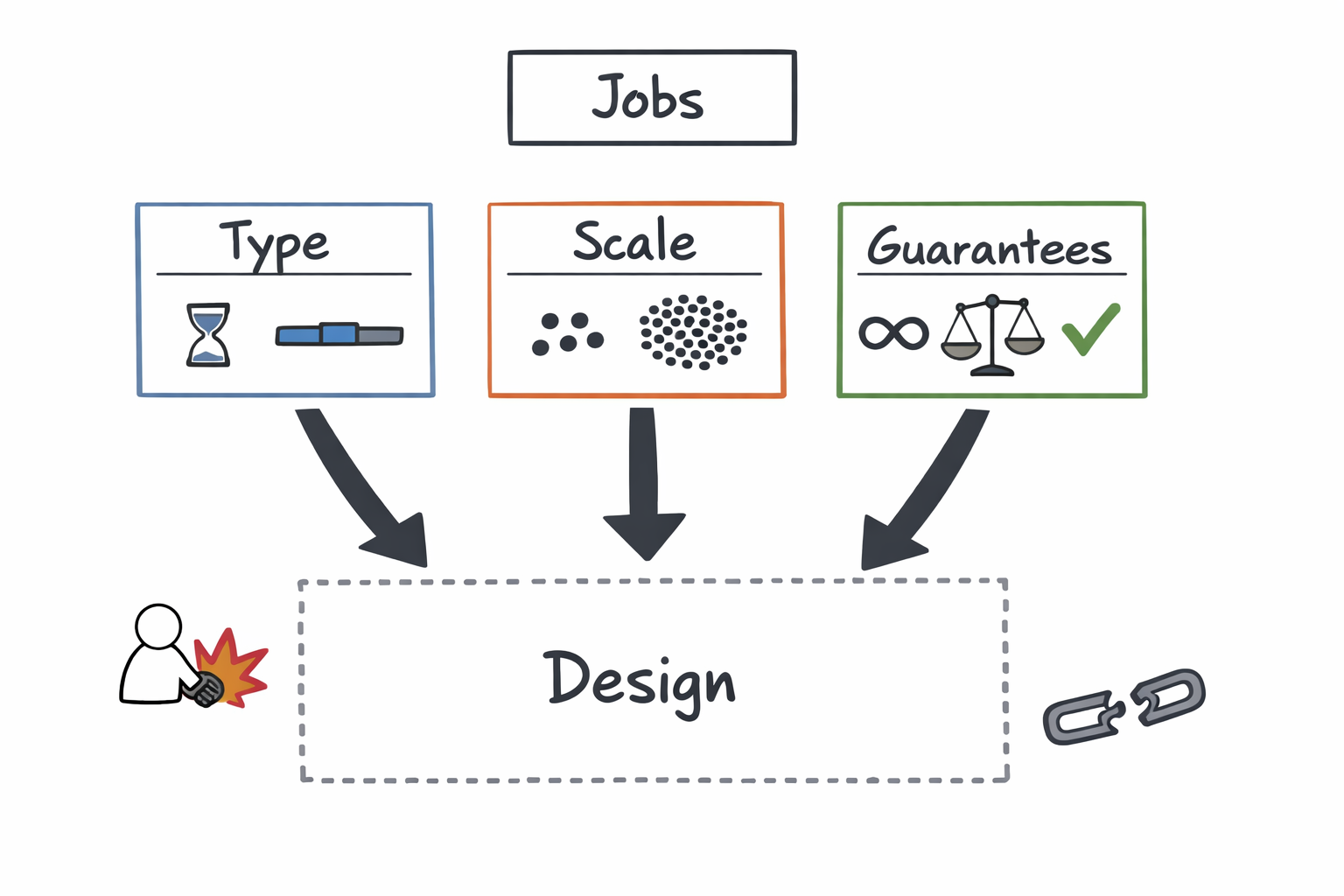
Then you clarify the guarantees. Is job loss unacceptable? Are duplicates tolerable? How important is latency compared to correctness?
This framing step matters because different assumptions radically change the design. A scheduler handling critical financial reconciliation jobs behaves differently from one dispatching thumbnail generation tasks.
Interviewers are less interested in what you schedule and more interested in what assumptions you make about failure.
If you explicitly state that worker crashes and network partitions are normal, you’ve already elevated the discussion.
What strong candidates do differently in scheduler interviews#
Strong candidates narrate the lifecycle of a job before diving into architecture. They think in sequences, not components.
They articulate execution guarantees early. They explain why exactly-once is difficult. They assume at-least-once semantics unless proven otherwise.
They also anticipate pushback. When describing retries, they immediately mention idempotency. When describing heartbeats, they acknowledge that silence is ambiguous.
Most importantly, they connect every design choice to a failure mode. If they choose a pull-based model, they explain how it handles worker churn. If they introduce leader election, they explain how split-brain is avoided.
The difference is not technical vocabulary. It is clarity of mental models under uncertainty.
End-to-end job lifecycle walkthrough#
Let’s walk through a job’s life in a well-designed distributed scheduler.
Job submission#
A client submits a job. The first priority is durability. Once the scheduler acknowledges the request, it must never lose that job—even if the scheduler crashes immediately afterward.
This implies persistent storage before acknowledgment. Submission is a responsibility boundary. Acknowledging too early risks loss. Acknowledging too late hurts availability.
Naive answers often skip this persistence step and jump straight to dispatching work.
Persistence and queueing#
After durable storage, the job transitions into a queued state. The queue is not just a list; it represents ordered or prioritized work waiting for assignment.
If the scheduler crashes now, queued jobs must still exist. If storage becomes unavailable, the scheduler must stop accepting new jobs rather than silently dropping them.
Primary priority: durability and state correctness.
Worker discovery and assignment#
Workers must discover jobs or be assigned work. This is where scheduling models diverge.
Push-based scheduling involves the scheduler assigning tasks directly to workers. and allows them to request work when ready. The choice reflects your assumptions about worker reliability and system scale.
Model | What you gain | What you risk | Mitigation |
Push-based | Low dispatch latency | Fragile under worker failure | Strong health tracking + reassign |
Pull-based | Resilience to worker churn | Slight dispatch delay | Short polling intervals |
Push-based models require accurate health tracking. If a worker crashes after assignment, the scheduler must detect and recover.
Pull-based models trade a small delay for greater resilience. Workers only claim jobs when ready, reducing stale assignments.
After choosing, you explain why it aligns with your failure assumptions.
Execution and heartbeat monitoring#
Once a worker begins executing a job, uncertainty increases.
Workers send heartbeats to signal liveness. If heartbeats stop, the scheduler must infer whether the worker crashed or the network partitioned.
In schedulers, silence is a signal, not an absence of one.
The scheduler sets a timeout threshold. If heartbeats exceed that threshold, the job may be reassigned.
Naive designs treat heartbeats as perfect signals. Mature designs treat them as probabilistic hints.
Completion and final state#
When a worker completes a job, it reports success or failure. The scheduler updates the persistent state accordingly. If the completion acknowledgment is lost due to network issues, the worker may retry reporting. This must not corrupt state. Primary priority: consistency of final state.
Retry and propagation#
If a job fails or times out, retry logic activates. Retrying too aggressively risks cascading failures. Retrying too slowly reduces throughput. Failures propagate. If downstream systems are slow, retries amplify load. This is where careful timeout calibration and exponential backoff protect system stability.
Scheduling models and assignment strategies#
Push and pull are not just architectural preferences; they encode different operational philosophies.
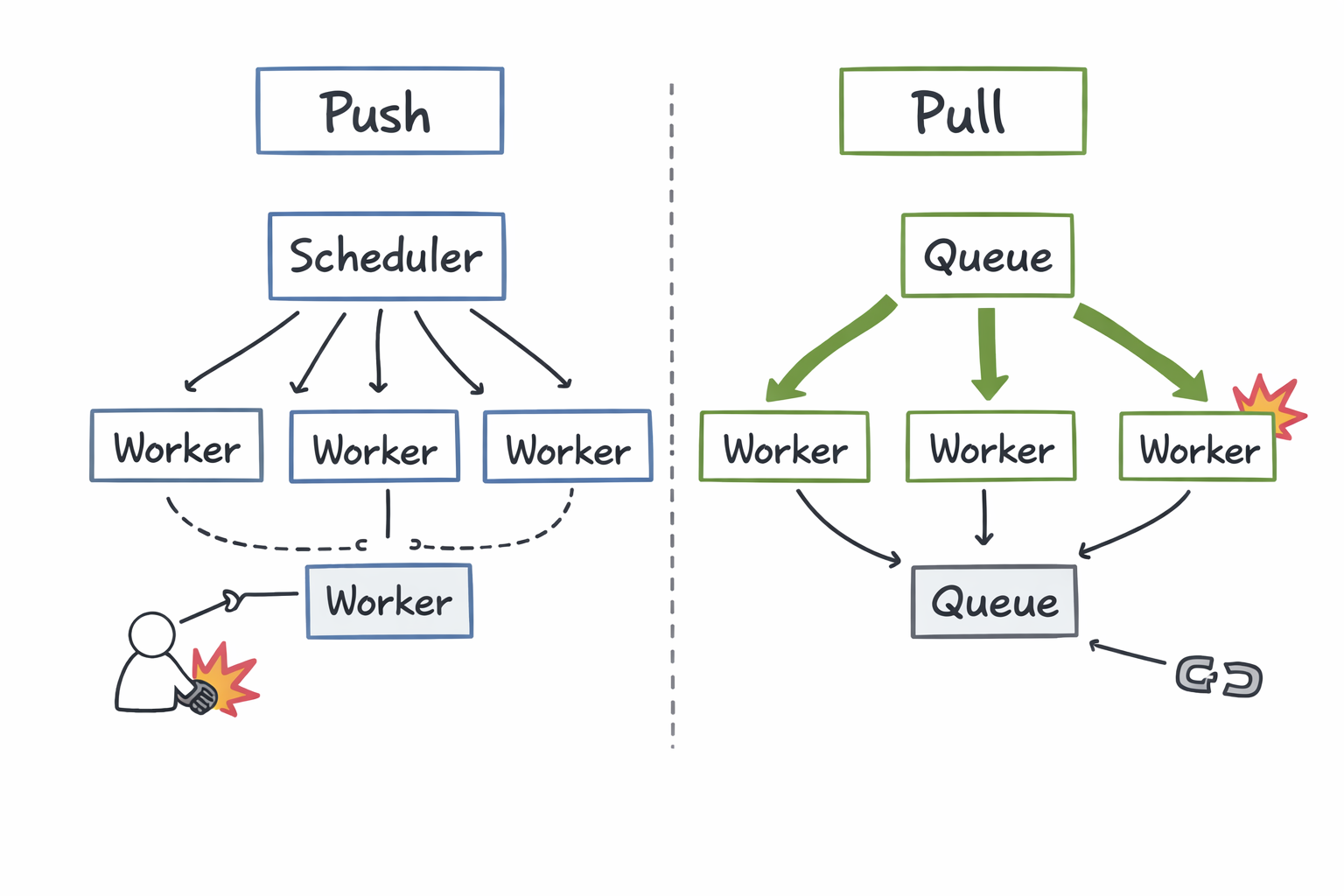
Push-based schedulers assume central coordination is strong. They require accurate worker state and quick reassignment when failures occur. Pull-based schedulers assume workers are ephemeral and unreliable. Workers fetch work when capable, reducing coordination complexity.
Your explanation should not stop at describing the models. It should articulate why your chosen model handles failure better under your assumptions.
Execution guarantees and idempotency#
Execution guarantees define correctness boundaries.
Exactly-once execution sounds ideal but is extremely difficult in distributed systems. Network partitions, retries, and crashes make it hard to guarantee a job runs only once without heavy coordination.
Exactly-once | No duplicates | Very high | Rare |
At-least-once | No job loss | Moderate | Common |
At-most-once | No duplicates | Job loss risk | Rare |
At-least-once is the most common model. It guarantees no job loss but allows duplicates.
Exactly-once requires coordination across storage and execution layers, often involving distributed transactions. This increases latency and fragility.
When idempotency is possible, at-least-once becomes acceptable. When idempotency is impossible, deduplication keys or application-level safeguards are needed.
Strong candidates say “at-least-once” confidently and explain why it’s usually enough.
This signals distributed systems maturity.
Coordination and leader election#
Many distributed schedulers require a leader to coordinate state transitions.
A single leader simplifies job assignment and state management. However, leader failure must be handled gracefully.
Leader election ensures only one scheduler instance makes authoritative decisions at a time. Without it, split-brain scenarios can occur, where multiple schedulers assign the same job simultaneously.
During failover, a new leader must reconstruct state from durable storage. If leadership transitions are not carefully managed, duplicate assignments or job loss may occur.
Coordination improves consistency but reduces availability during leader transitions.
Strong leadership | Clear authority | Downtime during failover | Fast election + state replay |
Loose coordination | Higher availability | Duplicate assignment risk | Idempotent job design |
Leader-based systems simplify reasoning but require careful failover handling.
Failure handling and retry logic#
Failures are inevitable.
Timeout calibration is subtle. Too short, and jobs are retried prematurely. Too long, and stalled jobs block progress.
Exponential backoff prevents retry storms. Without it, transient downstream failures can cascade into systemic overload.
Consider poison jobs—jobs that always fail due to data corruption or logic errors. Infinite retries will clog the system. A dead-letter mechanism isolates permanently failing jobs for inspection.
Retry storm | Cascading overload | Exponential backoff + rate limits |
Poison job | Queue blockage | Dead-letter isolation |
Miscalibrated timeout | Duplicate or stalled jobs | Dynamic timeout tuning |
Dialogue 1 (worker crash mid-job)#
Interviewer: “A worker crashes halfway through a long-running job. What happens next?”
You: “The scheduler detects missed heartbeats after a timeout and marks the job as uncertain. It reassigns the job to another worker.”
Interviewer: “How do you avoid running it twice?”
You: “We assume at-least-once semantics. Either the job is idempotent, or we use a deduplication key so duplicate execution does not corrupt state.”
This exchange shows comfort with uncertainty rather than denial of it.
Dialogue 2 (network partition scenario)#
Interviewer: “The scheduler loses connectivity to a subset of workers. Are they dead?”
You: “Not necessarily. It could be a partition. We treat them as potentially alive but unreachable.”
Interviewer: “What if they were still running jobs?”
You: “We eventually retry after timeout. That introduces duplicate risk, which we mitigate through idempotency and job state validation.”
Acknowledging ambiguity is key.
Below are expanded versions of the requested sections. They are written to integrate seamlessly into the existing article while preserving tone, structure, and interview focus.
Observability and operational readiness#
Distributed schedulers rarely fail dramatically. They fail slowly, subtly, and asymmetrically. A small increase in job duration leads to a slight queue buildup. A downstream service degrades, causing retries. Heartbeats begin to lag under CPU pressure. Nothing explodes—but the system is drifting toward instability.
That is why observability is not optional in scheduler design. It is the difference between controlled degradation and chaotic collapse.
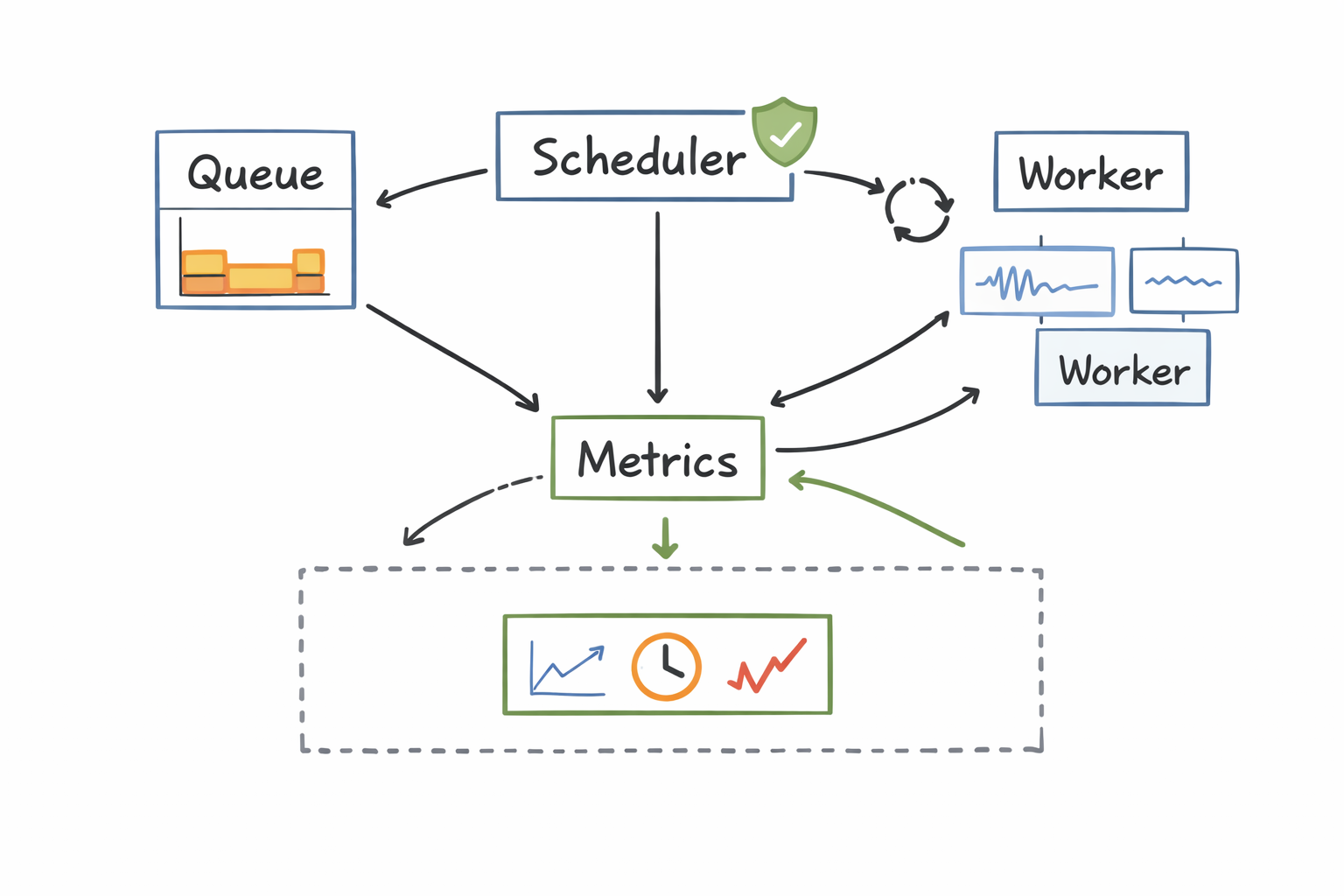
At a minimum, you need visibility into queue health, execution health, and worker health. But a senior-level answer goes further: you describe how these signals interact.
For example, a growing queue alone does not necessarily indicate worker failure. It may indicate that average job duration has increased. Rising retries combined with increasing job latency might signal downstream instability rather than scheduler malfunction.
The scheduler’s health model should include leading indicators, not just lagging ones.
Signal | Why it matters | What it indicates |
Growing queue depth | Backlog accumulation | Insufficient capacity or job slowdown |
Rising retry rate | Failure amplification | Downstream instability or timeout miscalibration |
Missed heartbeats | Worker liveness uncertainty | Crash, partition, or overload |
Queue depth is a capacity signal. If it grows steadily while submission rate remains constant, workers are under-provisioned or overloaded.
Retry rate is a stability signal. A sudden spike suggests external dependencies are failing. If unbounded, retries create cascading load. Missed heartbeats are a coordination signal. They indicate ambiguity: the worker may be dead, partitioned, or just slow.
Operational readiness also means defining thresholds. At what queue depth do you autoscale? At what retry rate do you alert? When do you temporarily reject new submissions to preserve stability?
Backpressure is a particularly important concept. If the scheduler continues accepting jobs while downstream systems are degraded, it can create an unmanageable retry storm. A mature design includes traffic shaping, rate limiting, or temporary admission control.
Observability is not about dashboards. It is about building early-warning systems that detect instability before it becomes irreversible.
If you cannot explain how you would detect instability early, your design is incomplete.
In interviews, explicitly mentioning feedback loops—queue depth influencing scaling, retry rates influencing backoff tuning—signals operational maturity.
Capacity planning and scaling math#
Interviewers often ask: “How would this scale?”
This is not an invitation to name technologies. It is an invitation to reason quantitatively.
Assume the system handles 10,000 jobs per second at peak. Average job duration is 5 seconds. That implies roughly 50,000 concurrent jobs in flight.
Now add retries. If 5 percent of jobs fail transiently and are retried once, effective job throughput increases to 10,500 jobs per second. If failures spike to 20 percent during an outage, load jumps dramatically.
This is why retry storms are more dangerous than steady load. Steady load is predictable. Retries are multiplicative.
Queue depth is not just throughput × duration. It must absorb bursts. Suppose traffic spikes to 20,000 jobs per second for 30 seconds. That’s 600,000 jobs that need to be buffered and eventually processed.
Capacity planning influences several design parameters:
Worker count: Must exceed steady-state needs with headroom for spikes.
Timeout thresholds: Must account for maximum expected job duration, not average.
Heartbeat intervals: Must balance detection speed with overhead.
If average job duration is 5 seconds but p99 is 20 seconds, timeouts shorter than 20 seconds will cause premature retries and duplicates.
Queue storage must support peak write and read rates. If persistence cannot handle submission bursts, durability becomes the bottleneck.
Scaling math also informs sharding decisions. If 100,000 concurrent jobs strain a single coordination node, partitioning job state across shards reduces contention.
A senior-level answer shows that numbers influence architecture. It does not hand-wave with “we’ll scale horizontally.”
Back-of-the-envelope math reveals design flaws before production does.
Even rough estimates demonstrate control over the problem.
Consistency vs availability trade-offs#
Schedulers live at the boundary between coordination and execution. That boundary forces trade-offs.
If you require strong consistency—ensuring that only one scheduler instance can assign a job—you need coordination. Coordination introduces latency and can reduce availability during leader failover.
If you favor availability, multiple schedulers may temporarily assign overlapping work. That increases duplicate execution risk.
The key is to articulate what you gain, what you risk, and how you mitigate.
Favoring availability means work continues during partial failure. But you must mitigate duplicates with idempotency. Favoring strong consistency prevents duplicates at assignment time. But during coordination outages, job processing may pause.
There is no universally correct answer. The right choice depends on job semantics.
For financial reconciliation jobs, duplicate execution may be unacceptable. Strong coordination may be justified.
For image processing or log aggregation jobs, duplicates may be harmless. Availability becomes more important. A mature answer acknowledges that consistency is not binary. It is contextual.
Every guarantee you strengthen reduces something else—usually availability.
Interviewers want to see you navigate this tension deliberately.
Interview communication strategy#
Even a strong design can fail if poorly communicated.
Structure your answer around the job lifecycle. That gives the interviewer a mental map. Start with submission and durability. Move through assignment and execution. End with retries and completion.
When the interviewer introduces a failure scenario, pause. Tie the failure back to your execution model. If you chose at-least-once semantics, explain how that handles worker crashes.
If scale assumptions change mid-interview—say jobs increase tenfold—adjust calmly. Show how queue depth, worker count, and coordination complexity scale. Do not abandon your architecture unless necessary. Adapt it.
Avoid overengineering early. Start with a simple design aligned to stated scale. Then evolve it if prompted.
Scheduler interviews are about reasoning through uncertainty, not defending a diagram.
Demonstrate flexibility. Confidence comes from explaining trade-offs clearly, not from rigid adherence to an initial plan.
Common pitfalls#
One common mistake is promising exactly-once execution without explaining the coordination cost. Interviewers will probe here. If you cannot justify how you prevent duplicates under partition, credibility drops.
Another mistake is assuming worker reliability. Workers crash. They pause. They stall under load. Designs that ignore this are fragile.
Ignoring operational aspects is also a red flag. If you never mention metrics, queue depth, or retry rates, your system exists only on a whiteboard.
Overengineering is equally problematic. Introducing complex consensus mechanisms for a low-scale system signals poor judgment.
Perhaps the most subtle mistake is ignoring ambiguity. When a network partition occurs, the scheduler cannot know the ground truth. Pretending certainty reveals inexperience.
Distributed systems are about managing uncertainty, not eliminating it.
A strong candidate embraces that uncertainty and designs defensively.
Conclusion#
A distributed job scheduler tests your understanding of coordination, durability, and uncertainty. There is no perfect design. There are only trade-offs shaped by execution guarantees and failure assumptions.
If you narrate the job lifecycle clearly, reason explicitly about failure, and connect every design choice to a risk and mitigation, you demonstrate the distributed systems thinking interviewers expect from mid-to-senior engineers.
Happy learning!
