LLM System Design Explained
Ready to master LLM System Design? Learn how to architect scalable, GPU-efficient, cost-aware platforms with smart scheduling, context management, and streaming. Design beyond the model and build production-ready AI systems that perform reliably at scale.
Large Language Models have transitioned from academic research projects to production-critical infrastructure in an incredibly short period of time. Today, LLMs power chat assistants, enterprise copilots, semantic search platforms, internal productivity tools, customer support automation, and code generation systems. For many organizations, LLM platforms are no longer experimental features; they are core business systems.
However, deploying an LLM at scale is far more complex than training a model or exposing an API endpoint. Running inference for large models introduces new constraints that reshape system architecture. GPU-bound compute, token-based billing, streaming outputs, context window management, and unpredictable workloads fundamentally alter how infrastructure must be designed.
That is why LLM System Design has become a challenging and increasingly common System Design interview question. It blends traditional distributed systems thinking with AI-specific constraints such as GPU scheduling, memory-heavy workloads, token-level latency, fairness enforcement, and cost control.
Grokking the Generative AI System Design
GenAI System Design is emerging as its own interview category at top tech companies, distinct from traditional ML System Design. The questions are different, the architectures are different, and the scale considerations (GPU compute, parallelism, inference optimization) require their own mental models. Having spent years researching adaptive AI systems and neural networks, and now leading the creation of learning content at Educative, I designed this course to bridge that gap between understanding generative AI conceptually and being able to architect these gen AI systems end-to-end. You'll learn the SCALED framework, which is a 6-step methodology for breaking down any GenAI System Design problem, then apply it across five real-world systems spanning text, image, speech, and video generation. Each case study walks through training architecture, deployment design, and the specific tradeoffs involved in that modality. Before diving into the case studies, the course covers the foundational concepts you'll need: neural networks, transformers, tokenization, embeddings, parallelism strategies, inference optimization, RAG, and fine-tuning. You'll also learn how to do back-of-the-envelope calculations for LLM training and deployment. A bonus: if you have a GenAI or ML System Design interview coming up, this will give you both the framework and the depth to handle whatever systems are asked to design.
In this blog, we will walk through how to design a production-ready LLM platform step by step. The focus will remain on architecture, orchestration, operational resilience, and trade-offs rather than model internals.
Understanding the core problem in LLM System Design#
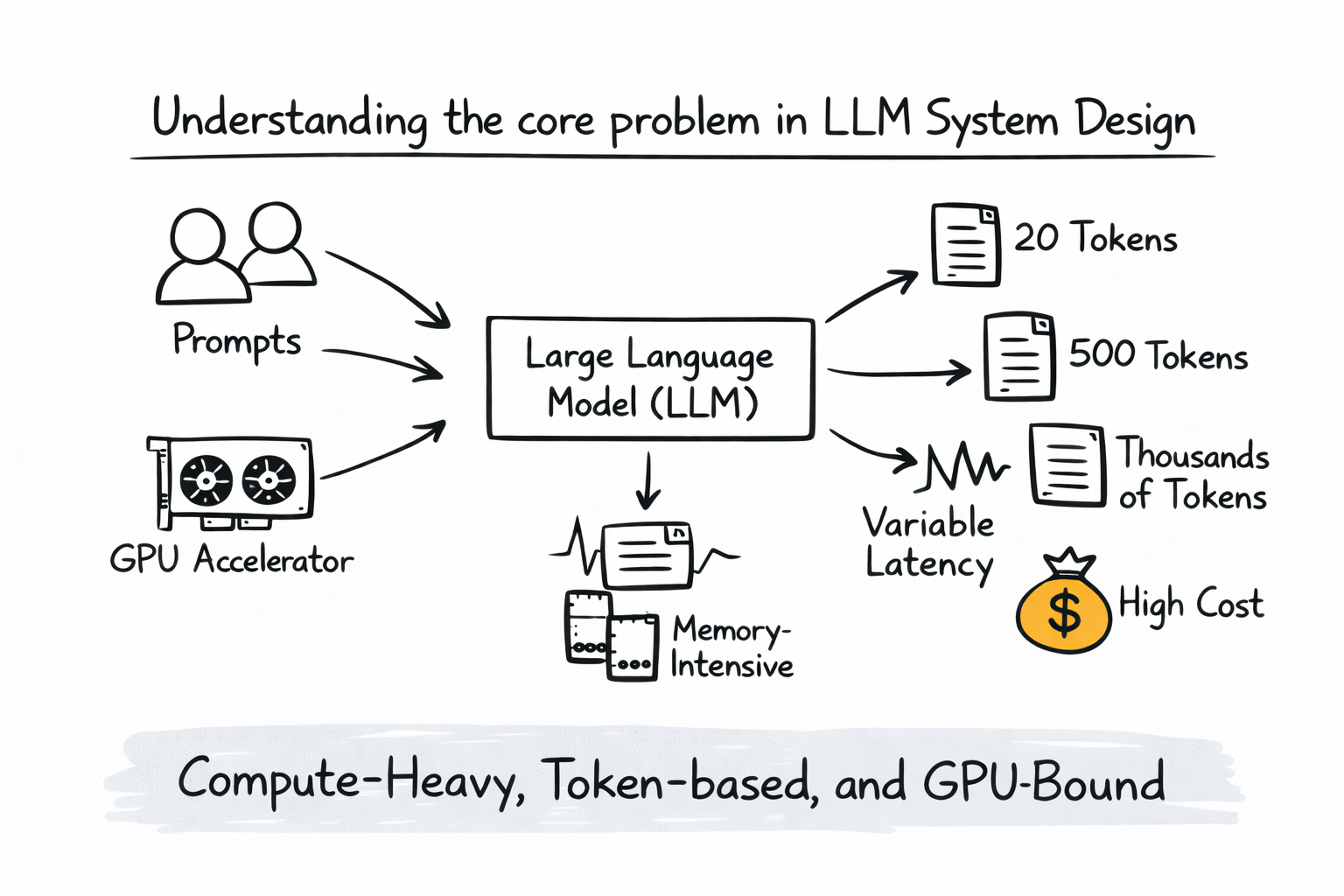
At its core, an LLM system serves inference requests for large neural language models. Users submit prompts. The system processes those prompts using one or more LLMs. Responses are generated token by token and returned to the user.
This seems straightforward at first glance, but the defining characteristics of LLM workloads shape the entire system architecture.
Requests are compute-heavy and GPU-bound. Unlike traditional REST APIs that execute quickly on CPUs, LLM inference requires expensive accelerators. Input and output sizes vary widely in token count. One request may generate 20 tokens; another may generate thousands. Latency matters for user experience, but predictability often matters even more. Models are large, memory-intensive, and costly to operate.
LLMOps: Building Production-Ready LLM Systems

LLMOps is the practice of keeping an LLM application reliable under production traffic, within cost limits, and in the face of security threats. In this course, you’ll learn LLMOps by building and operating an application from the ground up with production constraints in mind. You’ll begin with the shift from classical ML to foundation models and the constraints that drove LLMOps: stochastic outputs, high inference costs, and new operational artifacts like prompts and vector indexes. You’ll apply the 4D LLMOps life cycle to define quality gates that prevent the project from stalling at the proof-of-concept stage. You’ll implement a reference RAG architecture, and validate retrieval using golden datasets. Next, you’ll version prompts, enforce structured outputs, and add automated evaluation with LLM-as-a-judge patterns and regression tests. Finally, you’ll prepare for production with security and compliance controls, containerized deployment, and feedback loops to keep quality improving after launch.
The table below summarizes how LLM workloads differ from traditional APIs.
Characteristic | Traditional API | LLM Inference API |
Compute | CPU-bound | GPU-bound |
Latency pattern | Predictable | Variable per token |
Memory footprint | Moderate | Very large |
Cost per request | Low | High |
Workload variability | Relatively stable | Bursty and unpredictable |
Grokking the System Design of an LLM begins by acknowledging that compute is the primary bottleneck and designing around efficient GPU utilization, scheduling fairness, and cost awareness.
Functional requirements of an LLM platform#
Functional requirements describe what the system must support from a user or developer perspective.
At a minimum, an LLM system must allow users or applications to submit prompts and receive generated responses. In production settings, additional capabilities are often required, such as model selection, streaming outputs, structured response formats, and usage tracking.
The following table outlines common functional capabilities in LLM System Design.
Functional Capability | Description |
Prompt submission | Accept text input via API or UI |
Model selection | Support multiple LLM variants |
Response generation | Return generated text or structured data |
Streaming support | Return tokens incrementally |
Usage tracking | Monitor token consumption and billing |
In interviews, it is acceptable to narrow the scope explicitly to text generation unless the interviewer specifies otherwise. Clarifying the scope early demonstrates structured thinking.
System Design Deep Dive: Real-World Distributed Systems

Modern software systems are expected to operate at a massive scale while meeting strict reliability and latency requirements. Whether it’s a feed refresh, a payment request, or a real-time analytics query, users expect systems to respond instantly and consistently. That expectation has raised the bar for engineers today, understanding that System Design isn’t optional. It’s a core skill for building and evaluating production-grade systems. I built this course from my experience working on large-scale distributed systems at Microsoft (Azure) and Meta (Scuba), and from interviewing hundreds of candidates across both companies. The pattern I kept seeing was this: candidates understood individual components, but struggled to combine them into a coherent system. They knew what a cache or load balancer was, but not when or why to use it. This course is designed to bridge that gap. We start with the foundational building blocks of System Design, including databases, caching layers, load balancing, and messaging systems, and focus on how they interact under real-world constraints. From there, we analyze systems built by companies like Google, Facebook, and Amazon, breaking them down to understand the trade-offs behind each design decision. The goal is not just to learn concepts, but to develop the ability to reason through them in practice. This approach has helped a large number of engineers build stronger intuition for System Design and perform better in interviews. If you want to understand how real systems are designed and be able to design them yourself, this course gives you a clear, practical path forward.
Non-functional requirements that drive architectural complexity#
Non-functional requirements are the primary source of complexity in LLM System Design.
An LLM platform must scale to handle large volumes of inference requests while maintaining consistent performance. It must enforce fairness across users, prevent abuse, manage costs, and maintain high availability. Unlike traditional web services, every request has a significant marginal cost.
The table below highlights key non-functional constraints and their architectural implications.
Non-Functional Requirement | Architectural Impact |
Scalability | Horizontal scaling of GPU workers |
Predictable latency | Queueing and load smoothing |
High availability | Redundant inference clusters |
Fairness | Rate limiting and priority scheduling |
Cost efficiency | Token limits and model routing |
Observability | Detailed token and GPU metrics |
Strong LLM System Design explicitly addresses these constraints rather than assuming they are implicitly handled.
High-level architecture of an LLM platform#
A production LLM platform is best designed as a modular, layered architecture. This separation of concerns allows independent evolution of models, scheduling systems, and client-facing services.
At the edge of the system are client applications, web interfaces, and SDKs. These communicate with an API gateway responsible for authentication, request validation, and rate limiting.
After ingestion, requests pass to prompt processing and context management services. The prepared request is forwarded to an inference orchestration layer that schedules GPU-backed model serving workers. Logging, analytics, and monitoring services observe system health and usage.
The following table summarizes the high-level architectural layers.
Layer | Responsibility |
Client layer | Accept user prompts |
API gateway | Authentication and rate limiting |
Prompt processing | Context trimming and formatting |
Scheduler | GPU allocation and queueing |
Model serving | Execute inference |
Observability layer | Track metrics and costs |
This modular structure ensures that changes in model versions or inference strategies do not require rewriting the entire platform.
Request ingestion and validation#
Every request begins at the ingestion layer.
When a prompt is submitted, the system authenticates the user, enforces rate limits, and validates input constraints such as maximum token count. Early validation is essential because malformed or abusive requests can waste expensive GPU resources.
Normalization may also occur at this stage. For example, the system might inject system-level instructions, sanitize whitespace, or enforce formatting standards. Performing these steps early protects downstream components and stabilizes overall performance.
Prompt processing and context management#
Context management is a critical differentiator in LLM System Design.
Large Language Models have finite context windows. Sending excessive historical messages increases latency and cost. Sending insufficient context reduces response quality.
The system must intelligently decide how much history to include. Strategies may involve truncating older messages, summarizing prior conversations, or selecting only the most relevant context.
The table below captures the trade-offs inherent in context management.
Objective | Impact |
Maximize coherence | Increase context length |
Reduce latency | Shorten input tokens |
Lower cost | Minimize token count |
Explicitly discussing this trade-off in interviews demonstrates a deep understanding of LLM behavior and cost sensitivity.
Inference orchestration and GPU scheduling#
Inference orchestration is the operational heart of LLM System Design.
Once a request is validated and processed, it enters a scheduling system. The scheduler determines where inference should run based on GPU availability, model compatibility, request priority, and fairness constraints.
Because GPUs are expensive and scarce, intelligent scheduling is critical. Requests may queue during peak load. Some users may receive priority based on subscription tier. Routing decisions may balance model quality against cost.
The following table outlines scheduling considerations.
Scheduling Concern | Why It Matters |
Queue management | Prevent overload during spikes |
Fairness | Ensure equitable resource access |
Model routing | Balance performance and cost |
GPU utilization | Maximize hardware efficiency |
Effective orchestration directly impacts latency, reliability, and infrastructure spending.
GPU-backed model serving infrastructure#
Model serving is where inference physically occurs.
Each LLM is hosted on GPU-backed worker nodes. These workers load models into memory and execute token generation. Because models are memory-intensive, worker nodes must be carefully provisioned to avoid fragmentation or overcommitment.
Stateless serving architecture simplifies scaling and failure recovery. Model versioning enables safe rollouts and A/B testing. Warm loading reduces cold-start latency and improves user experience.
Resource management is critical. An overloaded GPU can degrade performance for all concurrent requests.
Streaming responses and perceived latency#
Many LLM systems support streaming responses, where tokens are returned incrementally as they are generated.
Streaming improves perceived latency because users see partial responses almost immediately. However, streaming introduces connection management challenges. Long-lived connections must handle network interruptions gracefully.
Separating streaming from core inference logic keeps the architecture modular. The inference engine focuses on token generation, while a streaming layer manages delivery semantics.
Failure handling and resilience#
Failures are inevitable in large-scale LLM systems.
GPU nodes may fail. Inference may time out. Network interruptions may disrupt streaming sessions. Robust LLM System Design anticipates these issues and implements predictable recovery strategies.
Idempotent request handling ensures retries do not duplicate results. Retry mechanisms must include backoff and limits to prevent runaway costs. Clear error states improve developer trust and user experience.
Graceful degradation strategies, such as routing to smaller fallback models, can maintain service continuity during partial outages.
Observability and monitoring#
Operating an LLM platform without observability is operationally dangerous.
Critical metrics include request latency, throughput, GPU utilization, queue depth, error rates, and token consumption. Monitoring token usage is particularly important because the cost scales with token count.
The following table summarizes key observability categories.
Metric Category | Examples |
Performance | Latency per request |
Infrastructure | GPU memory utilization |
Queue health | Wait time and backlog |
Cost | Tokens per request |
Reliability | Error and timeout rates |
Visibility into these signals allows teams to scale proactively, debug effectively, and optimize spending.
Cost management as a first-class design constraint#
Cost is a defining challenge in LLM System Design.
Inference cost grows with model size, token length, and concurrency. Architectural decisions directly influence operational expenses.
Common optimization strategies include batching compatible requests, limiting maximum token output, routing low-priority traffic to smaller models, and implementing tiered pricing structures.
Explicitly acknowledging cost trade-offs during interviews signals real-world engineering maturity.
Multi-tenancy and fairness#
LLM platforms often serve diverse customers with varying needs.
Multi-tenancy introduces challenges around isolation and fairness. The system must prevent individual users or applications from monopolizing GPU resources.
Quota enforcement, rate limiting, and priority scheduling help ensure equitable access. Usage tracking enables billing transparency and abuse detection.
Designing fairness mechanisms explicitly demonstrates thoughtful platform engineering.
How interviewers evaluate LLM System Design#
Interviewers are not testing your knowledge of transformer architectures or training techniques. They are evaluating your ability to design infrastructure around AI workloads.
They assess how you handle compute-heavy, token-based traffic. They observe how you manage scheduling and fairness. They evaluate how you balance latency, quality, and cost. They listen for structured reasoning and clear articulation of trade-offs.
Strong answers focus on architecture, orchestration, resilience, and cost awareness rather than deep model internals.
Final thoughts on LLM System Design#
LLM System Design represents a modern evolution of System Design interviews. It requires combining distributed systems fundamentals with AI-specific constraints such as GPU-bound inference, token-level cost scaling, and context management.
A strong design emphasizes modular architecture, intelligent scheduling, thoughtful context trimming, observability, and cost-aware decision-making. If you can clearly explain how a prompt flows from ingestion through validation, context management, inference, streaming, and monitoring, you demonstrate the system-level judgment required to build scalable, production-grade LLM platforms.
