eBay System Design Interview
Master eBay System Design by learning to architect scalable search, real-time auctions, secure payments, fraud detection, and global marketplace infrastructure. Design for fairness, trust, and resilience, and stand out in your eBay interview.
Preparing for the eBay System Design interview means understanding how to architect global e-commerce platforms that support marketplace dynamics, auctions, buyer–seller interactions, product discovery, and financial transactions. eBay’s systems must handle high traffic, complex workflows, distributed seller networks, and strict correctness requirements, especially for bidding, payments, and fraud prevention.
Unlike typical e-commerce companies, eBay operates a marketplace model, where the platform must enable transactions between millions of sellers and buyers while ensuring fairness, accuracy, trust, and real-time performance.
Grokking Modern System Design Interview

For a decade, when developers talked about how to prepare for System Design Interviews, the answer was always Grokking System Design. This is that course — updated for the current tech landscape. As AI handles more of the routine work, engineers at every level are expected to operate with the architectural fluency that used to belong to Staff engineers. That's why System Design Interviews still determine starting level and compensation, and the bar keeps rising. I built this course from my experience building global-scale distributed systems at Microsoft and Meta — and from interviewing hundreds of candidates at both companies. The failure pattern I kept seeing wasn't a lack of technical knowledge. Even strong coders would hit a wall, because System Design Interviews don't test what you can build; they test whether you can reason through an ambiguous problem, communicate ideas clearly, and defend trade-offs in real time (all skills that matter ore than never now in the AI era). RESHADED is the framework I developed to fix that: a repeatable 45-minute roadmap through any open-ended System Design problem. The course covers the distributed systems fundamentals that appear in every interview – databases, caches, load balancers, CDNs, messaging queues, and more – then applies them across 13+ real-world case studies: YouTube, WhatsApp, Uber, Twitter, Google Maps, and modern systems like ChatGPT and AI/ML infrastructure. Then put your knowledge to the test with AI Mock Interviews designed to simulate the real interview experience. Hundreds of thousands of candidates have already used this course to land SWE, TPM, and EM roles at top companies. If you're serious about acing your next System Design Interview, this is the best place to start.
This blog breaks down what the eBay System Design interview questions evaluate, what questions are most common, and the exact structure you should use to deliver a high-scoring solution.
Understanding What eBay Evaluates#
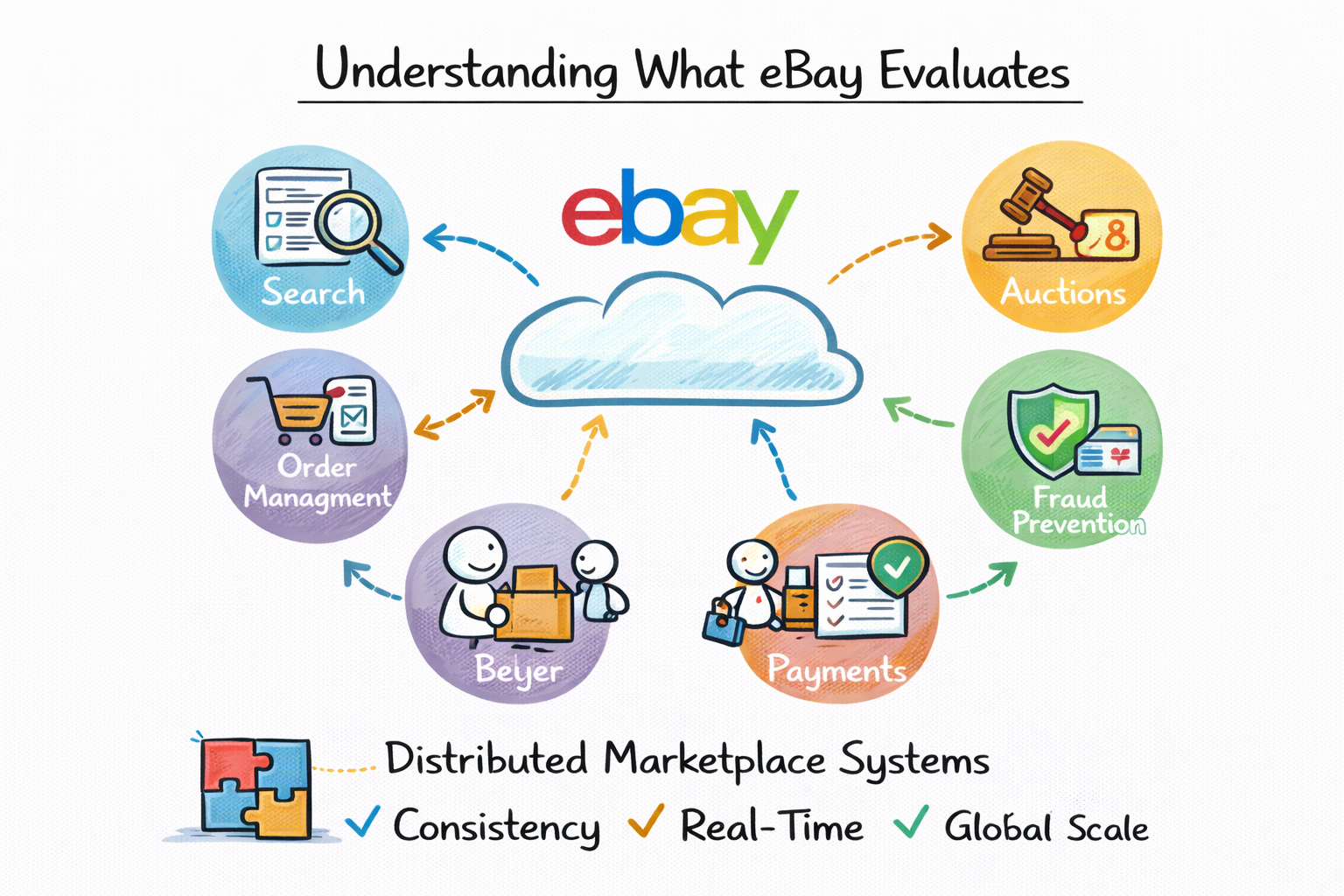
eBay’s System Design interviews focus heavily on distributed marketplace systems rather than simple retail flows. Buyers and sellers operate independently, which means the platform must coordinate listings, search visibility, bidding fairness, payments, and dispute resolution without controlling inventory directly.
Interviewers evaluate whether you understand the interplay between search, auctions, order management, fraud prevention, and payments. They expect clear reasoning about consistency models, real-time requirements, and global scalability.
Core Engineering Surfaces#
The most common domains evaluated during the interview are summarized below.
Major System Areas in eBay Design Interviews#
Area | Real-World Function | Design Emphasis |
Search & ranking | Discovering listings | Latency, indexing, personalization |
Listing ingestion | Seller uploads | Validation, deduplication, enrichment |
Auctions | Real-time bidding | Concurrency, fairness, atomic writes |
Messaging | Buyer–seller interaction | Moderation, reliability |
Inventory & orders | Transaction lifecycle | Consistency, state transitions |
Fraud detection | Risk prevention | Real-time scoring, ML + rules |
Payments | Multi-party settlement | Financial correctness |
Global reliability | Multi-region marketplace | Replication, availability |
This framing ensures your design touches the systems that matter most.
Scalability & System Design for Developers

As you progress in your career as a developer, you'll be increasingly expected to think about software architecture. Can you design systems and make trade-offs at scale? Developing that skill is a great way to set yourself apart from the pack. In this Skill Path, you'll cover everything you need to know to design scalable systems for enterprise-level software.
Search and Ranking Systems#
Search is mission-critical for eBay because it directly connects buyers to listings. Millions of searches occur daily, and latency must remain low even under heavy traffic.
The search system must support full-text indexing, filtering, ranking, personalization, and real-time updates when new listings are created or updated. Search accuracy directly influences conversion rates and user satisfaction.
Indexing Pipeline#
Listings flow into indexing workers that extract metadata and update inverted indexes. Distributed search clusters process queries across shards and merge ranked results.
Caching frequently accessed queries reduces load while preserving responsiveness. Personalization signals can adjust ranking dynamically based on user behavior.
Search Architecture Components#
Component | Responsibility | Key Challenge |
Indexer | Processes listing updates | Freshness guarantees |
Inverted index | Supports keyword queries | Scale across millions of listings |
Ranking service | Scores results | Personalization & relevance |
Cache layer | Speeds up popular queries | Staleness management |
Search performance and freshness must be carefully balanced.
System Design Deep Dive: Real-World Distributed Systems

Modern software systems are expected to operate at a massive scale while meeting strict reliability and latency requirements. Whether it’s a feed refresh, a payment request, or a real-time analytics query, users expect systems to respond instantly and consistently. That expectation has raised the bar for engineers today, understanding that System Design isn’t optional. It’s a core skill for building and evaluating production-grade systems. I built this course from my experience working on large-scale distributed systems at Microsoft (Azure) and Meta (Scuba), and from interviewing hundreds of candidates across both companies. The pattern I kept seeing was this: candidates understood individual components, but struggled to combine them into a coherent system. They knew what a cache or load balancer was, but not when or why to use it. This course is designed to bridge that gap. We start with the foundational building blocks of System Design, including databases, caching layers, load balancing, and messaging systems, and focus on how they interact under real-world constraints. From there, we analyze systems built by companies like Google, Facebook, and Amazon, breaking them down to understand the trade-offs behind each design decision. The goal is not just to learn concepts, but to develop the ability to reason through them in practice. This approach has helped a large number of engineers build stronger intuition for System Design and perform better in interviews. If you want to understand how real systems are designed and be able to design them yourself, this course gives you a clear, practical path forward.
Listing Ingestion and Catalog Management#
Millions of sellers upload new listings daily. Each listing must be validated, enriched with metadata, categorized properly, and indexed for search.
Incorrect or low-quality listings harm buyer trust and search quality. Therefore, ingestion pipelines must enforce validation rules and enrichment processes before publishing.
Ingestion Pipeline Design#
A robust ingestion pipeline validates listing attributes, processes images, detects duplicates, maps categories, and publishes events for indexing.
Listing Ingestion Workflow#
Stage | Purpose | Design Consideration |
Validation | Verify required fields | Schema enforcement |
Metadata enrichment | Extract attributes | Automated classifiers |
Image processing | Resize & moderate | Content filtering |
Dedup detection | Prevent duplicates | Hashing + ML |
Event publish | Notify indexer | Event-driven architecture |
This pipeline ensures listing quality and search accuracy.
Auction and Bidding System#
Auctions are a defining feature of eBay and require strong correctness guarantees. Bids may arrive concurrently near the auction deadline, creating high contention.
Atomic bid placement is essential to prevent inconsistencies. Systems must enforce bid increments, determine the highest bidder, and handle edge cases reliably.
Designing Fair Bidding#
A write-optimized auction service should handle atomic updates and concurrency controls. Distributed locking or optimistic concurrency can ensure fairness without bottlenecks.
Real-time countdown updates must broadcast to clients accurately. Anti-sniping logic may extend auction time slightly if last-second bids occur.
Auction System Responsibilities#
Component | Role | Risk Mitigation |
Bid service | Accept bids | Atomic updates |
Countdown service | Track deadlines | Time synchronization |
Notification system | Inform participants | Reliable messaging |
Finalization job | Determine winner | Idempotent execution |
Auction fairness and correctness are non-negotiable.
Inventory and Order Management#
Once a transaction completes, inventory must update accurately, and orders must move through consistent state transitions.
Order management includes reservation, payment confirmation, shipping updates, cancellations, and refunds. Each state transition must be auditable.
Consistency Considerations#
Inventory consistency is crucial, especially for fixed-price listings. Reservations prevent overselling during concurrent checkouts.
Event-driven workflows allow services such as shipping and refunds to react asynchronously while preserving correctness.
Payments and Settlement#
eBay handles payments that involve buyers, sellers, fees, taxes, and sometimes escrow-like holds. Financial correctness is critical because errors directly impact trust.
Payment services must support currency conversions, refunds, and chargeback handling. Secure tokenization and compliance are mandatory.
Payment Architecture#
A payment service integrates with fraud detection and ledger systems to ensure secure settlement.
Payment Flow Components#
Component | Responsibility | Priority |
Fraud screening | Evaluate risk | Real-time |
Authorization | Secure payment | High reliability |
Settlement | Transfer funds | Accuracy |
Reconciliation | Match transactions | Auditability |
Payments must degrade safely if external processors experience delays.
Fraud Detection and Trust Systems#
Fraud prevention is central to maintaining marketplace integrity. Systems must evaluate listing behavior, payment risk, and seller reputation.
Real-time risk scoring often combines rule engines with ML-based anomaly detection.
Trust Signals and Reputation#
Reputation systems aggregate ratings, disputes, and transaction history. Behavioral analysis can flag suspicious activity patterns.
Balancing fraud strictness with user experience is a constant trade-off.
Messaging Between Buyers and Sellers#
Buyer–seller messaging supports negotiations, questions, and dispute resolution. The system must support near-real-time messaging and reliable delivery.
Spam detection and moderation filters protect users from abuse.
Message Storage and Notifications#
Conversation threads must be stored durably and retrievable efficiently. Push notifications ensure users receive timely updates.
Messaging often intersects with fraud and trust workflows.
Multi-Region Reliability and Scaling#
eBay operates globally, which requires multi-region deployment. Services must replicate data and handle latency across continents.
Read/write separation improves scalability while balancing consistency needs.
Consistency Models#
Some surfaces, such as auctions, require strong consistency. Others, such as search indexing, can tolerate eventual consistency.
Consistency Trade-Offs#
Surface | Preferred Consistency | Reason |
Auctions | Strong | Fairness & correctness |
Payments | Strong | Financial integrity |
Search | Eventual | Performance |
Messaging | Eventual | High throughput |
Choosing the right model demonstrates architectural maturity.
Structuring Your Interview Answer#
Step 1: Clarify Requirements#
Begin by clarifying whether the system involves auctions, fixed-price listings, or both. Ask about expected traffic, search features, global scope, and payment flows.
Clear scope definition prevents misalignment.
Step 2: Identify Non-Functional Requirements#
Discuss availability, latency, fairness, fraud resilience, and scalability. These constraints shape service boundaries.
Step 3: Estimate Scale#
Assume millions of listings, thousands of new uploads per minute, and heavy bidding spikes near auction deadlines.
Demonstrating scale awareness signals senior-level reasoning.
Step 4: Present High-Level Architecture#
Your design should include an API gateway, listing service, search system, auction service, payment service, fraud detection engine, messaging service, notification system, and distributed cache.
Explain how requests flow across these services.
Step 5: Deep Dive into a Critical Component#
Choose auctions, search, or payments, and explain technical details. Depth and clarity matter more than covering everything superficially.
Step 6: Handle Failures#
Discuss search outages, auction overload, payment timeouts, ingestion retries, and regional failovers.
Graceful degradation is essential.
Step 7: Explain Trade-Offs#
Mention trade-offs such as consistency versus latency, strict fraud filtering versus false positives, and caching depth versus freshness.
Balanced reasoning reflects senior engineering judgment.
Example: Designing an eBay Auction System#
A user places a bid through the API gateway, which routes the request to the auction service. The service applies concurrency controls and atomically updates the highest bid.
Real-time countdown updates are broadcast to participants, and anti-sniping logic extends deadlines when necessary. At auction completion, a finalization process determines the winner, triggers order creation, invokes fraud screening, and initiates payment processing.
This end-to-end flow ensures fairness, correctness, and reliability.
Final thoughts#
The eBay System Design interview tests your ability to design large-scale marketplace systems that support millions of listings, buyers, sellers, and global transactions. Strong candidates demonstrate deep knowledge of search, auctions, listing ingestion, inventory accuracy, fraud detection, payments, and distributed system reliability.
If you follow the structured approach in this guide, clarify requirements, design modular marketplace components, dive into bidding/search/payments, justify trade-offs, and ensure global resilience, you’ll stand out as a high-quality engineering candidate.
