GitHub System Design Interview
Master the GitHub System Design interview by learning to architect Git storage, metadata, CI/CD, search, and security at a global scale. Practice structured thinking, clarify trade-offs, and design like a production engineer to stand out and land the offer.
Preparing for the GitHub System Design interview means understanding how to architect one of the world’s largest developer platforms. GitHub handles trillions of Git objects, millions of developers, millions of CI workflows per day, and petabytes of code data, all while maintaining a global collaboration surface that must remain reliable, low-latency, and secure.
Unlike typical application design interviews, the GitHub System Design interview focuses on distributed version control, Git internals, repository storage, code indexing, workflow orchestration (GitHub Actions), webhooks, API scaling, permission models, and global availability. Your design must reflect practical knowledge of how version control systems operate at an enormous scale.
Grokking Modern System Design Interview

For a decade, when developers talked about how to prepare for System Design Interviews, the answer was always Grokking System Design. This is that course — updated for the current tech landscape. As AI handles more of the routine work, engineers at every level are expected to operate with the architectural fluency that used to belong to Staff engineers. That's why System Design Interviews still determine starting level and compensation, and the bar keeps rising. I built this course from my experience building global-scale distributed systems at Microsoft and Meta — and from interviewing hundreds of candidates at both companies. The failure pattern I kept seeing wasn't a lack of technical knowledge. Even strong coders would hit a wall, because System Design Interviews don't test what you can build; they test whether you can reason through an ambiguous problem, communicate ideas clearly, and defend trade-offs in real time (all skills that matter ore than never now in the AI era). RESHADED is the framework I developed to fix that: a repeatable 45-minute roadmap through any open-ended System Design problem. The course covers the distributed systems fundamentals that appear in every interview – databases, caches, load balancers, CDNs, messaging queues, and more – then applies them across 13+ real-world case studies: YouTube, WhatsApp, Uber, Twitter, Google Maps, and modern systems like ChatGPT and AI/ML infrastructure. Then put your knowledge to the test with AI Mock Interviews designed to simulate the real interview experience. Hundreds of thousands of candidates have already used this course to land SWE, TPM, and EM roles at top companies. If you're serious about acing your next System Design Interview, this is the best place to start.
This blog breaks down what the GitHub System Design interview evaluates, common prompts, and a structured approach to System Design interview questions that demonstrate production-grade engineering.
Understanding the scale and complexity of GitHub#
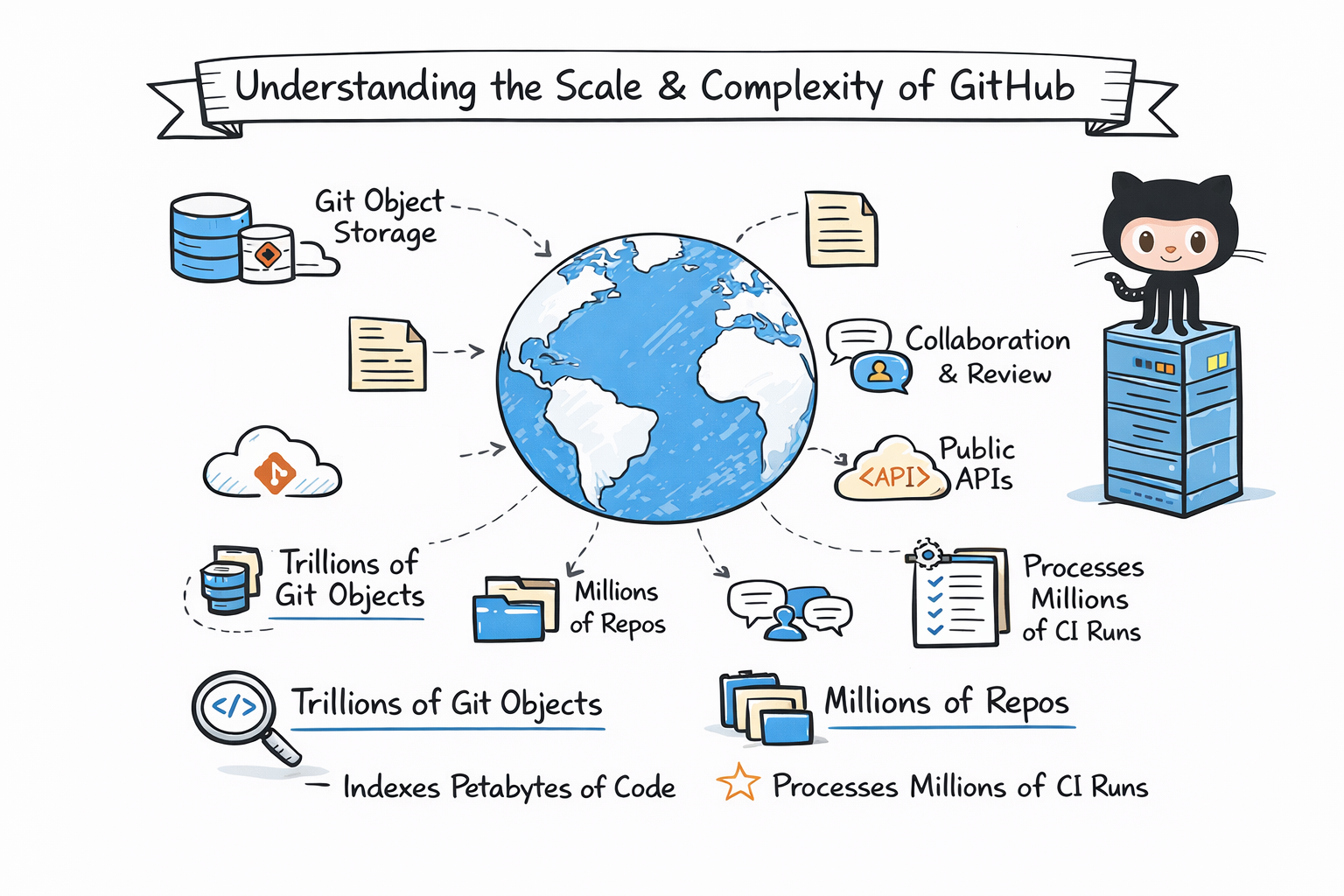
Before diving into architecture, it is important to internalize the scale at which GitHub operates. GitHub stores trillions of Git objects, manages millions of repositories, processes millions of CI workflow runs every day, and indexes petabytes of source code. Every feature you design must respect this scale, because assumptions that work for small systems collapse under GitHub-level load.
At its core, GitHub combines several subsystems that each operate at a massive scale. These include Git object storage, repository metadata services, collaboration and review workflows, search infrastructure, public APIs, and CI/CD orchestration. During the interview, you may be asked to design the entire platform at a high level or to zoom in on one of these subsystems and design it in depth.
Scalability & System Design for Developers

As you progress in your career as a developer, you'll be increasingly expected to think about software architecture. Can you design systems and make trade-offs at scale? Developing that skill is a great way to set yourself apart from the pack. In this Skill Path, you'll cover everything you need to know to design scalable systems for enterprise-level software.
What the GitHub System Design interview evaluates#
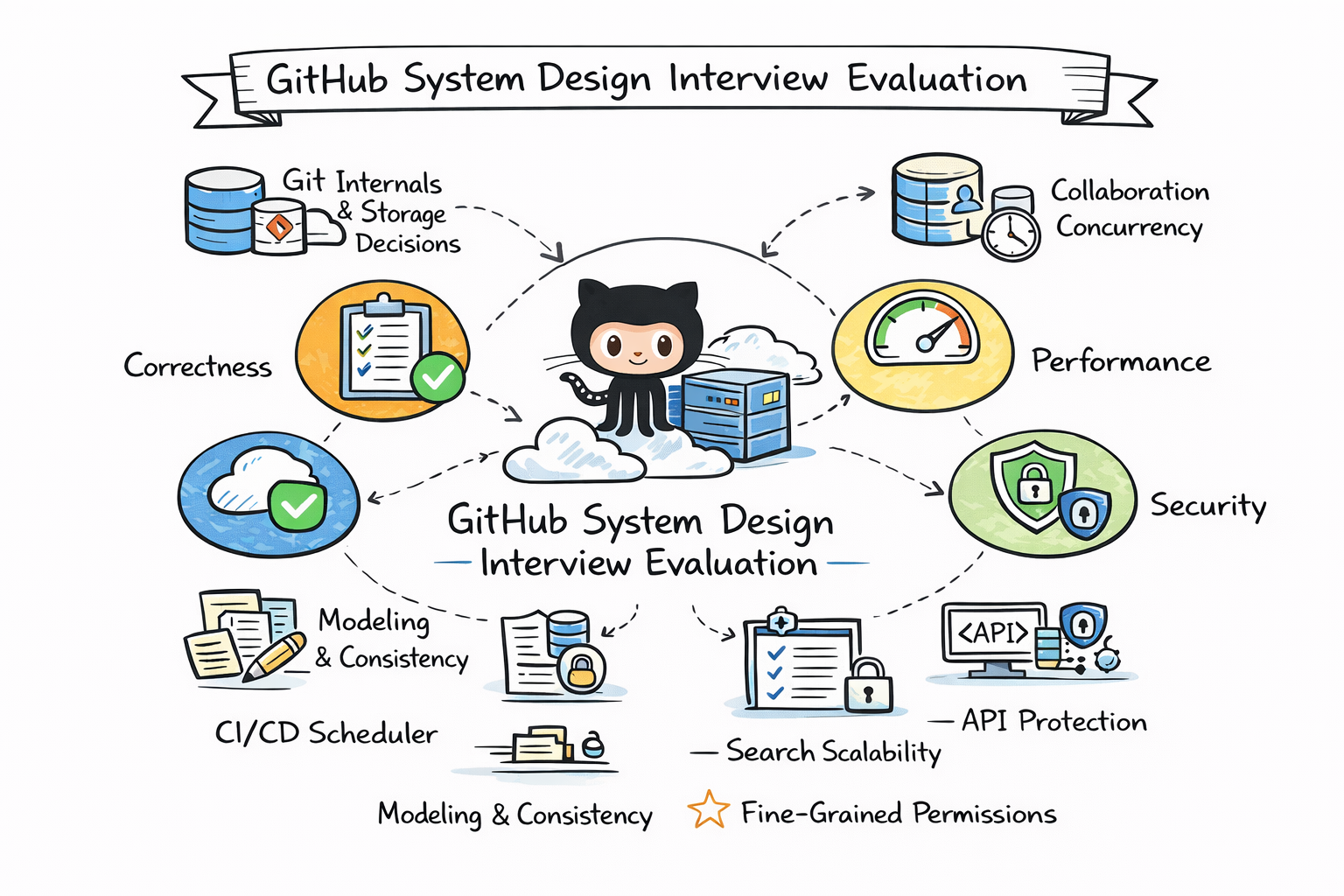
The GitHub System Design interview evaluates whether you can design developer infrastructure that balances correctness, performance, availability, and security. Interviewers are not looking for flashy diagrams; they are looking for thoughtful reasoning grounded in real-world trade-offs.
You are evaluated on how well you understand Git internals and how those internals influence storage decisions. You are assessed on your ability to model metadata consistency, handle concurrency in collaboration workflows, design CI/CD schedulers, build scalable search systems, protect APIs from abuse, and enforce fine-grained permission systems. The interview is as much about architectural judgment as it is about technical correctness.
System Design Deep Dive: Real-World Distributed Systems

Modern software systems are expected to operate at a massive scale while meeting strict reliability and latency requirements. Whether it’s a feed refresh, a payment request, or a real-time analytics query, users expect systems to respond instantly and consistently. That expectation has raised the bar for engineers today, understanding that System Design isn’t optional. It’s a core skill for building and evaluating production-grade systems. I built this course from my experience working on large-scale distributed systems at Microsoft (Azure) and Meta (Scuba), and from interviewing hundreds of candidates across both companies. The pattern I kept seeing was this: candidates understood individual components, but struggled to combine them into a coherent system. They knew what a cache or load balancer was, but not when or why to use it. This course is designed to bridge that gap. We start with the foundational building blocks of System Design, including databases, caching layers, load balancing, and messaging systems, and focus on how they interact under real-world constraints. From there, we analyze systems built by companies like Google, Facebook, and Amazon, breaking them down to understand the trade-offs behind each design decision. The goal is not just to learn concepts, but to develop the ability to reason through them in practice. This approach has helped a large number of engineers build stronger intuition for System Design and perform better in interviews. If you want to understand how real systems are designed and be able to design them yourself, this course gives you a clear, practical path forward.
Git object storage at massive scale#
At the foundation of GitHub is Git itself, which uses a content-addressable storage model. Every commit, tree, and blob is stored as an object identified by a cryptographic hash derived from its contents. This design allows for deduplication, immutability, and efficient storage of versioned data, but at GitHub scale, it introduces distributed storage challenges.
Git objects include blobs that store file contents, trees that represent directory structures, commits that capture repository snapshots, tags that label specific commits, refs that act as pointers, and packfiles that bundle objects together using compression. While Git works efficiently on a local machine, hosting billions of such objects across millions of repositories requires intelligent sharding and replication strategies.
Git object types and architectural implications#
Git Object Type | What It Represents | Why It Matters at GitHub Scale | Design Implication |
Blob | Raw file content | Billions of unique file versions across repos | Enables global deduplication using content hashes |
Tree | Directory structure | Massive nested hierarchies | Efficient traversal and caching required |
Commit | Snapshot of repository state | Heavy read traffic for history queries | Optimized commit graph storage |
Tag | Named pointer to commit | Release versioning at scale | Lightweight metadata handling |
Ref | Branch pointer | Frequently updated | Requires strongly consistent metadata layer |
Packfile | Compressed collection of objects | Storage optimization across trillions of objects | CPU vs storage trade-off due to delta compression |
A strong answer explains how content-addressable hashes can be used to shard objects across distributed storage clusters. You should discuss how packfile compression trades CPU time for storage savings and how garbage collection reclaims unreachable objects without blocking reads. You should also describe how multi-region replication ensures durability while maintaining acceptable latency for repository operations across continents.
Repository metadata and strong consistency#
Git objects themselves are immutable, but repository metadata is not. Branch pointers move, pull requests change state, comments are added, reviews are updated, and permissions are modified. This metadata layer must provide strong consistency guarantees because an incorrect state can break collaboration.
Metadata services typically rely on relational databases or distributed strongly consistent data stores. These services manage branch pointers, pull request states, issue threads, review comments, checks, and permissions. Since metadata changes frequently and is often written concurrently, your design must consider transaction boundaries and atomic updates.
Git object storage vs metadata services#
Dimension | Git Object Storage | Metadata Service |
Mutability | Immutable | Frequently updated |
Consistency Model | Eventual consistency acceptable | Strong consistency required |
Write Frequency | Lower | High (PR updates, comments, merges) |
Storage Type | Distributed object store | Relational or strongly consistent distributed DB |
Failure Impact | Recoverable via replication | High impact if inconsistent |
Caching Strategy | Aggressive read caching | Careful cache invalidation required |
You should explain how read replicas can be used to scale reads while maintaining a single write leader for consistency. You should also discuss caching strategies and cache invalidation challenges, especially when pull request states change rapidly. Strong candidates treat metadata as a first-class system that requires careful design rather than an afterthought layered on top of Git storage.
Designing collaboration workflows#
GitHub’s defining value lies in collaboration, particularly through pull requests. Designing a pull request system is one of the most common GitHub System Design prompts because it forces candidates to combine Git knowledge with distributed systems reasoning.
A pull request system must compute diffs between branches, manage threaded comments, enforce reviewer permissions, track approvals, integrate CI status checks, and determine mergeability. Each of these actions may occur concurrently, which introduces race conditions that must be handled gracefully.
Diff computation can be CPU-intensive, especially for large repositories, so you may discuss asynchronous diff generation and caching. Merge conflict detection requires an understanding of three-way merges and Git internals. When describing concurrency handling, you should explain how optimistic locking or versioning can prevent inconsistent pull request state transitions.
GitHub Actions and CI/CD orchestration#
GitHub Actions represents one of the most infrastructure-heavy components of the platform. It processes millions of workflow jobs daily and must isolate workloads across thousands of repositories and tenants.
Designing a CI/CD system like GitHub Actions requires thinking about event ingestion, workflow parsing, job scheduling, runner management, secrets injection, artifact storage, and monitoring. When a repository event, such as a push or pull request, occurs, it must trigger workflow evaluation and potentially schedule multiple parallel jobs.
Core components of a GitHub Actions-style system#
Component | Responsibility | Scaling Challenge |
Event Listener | Captures push, PR, and schedule triggers | Burst traffic during releases |
Workflow Parser | Interprets YAML definitions | Validation and versioning |
Job Scheduler | Assigns jobs to runners | Fairness across tenants |
Runner Pool | Executes containerized workloads | Isolation and resource contention |
Secrets Manager | Injects secure environment variables | Preventing secret leakage |
Artifact Store | Persists build outputs | High storage throughput |
Monitoring System | Tracks job health and failures | Observability at scale |
You should explain how a distributed scheduler assigns jobs to runner pools and how those runners are isolated using containers or virtual machines. Secrets management must ensure that environment variables are securely injected and never exposed to unauthorized jobs. Additionally, fairness mechanisms must prevent a single repository or organization from monopolizing resources, which requires quotas or weighted scheduling.
Designing code search infrastructure#
GitHub’s search feature must operate across billions of files while providing fast, relevant results. Designing code search at this scale is a challenging but common interview topic because it combines indexing pipelines with distributed query execution.
The search system begins with an ingestion pipeline that listens for repository updates and processes new commits. Indexing workers parse code, tokenize content, and extract symbols in a language-aware manner. These tokens are stored in a distributed inverted index that supports efficient query retrieval.
You should discuss incremental indexing strategies that update only changed files rather than rebuilding entire indexes. Query processing must distribute requests across search nodes and aggregate results efficiently. Ranking strategies and caching of frequent queries further improve performance and developer experience.
API gateway and abuse prevention#
GitHub’s APIs power thousands of third-party integrations, from continuous integration tools to project management dashboards. Without strong rate limiting and abuse detection, the API layer would be vulnerable to misuse and denial-of-service scenarios.
An API gateway typically handles routing, authentication, and request validation. Rate-limiting mechanisms such as token buckets or sliding window algorithms enforce quotas per user or per token. Abuse detection systems monitor patterns such as unusual request bursts or suspicious IP behavior.
A thoughtful design discusses how caching can reduce backend load and how authentication tokens with scoped permissions restrict access to specific repositories or operations. You should also explain how API versioning allows backward compatibility without breaking existing integrations.
Security and permissions at enterprise scale#
Security is fundamental to GitHub’s value proposition because organizations trust it with proprietary source code. A breach in repository permissions or secret exposure would have severe consequences.
Permission models typically include user-level authentication, organization-level role assignments, repository-level access controls, and branch-level protections. Role-based access control ensures that only authorized users can read or modify repository content. Token scopes restrict API access to specific operations and repositories.
You should explain how audit logging captures sensitive operations for compliance and monitoring. Secret scanning and vulnerability alerts add additional layers of defense by proactively identifying exposed credentials or insecure dependencies. A strong answer demonstrates that security is integrated into every layer of the system rather than bolted on afterward.
Structuring your answer during the interview#
The GitHub System Design interview usually lasts between forty-five and sixty minutes, and structure is critical. Without structure, even technically correct answers can feel scattered.
You should begin by clarifying the problem scope and understanding whether the interviewer wants a high-level GitHub design or a focused subsystem, such as CI/CD or repository storage. Asking about expected user scale, latency requirements, consistency expectations, and repository types demonstrates maturity and ensures alignment.
Next, identify non-functional requirements such as high availability, durability, low latency, strong consistency for metadata, and cost efficiency. These requirements shape your architecture decisions and show that you think beyond feature correctness.
When estimating scale, you should provide reasonable assumptions about repository count, object volume, API call frequency, and CI job concurrency. Even rough calculations show that you understand how scale influences design trade-offs.
Structured framework for answering GitHub System Design questions#
Step | What You Should Do | What It Signals to Interviewers |
Clarify Requirements | Define scope, users, constraints | Strategic thinking |
Identify NFRs | Availability, consistency, latency | Production awareness |
Estimate Scale | Rough calculations and assumptions | Senior-level reasoning |
Present High-Level Architecture | Clean service separation | Communication clarity |
Deep Dive | Explore one subsystem thoroughly | Technical depth |
Discuss Failures | Regional outages, crashes, corruption | Operational maturity |
Explain Trade-offs | Latency vs consistency, CPU vs storage | Architectural judgment |
Suggest Evolution | Future improvements | Long-term vision |
Presenting a high-level architecture#
After clarifying requirements and scale, present a clean high-level architecture. The system typically includes an API gateway, authentication service, Git object storage service, metadata database, collaboration service, CI/CD engine, search service, webhook dispatcher, caching layer, event streaming backbone, and multi-region replication strategy.
Walk through a typical request flow, such as a developer pushing code. The request passes through the API gateway, authentication is verified, Git objects are stored in distributed storage, metadata is updated, search indexes are refreshed asynchronously, and CI workflows are triggered through an event bus. This narrative approach helps interviewers follow your reasoning clearly.
Deep-diving into a critical component#
Once the high-level architecture is established, choose one component to explore deeply. For example, if you choose Git object storage, you can explain how object hashes determine shard placement and how packfile optimization reduces storage costs. If you choose CI/CD scheduling, you can explain how job queues are partitioned and how runner crashes trigger rescheduling.
Depth is more important than covering every possible feature. Interviewers prefer a well-analyzed subsystem with clear trade-offs over a shallow overview of many components.
Handling failures and edge cases#
Reliability is central to GitHub’s brand, so failure handling must be addressed. You should discuss how traffic is rerouted during regional outages, how stale search results are temporarily served if indexing lags, how failed CI jobs are retried, and how corrupted metadata can be restored from replicas.
Failure discussions demonstrate that you think like an operator, not just a designer. Systems at GitHub scale must assume that components will fail and must degrade gracefully rather than catastrophically.
Discussing trade-offs#
Trade-offs reveal architectural maturity. Strong consistency for metadata increases write latency but ensures correctness. Aggressive packfile compression saves storage space but increases CPU usage. Incremental indexing improves freshness but adds pipeline complexity.
Explaining these trade-offs clearly shows that you understand engineering decisions are rarely absolute. Instead, they involve balancing competing priorities based on system goals.
Thinking about long-term evolution#
Closing your answer with forward-looking improvements can elevate your performance. You might suggest semantic search powered by machine learning, predictive CI scheduling based on historical workloads, or enhanced diff algorithms optimized for specific languages.
Future-oriented thinking demonstrates that you view architecture as an evolving system rather than a static design.
Final thoughts#
The GitHub System Design interview tests more than your ability to draw boxes on a whiteboard. It tests whether you understand distributed version control, metadata consistency, collaboration workflows, CI/CD orchestration, search infrastructure, API reliability, and security at a global scale.
If you approach the interview with structure, clarify requirements, reason about scale, design clean architecture, dive deep into critical components, address failures, and articulate trade-offs thoughtfully, you will demonstrate the kind of production-grade thinking GitHub looks for in its engineers.