Google Calendar System Design
Learn how Google Calendar keeps millions of schedules in sync worldwide. This deep dive covers event modeling, time zones, recurrence, notifications, and the System Design behind reliable scheduling.
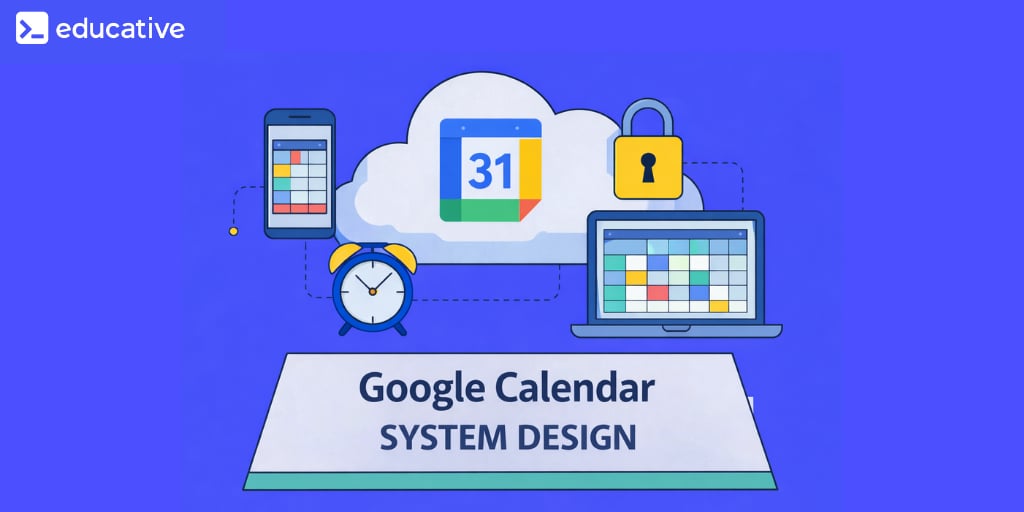
Google Calendar System Design is the architectural challenge of building a globally distributed, time-aware collaboration platform that must handle shared mutable state, concurrent edits, recurring event logic, and real-time synchronization across hundreds of millions of users and devices. The core difficulty lies in treating time as a primary constraint, where correctness in scheduling, notifications, and conflict resolution matters just as much as availability and low latency.
Key takeaways
- Time is the hardest data type: Storing events in UTC while dynamically rendering them per user’s time zone and adapting recurring events across daylight saving transitions demands careful temporal modeling that most systems never face.
- Recurring events need a hybrid strategy: Separating event templates from materialized instances, and using an exception model for single-occurrence overrides, balances storage efficiency against read-time performance.
- Consistency requirements are not uniform: Core event mutations and invitation state demand strong consistency, while availability views and calendar rendering can tolerate brief eventual consistency.
- Notifications are a trust contract: Missed or late reminders erode user confidence faster than almost any other failure mode, making the reminder pipeline one of the most reliability-critical subsystems.
- Scale hotspots are predictable: Shared organizational calendars and popular resources like meeting rooms create “hot calendars” that require dedicated sharding, caching, and throttling strategies to prevent cascading slowdowns.
Every morning, hundreds of millions of people open Google Calendar and trust it completely. They trust that the 9 AM standup is still at 9 AM, that the time zone math is correct for a colleague in Tokyo, and that a reminder will fire exactly when it should. That quiet trust is earned by one of the most deceptively complex distributed systems in production today.
What looks like a simple grid of colored blocks is actually a system that must resolve concurrent edits to shared events, expand infinite recurrence rules into finite views, synchronize state across a constellation of devices, and deliver time-critical notifications with near-perfect reliability. The moment any of these guarantees breaks down, someone misses a meeting, and meetings have real-world consequences.
This makes Google Calendar an exceptional system design interview topic. It probes whether you can reason about shared mutable state, temporal correctness, fan-out strategies, and the subtle line between strong and eventual consistency. In this guide, we will walk through the full architecture of a Google Calendar-like system, covering data modeling, recurrence engines, availability queries, notification pipelines, and the trade-offs that hold it all together.
Understanding the core problem#
At its heart, Google Calendar is a time-based collaboration and scheduling platform. Users create events, invite others, respond to invitations, and depend on the system to keep everyone aligned. What elevates this from a simple CRUD application is one key property: calendar events are inherently shared and mutable.
Multiple users interact with the same event. An organizer might change the meeting room while a participant is RSVPing. A recurring series might span years, but a single instance might be canceled five minutes before it starts. The system must answer hard questions continuously:
- Who owns this event? Organizer authority determines which edits take precedence.
- What is the authoritative version right now? Concurrent updates must converge to a single consistent state.
- Has everyone been notified of changes? Stale information in someone’s calendar view is not just a bug; it is a missed meeting.
- How do we represent time correctly? A 2 PM event in New York is not a 2 PM event in London, and daylight saving transitions make even that relationship unstable.
Real-world context: Google Calendar reportedly serves over 500 million monthly active users across consumer and Google Workspace accounts, making it one of the most widely consulted data sources on the planet.
These questions define the heart of the design. Small errors cascade into real-world disruptions: a missed interview, a double-booked conference room, a phantom meeting that was canceled but still shows up on someone’s phone. The system’s tolerance for incorrectness is effectively zero for its core operations.
Before we can reason about architecture, we need to pin down exactly what the system must do and how well it must do it.
Functional requirements#
To ground the design, we start with what Google Calendar must do from both a user and a platform perspective. These functional requirements form the contract the system makes with its users.
Event life cycle management. Users must be able to create, read, update, and delete events. Each event carries metadata including title, description, start time, end time, time zone, location, and organizer. Events are long-lived and mutable, meaning the system must support frequent edits over the event’s lifetime without data loss.
Invitations and RSVP tracking. An organizer invites participants by email or user ID. Each participant can accept, decline, or tentatively accept. These responses must propagate to the organizer and all other attendees. The invitation subsystem is essentially a lightweight distributed state machine with well-defined transitions.
Recurring events and exceptions. Users create events that repeat daily, weekly, monthly, or on custom schedules. Individual occurrences within a series can be modified or canceled independently. This is where a significant portion of the system’s complexity lives, as we will explore in depth later.
Time zone-aware scheduling. Events are created in a specific time zone but must render correctly for every viewer regardless of their location. Daylight saving transitions must be handled transparently.
Notifications and reminders. Users configure reminders (10 minutes before, 1 hour before, etc.) and expect them to fire at precisely the right moment. Event updates (time changes, cancellations, new invitees) must trigger notifications to all affected participants.
Calendar sharing and access control. Users can share entire calendars with configurable permissions (owner, writer, reader). Shared calendars are common in organizational settings and introduce both scaling and authorization challenges.
Availability queries. Users and scheduling tools query the system to find time slots when a group of participants is free. These
Attention: It is tempting to treat calendar design as a simple CRUD problem. The real complexity emerges from the intersection of these features, such as when a recurring event with 50 invitees is modified, requiring recurrence recalculation, notification fan-out, availability cache invalidation, and multi-device sync simultaneously.
The following visual captures how these functional areas relate to the subsystems that serve them.
With the functional contract defined, the real architectural constraints come from how well the system must perform these operations.
Non-functional requirements that shape the design#
Google Calendar’s architecture is driven more by its non-functional requirements than by its feature list. The features tell you what to build. The NFRs tell you how to build it and where the hard trade-offs live.
Correctness is paramount. An incorrect meeting time, a lost RSVP, or a phantom event has immediate real-world impact. Users plan their days around what the calendar shows them. For core event data and invitation state, the system must provide strong consistency. There is no acceptable window where two users see contradictory versions of who accepted an invitation.
Availability must be continuous. Calendars are consulted dozens of times per day, often at the worst possible moment, such as two minutes before a meeting when someone needs the room number. Downtime during business hours is extremely costly. The system targets well above 99.99% availability for read paths.
Latency must be low for reads. Calendar views, daily agendas, and availability checks must return within 100 to 200 milliseconds. Writes (event creation, updates) can tolerate slightly higher latency, perhaps 300 to 500 milliseconds, because users perceive these as intentional actions rather than instant lookups.
Consistency requirements are not uniform. This is a critical insight for interview discussions. Here is how consistency maps across the system:
Consistency Requirements Across Subsystems
Subsystem | Consistency Model | Rationale |
Event Mutations | Strong Consistency | Prevents silent overwrites by ensuring all nodes share the same data view at all times |
Invitation/RSVP State | Strong Consistency | Avoids contradictory attendance records by guaranteeing the most recent write is always returned |
Calendar View Rendering | Eventual Consistency | Brief staleness is acceptable; prioritizes scalability and availability over immediate accuracy |
Free/Busy Queries | Eventual Consistency | Queries are advisory, not authoritative, making temporary inconsistencies tolerable |
Notification Delivery | At-least-once with Deduplication | Ensures no notifications are missed, as gaps in delivery erode user trust |
Scalability to hundreds of millions of users. Rough estimates help anchor architectural choices:
- ~500 million monthly active users
- ~2 billion events created per month
- ~10 billion notification deliveries per month
- Average of 3 to 4 devices per active user requiring sync
Pro tip: In an interview, stating explicit scale estimates early signals that you think about architecture decisions in terms of load, not just abstractions. Even rough numbers like “tens of millions of events per day” justify choices around sharding, caching, and queue sizing.
Reliability over throughput. Calendar systems do not need the raw write throughput of a messaging platform or the bandwidth of a video service. What they need is predictability. A system that is fast 99% of the time but silently drops an event update 1% of the time is far worse than one that is slightly slower but never loses data.
These constraints directly inform the storage architecture, replication strategy, and notification pipeline design we will examine next.
High-level architecture overview#
At a high level, a Google Calendar system decomposes into six major subsystems, each responsible for a distinct dimension of calendar complexity. They are loosely coupled through asynchronous messaging but tightly coordinated through shared event metadata.
- Event Storage and Metadata Service: The authoritative source of truth for all event data. Handles CRUD operations, versioning, and conflict detection.
- Recurrence Engine: Expands recurrence rules into concrete event instances at read time and manages the exception model for single-occurrence overrides.
- Sharing and Access Control Service: Enforces permissions on every calendar view and event interaction. Manages calendar-level and event-level authorization.
- Sync and Real-Time Update Service: Propagates changes to all connected clients using incremental change tokens and push-based delivery.
- Notification and Reminder Pipeline: Schedules, dispatches, and retries time-critical reminders and event update notifications.
- Free/Busy Aggregation Layer: Computes availability across multiple calendars for scheduling queries.
The distinction between
Let us now look at the foundational data model that underpins all of these subsystems.
Core entities and data model#
A strong data model is the skeleton of any calendar system. Competitors that rank well for this topic consistently define a shared set of core entities early and reuse them across features. This avoids duplication and makes the system easier to reason about during an interview.
The six core entities are:
- Event: The base record containing title, description, start/end time, time zone, location, organizer ID, visibility, and an optional recurrence rule. For recurring events, this serves as the template.
- EventInstance: A concrete materialized occurrence of a recurring event for a specific date. Non-recurring events are effectively their own single instance.
- EventException: An override for a single occurrence in a recurring series, such as a changed time, modified location, or cancellation. This entity references the parent Event and the specific instance date it overrides.
- Invitation: Tracks the relationship between an event and a participant, including RSVP status (pending, accepted, declined, tentative) and permission level.
- FreeBusyBlock: A derived, precomputed time interval marking a user as busy. Used exclusively for availability queries and never as a source of truth.
- ChangeLog: An append-only record of every mutation to an event, used to drive incremental sync, notification triggers, and audit trails.
Historical note: The iCalendar specification (RFC 5545) established many of these entity concepts decades ago, including VEVENT, RRULE for recurrence, and EXDATE for exceptions. Google Calendar’s internal model is more sophisticated but philosophically descended from these standards.
The separation of Event from EventInstance and EventException is the single most important modeling decision. It is what allows the system to represent a “weekly standup for the next two years” as a compact rule rather than 104 individual records, while still supporting “skip next Tuesday” or “move Friday’s instance to 3 PM.”
This model directly feeds the recurrence engine, which is one of the most nuanced components in the entire system.
Recurring events and the exception model#
Recurring events are where calendar systems earn their complexity budget. A rule like “every weekday at 9 AM” sounds simple until you need to handle cancellations of individual instances, modifications to a single occurrence’s time or location, series-wide edits that should not overwrite individual changes, and recurrence rules that span daylight saving transitions.
Expansion strategies#
There are two primary strategies for turning a recurrence rule into viewable instances, and each has sharp trade-offs.
Eager materialization creates all future instances at event creation time. This makes reads trivially fast because instances already exist as rows in the database. However, it is storage-expensive for long or infinite recurrence rules, makes series-wide edits painful (you must update hundreds of rows), and creates a maintenance burden for cleaning up far-future instances that may never be viewed.
Dynamic expansion stores only the recurrence rule and computes instances at read time. This is storage-efficient and makes series edits simple (update the rule, recompute). However, it adds computational cost to every read and makes it harder to query across events efficiently.
The practical answer, used by most production calendar systems, is a
Comparison of Recurrence Expansion Strategies
Strategy | Read Performance | Write Complexity | Storage Cost | Best For |
Eager Materialization | High | High | High | Infrequent updates, frequent reads |
Dynamic Expansion | Low | Low | Low | Frequent updates, infrequent reads |
Hybrid Window | Moderate | Moderate | Moderate | Mixed read/write workloads |
Handling exceptions#
When a user modifies a single occurrence, such as moving next Tuesday’s standup from 9 AM to 10 AM, the system creates an EventException record that overrides the base rule for that specific instance date. When expanding the recurrence for display, the engine checks for exceptions at each date and applies overrides before returning results.
Canceling a single occurrence works similarly: the exception record marks that instance as deleted without affecting the rest of the series. This is directly analogous to the EXDATE mechanism in the iCalendar standard, though production systems typically store richer override data than a simple exclusion date.
Attention: A common interview mistake is proposing that series-wide edits simply overwrite the recurrence rule. This would destroy all existing exceptions. A robust system must apply series edits only to instances that have not been individually modified, or prompt the user to choose between “this and following events” vs. “all events.”
The recurrence engine’s output feeds directly into what users see on their calendar grid, but it also feeds the availability system, which must know about recurring events to compute free/busy blocks accurately.
Free/busy availability queries#
One of the most frequently used but least discussed features in calendar system design is the ability to ask “when is everyone free?” This powers the scheduling assistant in Google Calendar, the “find a time” feature in Google Workspace, and automated meeting schedulers.
How availability works#
A free/busy query takes a list of user IDs and a time range and returns, for each user, the set of time intervals during which they are busy. Importantly, it does not return event details, only opaque busy blocks. This is both a privacy design and a performance optimization.
The system maintains a derived FreeBusyBlock cache for each user. This cache is populated asynchronously whenever an event is created, updated, or deleted. For recurring events, the materialized instances within the cache window are used to generate busy blocks.
The query path looks like this:
- Client sends
GET /v1/freebusywith user IDs, start time, and end time. - The Free/Busy Aggregation Layer retrieves precomputed busy blocks for each user from the cache.
- Blocks are merged and returned as a set of intervals per user.
- The client renders these intervals against the requested time grid.
Because free/busy data is derived and advisory (the actual scheduling still requires creating an event and checking for conflicts), slight staleness is acceptable. The cache can lag behind authoritative event data by a few seconds without causing problems. This makes it a textbook case for eventual consistency.
Pro tip: In an interview, explicitly calling out that free/busy is a “derived, eventually consistent projection” while event mutations require “strong consistency at the authoritative store” demonstrates nuanced understanding of consistency boundaries within a single system.
Scaling free/busy for organizations#
In enterprise environments, a single scheduling query might span 20 participants, each with multiple calendars (personal, team, resource). This creates a fan-in problem: the aggregation layer must read from many sources quickly.
The solution is to precompute and cache FreeBusyBlocks per user-calendar pair, indexed by time range. Cache entries are invalidated asynchronously via the ChangeLog stream. For
Availability queries are read-heavy, but time handling is the dimension that cuts across every read and write path in the system.
Time zones and daylight saving correctness#
Time zone handling is not a feature. It is a cross-cutting concern that affects every layer of the stack, from storage to rendering to notification scheduling. Getting it wrong produces bugs that are both subtle and high-impact: a meeting that shifts by an hour after a daylight saving transition, or a recurring event that fires at the wrong time for half the year.
Storage model#
The foundational rule is to store all event timestamps in UTC and separately record the event’s original time zone (as an IANA time zone identifier like America/New_York, not a raw offset like -05:00). Raw offsets are dangerous because they do not encode daylight saving rules. A fixed offset of -05:00 is correct for New York in winter but wrong in summer.
At render time, the system converts UTC timestamps to the viewer’s local time zone. This means a 2 PM meeting created in America/New_York will display as 11 AM for a viewer in America/Los_Angeles and 7 PM for a viewer in Europe/London, and these conversions automatically adjust when daylight saving transitions occur.
Recurring events and DST transitions#
The hardest edge case involves recurring events that cross a daylight saving boundary. Consider a recurring meeting at 2:00 PM every Tuesday in America/New_York. When the clocks spring forward in March:
- Before the transition: 2:00 PM EST = UTC-5 = 19:00 UTC
- After the transition: 2:00 PM EDT = UTC-4 = 18:00 UTC
If the system stored recurrence instances as fixed UTC times, the meeting would appear to shift by one hour for all viewers after the transition. The correct behavior is to store the recurrence rule as “2:00 PM in America/New_York every Tuesday” and recompute the UTC equivalent for each instance. This is why the recurrence engine must be time zone-aware, not just UTC-aware.
Real-world context: The IANA Time Zone Database is updated multiple times per year as governments change their daylight saving rules, sometimes with only a few weeks’ notice. Production calendar systems must consume these updates and retroactively adjust future recurring instances.
Time correctness protects the integrity of individual events, but when multiple users interact with the same event, a different kind of correctness is required: resolving concurrent edits.
Concurrent updates and conflict resolution#
Calendar events are shared mutable objects, and shared mutable objects under concurrent access are among the hardest problems in distributed systems. An organizer changes the meeting room. Simultaneously, a participant adds a note. A third user accepts the invitation while the event is being modified. The system must handle all of these without silent data loss.
Versioning and conditional writes#
The primary mechanism is
This pattern works well because most calendar edits are non-overlapping. Two users rarely change the same field of the same event at the same moment. When they do, the version check catches it.
Deterministic resolution rules#
For cases where automatic resolution is desirable (rather than forcing a retry), the system applies deterministic rules:
- Organizer changes take precedence for core fields like time, location, and title.
- Participant changes are scoped to their own RSVP status and personal notes, which do not conflict with organizer edits.
- Last-writer-wins is used for truly concurrent edits to the same field by users of equal authority, but only after version-check gating.
Attention: Avoid proposing a global lock on events during updates. At Google’s scale, locking would create unacceptable contention on popular shared events. Optimistic concurrency with field-level conflict detection is the standard approach.
The ChangeLog entity plays a critical role here. Every accepted mutation is appended to the log with a monotonically increasing sequence number. This log serves triple duty: it drives sync (clients fetch changes since their last sequence number), triggers notifications (the notification pipeline consumes the log), and provides an audit trail.
Conflict resolution keeps the authoritative state clean. The next challenge is propagating that state to every device the user owns.
Sync across devices and the ChangeLog pipeline#
Synchronization is what makes Google Calendar feel like a single seamless surface rather than a collection of disconnected clients. A user creates an event on their laptop, and it appears on their phone within seconds. An organizer changes the meeting time, and the update propagates to 30 attendees across browsers, Android, iOS, and third-party integrations.
Incremental sync with change tokens#
Full calendar re-sync on every open would be prohibitively expensive. Instead, sync clients use
- Client sends its last sync token to the server.
- Server queries the ChangeLog for all entries with sequence numbers greater than the token’s position.
- Server returns the delta (new, modified, and deleted events) plus a new sync token.
- Client applies the delta to its local store and saves the new token.
For freshly installed clients or clients whose tokens have expired (because they have been offline too long), the system falls back to a full sync of the user’s calendar within a bounded time window.
Push-based delivery#
Polling with sync tokens works but introduces latency proportional to the polling interval. For real-time feel, the system also supports push-based delivery via WebSocket connections or platform-specific push notification channels (FCM for Android, APNs for iOS). When a mutation hits the ChangeLog, a fan-out service determines which users are affected and pushes a lightweight “sync hint” to their connected devices, prompting an immediate incremental sync.
This is a classic
Pro tip: In an interview, discussing the crossover point where fan-out-on-write becomes impractical and the system switches to fan-out-on-read shows you understand real-world scaling boundaries, not just textbook patterns.
Sync ensures everyone sees the latest state. But seeing the latest state is not enough if nobody is reminded about it in time.
Notifications and the reminder pipeline#
Notifications are Google Calendar’s trust layer. Users do not just expect to see the right events on their calendar. They expect to be reminded at the right time. A reminder that fires 30 seconds late is an annoyance. A reminder that never fires is a broken contract.
Reminder scheduling#
When a user creates or updates an event with a reminder (e.g., “10 minutes before”), the system schedules a reminder job in a durable, time-indexed queue. The job fires at event_start_time - reminder_offset. If the event time changes, the old reminder must be canceled and a new one scheduled, which is why the notification pipeline subscribes to the ChangeLog rather than operating in isolation.
The reminder queue must be:
- Durable: Jobs survive server restarts and regional failovers.
- Time-accurate: Jobs fire within a few seconds of their target time. This requires a distributed scheduler with high clock fidelity, not a simple cron job.
- Redundant: Jobs are scheduled on multiple nodes. The system uses leader election or distributed locking to ensure exactly-once delivery despite redundant scheduling.
Event update notifications#
Beyond reminders, the system must notify participants when events change. A time change, a location update, a cancellation: all of these generate notifications to every affected user. The pipeline works as follows:
- A mutation lands in the ChangeLog.
- The Notification Service consumes the entry and determines affected users.
- For each user, it resolves delivery preferences (email, push, in-app).
- Messages are dispatched to the appropriate channel adapters.
- Failed deliveries are retried with exponential backoff.
Real-world context: Google’s notification infrastructure likely leverages systems similar to their publicly described Cloud Pub/Sub for durable message delivery with at-least-once guarantees, combined with deduplication at the consumer layer to prevent duplicate notifications.
Notification delivery is explicitly at-least-once. It is better for a user to receive a duplicate reminder than to miss one entirely. Client-side deduplication (using the ChangeLog sequence number as an idempotency key) ensures the user experience remains clean.
Notifications keep users informed about individual events. But another critical use case involves looking at the calendar holistically, searching through past events or finding specific meetings.
Search, discovery, and indexing#
Users with years of calendar history need to find specific events quickly: “When was my last meeting with the design team?” or “Where was the offsite in September?” Search is a secondary navigation path, not a primary one, but it must be fast and reasonably current.
Event metadata (titles, descriptions, participant names, locations) is indexed asynchronously. When a mutation hits the ChangeLog, a downstream indexing job extracts searchable fields and updates a full-text search index. Because search is a derived view, slight indexing lag (on the order of seconds to low tens of seconds) is acceptable.
Search results are scoped by access control. A user can only find events they have permission to see, which means the search layer must integrate with the Access Control Service on every query. This is often implemented by storing the user’s calendar IDs as filter terms in the index, allowing efficient scoped queries without a separate authorization round-trip.
The read-heavy nature of calendar views, availability queries, and search brings us to the caching and performance strategy that makes all of this feel instantaneous.
Performance optimization and caching#
Google Calendar is overwhelmingly read-heavy. For every event creation or update, there are hundreds of calendar view renders, availability checks, and agenda lookups. Caching is not optional. It is the mechanism that makes the system viable at scale.
Cache layers and strategies#
Different data has different caching profiles:
- Today’s agenda and near-future views are cached aggressively with short TTLs (seconds to low minutes). These are the most frequently accessed and most latency-sensitive.
- Historical calendar data (past months) is cached with longer TTLs because it changes rarely (only when users retroactively edit old events, which is uncommon).
- FreeBusyBlocks are cached per user with invalidation driven by the ChangeLog stream.
- Expanded recurrence instances for the materialization window are cached after first expansion and invalidated when the base event or an exception changes.
Cache invalidation follows a conservative philosophy. For most layers, it is safer to let a short TTL expire and recompute than to build complex invalidation logic that might have bugs. The exception is the FreeBusy cache, where ChangeLog-driven invalidation is necessary because stale availability data can lead to double-bookings.
Historical note: Google’s internal caching infrastructure likely builds on concepts from systems like Memcached and their proprietary distributed caching layers, using consistent hashing for key distribution and supporting billions of cache lookups per day.
Cache Layer Comparison by Data Type
Data Type | TTL Strategy | Invalidation Mechanism | Staleness Tolerance |
Today's Agenda | Short TTL | Time-based expiry | Seconds |
Historical Views | Long TTL | Time-based expiry | Minutes |
FreeBusyBlocks | Medium TTL | ChangeLog-driven invalidation | Low seconds |
Recurrence Instances | Medium TTL | Event/exception mutation invalidation | Seconds |
Efficient caching handles the common case. But distributed systems must also plan for the uncommon case: when things go wrong.
Sharing, access control, and resource scheduling#
Sharing is not a bolt-on feature. It is central to how Google Calendar operates in organizational settings, where shared calendars, delegated access, and resource scheduling are daily necessities.
Calendar-level permissions#
Each calendar supports role-based access control with three primary roles:
- Owner: Full control, including sharing permissions and deletion.
- Writer: Can create and modify events on the calendar.
- Reader: Can view events but not modify them. May see limited details depending on visibility settings.
When a user requests a calendar view, the Access Control Service checks their role against the target calendar before returning any data. These checks must be fast (sub-millisecond after cache hit) because they gate every single API call.
Resource calendars#
Organizations commonly model shared resources like conference rooms, projectors, and vehicles as special calendars. A room booking is simply an event created on the room’s calendar. Conflict detection (double-booking prevention) uses the same OCC mechanism as regular events: the room’s calendar version is checked before accepting a new booking.
Real-world context: In Google Workspace, resource calendars can enforce policies like maximum booking duration, auto-decline for overlapping requests, and working hours restrictions. These are implemented as server-side validation rules in the Event Service, not as client-side logic.
Hot calendars, which are popular shared resources queried by hundreds of users, require dedicated caching, potentially separate database shards, and request-level rate limiting. Without these protections, a single popular conference room calendar could become a bottleneck for the entire system.
Resource scheduling and access control operate within a single region, but Google Calendar is a global system. That introduces its own category of architectural challenges.
Scaling globally and handling failures#
Google Calendar operates across continents. A user in Singapore schedules a meeting with a colleague in Berlin. The system must route requests efficiently, replicate data for durability, and isolate failures so that a regional outage does not cascade globally.
Data placement and replication#
Event metadata is globally replicated using a strongly consistent distributed database, conceptually similar to Google’s Spanner. This ensures that an event created in one region is immediately visible and consistent worldwide. The cost of global strong consistency (higher write latency due to cross-region consensus) is acceptable for event mutations because they are relatively infrequent compared to reads.
Derived data like FreeBusy caches, notification queues, and sync state operate regionally. A notification for a user in Tokyo is dispatched from a Tokyo-region notification service, even if the event was created by a server in Virginia. This hybrid model, with global strong consistency for authoritative state and regional eventual consistency for derived views, is the standard approach for latency-sensitive global systems.
Failure handling and graceful degradation#
Failures are inevitable. The system is designed so that secondary features degrade gracefully without compromising core functionality:
- If the notification pipeline lags: Users can still view and edit events. Reminders fire late rather than not at all, thanks to durable queues.
- If the FreeBusy cache is stale: Availability queries return slightly outdated results, but manual scheduling still works.
- If sync services are slow: Clients show their last-known state and catch up when connectivity is restored.
- If a regional database replica is unavailable: Traffic is rerouted to the nearest healthy region with slightly higher latency.
Pro tip: In an interview, describing failure modes and their user-visible impact is more impressive than claiming the system “never fails.” Interviewers want to see that you understand which failures are tolerable and which are not.
The system favors
Data integrity and the cost of getting it wrong#
Trust is the currency of calendar systems. Users do not verify that their calendar is correct. They trust that it is, and they build their entire day around that trust. This is why Google Calendar System Design prioritizes conservative decisions at every layer.
A silently dropped event update can cause someone to show up at the wrong time, in the wrong room, or not at all. A missed reminder for a job interview or a medical appointment has consequences that no amount of “eventual consistency” can undo. The system’s design reflects this reality:
- Writes are acknowledged only after durable persistence, never after a cache write alone.
- Conflict resolution rules are deterministic and favor safety over convenience.
- Notification delivery uses at-least-once semantics with client-side deduplication.
- ChangeLog entries are immutable and append-only, providing a complete audit trail.
The engineering philosophy is simple: when in doubt, choose the safer option, even if it is slower.
This philosophy of correctness-first design is exactly what interviewers are looking for when they pose this question.
How interviewers evaluate this design#
Interviewers use Google Calendar to assess your ability to design shared, time-based systems under real-world constraints. They are not looking for a perfect architecture. They are looking for structured reasoning, clear trade-off articulation, and awareness of the hard parts.
What strong candidates demonstrate:
- Separation of authoritative state from derived views, with explicit consistency models for each.
- A clear recurring event strategy with exception handling, not just “store a recurrence rule.”
- Awareness that time zones are a cross-cutting concern requiring IANA identifiers, not fixed offsets.
- A notification pipeline design that treats reliability as a primary requirement, not an afterthought.
- Discussion of failure modes and graceful degradation rather than assuming everything works.
What weak candidates do:
- Treat the problem as simple CRUD with a
start_timeandend_timecolumn. - Ignore concurrent access entirely or propose global locks.
- Hand-wave time zones as “just store UTC.”
- Design notifications as a synchronous side effect of event writes.
Attention: Do not spend interview time on UI layout, color schemes, or drag-and-drop interactions. Interviewers for system design rounds care about backend architecture, data flow, and trade-offs. Mention the client layer briefly and move on.
The ability to clearly explain how Google Calendar keeps millions of people in sync across time zones and devices, while being honest about where the system trades off perfection for practicality, is what separates a strong system design answer from a mediocre one.
Conclusion#
Google Calendar System Design reveals that even the most familiar productivity tools conceal deep distributed systems complexity. Three insights stand out above all others. First, the separation of event templates from materialized instances, combined with a robust exception model, is the key to handling recurrence at scale without drowning in storage costs or sacrificing flexibility. Second, consistency requirements are not one-size-fits-all: knowing where to demand strong consistency (event mutations, RSVP state) and where to accept eventual consistency (free/busy caches, search indexes, calendar views) is what makes the architecture both correct and performant. Third, the notification pipeline is not a secondary feature but a primary trust mechanism that demands the same durability and reliability guarantees as the event store itself.
Looking ahead, calendar systems are evolving toward AI-assisted scheduling, where the system not only tracks events but proactively suggests optimal meeting times based on participant preferences, working hours, focus time patterns, and even travel time between physical locations. This will push the free/busy aggregation layer from a simple interval query into a constraint-satisfaction engine, adding another layer of architectural complexity.
If you can design a system that keeps millions of people synchronized across time zones, devices, and organizational boundaries, and explain exactly where and why you made each trade-off, you have demonstrated the kind of engineering judgment that builds dependable platforms people trust with their most valuable resource: their time.