How Reasoning Models work
Curious how reasoning models solve complex problems? Learn how AI moves beyond pattern recognition to step-by-step thinking, improving accuracy in math, logic, and decision-making tasks. Explore the future of intelligent systems.
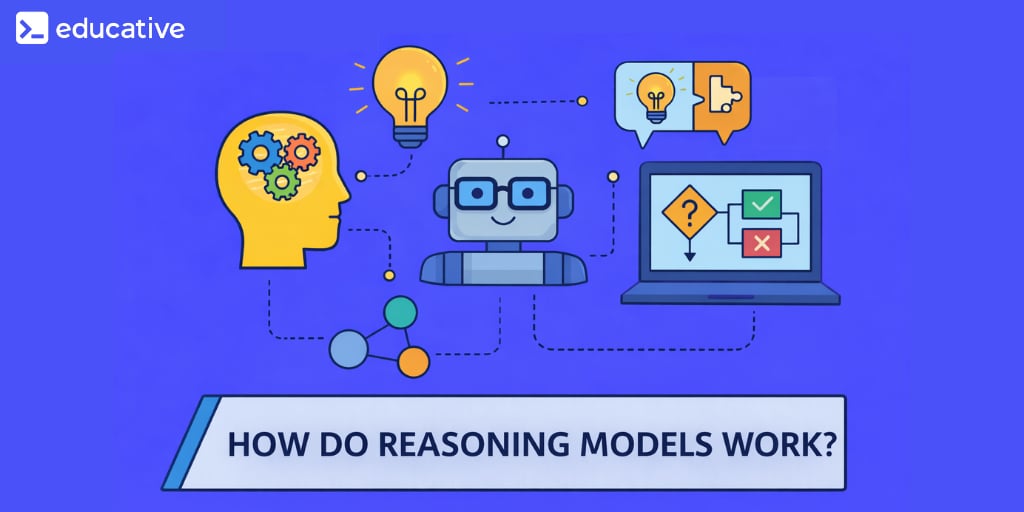
Modern artificial intelligence systems can generate text, analyze images, translate languages, and answer complex questions by learning patterns from massive datasets. These capabilities are powered by deep neural networks that can capture relationships between words, images, and other forms of information. While these systems are highly capable in many domains, certain types of problems require more than pattern recognition alone. Tasks involving mathematical reasoning, logical deduction, or multi-step planning require AI systems that can simulate structured thinking processes.
As researchers and developers explore these capabilities, they frequently ask how do reasoning models work and how they differ from traditional large language models. Understanding this distinction is important because reasoning models represent a shift toward AI systems that can break down complex problems, analyze intermediate steps, and produce logically consistent solutions.
Reasoning models aim to generate structured chains of thought that guide the system toward a correct answer. Rather than producing a direct response immediately, these models attempt to analyze the problem, generate intermediate reasoning steps, and then arrive at a final conclusion. This capability has become increasingly important in modern AI research and development.
Essentials of Large Language Models: A Beginner’s Journey
Large language models (LLMs) are at the core of today’s AI transformation, powering everything from conversational agents to code generation and enterprise automation. As adoption accelerates, understanding how LLMs actually work, and how to use them effectively in real systems, is no longer optional for developers and data professionals. I built this course from my work in neural networks and intelligent systems, where LLMs represent a shift from traditional modeling to probabilistic reasoning at scale. A recurring pattern I observed was that many practitioners could use APIs but lacked a clear mental model of how LLMs process language, make decisions, and fail in edge cases. This course is designed to bridge that gap with a systems-level perspective. You’ll learn LLM fundamentals from first principles, covering architecture, tokenization, embeddings, attention, and training dynamics, before moving into practical workflows like prompting, retrieval-augmented generation (RAG), and tool integration. Each concept is tied to how LLMs are actually deployed in production systems. Engineers and researchers are already building on these foundations to create real-world AI applications. If you want to go beyond surface-level usage of LLMs, this is where you begin.
AI model overview#
Artificial intelligence models have evolved significantly over the past decade. Early machine learning systems focused primarily on classification tasks, such as identifying objects in images or categorizing text documents. These systems relied on statistical methods and relatively small neural networks.
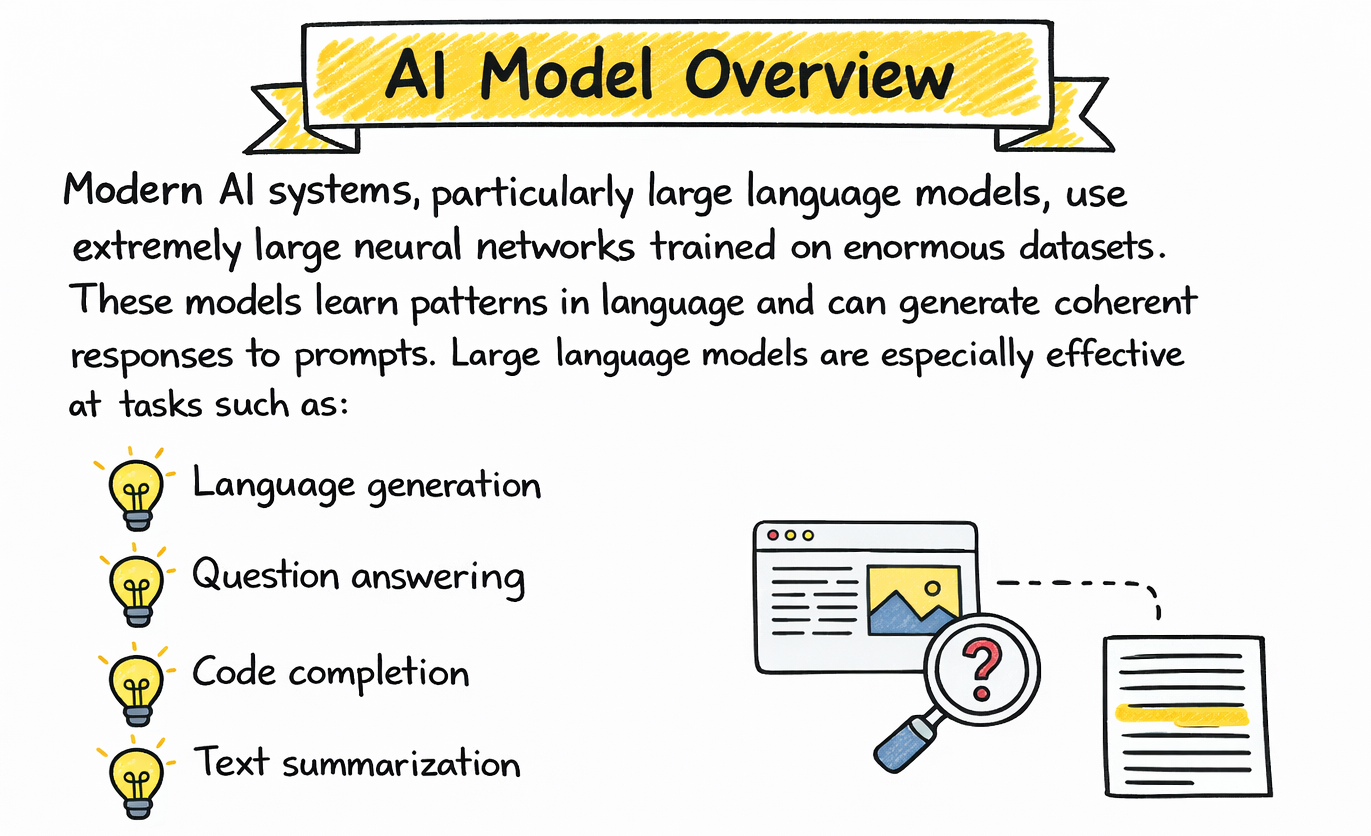
Modern AI systems, particularly large language models, use extremely large neural networks trained on enormous datasets. These models learn patterns in language and can generate coherent responses to prompts. Large language models are especially effective at tasks such as:
Language generation
Question answering
Code completion
Text summarization
These capabilities emerge because the model learns statistical relationships between words and concepts during training. When given a prompt, the model predicts the most likely sequence of tokens that should follow.
However, while traditional models can produce fluent responses, they sometimes struggle with tasks that require explicit reasoning. For example, solving a multi-step mathematical problem or analyzing a logical puzzle may require structured reasoning rather than simple pattern prediction.
This limitation has led researchers to develop models and techniques designed specifically to improve reasoning performance.
Understanding traditional AI and language models#
Most modern AI systems rely on neural network architectures that process information in layers. Large language models, for example, use transformer architectures that analyze relationships between words across entire sequences of text.
These models learn by training on vast collections of data. During training, the model repeatedly attempts to predict the next token in a sequence and adjusts its internal parameters when predictions are incorrect. Over time, this process allows the model to learn complex relationships between concepts.
While this approach produces impressive results, it does not explicitly teach the model how to reason through complex problems step by step. Instead, the model generates responses based on patterns observed during training.
For many tasks, this pattern-based approach works well. However, for problems requiring multi-step analysis, models may produce incorrect answers because they skip intermediate reasoning steps.
This limitation motivates the development of reasoning-based architectures and prompting strategies.
Generative AI Handbook
Since the rise of generative AI, the landscape of content creation and intelligent systems has profoundly transformed with large language models (LLMs). This free generative AI course will guide you through the fascinating evolution of generative AI, exploring how these models power everything from text generation to advanced multimodal capabilities. You’ll begin with the basics of content creation. You’ll explore what generative AI is and how does generative AI works. You’ll learn how LLMs and diffusion models are used to generate everything from text to images. You’ll get familiar with LangChain and vector databases in managing AI-generated content. You’ll also cover RAG and the evolving role of AI agents and smart chatbots. From fine-tuning LLMs for specialized tasks to creating multimodal AI experiences with AI-powered images and speech recognition, you’ll unlock the full potential of generative AI with this free course and navigate the future challenges of this dynamic field.
What are reasoning models?#
Reasoning models are artificial intelligence systems designed to simulate structured thinking processes. Instead of producing a direct answer immediately, these models attempt to analyze a problem through a series of intermediate logical steps.
This approach mirrors the way humans often solve complex problems. When confronted with a challenging task, people typically break the problem into smaller components and evaluate each step before reaching a conclusion.
Reasoning models attempt to replicate this behavior by generating intermediate reasoning steps that guide the model toward a solution. These models support capabilities such as:
Multi-step reasoning
Planning and decision making
Logical inference
Structured problem decomposition
By explicitly modeling reasoning processes, these systems can solve problems that are difficult for traditional language models.
Reasoning model architecture explained#
The architecture of reasoning models often builds on existing large language models while adding mechanisms that support structured reasoning.
One common approach involves training language models to generate chains of intermediate reasoning steps before producing a final answer. These intermediate steps help guide the model’s reasoning process.
Another approach involves search-based reasoning techniques. In these systems, the model explores multiple possible reasoning paths and evaluates which path leads to the most coherent solution.
Some reasoning models also incorporate reinforcement learning techniques that reward correct reasoning processes rather than simply rewarding correct final answers.
These architectural strategies help explain how reasoning models work in practice. Instead of relying solely on statistical pattern matching, the model actively explores logical structures that lead to solutions.
How reasoning models process problems#
Reasoning models follow a structured workflow when analyzing complex problems.
Step 1: Problem interpretation#
The system first analyzes the input prompt to understand the problem being presented. This step involves identifying key entities, relationships, and constraints that define the task.
Step 2: Decomposing the task#
Instead of jumping directly to a solution, the model breaks the task into smaller components. Each component represents a step in the reasoning process.
Step 3: Generating intermediate reasoning#
The model evaluates each step sequentially and produces intermediate outputs. These outputs guide the reasoning process and help refine the solution.
Step 4: Producing the final answer#
After evaluating the reasoning chain, the model synthesizes the intermediate results into a final answer.
This structured workflow illustrates how reasoning models work when solving complex problems that require logical analysis.
LLMs vs reasoning models#
Feature | Standard LLM | Reasoning Model |
Output generation | Direct answer generation | Step-by-step reasoning |
Problem solving | Pattern recognition | Structured reasoning |
Accuracy on complex tasks | Moderate | Improved with reasoning steps |
Traditional large language models often generate answers directly based on learned patterns. Reasoning models, by contrast, attempt to produce intermediate logical steps before generating a final response.
This difference allows reasoning models to perform better on tasks involving mathematical calculations, logical puzzles, or strategic decision-making.
Techniques used in reasoning models#
Researchers have developed several techniques to improve reasoning performance in AI systems.
Chain-of-thought reasoning encourages models to produce intermediate reasoning steps. By explicitly generating a sequence of logical steps, the model can organize its analysis more effectively.
Tree-of-thought reasoning extends this concept by exploring multiple possible reasoning branches. The system evaluates different reasoning paths and selects the one that leads to the most coherent solution.
Self-consistency evaluation generates multiple reasoning chains and compares the final results. If multiple reasoning paths produce the same answer, the model can have greater confidence in the result.
Reinforcement learning techniques can also be used to train models to produce better reasoning strategies. In these systems, models receive feedback based on the quality of their reasoning process.
These techniques illustrate how researchers continue improving reasoning capabilities in AI systems.
Real-world applications #
Reasoning-based AI systems have many practical applications across different domains.
Mathematical problem solving is one of the most obvious applications. AI systems capable of structured reasoning can analyze equations, break down calculations, and produce step-by-step solutions.
Scientific research assistance also benefits from reasoning models. These systems can analyze research papers, evaluate hypotheses, and assist researchers in exploring complex ideas.
Software debugging represents another important application. AI systems can analyze code, identify logical errors, and propose solutions that involve multiple reasoning steps.
Strategic planning and decision support systems also rely on reasoning capabilities. In business or logistics applications, AI systems can analyze multiple constraints and propose optimized strategies.
These examples demonstrate why researchers and engineers continue investigating how reasoning models work and how they can be improved.
Challenges in building reasoning models#
Despite recent advances, developing reliable reasoning models remains challenging.
One difficulty involves maintaining logical consistency across multiple reasoning steps. If the model makes a mistake early in the reasoning chain, subsequent steps may propagate the error.
Another challenge involves hallucinations, where models generate plausible but incorrect reasoning steps. Ensuring that intermediate reasoning remains grounded in accurate information is an active area of research.
Scaling reasoning capabilities also presents computational challenges. Structured reasoning often requires generating longer outputs and evaluating multiple reasoning paths, which increases computational cost.
Researchers continue developing techniques to improve the reliability and efficiency of reasoning models.
FAQ#
Are reasoning models different from large language models?#
Reasoning models are often built on top of large language model architectures. The difference lies in how they are used or trained. Reasoning models emphasize structured problem solving and intermediate reasoning steps, while traditional language models focus on generating coherent text.
Do reasoning models require special training data?#
Many reasoning models benefit from training data that includes examples of step-by-step reasoning. This type of data helps the model learn how to structure its responses logically.
Can reasoning models solve mathematical problems?#
Yes, reasoning models are particularly useful for mathematical tasks. By generating intermediate calculation steps, the model can perform multi-step arithmetic and logical analysis more effectively.
Why do reasoning prompts sometimes improve LLM responses?#
Prompts that encourage reasoning guide the model toward generating intermediate steps. These steps help organize the model’s thinking process and often lead to more accurate results.
Conclusion#
Reasoning models represent an important step in the evolution of artificial intelligence. While traditional AI systems rely primarily on pattern recognition, reasoning models attempt to simulate structured thinking processes.
By generating intermediate reasoning steps and exploring logical problem-solving strategies, these systems can tackle tasks that require deeper analysis. Understanding how reasoning models work helps developers appreciate the transition from simple language generation systems to AI systems capable of structured reasoning and complex decision making.
Happy learning!
