How to become a Solutions Architect from a Developer
Thinking beyond code? Discover how to become a solution architect from a developer by mastering system design, understanding trade-offs, and evolving your mindset. Start building scalable systems and shaping real-world architecture today.
At some point in your career, you start to feel a subtle shift in how you look at your work. Writing clean code, fixing bugs, and delivering features still matter, but they no longer feel like the full picture. You begin to notice how systems behave in production, how decisions made months ago impact performance today, and how small architectural choices can create long-term complexity. That’s usually when the question starts forming: what comes next?
This is where many developers encounter the idea of becoming a solution architect. It sounds like a natural progression, but it’s also frustratingly vague. You might search for how to become a solution architect from a developer and find advice focused on certifications or tools, but those rarely explain what actually changes in your day-to-day thinking and responsibilities.
The reality is that this transition is not a single leap or a checklist you complete. It’s a gradual evolution in how you understand systems, make decisions, and take ownership of outcomes. In this article, we’ll walk through that evolution, not as a step-by-step guide, but as a shift in perspective that unfolds over time.
Master AWS Certified Solutions Architect Associate SAA-C03 Exam
Cloud architecture has become a core skill for modern engineers. Whether you're building backend systems, deploying microservices, or scaling global applications, understanding how to design on AWS is no longer optional. The challenge is that AWS is an ecosystem. Without a clear structure, it’s easy to get lost in services without understanding how to use them together to build secure, reliable systems. I built this course from my experience working on Azure’s Fabric Controller and Remote Desktop services for Windows Server. In those environments, we dealt with real-world problems around availability, fault tolerance, and large-scale system management. The pattern I’ve seen with learners is similar: they can learn individual services, but struggle to connect them into a complete architecture. This course is designed to help you think in systems, not just services. We focus on the core pillars of AWS architecture, security, reliability, performance, and cost optimization, and show how they come together in practical designs. You’ll learn how to secure accounts and resources, design for high availability using load balancing and replication, and choose the right storage and analytics services for performance. The course also includes hands-on Cloud Labs so you can deploy and interact with real AWS resources, along with practice exams aligned to the SAA-C03 certification. This approach has helped many learners build confidence in AWS and successfully prepare for certification. If you’re aiming to become an AWS Certified Solutions Architect Associate and design systems the right way, this course gives you a clear and structured path.
Why the transition is not just about learning new tools#
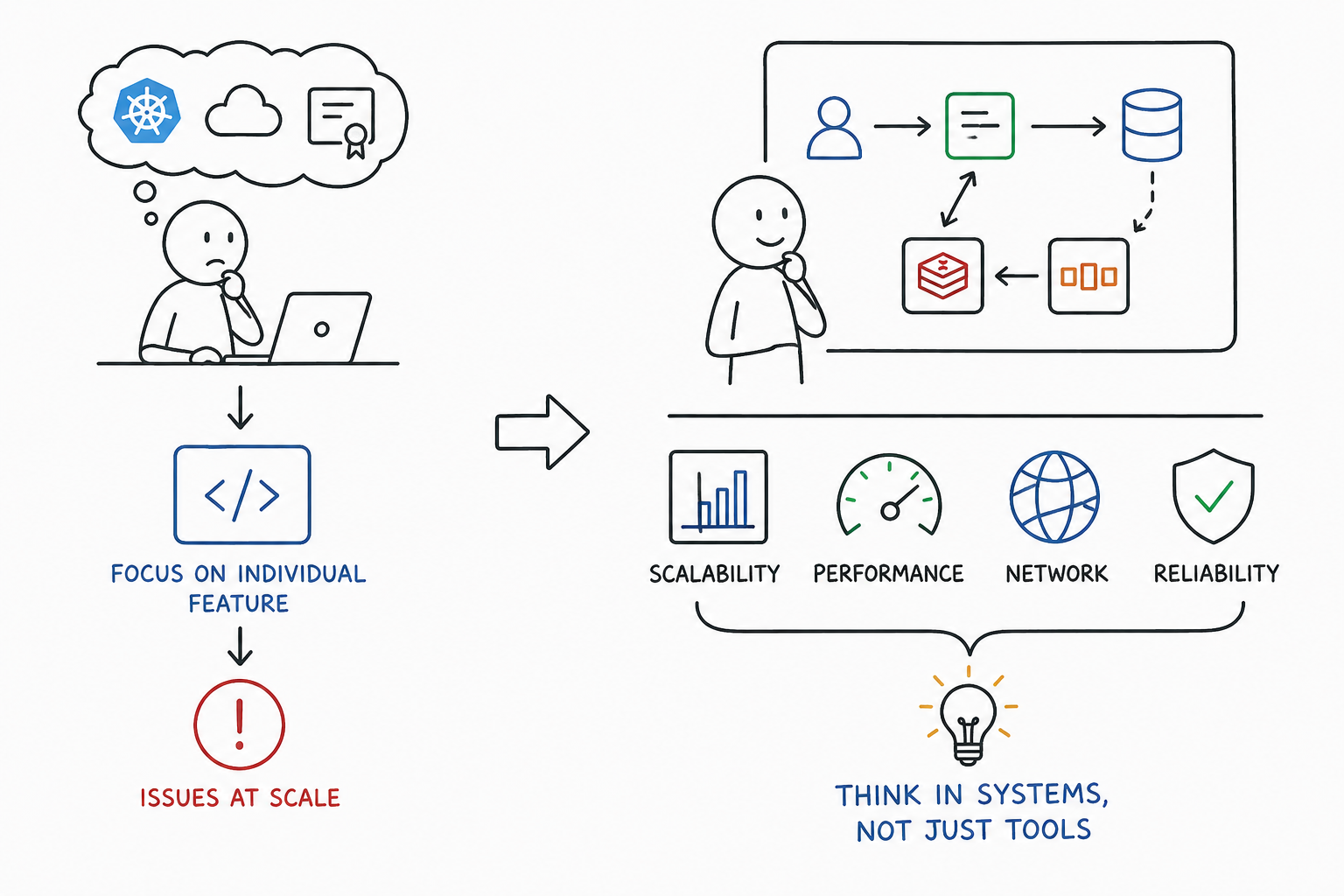
A common assumption is that becoming a solutions architect is about learning new technologies. You might think that mastering cloud platforms, understanding Kubernetes, or earning certifications will automatically move you into an architect role. While these skills are valuable, they are not the defining factor in this transition.
The real shift is in how you think about systems. As a developer, you are often focused on solving well-defined problems within a given scope. You implement features, optimize functions, and ensure that your code behaves correctly. But as you grow, you start to see that these individual pieces are part of a much larger system with its own behavior and constraints.
Imagine working on a feature that performs well in isolation but causes issues when deployed at scale. You begin to realize that performance is not just about code efficiency; it’s about data flow, network latency, and system architecture. This realization marks the beginning of your transition, where understanding systems becomes more important than mastering individual tools.
Learn the A to Z of Amazon Web Services (AWS)

Learn about the core AWS's services like compute, storage, networking services and how they work with other services like Identity, Mobile, Routing, and Security. This course provides you with a good grasp an all you need to know of AWS services. This course has been designed by three AWS Solution Certified Architects who have a combined industry experience of 17 years. We aim to provide you with just the right depth of knowledge you need to have.
Moving from implementation to system-level thinking#
The most significant change in this journey is moving from implementation-focused thinking to system-level thinking. As a developer, your primary goal is to build and deliver functionality. Your scope is typically limited to a service, a module, or a feature within a larger system.
As an architect, your focus expands to the entire system. You start asking questions about how different components interact, how the system scales under load, and how it behaves when something fails. Your decisions are no longer about how to implement a feature, but how that feature fits into the overall architecture.
This shift also changes your priorities. Instead of optimizing a single piece of code, you consider trade-offs across the system. For example, you might choose a slightly less efficient algorithm if it simplifies the architecture or improves maintainability. This ability to think in terms of trade-offs is what defines architectural thinking.
Understanding how to become a solution architect from a developer in practice#
When you think about how to become a solution architect from a developer, it helps to view it as a multi-dimensional progression rather than a linear path. This transition involves developing technical depth, expanding your perspective, and gaining experience with complex systems over time.
You don’t wake up one day as an architect. Instead, you gradually take on responsibilities that require you to think beyond your immediate tasks. You might start by contributing to design discussions, evaluating different approaches, or mentoring other developers. Each of these experiences builds your ability to operate at a higher level.
Over time, these small shifts accumulate. You begin to see patterns across systems, anticipate potential issues, and make decisions that consider long-term impact. This is how the role evolves, not through a single milestone, but through continuous growth and exposure.
Developing system design expertise#
System Design becomes central as you move toward architecture. It provides the framework for understanding how systems are structured, how they scale, and how they handle failures. Concepts like load balancing, data partitioning, and fault tolerance become part of your everyday thinking.
Consider designing a system that needs to handle millions of users. You need to think about how to distribute traffic, how to store and retrieve data efficiently, and how to ensure reliability under failure conditions. These are not isolated decisions; they are interconnected and influence each other.
What makes this challenging is that there is rarely a single correct solution. You need to evaluate trade-offs, consider constraints, and choose an approach that aligns with your system’s goals. This process of reasoning and decision-making is what transforms System Design from theory into a practical skill.
Expanding into cloud and infrastructure understanding#
As systems become more complex, your understanding of infrastructure becomes increasingly important. Modern architectures rely heavily on cloud platforms, which provide the building blocks for scalability, reliability, and performance. However, the goal is not to memorize services, but to understand how they fit into the system.
For example, you might use managed databases, caching layers, and load balancers to build a scalable application. But the real challenge lies in deciding how these components interact. How do you ensure data consistency? How do you handle failures? How do you optimize cost without compromising performance?
This is where your role begins to overlap with infrastructure decisions. You are no longer just consuming services; you are designing systems that depend on them. This deeper understanding of infrastructure is a key part of your evolution toward architecture.
Comparison of role evolution#
Aspect | Developer | Senior engineer | Solution architect |
Focus | Feature implementation | System components and optimization | End-to-end system design |
Decision scope | Localized to code | Component-level | System-wide and cross-team |
Impact | Immediate functionality | Performance and maintainability | Scalability, reliability, and business outcomes |
This progression highlights how your scope expands over time. As a developer, you focus on delivering features and ensuring correctness. As a senior engineer, you begin to optimize systems and think about performance and maintainability within a broader context.
As a solution architect, your focus shifts to the entire system and its long-term behavior. Your decisions impact multiple teams and often shape the direction of the product. This does not mean you become less technical; it means your technical knowledge is applied at a higher level of abstraction.
Learning to make trade-offs and decisions#
One of the defining aspects of architecture is decision-making. Unlike implementation tasks, where there is often a clear path forward, architectural decisions involve uncertainty and trade-offs. You need to balance competing priorities such as performance, cost, scalability, and complexity.
For example, you might need to choose between a simple architecture that is easy to maintain and a more complex one that offers better scalability. There is no universally correct answer, only the option that best fits your system’s requirements and constraints.
This ability to evaluate trade-offs and make informed decisions is what sets architects apart. It requires not just technical knowledge, but also judgment and experience. Over time, you develop an intuition for what works and what doesn’t, which becomes one of your most valuable assets.
The importance of communication and business context#
As your role evolves, communication becomes just as important as technical expertise. Architects work with a wide range of stakeholders, including developers, operations teams, and business leaders. Each group has its own priorities and perspectives, which must be aligned for the system to succeed.
You need to translate business requirements into technical solutions, ensuring that the system supports organizational goals. This might involve explaining trade-offs, justifying decisions, or negotiating constraints. The ability to communicate effectively is essential for building consensus and driving progress.
This also means understanding the business context in which your system operates. You are not just designing technology—you are enabling outcomes. This broader perspective is a key part of the transition from developer to architect.
Common misconceptions about the transition#
There are several misconceptions about how to become a solution architect from a developer that can lead to frustration. One of the most common is the belief that certifications alone are enough. While certifications can provide useful knowledge, they do not replace the experience needed to make real-world decisions.
Another misconception is that the role requires no coding background. In reality, a strong technical foundation is essential for understanding systems and evaluating trade-offs. Without this, it becomes difficult to design effective solutions.
There is also a tendency to view the transition as quick and linear. In practice, it is neither. It takes time, experience, and continuous learning to develop the skills required for architecture. Recognizing this helps set realistic expectations and focus on long-term growth.
How to grow into the role over time#
Growing into an architect role is about gradually expanding your scope and responsibilities. You start by taking ownership of larger parts of the system, contributing to design decisions, and thinking about long-term impact. These experiences help you build the skills and mindset required for architecture.
You can accelerate this growth by actively engaging with system design, learning from real-world systems, and seeking opportunities to make decisions. This might involve working on complex projects, collaborating with other teams, or exploring different architectural approaches.
Over time, these efforts shape your perspective. You begin to see systems as interconnected entities, understand the implications of your decisions, and take responsibility for outcomes. This is how the transition happens, not through a single step, but through continuous evolution.
Conclusion#
Understanding how to become a solution architect from a developer is less about following a predefined path and more about evolving your thinking over time. It involves moving beyond implementation, developing system-level understanding, and learning to make decisions that shape entire systems.
This journey requires patience, experience, and a willingness to embrace complexity. Instead of focusing on titles or shortcuts, focus on building systems, understanding trade-offs, and expanding your perspective. That’s what ultimately prepares you for the role of an architect.
Happy learning!