Key Topics for the AWS Cloud Practitioner Exam
Wondering what to actually study for the AWS Cloud Practitioner exam? This blog breaks down the key topics AWS tests, explains why they matter, and helps you focus on the concepts that truly impact your exam success.
When you first look at the AWS Cloud Practitioner exam guide, it can feel deceptively simple.
The certification is described as foundational. It doesn’t require coding. It’s often recommended as the starting point for beginners. And yet, as soon as you open the syllabus, you’re greeted with cloud concepts, security models, pricing structures, and a long list of AWS services that all seem important.
That’s when the real question appears.
What are the key topics you should actually focus on for the AWS Cloud Practitioner exam, and what can you safely de-emphasize?
This matters more than most people realize. The Cloud Practitioner exam is not about memorizing everything AWS offers. It’s about understanding how AWS wants you to think about cloud computing.
Master AWS Certified Cloud Practitioner CLF-C02 Exam
Cloud computing has become the foundation of modern software, and AWS continues to lead that shift. For many engineers and aspiring technologists, the AWS Certified Cloud Practitioner certification is the first step toward understanding how cloud systems are designed, managed, and scaled. The challenge is building a clear mental model of how everything fits together. I built this course around a common pattern I’ve seen: learners often approach AWS as a collection of tools rather than a system. When preparing for the AWS Certified Cloud Practitioner exam, they can recall services but struggle to explain how they work together in real scenarios. This course is designed to make those connections clear from the start. We begin with the fundamentals of cloud computing, then move into core AWS services across compute, storage, networking, and databases. From there, we explore analytics, machine learning, pricing, and billing, tying each concept back to real-world usage. You’ll also work through monitoring, security, and compliance practices, with hands-on Cloud Labs to reinforce your understanding. If you’re starting your journey as a cloud practitioner, this course gives you a structured path to pass the exam and build a strong foundation in AWS.
This blog walks you through the core topic areas that consistently matter on the exam, explains what AWS is really testing in each one, and helps you focus your preparation so studying feels purposeful instead of overwhelming.
Why focusing on the right topics matters more than studying everything#
One of the biggest mistakes beginners make is trying to learn AWS “completely” before the exam.
AWS is enormous, and the Cloud Practitioner exam can be hard. Even experienced engineers don’t know every service in depth. The Cloud Practitioner exam doesn’t expect that either.
What it does expect is clarity around a specific set of ideas. It tests whether you understand cloud fundamentals, AWS’s core services, responsibility boundaries, and pricing logic at a high level.
If you focus on the right topics, the exam feels fair and predictable. If you spread your attention too thin, it feels confusing and stressful.
This is why topic prioritization matters more than total study time.
Cloud Computing Fundamentals

We are surrounded by the technology that we utilize daily. Most of it makes use of cloud computing. Cloud is not a nuance anymore; it’s the norm. As software practitioners, it’s imperative to have a good understanding of cloud computing concepts. In this course, you will learn the fundamental concepts of cloud computing. Next, you’ll familiarize yourself with cloud’s standard services. You’ll also learn about various service models available in cloud computing. You’ll learn the concepts of clustering and its relevance in cloud computing. You’ll explore storage and deployment concepts in the cloud. You’ll wrap up with a hands-on experience of how to pick a cloud platform and start your cloud journey. In the end, you’ll have plenty of resources to continue your cloud learning journey. By the end of this course, you’ll have a deeper understanding of the basic concepts of cloud computing and the services and products that cloud platforms offer.
How AWS organizes Cloud Practitioner exam content#
Before diving into individual topics, it helps to understand the structure behind them.
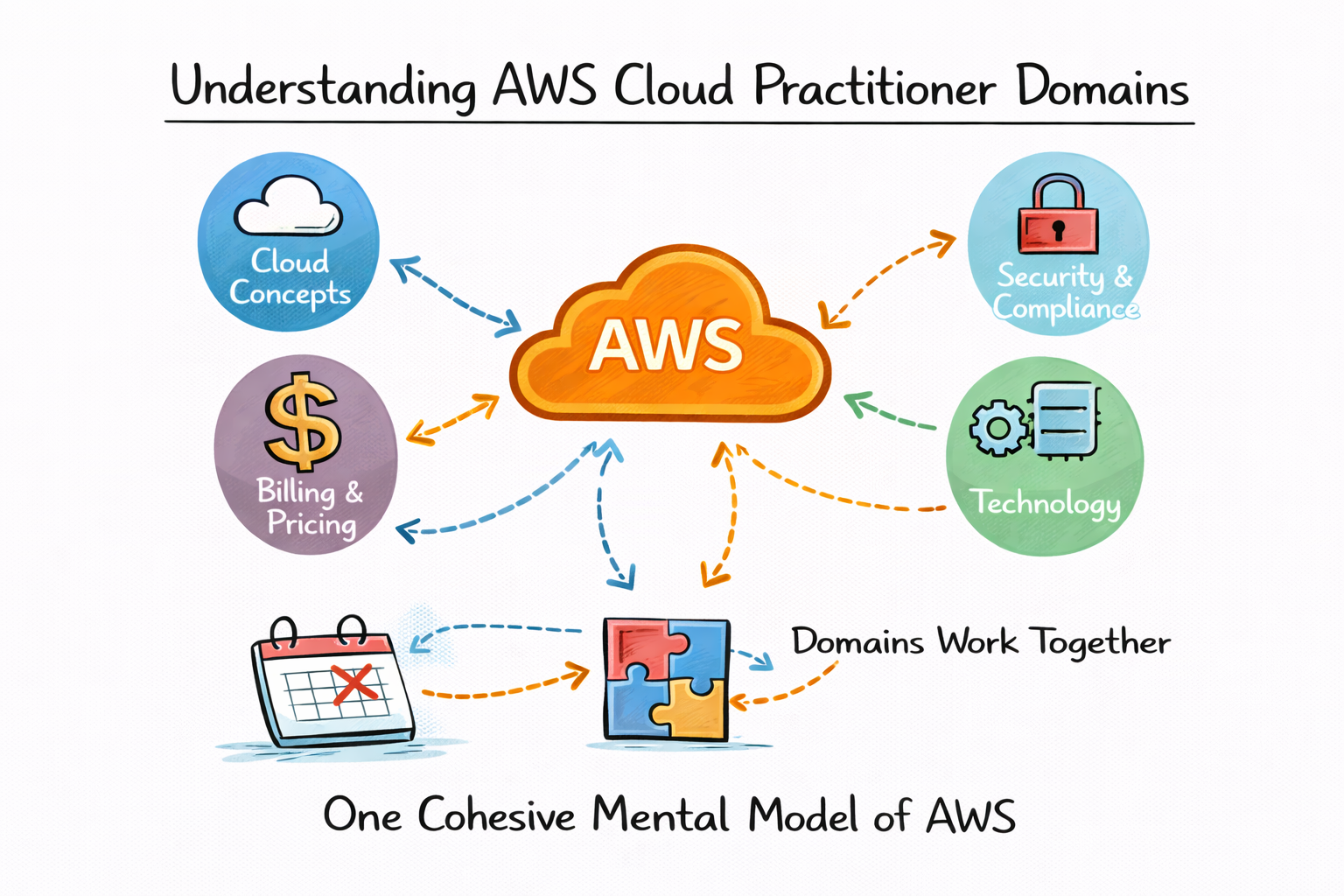
The AWS Cloud Practitioner exam is built around four major domains: cloud concepts, security and compliance, technology, and billing and pricing. Each domain contributes a portion of the questions, but more importantly, they are interconnected.
AWS does not test these areas in isolation. A single question might touch on cloud concepts, security, and pricing at the same time.
This means you are not memorizing four separate silos. You are learning one cohesive mental model of how AWS works.
Cloud concepts as the foundation of the exam#
Cloud concepts form the backbone of the Cloud Practitioner exam, especially for beginners.
This topic area focuses on understanding what cloud computing actually is and why organizations use it. You are expected to understand ideas like scalability, elasticity, reliability, and high availability at a conceptual level.
AWS also expects you to understand the benefits of cloud computing compared to traditional on-premises infrastructure. This includes cost flexibility, global reach, and operational efficiency.
For many beginners, this section feels abstract at first. Once it clicks, however, it makes the rest of the exam far easier to reason through.
Cloud concepts are less about memorization and more about mindset. When you understand why cloud computing exists, AWS’s service decisions start to make sense.
AWS global infrastructure and why it matters#
AWS’s global infrastructure is a recurring theme across the exam.
You need to understand the roles of Regions, Availability Zones, and edge locations, and how they work together to support availability and fault tolerance.
This topic often trips up beginners because the terms sound similar. The exam doesn’t expect you to design multi-region architectures, but it does expect you to understand why AWS organizes infrastructure this way.
Questions in this area often focus on availability, disaster recovery, and latency rather than technical implementation.
Once you grasp the purpose behind AWS’s global design, these questions become straightforward.
Core AWS services and high-level service categories#
The Cloud Practitioner exam does not require deep knowledge of every AWS service, but it does expect familiarity with core service categories.
Compute, storage, networking, and databases appear frequently. You should understand what each category is responsible for and recognize a few flagship services within each one.
For example, you are expected to know that compute services run workloads, storage services hold data, networking services connect resources, and database services manage structured information.
You are not expected to configure these services or understand their internals. The exam focuses on recognizing which type of service fits a given scenario.
This is why service roles matter more than service details.
Identity, security, and the shared responsibility model#
Security is one of the most important and misunderstood topics on the Cloud Practitioner exam.
AWS places heavy emphasis on the shared responsibility model, which defines what AWS is responsible for and what the customer is responsible for.
You need to understand this concept clearly, because it appears repeatedly across different question types. Many incorrect answers on the exam stem from a misunderstanding of responsibility boundaries.
Identity and access management also play a role. You are expected to understand the purpose of identity management and why controlling access matters in the cloud.
The exam stays at a conceptual level. You are not configuring permissions. You are recognizing responsibility and intent.
Compliance, governance, and trust in AWS#
Closely related to security is the topic of compliance and governance.
AWS wants you to understand how it supports regulatory compliance and how customers can meet their own compliance requirements using AWS services.
This topic often feels abstract, but the exam keeps it practical. Questions focus on AWS’s role in maintaining infrastructure compliance and the tools it provides to support governance.
You are not tested on specific regulations. You are tested on awareness that AWS operates in regulated environments and provides mechanisms to support customers.
Billing, pricing models, and cost management#
Billing and pricing are one of the most heavily weighted and anxiety-inducing sections for beginners.
The good news is that the exam does not require math. You are not calculating bills or estimating costs.
Instead, AWS tests whether you understand pricing models conceptually. This includes knowing the difference between pay-as-you-go pricing, long-term commitments, and usage-based billing.
Cost management tools and cost awareness also appear. You are expected to recognize how AWS helps customers monitor and control spending.
Once you stop expecting calculations, this topic becomes much easier to handle.
AWS support plans and customer assistance#
Support plans are a surprisingly common topic on the Cloud Practitioner exam.
You should understand that AWS offers different levels of support and that these plans vary in terms of response time, guidance, and access to expertise.
The exam focuses on recognizing which type of support fits a given business need. It does not test pricing specifics or operational details.
This topic is straightforward once you understand that AWS support scales with customer needs.
Deployment models and cloud service models#
Another foundational topic involves understanding different cloud deployment models and service models.
You should understand the difference between public cloud, private cloud, and hybrid approaches at a high level. Similarly, you should be familiar with the idea of managed services versus customer-managed components.
The exam tests conceptual understanding rather than definitions. It focuses on recognizing which model suits a given scenario.
This topic often overlaps with cloud concepts and service categories.
Comparing key Cloud Practitioner topic areas#
To help you see how these topics relate to one another, the table below summarizes their purpose and exam relevance.
Topic area | What AWS is testing | Common beginner challenge |
Cloud concepts | Understanding why the cloud exists | Abstract thinking |
Global infrastructure | Availability and fault tolerance | Similar terminology |
Core services | Recognizing service roles | Over-memorization |
Security & responsibility | Knowing who handles what | Misplaced assumptions |
Compliance & governance | Trust and regulatory awareness | Vagueness |
Billing & pricing | Cost logic and models | Fear of math |
Support plans | Matching support to needs | Forgetting this topic |
Deployment models | Choosing the right approach | Concept overlap |
This overview highlights why the exam feels broad but manageable when topics are understood in context.
How AWS blends topics together in exam questions#
One reason the Cloud Practitioner exam feels tricky is that questions rarely test a single topic in isolation.
A scenario about launching an application might involve cloud concepts, global infrastructure, security responsibility, and pricing considerations at once.
This is intentional. AWS wants to see whether you understand how concepts connect, not whether you memorized isolated facts.
When you study topics as a cohesive system rather than separate chapters, the exam feels far more intuitive.
Topics beginners often over-study unnecessarily#
Beginners often assume they need deep technical knowledge of services, APIs, or configurations.
The Cloud Practitioner exam does not test this level of detail. Spending time on service internals, advanced features, or low-level networking usually adds confusion rather than clarity.
If a topic feels overly technical, it is probably outside the scope of this exam.
Focusing on roles, purpose, and responsibility yields much better results.
How to prioritize topics based on your background#
If you are completely new to cloud computing, cloud concepts, and global infrastructure deserve extra attention.
If you come from a business background, security responsibility and pricing models may feel more intuitive, but technical service categories may require more focus.
Understanding your own starting point helps you allocate study time wisely.
How topic mastery changes exam confidence#
As you master the key topics, something important happens.
Questions stop feeling unfamiliar. Scenarios feel predictable. Answer choices become easier to eliminate.
This shift is the clearest sign that you are focusing on the right material.
Confidence on this exam comes from clarity, not memorization.
Final thoughts#
So, what are the key topics you should focus on for the AWS Cloud Practitioner exam?
You should focus on cloud concepts, AWS global infrastructure, core service categories, security and shared responsibility, billing and pricing models, and support and governance awareness.
You do not need great technical skills. You need clear mental models.
When you study these topics intentionally and understand how they connect, the Cloud Practitioner exam becomes far more approachable than it appears at first glance.
