Machine learning with scikit-learn and TensorFlow
This blog shows machine learning with scikit learn and TensorFlow by explaining that scikit-learn is best for classical ML, while TensorFlow is for deep learning and scalable models, and both can be used together.
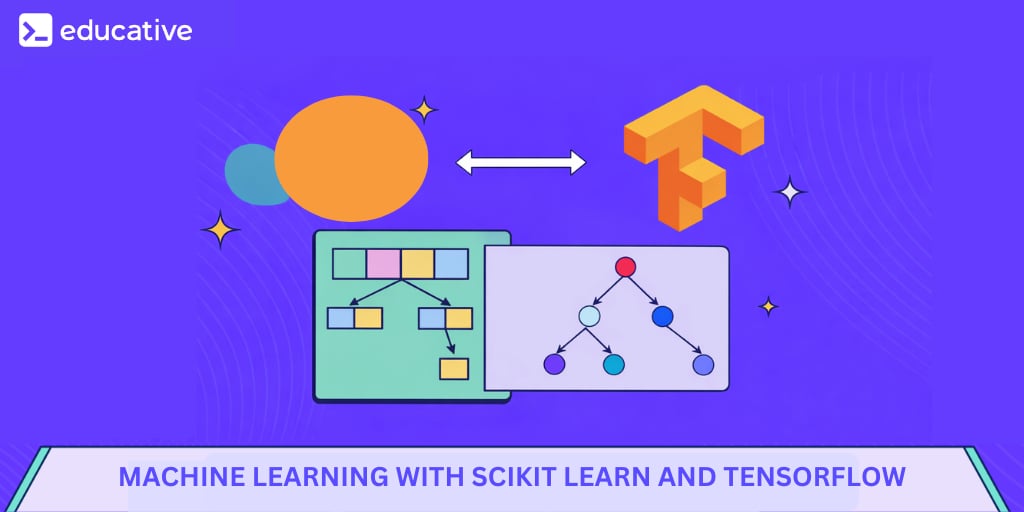
When people begin exploring machine learning with scikit-learn and TensorFlow, the conversation often collapses into comparisons: which one is faster, which one is more powerful, which one is “better.” That framing misses the deeper architectural story. These libraries are not rivals operating at the same level of abstraction. They represent different layers of the machine learning ecosystem, built around distinct philosophies and intended for different problem classes.
Understanding how they fit together requires stepping back from surface-level APIs and examining what each library assumes about models, workflows, and system design. Only then can you decide when to use one, when to use the other, and when they can coexist in the same project.
For a decade, when developers talked about how to prepare for System Design Interviews, the answer was always Grokking System Design. This is that course — updated for the current tech landscape. As AI handles more of the routine work, engineers at every level are expected to operate with the architectural fluency that used to belong to Staff engineers. That's why System Design Interviews still determine starting level and compensation, and the bar keeps rising. I built this course from my experience building global-scale distributed systems at Microsoft and Meta — and from interviewing hundreds of candidates at both companies. The failure pattern I kept seeing wasn't a lack of technical knowledge. Even strong coders would hit a wall, because System Design Interviews don't test what you can build; they test whether you can reason through an ambiguous problem, communicate ideas clearly, and defend trade-offs in real time (all skills that matter more than ever now in the AI era). RESHADED is the framework I developed to fix that: a repeatable 45-minute roadmap through any open-ended System Design problem. The course covers the distributed systems fundamentals that appear in every interview – databases, caches, load balancers, CDNs, messaging queues, and more – then applies them across 13+ real-world case studies: YouTube, WhatsApp, Uber, Twitter, Google Maps, and modern systems like ChatGPT and AI/ML infrastructure. Then put your knowledge to the test with AI Mock Interviews designed to simulate the real interview experience. Hundreds of thousands of candidates have already used this course to land SWE, TPM, and EM roles at top companies. If you're serious about acing your next System Design Interview, this is the best place to start.
Philosophical foundations: algorithms versus computation graphs#
At its core, scikit-learn is an algorithms library. It offers a curated collection of classical machine learning methods—linear models, tree ensembles, support vector machines, clustering algorithms—wrapped in a consistent interface. The philosophy is pragmatic and opinionated: provide robust, well-tested implementations of established techniques and make them composable through a unified API.
TensorFlow, in contrast, is a computational framework. While it includes high-level APIs for neural networks, its deeper identity lies in building and executing computational graphs. It is designed to define differentiable models, perform automatic differentiation, and scale training across GPUs and distributed systems. The philosophy is not just about implementing algorithms but about constructing trainable numerical programs.
This philosophical distinction shapes everything else. scikit-learn assumes that most users are selecting among established models and tuning hyperparameters. TensorFlow assumes that users may need to define custom layers, loss functions, and training loops.
One library is optimized for breadth of classical algorithms and ease of experimentation. The other is optimized for flexibility in defining and training large-scale models.
“Scikit-learn is for beginners and TensorFlow is for serious machine learning.” This misconception confuses abstraction level with capability. scikit-learn is serious engineering for classical ML. TensorFlow is serious engineering for differentiable models. They serve different architectural purposes.
Scikit-Learn is a powerful library that provides a handful of supervised and unsupervised learning algorithms. If you’re serious about having a career in machine learning, then scikit-learn is a must know. In this course, you will start by learning the various built-in datasets that scikit-learn offers, such as iris and mnist. You will then learn about feature engineering and more specifically, feature selection, feature extraction, and dimension reduction. In the latter half of the course, you will dive into linear and logistic regression where you’ll work through a few challenges to test your understanding. Lastly, you will focus on unsupervised learning and deep learning where you’ll get into k-means clustering and neural networks. By the end of this course, you will have a great new skill to add to your resume, and you’ll be ready to start working on your own projects that will utilize scikit-learn.
Model classes and problem domains#
The types of models each library is designed for reveal their intended roles.
scikit-learn excels at structured data problems. Tabular datasets with numerical and categorical features are its natural habitat. Gradient boosting, random forests, logistic regression, and linear models are optimized for exactly these scenarios. Its tools are tailored to supervised and unsupervised learning where features are explicitly engineered.
TensorFlow is built for deep learning and differentiable programming. Convolutional neural networks, recurrent models, transformers, and custom neural architectures are native citizens. When the model itself must be expressed as a differentiable graph and trained via backpropagation, TensorFlow provides the necessary primitives.
That does not mean scikit-learn cannot handle neural networks or that TensorFlow cannot process tabular data. It means their architectures are optimized for different computational assumptions. scikit-learn treats models as relatively static objects with explicit parameters. TensorFlow treats models as programs whose behavior emerges from trainable tensors flowing through layers.
The difference is not just about scale but about representational flexibility.
Abstraction levels and workflow design#
The workflow in scikit-learn is built around a simple pattern: fit, transform, and predict. Data flows through transformers and estimators. Cross-validation and pipelines wrap these components to ensure consistency. The abstraction is intentionally high-level and uniform.
TensorFlow operates at multiple abstraction layers. At the highest level, Keras provides model definitions that resemble scikit-learn’s interface, but beneath that lies a graph execution engine, gradient tapes, distributed training strategies, and device placement controls. The user can descend as deep into the stack as necessary.
This layering affects workflow decisions. In scikit-learn, preprocessing is explicit and separate from modeling. You construct pipelines that combine scalers, encoders, and estimators. In TensorFlow, preprocessing may occur within the computational graph itself, especially when using tf.data pipelines or preprocessing layers embedded in models.
Deployment reflects this difference as well. scikit-learn models are often serialized with joblib and deployed in lightweight API services. TensorFlow models may be exported as SavedModel artifacts and served through TensorFlow Serving, integrated with hardware accelerators.
The abstraction gap is visible in how much of the computational machinery is exposed to the user.
A structured architectural comparison#
To ground these distinctions, consider the following comparison across core dimensions:
Dimension | scikit-learn | TensorFlow | Practical Implication |
Core Philosophy | Library of classical ML algorithms | Framework for differentiable computation | Algorithm selection vs model definition |
Primary Model Types | Linear models, trees, SVMs, clustering | Neural networks, deep architectures | Tabular ML vs deep learning |
Abstraction Level | High-level, uniform API | Multi-layered, from high-level to low-level graph control | Simplicity vs flexibility |
Scaling Strategy | CPU-centric, parallel via joblib | GPU/TPU acceleration, distributed training | Small-to-medium datasets vs large-scale models |
Deployment Pattern | Lightweight serialization | Serving infrastructure, hardware-aware deployment | Simpler inference vs production-grade DL serving |
This table is not a competition scorecard. It illustrates architectural orientation.
Preprocessing and data handling differences#
Data preparation reveals another philosophical divide. scikit-learn emphasizes explicit preprocessing steps. Feature scaling, encoding, imputation, and dimensionality reduction are modular transformers chained in pipelines. This explicitness encourages transparency and makes cross-validation safe by design.
TensorFlow, especially in deep learning workflows, often integrates preprocessing within the model graph. Feature normalization can become a layer. Tokenization for text may occur through TensorFlow-specific utilities. The data pipeline itself becomes part of the computational graph when using tf.data.
The implication is that scikit-learn separates preprocessing and modeling conceptually, while TensorFlow allows them to merge into a unified trainable system. Neither approach is inherently superior; they reflect different assumptions about what the “model” includes.
A narrative evolution: from scikit-learn to TensorFlow#
Consider a startup building a fraud detection system. The initial dataset is structured tabular data: transaction amounts, user metadata, device signals. The team begins with scikit-learn because it offers strong baseline models for tabular classification. Gradient boosting and logistic regression provide interpretable, competitive results quickly.
As the product evolves, the team incorporates unstructured data: transaction descriptions, behavioral sequences, perhaps even image uploads. Classical feature engineering becomes cumbersome. The need arises to model sequential patterns and embeddings learned from raw inputs.
At this stage, the project evolves toward TensorFlow. The team builds a neural network that processes text embeddings and numerical features jointly. Training shifts from CPU-bound classical algorithms to GPU-accelerated deep learning. Deployment changes accordingly, perhaps requiring a model server optimized for neural inference.
In this scenario, the transition is not about abandoning scikit-learn but about architectural necessity. The nature of the problem changed, and the tool changed with it.
Coexistence in a single pipeline#
In practice, scikit-learn and TensorFlow can coexist. For example, scikit-learn may handle preprocessing and classical feature engineering, while TensorFlow models consume the transformed data for representation learning. Alternatively, TensorFlow may generate embeddings that are then fed into scikit-learn classifiers for downstream tasks.
Such hybrid architectures are common in production systems. An NLP model trained in TensorFlow might produce document embeddings. A scikit-learn model might use those embeddings for clustering or classification within a larger analytics pipeline.
The decision is rarely binary. Instead, it reflects which layer of abstraction your current problem inhabits.
Deciding which to use in real projects#
Choosing between the two libraries is not about popularity or performance benchmarks. It is about aligning your tool with your problem structure.
If your dataset is moderate in size, structured, and tabular, and your goal is predictive modeling with classical algorithms, scikit-learn offers efficiency and simplicity. Its pipelines and cross-validation tools make experimentation reliable.
If your problem requires custom neural architectures, large-scale training, or hardware acceleration, TensorFlow becomes necessary. Its ability to define differentiable graphs and scale training across devices addresses requirements beyond classical ML.
In some cases, starting with scikit-learn provides a baseline that clarifies whether deep learning is even required. In others, the complexity of the data dictates a deep learning approach from the outset.
The important shift is to think architecturally rather than comparatively.
Returning to the broader ecosystem#
The phrase machine learning with scikit learn and TensorFlow should not imply rivalry. It describes a layered ecosystem. scikit-learn occupies the space of structured classical modeling with a disciplined, consistent API. TensorFlow occupies the space of differentiable computation and scalable neural architectures.
They reflect different levels of abstraction and different computational assumptions. Understanding those layers allows you to design systems intentionally rather than defaulting to whichever library you learned first.
In mature machine learning systems, the two often complement rather than compete. One provides rapid experimentation with established algorithms; the other enables expressive, large-scale models when the problem demands it.
The question, then, is not which library wins. It is which abstraction matches the layer of complexity your project currently inhabits. Machine learning with scikit learn and TensorFlow becomes most powerful when viewed not as a comparison, but as a progression across levels of modeling sophistication.
