Think of a food delivery app: if the meal arrives hot, the system works as expected; if it arrives cold, the system fails. Performance and reliability are what make the difference for any platform.
At DoorDash, every minute counts. It is a three-sided marketplace connecting millions of consumers, merchants, and Dashers. A bug can disrupt millions of real-time deliveries in such a complex ecosystem. That is why DoorDash’s technical interviews go beyond abstract problems. They test your ability to design for scale, concurrency, and real-world logistics.
So, how do you prepare to think like a marketplace engineer? Should you follow curated lists of LeetCode problems like NeetCode 150 and Blind 75, or adopt the flexible, pattern-oriented approach of LeetCode’s Grokking patterns?
Grokking the Coding Interview Patterns

I created Grokking the Coding Interview because I watched too many talented engineers fail interviews they should have passed. At Microsoft and Meta, I saw firsthand what separated the candidates who succeeded from the ones who didn't. It wasn't how many LeetCode problems they'd solved. It was whether they could look at an unfamiliar problem and know how to approach it the right way. That's what this course teaches. Rather than throwing hundreds of disconnected problems at you, we organize the entire coding interview around 28 fundamental patterns. Each pattern is a reusable strategy. Once you understand two pointers, for example, you can apply them to dozens of problems you've never seen before. The course walks you through each pattern step by step, starting with the intuition behind it, then building through increasingly complex applications. As with every course on Educative, you will practice in a hands-on way with 500+ challenges, 17 mock interviews, and detailed explanations for every solution. The course is available in Python, Java, JavaScript, Go, C++, and C#, so you can prep in the language you'll actually use in your interview. Whether you're preparing for your first FAANG loop or brushing up after a few years away from interviewing, this course will give you a repeatable framework for cracking the coding interview.
In this blog, I will compare NeetCode 150 and DoorDash’s top 86 against the 28 LeetCode patterns from Grokking the Coding Interview. We will see how each pattern addresses DoorDash’s unique challenges and build a DoorDash-focused roadmap to help you solve problems at the speed of delivery.
A sneak peek at what really works for DoorDash interviews#
Deciding which prep path pays off at DoorDash is not something you can guess. To cut through the noise, I use a clear scoring rubric introduced in the first blog, NeetCode 150 vs. LeetCode patterns, of this series to measure how much an approach contributes toward complete coding interview preparation. Let’s quickly revisit the 1–2–1 rubric that will guide the analysis.


To adequately cover a pattern, you solve 1 easy problem (1 point), 2 medium problems (4 points each), and 1 hard problem (6 points) for a total of 15 points. With 28 patterns, the benchmark comes to 420 points.
Let’s see how NeetCode 150 and DoorDash’s top 86 measure against this benchmark.


The chart above captures only the big picture. You might wonder which specific problems and patterns contribute to these scores and, more importantly, what this DoorDash-focused roadmap is and why it stands out.
That is exactly what we’ll explore in this blog. We will look beyond the numbers to see how key patterns strengthen along the way, how coverage gaps close, and how to structure your preparation so you can confidently walk into a DoorDash coding interview.
Quick recap: NeetCode 150, DoorDash top 86, and LeetCode patterns#
NeetCode 150 is a carefully curated list of 150 LeetCode problems that cover the most common data structures and algorithms, such as Arrays, Linked Lists, Binary Trees, and Graphs. It is designed for broad interview prep, focusing on roles at MAANG companies and other top tech firms, and has become a go-to starting point for many candidates.
DoorDash top 86 is a company-specific selection of LeetCode problems frequently reported by successful candidates and practice communities. Working through this list helps you practice the scenarios that appear in DoorDash interviews.
LeetCode patterns are not a fixed list of problems but reusable problem-solving templates such as Sliding Window, Two Pointers, Modified Binary Search, and Dynamic Programming. They are popularized through guides like Grokking the Coding Interview. Instead of memorizing individual questions, you learn to recognize and apply these underlying patterns to new problems, a key skill when DoorDash interviewers add twists or scale challenges.
Does NeetCode 150 cover what DoorDash coding interviews expect?#
When it comes to DoorDash, NeetCode 150 alone isn’t enough. DoorDash interviews often test your ability to apply these fundamentals in scenarios that mimic real-world challenges. Problems can involve complex scheduling, route optimization, and handling large datasets efficiently. For example, a standard graph problem might be framed as optimizing delivery routes, or a heap problem might be managing driver assignments.
The modern interview landscape has evolved with the rise of AI. The emphasis shifts from memorization to strategic problem-solving, a dimension that a fixed list created years ago simply cannot cover. Developing interview questions with new twists and turns is easier than ever.
Do LeetCode patterns make DoorDash coding interview prep complete?#
Focusing on LeetCode patterns is an excellent strategy for DoorDash coding interviews because it trains you to think beyond memorizing solutions. Patterns shift your mindset from recalling steps of a single problem to recognizing the underlying structure so that you can adapt the same idea to new variations.
DoorDash’s interviews often present problems framed around its core business, a three-sided marketplace, meaning they won’t always be straightforward LeetCode problems. By understanding patterns like Dynamic Programming for a pricing problem or Graph Traversal for route optimization, you’re better equipped to handle novel, company-specific questions. This approach builds a more flexible, adaptable problem-solving mindset that aligns well with the challenges faced by engineers at a logistics-heavy company.
Overview of 28 patterns for DoorDash coding interviews#
There are 28 LeetCode patterns, so it’s easy to feel overwhelmed. To make it easier to decide where to start your DoorDash coding interview prep, I’ve categorized the patterns in the following way:

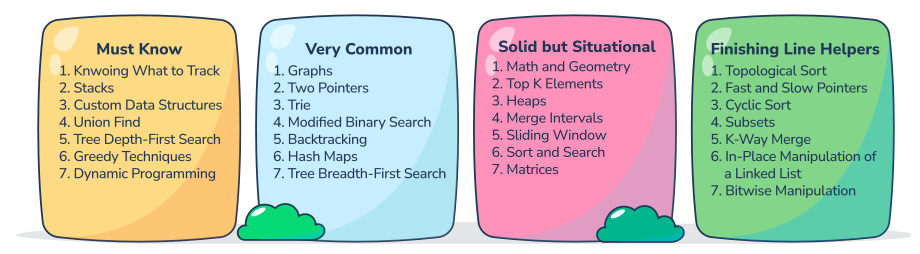
Must-know patterns: These appear often in DoorDash interviews and form the base of your preparation.
High-value patterns: They show up regularly and give you the extra depth you need.
Solid but situational patterns: These are less common but useful for handling different types of questions when the interview takes a turn.
Finishing-line helpers: These patterns don’t appear often, but covering them ensures you are fully prepared and not surprised by an unusual problem.
Although some patterns have appeared more often in past DoorDash coding interviews, it’s still important to practice all 28. This way, your prep feels complete, and you reduce the chances of being surprised in the actual interview.
The DoorDash-focused prep roadmap with 28 LeetCode patterns#
Preparing for DoorDash interviews is not about finishing every list you can find. The best approach is to build your prep in stages, where each step adds new coverage and strengthens you for the next one. Here is a clear roadmap that connects NeetCode 150, DoorDash-specific problems, and the 28 LeetCode Patterns.
Begin with the NeetCode-DoorDash overlap: These problems give you a strong starting point. They cover fundamentals you must know and align closely with what DoorDash has asked in the past.
Move to the DoorDash-only set: These problems show you the unique variations DoorDash prefers, such as delivery routing, scheduling, and optimization-heavy tasks.
Work through the rest of NeetCode 150: Expanding to the remaining problems ensures your prep is broad and you don’t leave any important area uncovered.
Finish with patterns: Covering all 28 patterns rounds out your prep. Patterns allow you to handle any variation, even if you haven’t practiced that question before.
As you follow this roadmap, remember the 1-2-1 rubric. It helps you measure progress and ensures balanced coverage across all patterns.


The NeetCode-DoorDash overlap#
The most effective first step is to cover the overlap between NeetCode 150 and DoorDash problems. This set is high-value because every problem you solve here strengthens your fundamentals while directly reflecting DoorDash’s interview history. It helps you recognize recurring patterns, reduces redundancy in your prep, and ensures that your effort is focused on questions most likely to come up again.
Let’s see how many problems overlap between NeetCode 150 and DoorDash top 86.
NeetCode 150 (Problem Name) | DoorDash Top 86 (Problem Name) |
Valid Sudoku | Valid Sudoku |
Largest Rectangle in Histogram | Largest Rectangle in Histogram |
Koko Eating Bananas | Koko Eating Bananas |
Max Area of Island | Max Area of Island |
Walls and Gates | Walls and Gates |
Longest Increasing Path in a Matrix | Longest Increasing Path in a Matrix |
Maximum Profit in Job Scheduling | |
Search Suggestions System | |
Encode and Decode Strings | Design File System |
. . . | . . . |
Diameter of N-Ary Tree | |
Task Scheduler II | |
Sum of Two Integers | Find Edges in Shortest Paths |
The table above shows only 32 problems out of 150 to avoid long scrolling. If you would like to see the complete set of problems for both NeetCode and DoorDash, click the “Show All Problems” button below.
The list above shows that there are 26 problems common to both sets. This is a decent number to start with. To see the real impact, let’s see how many patterns these overlapping problems cover and how well they are represented under the 1-2-1 rubric.
In the bar chart below, each bar represents a pattern. The length of the bar shows what percent of the full 15 points you’ve earned for that pattern, while the label highlights how many easy, medium, and hard problems went into that score.
Note: I have only considered the counts that satisfy our 1—2—1 rubric for this calculation. If a pattern has more questions than the rubric requires, I count only 1 easy, 2 medium, and 1 hard problem. For example, if Dynamic Programming has 10 medium questions, I have included just 2 in this calculation.


The chart above shows that the overlap between NeetCode 150 and DoorDash problems gives a strong head start, introducing you to 15 out of 28 patterns, which is almost half of the patterns.
Some core patterns, like Graphs and Trie, are almost fully covered, while the others remain underrepresented. The good part is that this stage at least exposes you to the patterns, which you can strengthen further using the 1-2-1 rubric.
Next: Focus on DoorDash-specific problems#
After covering the overlap, the next step is to practice the problems unique to DoorDash. These questions give you a clearer view of how DoorDash frames its interviews and prepare you for scenarios that NeetCode alone does not fully cover. Working through this set makes your prep more targeted and brings you closer to the company’s expectations.
Let’s look at the new patterns unlocked by the DoorDash-only problems.
Pattern |
The list above shows that 8 new patterns emerge, taking up 23 out of 28, about 82%. This is a big step forward and a sign that the prep is moving in the right direction.
Now, let’s see how well each pattern in the DoorDash-specific set is covered using the 1–2–1 rubric and scores. The bar chart below highlights the newly covered patterns in green on the y-axis.


The chart above shows that adding DoorDash-specific problems creates a big leap in coverage. Several previously identified patterns, such as Greedy Techniques, Dynamic Programming, and Stacks, have been strengthened.
Other patterns, such as Math and Geometry, Tree Breadth-First Search, and Backtracking, are partially covered. Only a handful of patterns remain underrepresented in red, such as Heaps, Sort and Search, Two Pointers, and Matrices, but the gaps can be filled easily with the 1-2-1 rubric in hand.
Complete the remaining NeetCode 150#
Once the overlap and DoorDash-specific problems are done, it’s important to go back and finish the rest of NeetCode 150. These problems may not map directly to DoorDash interviews, but still add significant value. Covering them strengthens your computer science fundamentals, exposes you to a wider set of patterns, and ensures no weak spots if an unfamiliar question comes your way. As a bonus, this also prepares you for interviews at other top tech companies, since the remaining problems cover common ground across the industry.
Let’s see what new patterns are introduced through the remaining NeetCode problems.
Pattern |
The list above shows that 5 new patterns are unlocked, increasing the total to 28 out of 28, which is 100%. This is a huge milestone as you are now exposed to all coding patterns.
Now, let’s see how well the patterns in this set are covered.


The chart above shows that completing the rest of NeetCode takes coverage close to completion. At this stage, most patterns are either fully covered or almost there. Several that were earlier red (underrepresented) or yellow (partially covered) now climb into green (well-covered). You also unlock the last few patterns like Subsets, Fast and Slow Pointers, and Cyclic Sort, ensuring that all 28 are represented.
Check if your DoorDash coding interview prep is done#
By this stage, you’ve worked through the overlap, DoorDash-specific problems, and the rest of NeetCode 150. The chart below gives you a snapshot of where your prep stands right now. It shows which patterns are well covered and which ones still need attention. This is a quick way to measure progress and confirm how close you are to completing preparation for DoorDash.


Looking at this chart, the overall coverage is very strong. Out of the 28 patterns, 17 are now well-covered. This shows that most of the important ground has already been covered.
The gap is smaller than it looks for the remaining patterns. A few are partially covered, such as Heaps, Knowing What to Track, and Bitwise Manipulation, and they only need one hard or medium problem each to move into the green section.
Underrepresented patterns include Subsets, Matrices, Hash Maps, K-way Merges, and Fast and Slow Pointers. These typically need two more problems to reach full strength.
Patterns recap for the DoorDash interview prep#
Let’s look at how we have progressed in pattern coverage along the DoorDash prep roadmap. Each stage adds more depth, fills missing areas, and steadily moves your prep closer to full coverage, i.e., 28 patterns.


The pie chart above shows that more than half of the patterns (53.6%) came from the common overlap between NeetCode and DoorDash, which gave the biggest push right at the start. The DoorDash-only problems added another 28.6%, introducing several new patterns and filling important gaps. Finally, the remaining NeetCode problems contributed 17.9%, which helped reach full coverage.
What is the score breakdown for this DoorDash roadmap?#
Let’s now quickly look at what score we have earned with the DoorDash-focused roadmap.


The score chart above shows steady progress toward the ideal target of 420 points. The common problems between NeetCode and DoorDash contribute 105 points, giving you a strong foundation immediately. Adding the DoorDash-only set brings in 123 points, the biggest boost in this roadmap. The remaining NeetCode problems add another 101 points, ensuring broader coverage across all core areas. Altogether, these stages give you 329 points out of 420.
That leaves only 91 points to be filled, which can be covered by focusing on the underrepresented patterns using the 1-2-1 rubric.
Wrapping up: NeetCode 150 or LeetCode patterns for DoorDash coding interviews?#
The short answer is that the most effective way to prepare for DoorDash coding interviews is to use LeetCode patterns within a smart strategy. That strategy is not about choosing one resource over another but blending the strengths of NeetCode 150, the DoorDash top 86 questions, and the 28 patterns.
This combination works because NeetCode 150 gives you a structured base, the DoorDash set aligns your practice with the company’s interview style, and the patterns provide the adaptability to handle problems you have never seen before. The 1-2-1 rubric makes this roadmap easier to follow, giving you a clear way to measure progress across all 28 patterns instead of getting lost in endless problem lists.
Learning patterns are especially crucial. Instead of memorizing solutions, you train yourself to recognize the underlying approach, whether heaps for scheduling, graphs for routing, or greedy optimization methods. This mindset shift lets you adapt quickly in the interview room and perform well under pressure.
The impact of this strategy is clear. You cover all 28 patterns, close gaps that a single list leaves behind, and build confidence in tackling any variation. More importantly, you walk into a DoorDash coding interview prepared not just to solve familiar problems, but to handle whatever challenge comes your way.
This blog is part of a broader series where I compare NeetCode 150 and LeetCode coding patterns across different companies. If you are preparing for coding interviews at any of these, you might also find the following blogs helpful:
NeetCode 150 vs. LeetCode Patterns: Which is best for Microsoft?
NeetCode 150 vs. LeetCode patterns: Which is effective for Apple?
NeetCode 150 vs. LeetCode patterns: Which prepares you for Amazon
NeetCode 150 vs. LeetCode patterns: What works best for Netflix?
NeetCode 150 vs. LeetCode patterns: Which is better for Google?
Recommended resources to level up your interview prep#
While this blog offers a data-driven way to measure and close your prep gaps, the right learning tools can further accelerate your progress. Here are two highly effective resources to complement your study plan:
Educative’s Personalized Interview Prep: Your tailored prep companion adapts to your skill level and focuses on the 28 essential LeetCode patterns we’ve been discussing. You can work on the patterns that need attention, track progress with clear metrics, and know exactly what to tackle next. Whether it’s adding an easy problem to build confidence or a hard one to push for mastery, you’ll always be working on the right problems at the right time.
Educative’s Mock Interviews: Practicing is not just about solving problems. It is also about handling real interview pressure. Educative’s AI mock interviews let you simulate actual interview conditions, get actionable feedback, and improve in areas like problem-solving speed. This way, you are technically prepared, confident, and ready to perform under time constraints.
