




To prepare for a Scala interview, start by mastering core concepts such as object-oriented programming, functional programming, types, and pattern matching. Practice coding problems on platforms like LeetCode and HackerRank to sharpen your problem-solving skills. Additionally, familiarize yourself with the Scala ecosystem, including frameworks like Play and Akka, libraries like Cats and Scalaz, and build tools such as SBT and Maven.
Table of Contents
Top Scala interview questions and answers
12 mins read
Mar 04, 2025
Share
Are you preparing for a Scala interview? As a language that blends functional and object-oriented programming paradigms, Scala has become an essential skill for developers. Mastering key concepts is especially important for roles at innovative companies like Scale AI. A solid understanding of Scala’s fundamentals and advanced topics will not only help you ace the interview but also give you a competitive edge in the tech world.
In this blog, we’ll dive into Scala concepts, providing insights into frequently asked questions and best practices. We’ll cover the following categories to ensure you are well-prepared:
Scala variables and data types
Functional programming and higher-order functions
Collections and data structures
Classes, objects, and traits
Advanced Scala interview questions
Let’s begin with one of the basics: Scala variables and data types, which are key to learning the language.
Learn Scala
Learn Scala
This course teaches you programming in Scala, one of the most popular languages today, used by companies like Twitter and LinkedIn. Scala is a statically typed, high-level language that blends functional and object-oriented programming, making it ideal for building scalable applications. This course covers everything from basic concepts like Scala variables, type casting in Scala, and print in Scala to advanced topics like recursive functions in Scala, tail recursion, Scala classes, and more. Whether building scalable apps or improving your skills, this course will help you master Scala programming.
Scala variables and data types#
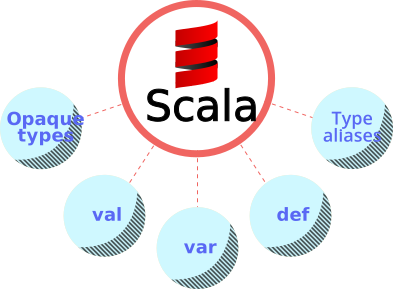
In Scala, variables are defined using specific keywords that govern their mutability and behavior. Additionally, Scala’s rich type system offers several advanced features that are important to understand.
Scala variables and data types
Let's now explore some of the most commonly asked interview questions that focus on Scala variables, data types, and related concepts.
What are the different ways to define variables in Scala?
In Scala, variables are defined using one of the following keywords:
val(value) defines an immutable reference, meaning once a value is assigned, it cannot be reassigned.vardefines a mutable reference, meaning the value can be changed after initialization.defis used to define a method or function, which can compute and return a value when called.lazy valdefines a reference that is initialized only when it is accessed for the first time, allowing for deferred computation.
What is the basic difference between
varandvalin Scala?
The main difference betweenvarandvallies in whether the variable is mutable or immutable:
val: Once assigned, the variable cannot be reassigned to a new value. It is immutable.var: The variable can be reassigned to a different value. It is mutable.
In essence, val creates constant references, while var creates references that can change.
What is the difference between
Null,Nil,None, andNothingin Scala?
These four terms are frequently used in Scala to represent different concepts of absence or non-existence, as explained in the following table:
Term | Description | Example |
| A special type that represents a reference pointing to no object. It is the type of all nullable reference types. |
|
| A value that represents an empty list, part of the Scala collections library. |
|
| Part of the “ |
|
| The bottom type in Scala, used to represent a value that never exists. Methods that do not return (such as those that throw exceptions) are typically typed as |
|
What is the difference between an opaque type and a type alias in Scala?
In Scala, both opaque types and type aliases allow you to give a new name to a type, but they do so in different ways with distinct use cases.
Type aliases: A type alias in Scala is a simple way to create an alternative name for an existing type. It does not create a new type but provides a shorthand to make the code more readable or simplify complex type signatures. Consider the following example:
// Complex class definition with a more descriptive nameclass EmployeePersonalAndProfessionalDetails(val name: String, val age: Int, val position: String, val department: String, val salary: Double)// Type alias for the complex classtype EmployeeInfo = EmployeePersonalAndProfessionalDetails// Creating an instance of EmployeeInfo (which is actually EmployeePersonalAndProfessionalDetails)val employee1: EmployeeInfo = new EmployeeInfo("Alice", 30, "Software Engineer", "Development", 80000.0)println(s"Employee Name: ${employee1.name}, Age: ${employee1.age}, Position: ${employee1.position}, Department: ${employee1.department}, Salary: ${employee1.salary}")
Type aliases in Scala
In this example, EmployeeInfo is a type alias for the class EmployeePersonalAndProfessionalDetails, providing a shorter and more convenient name for the same class. The alias does not change the behavior of the original class; it simply improves code readability, especially when dealing with lengthy or descriptive class names. At runtime, employee1 is still an instance of EmployeePersonalAndProfessionalDetails, and the compiler treats EmployeeInfo exactly as it would the original class name.
Opaque types: An opaque type, introduced in Scala 3, provides a more powerful way to create type safety by allowing you to define a new type that hides its underlying representation from the outside world. Opaque types provide encapsulation by ensuring that the new type behaves differently from its underlying type, even though they share the same representation at runtime. Consider the following example:
object NonNegativeInt {// Define an opaque type NonNegativeInt, backed by Intopaque type NonNegativeInt = Int// Constructor for creating NonNegativeInt instancesdef apply(value: Int): Option[NonNegativeInt] =if (value >= 0) Some(value) else None// Method to extract the underlying Int value from NonNegativeIntdef value(nn: NonNegativeInt): Int = nn}// Using the apply method to create instancesval positiveValue = NonNegativeInt(10)println(positiveValue.map(NonNegativeInt.value))// Using the apply method to create instances for negative valueval negativeValue = NonNegativeInt(-5)println(negativeValue) // Output: None (because the value is negative)
Opaque types in Scala
In this example:
NonNegativeIntis an opaque type backed byInt.You cannot directly assign an
Intto aNonNegativeIntvariable, ensuring that only non-negative integers can be constructed.The
applymethod ensures that the value is valid by returning anOption, which can either contain a validNonNegativeIntorNoneif the number is negative.Even though
NonNegativeIntis backed byInt, the type system treats it as a distinct type, offering greater type safety and encapsulation.
In summary, opaque types offer a way to enforce stricter type constraints and encapsulation, whereas type aliases are used for simplifying code without adding any new type safety or encapsulation.
Having covered Scala variables and data types, let’s now explore functional programming, focusing on higher-order functions that are key to writing clean and modular code.
Functional programming and higher-order functions in Scala#
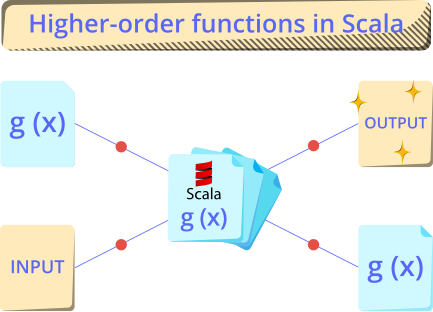
Higher-order functions either take one or more functions as parameters or return a function. In Scala, higher-order functions help create concise, reusable code by abstracting behavior and controlling flow.
Higher-order functions in Scala
Here’s a simple example where a higher-order function takes another function as an argument:
In the above code:
applyTwiceis a higher-order function that takes another functionf(which operates on integers) as an argument. It returns a new function that appliesftwice on the input valuex.In the example,
addOneis a simple function that increments its input by. addTwois created by passingaddOnetoapplyTwice, which results in a new function that appliesaddOnetwice. So,addTwo(3)first adds(resulting in ) and then adds again (resulting in ).
What are common higher-order functions in Scala?#
Scala provides several built-in higher-order functions, especially when working with collections. Let’s look at some of the most common ones:
map: Transforms each element in a collection using a given function.
val numbers = List(1, 2, 3, 4)val incrementedNumbers = numbers.map(x => x + 1) // List(2, 3, 4, 5)
filter: Filters a collection based on a predicate function.
val numbers = List(1, 2, 3, 4)val evenNumbers = numbers.filter(x => x % 2 == 0) // List(2, 4)
reduce: Aggregates the elements of a collection using a binary operation.
val numbers = List(1, 2, 3, 4)val sum = numbers.reduce((a, b) => a + b) // 10
fold: Similar toreduce, but it allows you to provide an initial value.
val numbers = List(1, 2, 3, 4)val sumWithInitial = numbers.fold(5)((a, b) => a + b) // 15
flatMap: Flattens a collection of collections and applies a function to each element.
val nestedList = List(List(1, 2), List(3, 4))val flattened = nestedList.flatMap(x => x) // List(1, 2, 3, 4)
for-comprehensions: A more concise way to work with collections and higher-order functions likemap,flatMap, andfilter.
val numbers = List(1, 2, 3, 4)val doubledEvens = for {x <- numbers if x % 2 == 0} yield x * 2 // List(4, 8)
With a strong foundation in functional programming, the next step is to understand how Scala’s powerful collections and data structures facilitate functional transformations and efficient data manipulation.
Interview Tip: Be ready to explain why higher-order functions are useful in functional programming. Practice writing and debugging code with map, flatMap, and filter.
Collections and data structures#
Scala’s collection library is one of the strongest aspects of the language, offering immutable and mutable collections with powerful built-in operations. With collections like Sets, Maps, Lists, and BitSets, Scala ensures efficient and flexible data handling.
Let’s now explore some interview questions related to Scala collections below:
What is a set in Scala? What are its different types?
Asetin Scala is a collection of unique elements. It has two main types:HashSet(unordered, fast) andTreeSet(sorted).What are maps in Scala?
AMapis a collection of key-value pairs. Scala offers both mutable and immutable maps, withHashMapandTreeMapbeing the most commonly used.How can we append to the list in Scala?
In Scala, lists are immutable, so to append to a list, you create a new list by prepending the element (e.g.,newElement :: list).Explain BitSet in Scala.
ABitSetin Scala is a collection that represents a set of integers using bits. It’s efficient in terms of memory and computation for storing sparse sets of numbers.Differentiate between a
view, alazyList, and aniteratorin Scala.
view: Aviewin Scala is a lazy collection that allows transformations without immediately applying them. The transformations are only evaluated when the data is accessed.LazyList: ALazyListis a lazy, immutable linked list in Scala, where elements are computed only when needed. Once an element is computed, it is cached for further use.iterator: Aniteratoris a collection that allows traversing through elements one at a time. It strictly consumes elements as it iterates, and once an element is consumed, it is not available again.
The following code example demonstrates the use of the three features:
In the above code, the view lazily transforms the list elements with map and evaluates only when explicitly converted to a collection using toList. The LazyList evaluates the list elements lazily, enabling partial computation when take(3) retrieves only the first three elements. The iterator sequentially traverses the list, processing each element one at a time, and cannot be reused after traversal.
After mastering collections and data structures, it’s essential to dive into how classes, objects, and traits provide a robust way to structure and organize Scala applications.
Classes, objects, and traits#
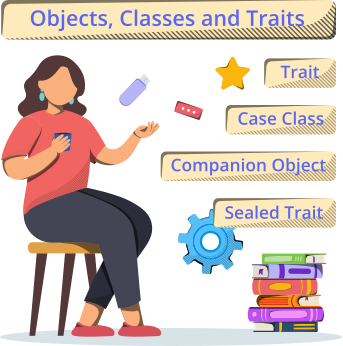
Scala provides a rich and flexible object-oriented programming model, where classes, objects, and traits play a vital role.
Classes, objects, and traits in Scala
Let’s explore some frequently asked questions in this category:
What is a trait in Scala?
A trait in Scala is a collection of abstract and concrete methods that define reusable behavior. Traits can be mixed into classes using theextendsorwithkeywords, providing Scala’s way of enabling multiple inheritance. Traits are similar tointerfacesin Java but can also include concrete methods and fields. They are a key feature of Scala’s support for multiple inheritance and modular design.What are case classes in Scala?
Case classes in Scala are a specialized type of class designed for immutability and concise syntax. They are typically used to define data models and enable features like:Automatic creation of
equals,hashCode, andtoStringmethods.Pattern matching for deconstructing objects.
Easy object instantiation without the
newkeyword.The
copymethod for creating modified copies of an instance.Support for pattern matching, allowing you to easily extract values from objects.
What is a companion class in Scala?
A companion class in Scala is a class that shares the same name as a companion object and resides in the same file. The class and object can access each other’s private members. This allows a clear separation between instance-specific logic (class) and shared functionality (object).What is an abstract type member in Scala?
An abstract type member in Scala allows you to define a type that will be concretely specified in a subclass or trait. It is useful when you want to abstract over a specific type without specifying it upfront. For example, in the following code snippet, theContainertrait declares an abstract typeA, which is specified later by a concrete class that extends the trait.
In the above code:
The
Containertrait defines an abstract type memberA,and a methodaddthat takes a parameter of typeA.In the
StringContainerclass, we provide a concrete definition for the type memberAasString, so now theaddmethod expects aStringparameter.We use a private list
elementsto store the added values and print them when added. The methodgetElementsreturns the list of added elements.
What is the difference between an abstract class and a sealed trait in Scala?
An abstract class can include constructors and be extended by classes outside its package. It is generally used when a base class with partial implementation is required.
A sealed trait, on the other hand, restricts its subtypes to be defined within the same file, ensuring exhaustive pattern matching and better type safety in functional programming.
In the above code, we demonstrate how traits, case classes, and companion objects work together in Scala:
Traits:
The
Vehicletrait provides common behavior (start()andstop()methods) that can be shared by multiple classes.The
Enginetrait defines an abstract methodstartEngine(), which is implemented by theCarclass. Traits allow us to mix in functionality from multiple sources.
Case class:
Caris a case class that extends both theVehicleandEnginetraits. Case classes in Scala are used for modeling immutable data and automatically provide methods likeequals(),hashCode(), andtoString().The
Carclass implements thestartEngine()method from theEnginetrait and includes its own methoddrive(), demonstrating how additional functionality can be added.
Companion object:
The
Carcompanion object contains anapply()method, which acts as a factory method to create instances of theCarclass. This simplifies object creation and avoids the need for thenewkeyword.
Sealed trait:
The
FuelTypetrait defines two case objects,PetrolandDiesel, which represent different fuel types. The sealed trait ensures that all possible subtypes ofFuelTypeare defined within the same file, allowing for safe pattern matching.
By combining these concepts, we achieve modular, reusable, and extensible code that takes advantage of Scala’s powerful type system and functional programming features.
Finally, let’s dive into some advanced Scala interview questions that will further enhance your understanding and mastery of the language.
Advanced Scala interview questions#
Once you have built a solid understanding of Scala fundamentals, it’s time to dive into more advanced topics that challenge your problem-solving and conceptual skills. Here are some of the advanced Scala interview questions to explore:
What is the use of tuples in Scala?
What is the difference between
varargsand aSeqin Scala?What is a context bound in Scala?
What is a higher-rank type in Scala?
Differentiate between a path-dependent type and a dependent method type in Scala.
Give one difference between type projection and type refinement in Scala.
Differentiate between a type constructor and a type parameterized trait in Scala.
Differentiate between the Product and Serializable traits in Scala.
What is the functionality of
yield?What is an auxiliary constructor?
What is the extractor in Scala?
How does Scala handle implicit resolution in the presence of ambiguity?
What is the difference between a future and a promise in Scala?
Differentiate between the Reader and Writer monads in Scala.
Differentiate between the IO and Task monads in Scala.
We recommend revisiting these questions once you have a strong grasp of Scala’s foundational concepts and are comfortable with its intermediate-level features. Becoming proficient in these topics will significantly enhance your understanding of the language and prepare you for challenging interview scenarios.
Grokking the Coding Interview Patterns
Grokking the Coding Interview Patterns
I created Grokking the Coding Interview because I watched too many talented engineers fail interviews they should have passed. At Microsoft and Meta, I saw firsthand what separated the candidates who succeeded from the ones who didn't. It wasn't how many LeetCode problems they'd solved. It was whether they could look at an unfamiliar problem and know how to approach it the right way. That's what this course teaches. Rather than throwing hundreds of disconnected problems at you, we organize the entire coding interview around 28 fundamental patterns. Each pattern is a reusable strategy. Once you understand two pointers, for example, you can apply them to dozens of problems you've never seen before. The course walks you through each pattern step by step, starting with the intuition behind it, then building through increasingly complex applications. As with every course on Educative, you will practice in a hands-on way with 500+ challenges, 17 mock interviews, and detailed explanations for every solution. The course is available in Python, Java, JavaScript, Go, C++, and C#, so you can prep in the language you'll actually use in your interview. Whether you're preparing for your first FAANG loop or brushing up after a few years away from interviewing, this course will give you a repeatable framework for cracking the coding interview.
Recommended resources for learning Scala#
To deepen your understanding of Scala and enhance your coding skills, here are some excellent resources that provide comprehensive learning paths and practical experience:
Learn Scala: This course is a great starting point for Scala beginners. It covers everything from the basics of Scala syntax to more advanced topics like functional programming and object-oriented concepts. With clear explanations and hands-on coding exercises, you’ll quickly become familiar with the core concepts of the language.
Become a Scala Developer: This Skill Path is perfect for those who want to dive deeper into Scala and build a solid foundation for real-world development. It includes content from multiple courses and practical exercises, covering everything you need to know to become proficient in Scala development and start applying your knowledge to solve complex problems.
Decode the Coding Interview in Scala: Real-World Examples: If you’re preparing for coding interviews, this course will help you tackle Scala-based coding challenges commonly asked in technical interviews. It offers real-world examples and problem-solving techniques, making it an invaluable resource for excelling at the art of coding interviews in Scala.
Test your Scala skills with mock interviews to improve problem-solving, receive feedback, and build confidence.
These resources will not only strengthen your Scala knowledge but also prepare you for real-world coding tasks and technical interviews. Happy learning!
Frequently Asked Questions
How to prepare for a Scala interview
How to prepare for a Scala interview
Is it difficult to learn Scala?
Is it difficult to learn Scala?
Do data engineers need to know Scala?
Do data engineers need to know Scala?
Is Scala similar to Java?
Is Scala similar to Java?
Written By:
Ishrat Fatima
Related Courses
Decode the Coding Interview in Scala: Real-World ExamplesMastering Leadership InterviewsEffective Unit and Integration Testing in ScalaGrokking the Coding Interview Patterns in C#Grokking the Coding Interview Patterns in JavaScriptGrokking the Coding Interview Patterns in C++Grokking the Coding Interview PatternsGrokking the Coding Interview Patterns in GoGrokking the Coding Interview Patterns in PythonThe All-in-One Guide to Java ProgrammingHTML for Front-end InterviewsWeb Development Interview HandbookJavaScript Design Patterns for Coding InterviewsThe Coding Career HandbookCompetitive Programming - Crack Your Coding Interview, C++