Spotify System Design Interview
Preparing for the Spotify System Design interview means understanding how to build global music streaming platforms with recommendations, playlists, search, and offline playback. Learn how to design scalable audio systems and demonstrate strong architecture.
Preparing for the Spotify System Design interview requires understanding how to architect one of the largest audio streaming ecosystems in the world. Spotify supports hundreds of millions of users who stream billions of songs daily while interacting with personalized recommendations, collaborative playlists, search systems, and multi-device playback. Designing systems that power these experiences requires deep knowledge of distributed systems, caching, streaming infrastructure, and large-scale data pipelines.
Unlike traditional System Design interviews that focus mainly on backend APIs or web platforms, the Spotify interview emphasizes large-scale media streaming systems and discovery algorithms. Engineers must demonstrate how to build pipelines that handle audio ingestion, encoding, catalog management, recommendation engines, search indexing, playlist collaboration, and offline playback while maintaining extremely low latency for streaming.
Grokking Modern System Design Interview
For a decade, when developers talked about how to prepare for System Design Interviews, the answer was always Grokking System Design. This is that course — updated for the current tech landscape. As AI handles more of the routine work, engineers at every level are expected to operate with the architectural fluency that used to belong to Staff engineers. That's why System Design Interviews still determine starting level and compensation, and the bar keeps rising. I built this course from my experience building global-scale distributed systems at Microsoft and Meta — and from interviewing hundreds of candidates at both companies. The failure pattern I kept seeing wasn't a lack of technical knowledge. Even strong coders would hit a wall, because System Design Interviews don't test what you can build; they test whether you can reason through an ambiguous problem, communicate ideas clearly, and defend trade-offs in real time (all skills that matter ore than never now in the AI era). RESHADED is the framework I developed to fix that: a repeatable 45-minute roadmap through any open-ended System Design problem. The course covers the distributed systems fundamentals that appear in every interview – databases, caches, load balancers, CDNs, messaging queues, and more – then applies them across 13+ real-world case studies: YouTube, WhatsApp, Uber, Twitter, Google Maps, and modern systems like ChatGPT and AI/ML infrastructure. Then put your knowledge to the test with AI Mock Interviews designed to simulate the real interview experience. Hundreds of thousands of candidates have already used this course to land SWE, TPM, and EM roles at top companies. If you're serious about acing your next System Design Interview, this is the best place to start.
The Spotify System Design interview questions evaluate whether candidates can design systems that combine high-performance media delivery with complex personalization infrastructure. This blog explains the architectural concepts that Spotify engineers expect candidates to understand and shows how to structure System Design answers that demonstrate senior-level engineering thinking.
What the Spotify System Design interview evaluates#
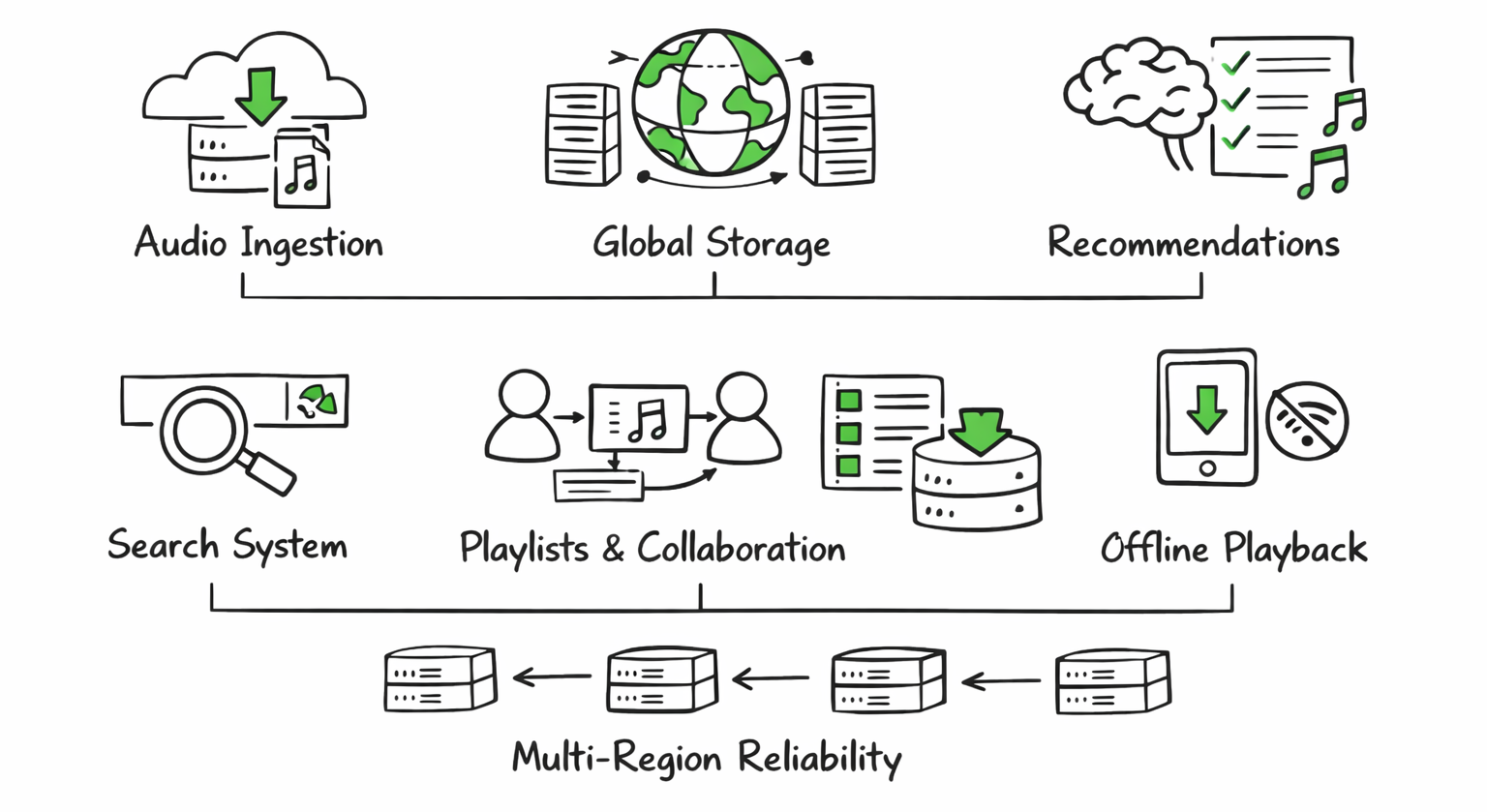
Spotify’s engineering infrastructure supports several critical systems that together create the modern music streaming experience. The System Design interview evaluates whether candidates understand how these systems interact and how they scale to support millions of simultaneous listeners.
These systems include audio ingestion pipelines, global audio storage and distribution networks, recommendation engines, search infrastructure, playlist collaboration systems, offline playback mechanisms, and multi-region reliability architecture. Each of these areas represents a major engineering challenge because they must operate reliably on an enormous scale.
Understanding the responsibilities of these systems helps candidates design architectures that reflect real-world Spotify infrastructure.
Scalability & System Design for Developers

As you progress in your career as a developer, you'll be increasingly expected to think about software architecture. Can you design systems and make trade-offs at scale? Developing that skill is a great way to set yourself apart from the pack. In this Skill Path, you'll cover everything you need to know to design scalable systems for enterprise-level software.
Audio ingestion and encoding pipeline#
Before users can stream music on Spotify, the platform must ingest audio files provided by record labels, distributors, and independent creators. These files often arrive in high-quality formats and must be processed before they can be streamed efficiently across millions of devices.
The ingestion pipeline begins by validating the uploaded files and checking metadata fields such as track identifiers, album information, and artist details. Accurate metadata is essential because it powers search functionality, recommendation algorithms, and licensing compliance across different geographic regions.
After validation, the pipeline processes the raw audio files by normalizing loudness levels and encoding them into multiple bitrate formats. These encoded files allow the streaming service to deliver audio at different quality levels depending on the user’s device and network conditions.
The table below summarizes the major components of the ingestion pipeline.
Pipeline Component | Role in the System |
Audio ingestion service | Accepts uploads from labels and distributors |
Metadata validator | Ensures track metadata accuracy |
Encoding service | Converts audio into multiple bitrates |
Preview generator | Creates short preview clips |
Object storage system | Stores encoded audio files |
This pipeline must operate continuously and reliably because Spotify receives thousands of new audio uploads each day.
System Design Deep Dive: Real-World Distributed Systems

Modern software systems are expected to operate at a massive scale while meeting strict reliability and latency requirements. Whether it’s a feed refresh, a payment request, or a real-time analytics query, users expect systems to respond instantly and consistently. That expectation has raised the bar for engineers today, understanding that System Design isn’t optional. It’s a core skill for building and evaluating production-grade systems. I built this course from my experience working on large-scale distributed systems at Microsoft (Azure) and Meta (Scuba), and from interviewing hundreds of candidates across both companies. The pattern I kept seeing was this: candidates understood individual components, but struggled to combine them into a coherent system. They knew what a cache or load balancer was, but not when or why to use it. This course is designed to bridge that gap. We start with the foundational building blocks of System Design, including databases, caching layers, load balancing, and messaging systems, and focus on how they interact under real-world constraints. From there, we analyze systems built by companies like Google, Facebook, and Amazon, breaking them down to understand the trade-offs behind each design decision. The goal is not just to learn concepts, but to develop the ability to reason through them in practice. This approach has helped a large number of engineers build stronger intuition for System Design and perform better in interviews. If you want to understand how real systems are designed and be able to design them yourself, this course gives you a clear, practical path forward.
Audio storage and global distribution#
Once audio files are encoded, they must be stored and distributed efficiently across the globe. Spotify users expect near-instant playback regardless of their geographic location, which means that the audio distribution system must minimize latency while supporting extremely high traffic volumes.
Spotify uses distributed object storage to store audio masters and encoded audio segments. These files are then replicated across multiple geographic regions to ensure reliability and availability even if one data center becomes unavailable.
To deliver audio efficiently to users, Spotify relies on content delivery networks that cache frequently requested tracks at edge locations close to listeners. Popular songs can therefore be served directly from edge caches rather than requiring repeated access to central storage systems.
The following table highlights the core components involved in global audio distribution.
Distribution Component | Purpose |
Object storage | Stores encoded audio segments |
Edge cache | Reduces latency for frequently played tracks |
CDN routing | Directs users to the closest cache |
Multi-region replication | Ensures reliability across regions |
Designing these systems requires careful consideration of storage efficiency, caching strategies, and global traffic routing.
Stream playback and device synchronization#
The streaming experience on Spotify involves much more than simply downloading audio files. The platform streams music in small chunks that allow playback to begin quickly while additional data continues downloading in the background.
This chunk-based streaming architecture supports adaptive buffering, which adjusts audio quality based on network conditions. When a user’s connection slows down, the system can switch to a lower bitrate stream to prevent playback interruptions.
Spotify also offers multi-device synchronization through a feature known as Spotify Connect. This feature allows users to control playback from one device while the music plays on another device, such as a smart speaker or gaming console.
Implementing this feature requires a messaging system that propagates playback commands across devices in real time. Technologies such as WebSockets or lightweight messaging protocols allow devices to remain connected to a central control channel.
Playback Component | Role |
Streaming server | Delivers audio chunks |
Adaptive bitrate logic | Adjusts quality based on network conditions |
Session manager | Tracks playback sessions |
Device synchronization service | Propagates playback commands |
These systems must operate with extremely low latency because users expect playback controls to respond instantly.
Personalized recommendation systems#
Spotify’s recommendation systems play a central role in the user experience because they help listeners discover new music. Features such as Discover Weekly and personalized playlists rely on machine learning models that analyze listening behavior and music similarity.
Recommendation systems typically use a combination of collaborative filtering and content-based analysis. Collaborative filtering identifies patterns among users with similar listening habits, while content-based methods analyze audio features such as tempo, rhythm, and instrumentation.
Modern recommendation architectures often rely on multi-stage ranking pipelines. These pipelines first retrieve a set of candidate songs and then apply machine learning models that score and rank these candidates according to user preferences.
Recommendation Component | Function |
User embedding model | Represents user listening behavior |
Track embedding model | Represents song characteristics |
Candidate retrieval system | Selects potential recommendations |
Ranking engine | Scores and orders candidates |
These systems must operate efficiently because recommendation updates occur frequently as user behavior evolves.
Search and catalog indexing#
Search functionality is another critical part of Spotify’s platform because it allows users to find songs, artists, albums, and playlists quickly. Designing an effective search system requires indexing large volumes of metadata while supporting fast query responses.
Spotify’s search infrastructure likely relies on inverted indexes that map terms to the documents containing those terms. These indexes enable efficient lookup of tracks and artists based on keywords entered by the user.
Search systems must also support features such as autocomplete suggestions, typo tolerance, and popularity-based ranking. For example, a search query for a popular artist should prioritize official content rather than unrelated results.
Search Component | Purpose |
Metadata index | Stores searchable track metadata |
Autocomplete service | Suggests search queries |
Ranking algorithm | Orders results by relevance |
Query processor | Handles search requests |
Efficient indexing ensures that search results remain accurate and responsive even as the music catalog grows.
Playlist management and collaboration#
Playlists are one of the most frequently used features on Spotify because they allow users to organize music according to their preferences. Many playlists are collaborative, meaning that multiple users can edit the same playlist simultaneously.
Supporting collaborative editing requires mechanisms that handle concurrent updates from multiple users. Systems must resolve conflicts when two users modify the same playlist at the same time while preserving a consistent order of tracks.
Playlist systems also store analytics data that tracks how often playlists are played or shared. This information can feed recommendation systems and help creators understand how audiences interact with their playlists.
Playlist Component | Role |
Playlist storage | Stores playlist data |
Collaboration service | Handles multi-user edits |
Conflict resolution system | Resolves concurrent changes |
Playlist analytics | Tracks usage patterns |
Efficient playlist management is essential because millions of playlists are created and modified every day.
Offline playback systems#
Spotify allows users to download music for offline listening, which introduces additional engineering challenges. Offline playback requires secure storage of encrypted audio files so that users can listen without an internet connection while still respecting licensing agreements.
The offline system must also enforce device limits and periodically verify that downloaded tracks remain authorized. These verification checks prevent unauthorized distribution of copyrighted audio files.
Offline synchronization services manage background downloads and ensure that updates to playlists or saved songs propagate correctly to offline devices.
Offline Component | Function |
Download manager | Handles background downloads |
Encryption module | Protects downloaded audio |
License validator | Verifies content permissions |
Sync service | Updates offline libraries |
Designing these systems requires balancing convenience for users with strict content licensing requirements.
Multi-region reliability#
Spotify’s global user base requires infrastructure that can handle traffic from hundreds of countries simultaneously. This demand necessitates multi-region architectures that replicate services across geographic locations.
Multi-region systems ensure that user requests are routed to nearby servers, which reduces latency and improves streaming performance. They also provide redundancy in case of outages affecting a specific region.
Engineers must design systems that maintain consistent metadata and user state across regions while isolating failures so that one region’s outage does not disrupt the entire platform.
Reliability Component | Role |
Global load balancer | Routes traffic to nearby regions |
Data replication system | Synchronizes metadata |
Regional failover system | Handles outages |
Disaster recovery system | Restores services |
Reliable global infrastructure ensures uninterrupted streaming even during large-scale infrastructure failures.
Format of the Spotify System Design interview#
The Spotify System Design interview typically lasts between forty-five and sixty minutes and focuses on evaluating a candidate’s ability to reason through complex distributed systems. Interviewers present a design problem and expect candidates to structure their response logically while explaining architectural decisions.
The interview often begins with requirement clarification, during which candidates identify the scope of the system and clarify performance or reliability expectations. This step helps avoid unnecessary complexity and ensures that the design aligns with the intended problem.
After clarifying requirements, candidates present a high-level architecture that outlines how the system processes data from ingestion through playback and personalization. Interviewers may then ask deeper questions about caching strategies, recommendation pipelines, or multi-region reliability.
Common Spotify System Design interview questions#
Spotify System Design interviews frequently include prompts related to streaming infrastructure or recommendation systems. One of the most common questions involves designing an end-to-end music streaming platform capable of supporting millions of users simultaneously.
Another frequently asked question focuses on designing Spotify’s Discover Weekly feature. Candidates must explain how user listening behavior feeds into machine learning pipelines that generate personalized playlists each week.
Interviewers may also ask candidates to design a collaborative playlist system that allows multiple users to edit playlists simultaneously. This problem evaluates how candidates handle concurrent updates and distributed data synchronization.
Search engine design is another common topic because music discovery depends heavily on efficient search infrastructure.
Structuring your System Design answer#
A strong System Design answer begins by clarifying requirements and identifying both functional and non-functional constraints. Candidates should ask questions about supported devices, streaming quality targets, geographic coverage, and whether recommendation systems are part of the scope.
After clarifying requirements, candidates should estimate the scale of the system, including the number of users, streams per day, and storage requirements. Providing realistic scale estimates demonstrates an understanding of large-scale system behavior.
Next, candidates present a high-level architecture that includes major components such as ingestion services, storage systems, recommendation engines, and playback services. This architecture should illustrate how data flows through the system from ingestion to user interaction.
Example architecture for Spotify streaming#
A simplified Spotify architecture begins when music files are uploaded through the ingestion pipeline and encoded into multiple bitrate formats. These encoded files are stored in distributed object storage and replicated across regions for reliability.
Content delivery networks cache popular tracks at edge locations to reduce latency. When a user starts playback, the client application requests a streaming manifest that lists available audio chunks.
The playback service streams audio chunks to the client while adaptive bitrate algorithms adjust audio quality based on network conditions. Meanwhile, recommendation systems analyze listening behavior to update personalized playlists and home screen suggestions.
Architecture Layer | Purpose |
Ingestion service | Processes audio uploads |
Object storage | Stores encoded audio |
CDN | Distributes audio globally |
Playback service | Streams audio chunks |
Recommendation engine | Personalizes music discovery |
This architecture demonstrates how distributed systems, caching strategies, and machine learning pipelines combine to create the modern streaming experience.
Final thoughts#
The Spotify System Design interview evaluates a candidate’s ability to design complex distributed systems that deliver media content to millions of users while providing highly personalized experiences. Engineers must understand streaming infrastructure, recommendation systems, search indexing, playlist collaboration, and offline playback mechanisms.
Candidates who succeed in these interviews typically present clear architectures that demonstrate scalability, reliability, and strong reasoning about trade-offs. By explaining how systems interact across ingestion, storage, distribution, and personalization pipelines, you can show the architectural thinking required to build global music streaming platforms.