What is ARN in AWS?
Master what ARN is in AWS to unlock a deeper understanding of IAM, security, and system design. If you are preparing for interviews or building real-world systems, learning ARNs will give you a strong edge in your AWS journey.
If you have spent even a little time exploring AWS, you have probably come across something called an ARN and wondered why it shows up everywhere. I remember the first time I encountered it while configuring IAM policies, and it felt like a long, confusing string that I just had to copy and paste without understanding. Over time, however, ARN turned out to be one of the most important concepts to truly grasp if you want to work confidently with AWS.
Understanding what is ARN in AWS is not just about memorizing a format but about learning how AWS identifies and manages resources at scale. Whether you are preparing for interviews or building real-world systems, this concept becomes essential when dealing with permissions, automation, and architecture design.
Learn the A to Z of Amazon Web Services (AWS)

Learn about the core AWS's services like compute, storage, networking services and how they work with other services like Identity, Mobile, Routing, and Security. This course provides you with a good grasp an all you need to know of AWS services. This course has been designed by three AWS Solution Certified Architects who have a combined industry experience of 17 years. We aim to provide you with just the right depth of knowledge you need to have.
What Does ARN Mean In AWS?#
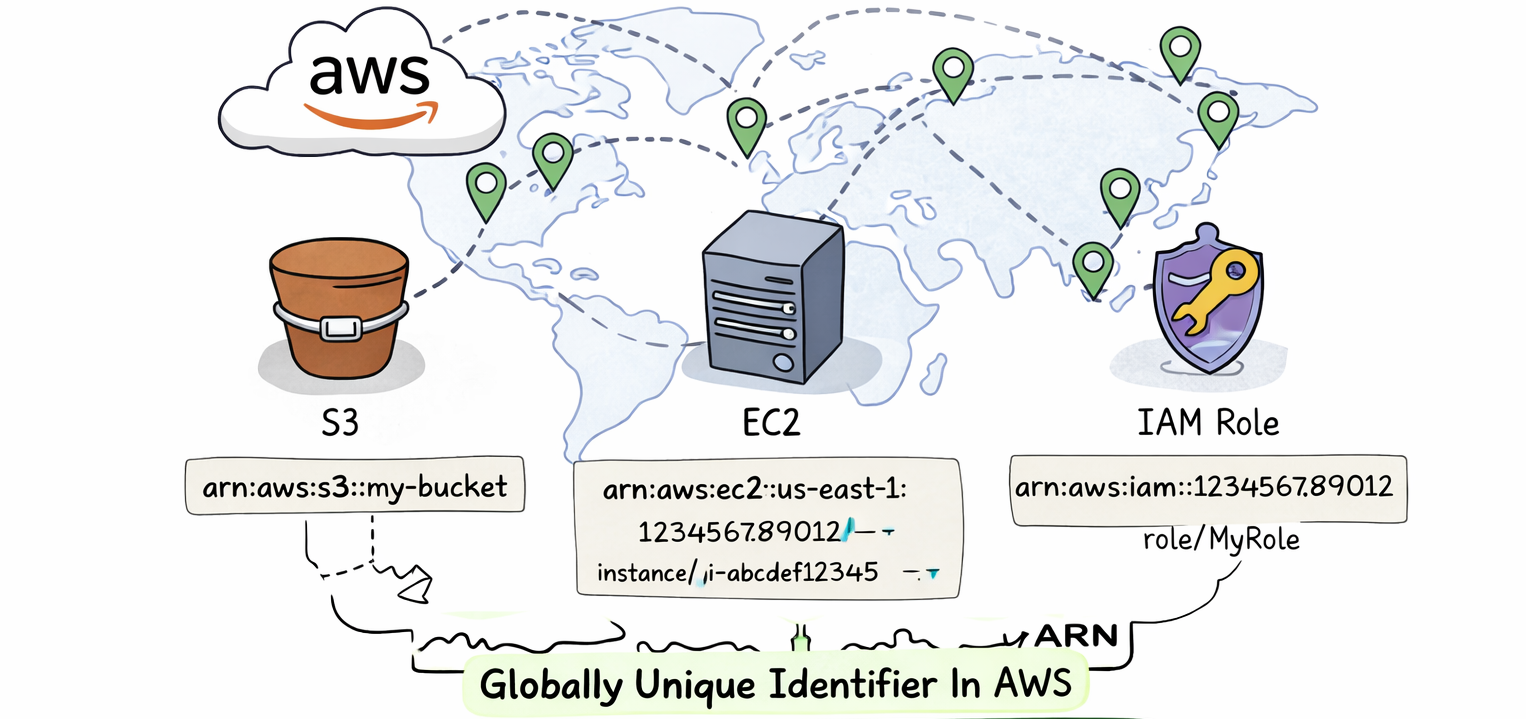
ARN stands for Amazon Resource Name, and it serves as a unique identifier for every resource in AWS. Think of it as a globally unique address that AWS uses internally to locate and manage resources across its infrastructure.
Whenever you create an S3 bucket, an EC2 instance, or even an IAM role, AWS assigns it an ARN that distinguishes it from every other resource. This becomes especially important in distributed systems where thousands of resources may exist across multiple regions and accounts.
Fundamentals of AWS

Amazon Web Services (AWS) is one of the front-runners in modern-day Cloud Computing. It provides users a one-stop-shop for all their cloud computing needs and resources. In recent years, Cloud Computing resources have taken over the industry, with use cases in multiple domains, ranging from Web Development to Machine Learning. This path will help you learn the fundamentals of AWS and be prepared to tackle real-world applications in AWS. By the end of this path, you will be comfortable with deploying applications on the platform.
Why ARN Matters In AWS Architecture#
At first glance, ARN may seem like an internal detail, but it plays a central role in how AWS systems communicate and enforce security. Without ARNs, AWS would not have a consistent way to reference resources across services.
In practice, ARNs are heavily used in IAM policies, service integrations, and automation workflows. If you want to grant access to a specific resource or trigger an action on a resource, you will almost always need its ARN, which makes understanding what ARN is in AWS critical for both beginners and experienced engineers.
The Good Parts of AWS: Cutting Through the Clutter
This is not your typical AWS reference course. You won’t find most of the knowledge that's shared here in the AWS docs. The goal here is to help you realize which AWS features you’d be foolish not to use — features that have passed the test of time by being at the backbone of most things on the Internet. In this course, you'll learn a technique used to help make reliable technical choices without getting paralyzed in the face of so many options. You’ll start by going through the most fundamental services AWS offers such as DynamoDB, S3, EC2. Each section breaks down how it’s used, the pros and cons, why you should (or shouldn't) be using it, and more. This course was written by a former Amazon engineer with 15 years of experience working on AWS.
Structure Of ARN In AWS#
One of the most important steps in mastering ARNs is understanding their structure. While they may look complex at first, they follow a predictable pattern that becomes easier to read once you break it down.
Here is the general format of an ARN:
arn:partition:service:region:account-id:resource
Each part of the ARN carries specific information about the resource, which allows AWS to uniquely identify it across its global infrastructure.
Components Of An ARN#
The following table explains each component of an ARN and its purpose:
Component | Description |
arn | Prefix indicating that this is an Amazon Resource Name |
partition | AWS partition such as aws, aws-cn, or aws-us-gov |
service | The AWS service, such as ec2, s3, or iam |
region | The region where the resource is located |
account-id | The AWS account ID that owns the resource |
resource | The specific resource identifier within the service |
Once you understand these components, reading an ARN becomes much more intuitive, and you can quickly identify what resource it refers to.
Real Examples Of ARN In AWS#
To make this more concrete, let’s look at some real examples of ARNs across different AWS services. Seeing these in context helps you connect the structure to actual use cases.
Service | Example ARN |
S3 Bucket | arn:aws:s3:::my-example-bucket |
EC2 Instance | arn:aws:ec2:us-east-1:123456789012:instance/i-1234567890abcdef0 |
IAM Role | arn:aws:iam::123456789012:role/MyRole |
Lambda Function | arn:aws:lambda:us-east-1:123456789012:function:my-function |
What stands out here is that not all ARNs look exactly the same, especially when it comes to the resource part. Some services, like S3, do not include a region, while others follow a more detailed structure.
Types Of ARN Formats In AWS#
While the general ARN structure remains consistent, AWS supports different formats depending on the service and resource type. This is where many learners get confused, especially during interview preparation.
Standard Format#
The most common format includes all components such as service, region, and account ID. This is typically used for resources like EC2 instances and Lambda functions.
Resource Type Format#
Some ARNs include a resource type along with the resource name, separated by a slash or colon. This helps AWS distinguish between different types of resources within the same service.
Simplified Format#
Certain services like S3 use a simplified ARN format without region or account ID. This is because S3 is a global service and does not operate within a specific region in the same way as others.
How ARN Is Used In IAM Policies#
One of the most practical applications of ARN is in IAM policies, where it defines which resources a user or service can access. This is where understanding what is ARN in AWS becomes directly relevant to real-world work.
When you write an IAM policy, you typically specify ARNs in the "Resource" field to control access. For example, you might allow a user to read data from a specific S3 bucket or invoke a particular Lambda function.
Here is a simplified view of how ARN appears in IAM policies:
Policy Element | Example |
Action | s3:GetObject |
Resource | arn:aws:s3:::my-example-bucket/* |
Effect | Allow |
This shows how ARNs act as the bridge between permissions and actual resources in AWS.
Wildcards In ARN#
Another important concept that often comes up during learning and interviews is the use of wildcards in ARNs. Wildcards allow you to match multiple resources without specifying each one individually.
For example, using an asterisk symbol can allow access to all objects within an S3 bucket. This is powerful but must be used carefully, as overly broad permissions can lead to security risks.
Wildcards are commonly used in automation and large-scale systems where defining every resource individually would not be practical. However, understanding their implications is key to designing secure systems.
ARN In Cross-Service Integration#
As you move into more advanced AWS use cases, ARNs become essential in connecting different services. For example, when setting up an event-driven architecture, services like SNS, SQS, and Lambda often reference each other using ARNs.
In these scenarios, ARNs act as the glue that binds services together, allowing them to interact seamlessly. This is why interviewers often test your understanding of ARNs in system design discussions involving AWS.
Common Mistakes When Working With ARN#
From my experience mentoring developers preparing for cloud interviews, there are a few common mistakes that repeatedly show up. These mistakes usually stem from treating ARNs as static strings rather than understanding their structure.
One common issue is hardcoding ARNs without considering environment differences such as region or account ID. Another frequent mistake is misunderstanding wildcard usage, which can either break functionality or introduce security vulnerabilities.
Recognizing these pitfalls early can save you a lot of debugging time and help you build more robust systems.
ARN And AWS Security Best Practices#
Security in AWS heavily relies on precise resource identification, and ARNs play a central role in achieving that precision. By defining exact resources in IAM policies, you can enforce the principle of least privilege, which is a cornerstone of secure system design.
When you fully understand what is ARN in AWS, you can design policies that grant only the necessary permissions. This not only improves security but also demonstrates a strong grasp of AWS fundamentals during interviews.
How To Remember ARN Easily#
If you are preparing for interviews, memorizing the ARN format might feel overwhelming at first. The trick is to focus on understanding the pattern rather than memorizing it word for word.
Once you recognize that every ARN follows a logical structure of service, region, account, and resource, it becomes much easier to reconstruct it when needed. With a bit of practice, you will start reading ARNs almost like URLs.
ARN In Real-World Projects#
In real-world AWS projects, ARNs appear everywhere, from infrastructure-as-code templates to monitoring configurations. Tools like Terraform and CloudFormation rely heavily on ARNs to define and connect resources.
When building scalable systems, you will often pass ARNs between services to enable communication. This makes ARNs a foundational concept that extends far beyond theory and directly impacts how you design and deploy applications.
How ARN Helps In Interview Preparation#
From an interview perspective, ARNs are often tested indirectly through questions about IAM, security, and system design. Interviewers may not always ask “what is ARN in AWS” directly, but they expect you to understand how resources are identified and referenced.
Being comfortable with ARNs allows you to confidently explain how permissions are configured, how services interact, and how resources are managed. This level of clarity can make a strong impression during technical interviews.
Final Thoughts#
Understanding what is ARN in AWS is one of those foundational concepts that quietly powers everything you do in the cloud. It might seem like a small detail at first, but it plays a critical role in security, architecture, and system design.
If you invest time in truly understanding ARNs rather than just memorizing them, you will find it much easier to work with AWS services and explain your solutions during interviews. Over time, it becomes second nature, and that is when you know you have moved beyond beginner-level understanding.