What is Dynamic Programming?
Struggling with inefficient algorithms? Learn how dynamic programming helps you eliminate repeated work, optimize performance, and solve complex problems with confidence; perfect for interviews and real-world engineering challenges.
When developers begin studying algorithms and advanced problem-solving techniques, they frequently encounter dynamic programming as a fundamental concept. At this stage, many learners try to figure out what dynamic programming is because it appears repeatedly in technical interview preparation materials, competitive programming challenges, and algorithm design courses.
Many computational problems initially appear straightforward but become inefficient when solved using simple recursion. Recursive solutions often repeat the same calculations multiple times, which can dramatically increase the time required to solve the problem. As the size of the input grows, these redundant computations can make an algorithm impractical.
Dynamic programming provides a structured way to address this challenge. Instead of recomputing the same values repeatedly, it stores previously computed results and reuses them when needed. This strategy reduces unnecessary calculations and significantly improves performance for certain types of problems.
Grokking Dynamic Programming Interview
Some of the toughest questions in technical interviews require dynamic programming solutions. Dynamic programming (DP) is an advanced optimization technique applied to recursive solutions. However, DP is not a one-size-fits-all technique, and it requires practice to develop the ability to identify the underlying DP patterns. With a strategic approach, coding interview prep for DP problems shouldn’t take more than a few weeks. This course starts with an introduction to DP and thoroughly discusses five DP patterns. You’ll learn to apply each pattern to several related problems, with a visual representation of the working of the pattern, and learn to appreciate the advantages of DP solutions over naive solutions. After completing this course, you will have the skills you need to unlock even the most challenging questions, grok the coding interview, and level up your career with confidence. This course is also available in C++, JavaScript, and Python—with more coming soon!
Because of its ability to transform inefficient recursive solutions into efficient algorithms, dynamic programming is widely used in software engineering interviews, algorithm competitions, and optimization problems in real-world systems.
Understanding dynamic programming#
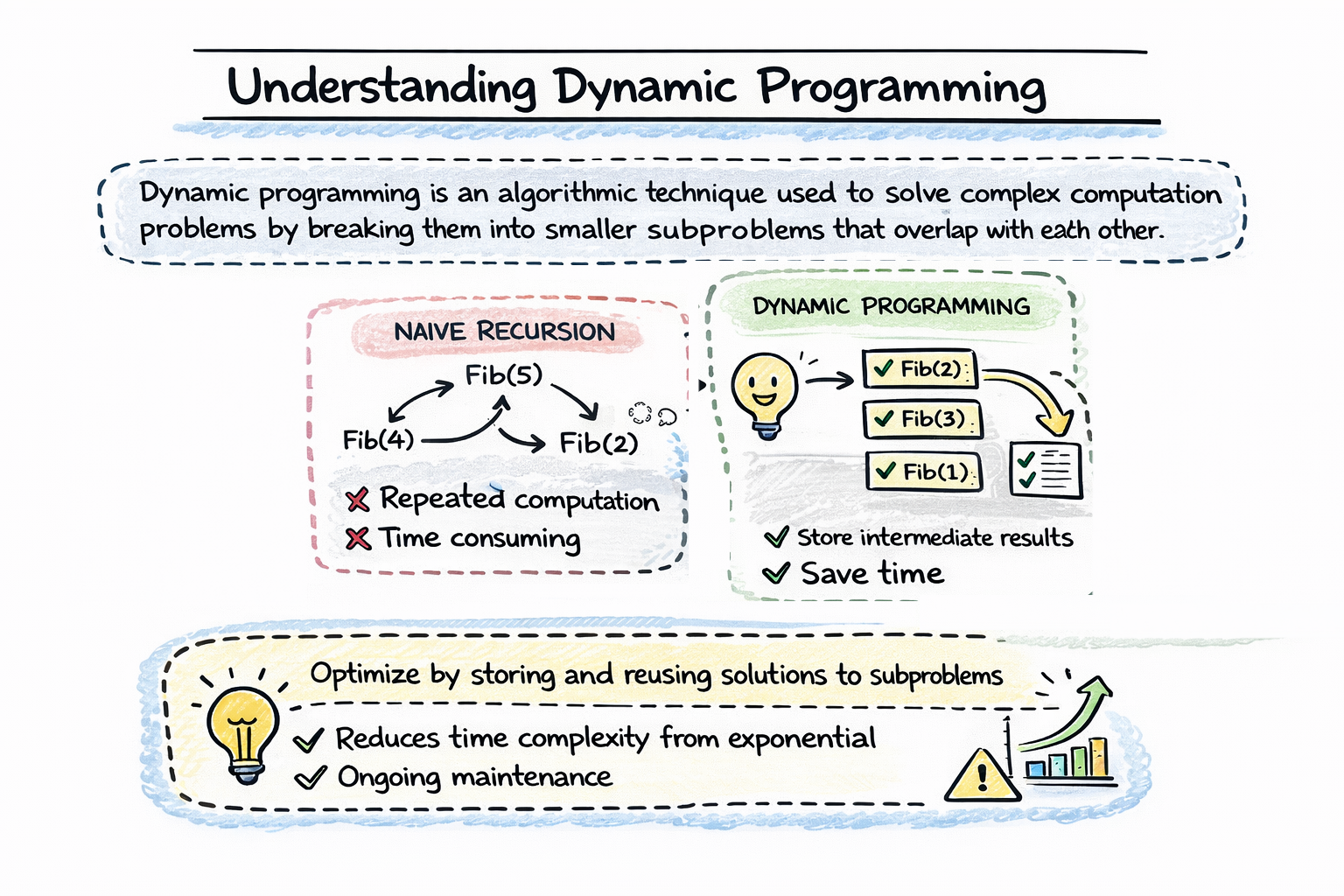
Dynamic programming is an algorithmic technique used to solve complex computational problems by breaking them into smaller subproblems that overlap with each other. Instead of solving the same subproblem multiple times, the algorithm stores the results of these subproblems so that they can be reused later.
This approach relies on the observation that many problems contain repeated computations. In a naive recursive solution, the same intermediate results may be calculated repeatedly, which increases the overall time complexity of the algorithm. Dynamic programming avoids this inefficiency by remembering previously computed values.
The stored results can be accessed whenever the same subproblem appears again, allowing the algorithm to reuse earlier work instead of recomputing it. As a result, problems that would otherwise require exponential time can often be solved in polynomial time.
Understanding what is dynamic programming is essential for developers who want to design efficient algorithms for problems involving optimization, counting, or sequential decision making.
Dynamic programming overview#
Concept | Description |
Dynamic programming | Technique that solves problems by dividing them into overlapping subproblems |
Memoization | Storing previously computed results during recursion |
Tabulation | Iteratively building solutions using a table |
Optimal substructure | Property where the optimal solution depends on solutions to smaller subproblems |
These concepts form the foundation of dynamic programming techniques.
Dynamic programming itself refers to the overall approach of solving complex problems by breaking them into smaller overlapping subproblems. Memoization represents a top-down technique where results are stored during recursion. Tabulation represents a bottom-up technique where solutions are built iteratively. Optimal substructure describes the property that the optimal solution to a problem depends on the optimal solutions to its subproblems.
Together, these ideas define the structure of dynamic programming algorithms.
Key characteristics of dynamic programming problems#
Certain characteristics make a problem suitable for dynamic programming solutions.
Overlapping subproblems: Many algorithmic problems require solving the same smaller problems repeatedly. In recursive solutions, these subproblems may appear multiple times throughout the computation. Dynamic programming addresses this inefficiency by storing the results of previously solved subproblems so they can be reused later.
Optimal substructure: A problem exhibits optimal substructure when the optimal solution to the overall problem can be constructed from the optimal solutions of its smaller subproblems. For example, the shortest path between two nodes in a graph may depend on the shortest paths between intermediate nodes.
State representation: In dynamic programming, each subproblem must be represented using a well-defined state. The state typically describes the parameters that uniquely identify the subproblem being solved.
Transition relation: The transition relation defines how solutions to smaller subproblems combine to produce the solution to a larger problem. This relationship is often expressed as a recurrence relation that describes how the current state depends on previous states.
Recognizing these characteristics helps developers identify problems that can be solved using dynamic programming techniques.
Two main approaches to dynamic programming#
Dynamic programming can be implemented using two primary approaches.
Memoization (Top-down approach)#
Memoization follows a top-down strategy that builds on recursive solutions. In this approach, the algorithm begins with the original problem and recursively breaks it into smaller subproblems.
Whenever a subproblem is solved, the result is stored in a data structure such as a dictionary or array. If the same subproblem appears again later, the algorithm retrieves the stored result instead of recomputing it.
Memoization preserves the natural structure of recursive solutions while improving performance by avoiding redundant calculations.
Tabulation (Bottom-up approach)#
Tabulation takes a bottom-up approach that builds the solution iteratively. Instead of starting with the original problem, the algorithm begins by solving the smallest possible subproblems.
The results of these small subproblems are stored in a table or array. Larger subproblems are then solved using the previously stored values until the final solution is obtained.
Tabulation avoids recursion entirely and can sometimes be more efficient because it eliminates function call overhead.
Example: Fibonacci using dynamic programming#
The Fibonacci sequence provides a classic example of how dynamic programming improves algorithm efficiency.
In this implementation, an array named dp stores previously computed Fibonacci numbers. Each new value in the sequence is calculated using the two preceding values that have already been stored.
This method avoids the repeated calculations that occur in naive recursive implementations, where the same Fibonacci numbers are recomputed many times.
Learning what is dynamic programming becomes clearer through examples like this because they demonstrate how storing intermediate results reduces computational effort.
Dynamic programming vs recursion#
Approach | Advantages | Limitations |
Recursion | Simple and intuitive | Repeated calculations |
Dynamic programming | Efficient with stored results | Requires additional memory |
Recursive solutions are often easier to write and understand because they follow the natural structure of many mathematical problems. However, they can become inefficient when subproblems overlap.
Dynamic programming addresses this inefficiency by storing intermediate results, which eliminates redundant computations. The trade-off is that dynamic programming algorithms typically require additional memory to store these results.
Developers choose between these approaches depending on the structure of the problem and performance requirements.
Real-world applications of dynamic programming#
Dynamic programming techniques appear in many real-world optimization problems.
In shortest path algorithms, dynamic programming principles help determine the most efficient route between nodes in a network. Algorithms such as the Bellman–Ford algorithm rely on this approach.
In resource allocation optimization, dynamic programming helps determine the best distribution of limited resources across competing tasks.
In bioinformatics, dynamic programming is used for sequence alignment, where algorithms compare DNA or protein sequences to identify similarities.
Dynamic programming also appears in financial optimization and decision-making systems, where algorithms evaluate multiple possible decisions and choose the most beneficial outcome.
These applications illustrate how the principles behind dynamic programming extend far beyond academic exercises.
FAQ#
Why is dynamic programming considered efficient?#
Dynamic programming is considered efficient because it eliminates repeated calculations by storing previously computed results. By reusing these results instead of recomputing them, the algorithm significantly reduces time complexity for problems that contain overlapping subproblems.
Is dynamic programming difficult to learn?#
Dynamic programming can initially appear challenging because it requires careful thinking about how to break problems into subproblems and define appropriate states. However, with practice and exposure to common patterns, many developers become comfortable applying these techniques.
When should developers use dynamic programming instead of recursion?#
Developers should consider dynamic programming when recursive solutions involve repeated calculations of the same subproblems. If a problem contains overlapping subproblems and optimal substructure, dynamic programming can often provide a more efficient solution.
How can beginners practice dynamic programming problems?#
Beginners can practice dynamic programming by solving classic algorithm problems such as Fibonacci sequences, coin change problems, longest common subsequences, and knapsack optimization. Working through these problems helps develop intuition about state representation and recurrence relations.
Final words#
Dynamic programming is a powerful algorithmic technique that improves efficiency by breaking complex problems into smaller overlapping subproblems and storing their results for reuse. This approach reduces redundant computations and enables developers to solve problems that would otherwise be computationally expensive.
Understanding what is dynamic programming helps developers design efficient algorithms for optimization, sequence analysis, and many other computational tasks. As developers gain experience applying these techniques, they become better equipped to solve challenging problems in both technical interviews and real-world software systems.