What is Seaborn and how does it work in Python?
Learn what seaborn is and how it simplifies data visualization in Python. Discover how data scientists use seaborn to analyze distributions, explore relationships, and build clear statistical graphics for machine learning and analytics.
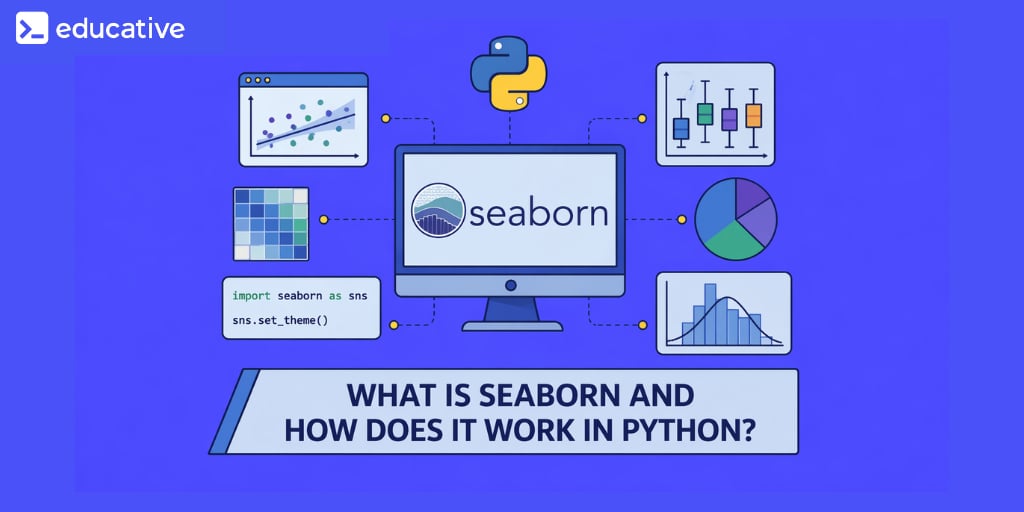
Data visualization plays a crucial role in modern data science and machine learning workflows because it helps analysts understand patterns, relationships, and trends within complex datasets. Raw data alone can be difficult to interpret, especially when working with large volumes of numerical information. This is why visualization libraries are essential tools for data analysts and scientists.
Many Python users encounter the question what is seaborn when they begin exploring data visualization libraries beyond the basics of matplotlib. Seaborn is a powerful Python library designed specifically to create attractive and informative statistical graphics with minimal code.
Understanding what seaborn is is important for anyone preparing to work in data science, machine learning, or analytics roles. This guide explores the purpose of the library, its key features, visualization capabilities, and how it fits into the Python data science ecosystem.
Data Visualization and Analysis With Seaborn Library
This course aims to provide an introduction to data visualization and analysis using Python and the Seaborn library. The course begins by introducing various variable types and statistical analysis methods. Then, you get to review the foundations of data cleaning and extraction using the pandas library. In the second half of the course, you will go over different plots in Seaborn for numerical, continuous, and categorical data, as well as distribution and regression plots to gain insightful information and identify patterns in the data. Lastly, you get to learn to create complex visualizations that are also aesthetically pleasing and go into great detail about the Seaborn themes, color palettes, styling, and multiplot grids. By the end of this course, you’ll apply the knowledge you’ve gained with a hands-on project.
Understanding Data Visualization In Python#
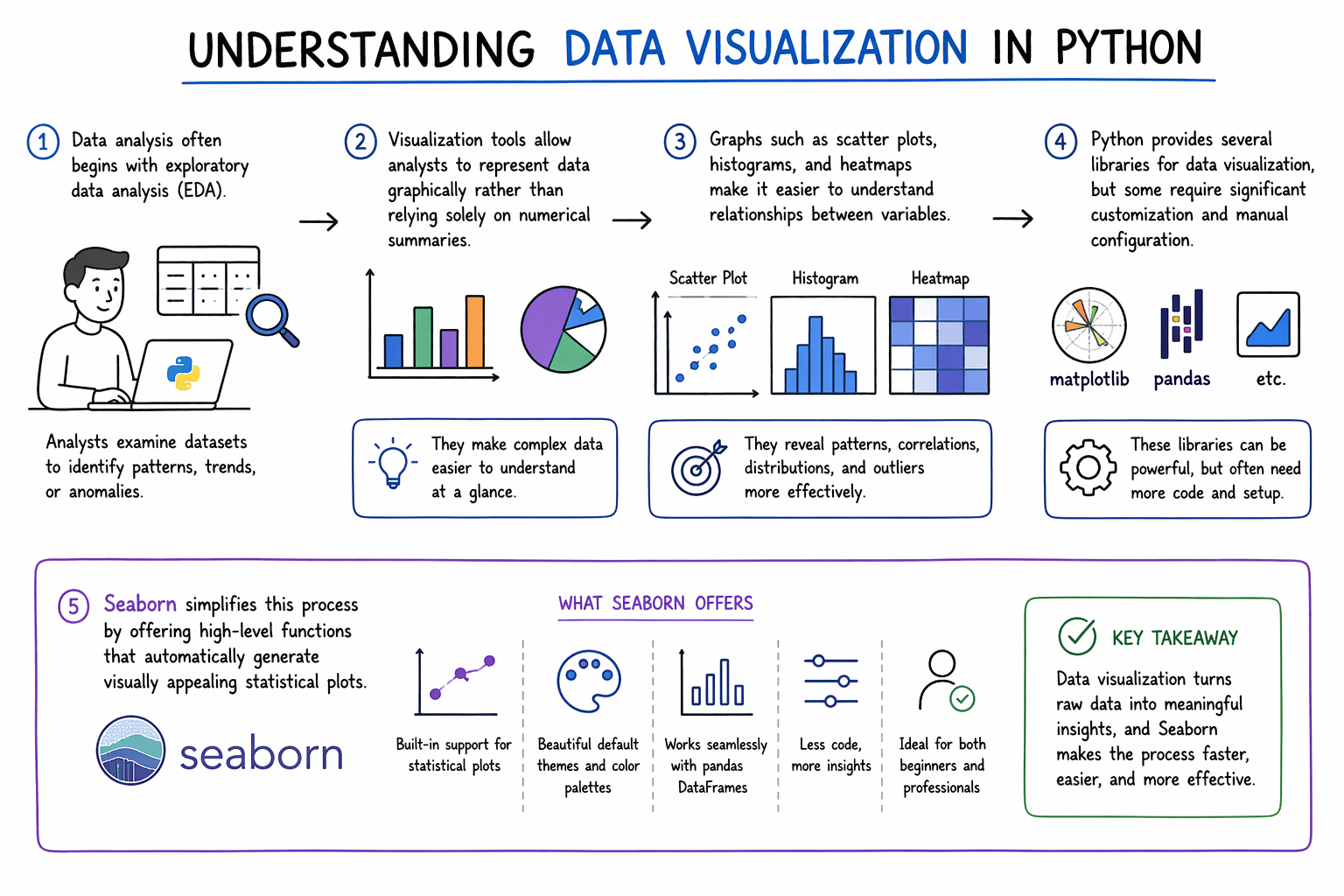
Before exploring what is seaborn, it is helpful to understand why visualization libraries are necessary in data science workflows. Data analysis often begins with exploratory data analysis, where analysts examine datasets to identify patterns, trends, or anomalies.
Visualization tools allow analysts to represent data graphically rather than relying solely on numerical summaries. Graphs such as scatter plots, histograms, and heatmaps make it easier to understand relationships between variables.
Python provides several libraries for data visualization, but some require significant customization and manual configuration. Seaborn simplifies this process by offering high-level functions that automatically generate visually appealing statistical plots.
The following table illustrates the relationship between common Python data visualization libraries.
Library | Purpose | Typical Use Case |
Matplotlib | Core plotting library | Basic visualizations |
Seaborn | Statistical visualization library | Data exploration |
Plotly | Interactive visualization library | Web-based dashboards |
Bokeh | Interactive data visualization | Data applications |
Understanding what seaborn is becomes easier when it is viewed as an advanced visualization layer built on top of matplotlib.
What Is Seaborn And Why Is It Used#
Seaborn is an open-source Python visualization library designed for creating statistical graphics that are both informative and aesthetically pleasing. It was developed to simplify the process of visualizing complex datasets and exploring relationships between variables.
One of the defining characteristics of seaborn is its ability to work directly with structured datasets such as pandas DataFrames. This integration allows users to generate visualizations without extensive data manipulation.
When learning data visualization with seaborn, it becomes clear that the library focuses heavily on statistical visualization rather than simple plotting. Many of its functions automatically compute statistical relationships and display them visually.
Seaborn allows analysts to focus on interpreting data rather than spending excessive time configuring graphical details.
Key Features Of Seaborn#
Seaborn provides a range of features that make it one of the most widely used data visualization tools in the Python ecosystem. These features allow analysts to create complex visualizations with relatively little code.
One important feature involves automatic styling and color palettes that produce visually appealing graphs by default. This eliminates the need for extensive customization that is often required when using lower-level visualization libraries.
Another important capability involves statistical plotting functions that visualize distributions, relationships, and categorical comparisons.
Understanding what seaborn is requires recognizing how these features simplify exploratory data analysis and make visual insights easier to discover.
Integration With Python Data Science Libraries#
Seaborn integrates closely with other libraries commonly used in data science workflows. This integration makes it easy to visualize datasets that have already been processed using other tools.
The library works particularly well with pandas, which is widely used for data manipulation and analysis. Seaborn functions often accept pandas DataFrames directly as input, allowing analysts to create visualizations using column names instead of manually extracting arrays.
The following table illustrates how seaborn integrates with other Python libraries.
Library | Role In Data Science | Integration With Seaborn |
Pandas | Data manipulation | Direct DataFrame support |
NumPy | Numerical computations | Underlying data structures |
Matplotlib | Plot rendering engine | Seaborn builds on top of it |
Scikit-Learn | Machine learning models | Visualization of results |
Understanding what is seaborn also involves recognizing how it complements these libraries in a typical data science pipeline.
Types Of Visualizations Supported By Seaborn#
Seaborn provides several categories of plots designed to visualize different types of statistical relationships. Each plot type focuses on a specific aspect of data analysis.
Distribution plots allow analysts to examine how values are distributed across a dataset. Relationship plots help visualize correlations between variables.
Categorical plots compare numerical values across different groups or categories.
The following table summarizes common visualization types supported by seaborn.
Plot Type | Purpose | Example Use Case |
Scatter Plot | Show relationship between variables | Analyzing correlations |
Histogram | Display data distribution | Examining feature distribution |
Box Plot | Compare data across categories | Detecting outliers |
Heatmap | Visualize correlation matrices | Feature relationships |
Understanding these visualization types helps explain what is seaborn and how it supports exploratory data analysis.
Distribution Visualization In Seaborn#
Distribution plots help analysts understand how data values are spread across a dataset. Understanding distributions is important for identifying skewness, central tendencies, and variability.
Seaborn offers functions that generate histograms, kernel density plots, and other distribution visualizations. These plots allow analysts to quickly examine whether a dataset follows normal or skewed distributions.
When exploring what seaborn is, distribution plots represent one of the most frequently used visualization techniques. They provide insights into how data behaves before applying machine learning models or statistical analyses.
Distribution visualizations play a fundamental role in exploratory data analysis workflows.
Relationship Visualization In Seaborn#
Relationship plots are used to explore how variables interact with one another. These plots help analysts identify correlations, trends, and dependencies between features.
Scatter plots are one of the most common relationship visualizations supported by seaborn. These plots represent data points in two-dimensional space, making it easier to observe patterns between variables.
Seaborn also provides regression plots that display trend lines alongside data points. These plots allow analysts to visualize statistical relationships between variables.
Understanding what is seaborn involves recognizing how relationship visualizations help reveal hidden patterns within datasets.
Categorical Data Visualization#
Categorical data visualization focuses on comparing numerical values across different categories or groups. These visualizations help analysts understand how values differ between categories.
Box plots and violin plots are commonly used to display categorical distributions. These plots illustrate how numerical values vary across categories while highlighting potential outliers.
Categorical visualizations are especially useful in fields such as business analytics and market research, where comparisons between groups are common.
Seaborn simplifies the creation of these visualizations by automatically handling grouping and statistical calculations.
Heatmaps And Correlation Analysis#
Heatmaps are another powerful visualization technique supported by seaborn. These plots display values within a matrix format where colors represent numerical magnitudes.
Heatmaps are frequently used to visualize correlation matrices that show relationships between multiple variables within a dataset. These visualizations help analysts identify highly correlated features that may influence machine learning models.
The following table illustrates how correlation values are interpreted in heatmap visualizations.
Correlation Value | Relationship Strength | Interpretation |
0.9 – 1.0 | Very Strong | Highly correlated variables |
0.7 – 0.9 | Strong | Significant relationship |
0.4 – 0.7 | Moderate | Moderate correlation |
0.0 – 0.4 | Weak | Limited relationship |
Heatmaps provide valuable insights when performing exploratory data analysis.
Advantages Of Using Seaborn#
One of the primary advantages of seaborn is its ability to produce complex statistical visualizations with minimal configuration. Analysts can generate professional-quality graphics without writing extensive plotting code.
Seaborn also includes built-in themes and color palettes that improve the appearance of visualizations automatically. These styling options make plots easier to interpret and present.
Another advantage involves seamless integration with pandas DataFrames, which simplifies the process of creating visualizations from structured datasets.
Understanding what seaborn is becomes easier when these advantages are considered within the context of real-world data analysis tasks.
When To Use Seaborn Instead Of Matplotlib#
Matplotlib is the foundational plotting library in Python, but it often requires significant customization to produce visually appealing graphs. Seaborn simplifies many of these tasks by providing higher-level interfaces.
Seaborn is particularly useful when working with statistical data visualizations or performing exploratory data analysis. It automatically computes statistical relationships and displays them visually.
However, matplotlib remains valuable for highly customized visualizations where full control over plot elements is required.
In practice, many data scientists use seaborn for quick exploratory plots and rely on matplotlib for detailed customization.
Seaborn In Data Science Workflows#
Seaborn plays an important role in the broader data science workflow because visualization is essential for understanding datasets before building predictive models.
Data scientists often use seaborn during exploratory analysis to identify patterns, detect outliers, and evaluate feature relationships. These insights help guide decisions about feature engineering and model selection.
Visualization tools such as seaborn also help communicate findings to stakeholders who may not have technical backgrounds.
Understanding what is seaborn involves recognizing its role as a bridge between data analysis and decision-making.
The Future Of Data Visualization In Python#
Data visualization continues to evolve as datasets grow larger and more complex. Libraries such as seaborn provide tools that help analysts interpret large volumes of data quickly and effectively.
New visualization frameworks are introducing interactive capabilities and real-time analytics features that allow users to explore data dynamically.
Despite these advancements, seaborn remains one of the most widely used libraries for statistical visualization because of its simplicity and integration with the Python data science ecosystem.
Learning what is seaborn provides a strong foundation for anyone interested in data science or machine learning.
Conclusion#
Understanding what is seaborn is an important step for anyone learning Python data visualization. Seaborn provides powerful tools for creating statistical graphics that help analysts explore datasets and uncover meaningful insights.
The library simplifies the process of generating visualizations by integrating closely with pandas and matplotlib while offering high-level functions designed specifically for data analysis.
By mastering seaborn, data scientists can improve their ability to analyze complex datasets, communicate findings effectively, and support data-driven decision-making across many industries.
