Why you should learn Node.js for modern web development
Thinking about learning Node.js? Discover why developers choose Node.js for scalable web applications, APIs, and real-time platforms, and learn how mastering this technology can open new opportunities in modern backend development.

Modern software development has evolved rapidly as organizations increasingly rely on scalable web applications and distributed systems. Developers today need technologies that can handle high traffic, support real-time interactions, and simplify the process of building modern digital products.
One technology that has gained widespread popularity among developers is Node.js. Many programmers beginning their backend development journey often ask why learn Node.js and whether it is worth investing time in mastering this technology.
Node.js allows developers to use JavaScript beyond the browser environment and build high-performance server applications. Understanding why learning Node.js is important for developers who want to work on scalable web platforms, APIs, and cloud-based systems.
This guide explores why you should learn Node.js by examining its architecture, advantages, real-world use cases, career benefits, and the reasons it has become one of the most widely used technologies in backend development.
Learn Node.js
Modern applications rely on fast, scalable backend services, and Node.js has become one of the most widely used platforms for building them. From APIs and microservices to real-time applications, companies expect developers to understand asynchronous programming, networking, and production-ready server architecture. This course provides a structured path to developing the Node.js skills used in modern backend engineering. I built this course from my experience working on large-scale distributed systems for seven years at Microsoft, and later co-founding Educative. One challenge I consistently observed was that many developers could build simple Node.js applications but struggled to understand what happens behind the scenes. Rather than focusing only on frameworks, this course emphasizes the core runtime concepts that help you reason about performance, scalability, and maintainability. You'll begin by learning Node.js fundamentals, modules, and server-side JavaScript before diving into asynchronous programming with callbacks, Promises, async/await, and the event loop. From there, you'll explore event-driven programming, file systems, buffers, streams, HTTP servers, routing, REST APIs, PostgreSQL integration, JWT authentication, WebSockets, and automated testing with Jest. Throughout the course, interactive lessons and hands-on exercises reinforce each concept, culminating in a capstone project in which you'll build a production-style REST API capable of storing, filtering, and serving JSON data in multiple formats. Thousands of developers have used Educative's interactive learning platform to build practical software engineering skills and advance their careers. If you want to become a confident Node.js backend developer who understands not just how to write code but why it works, this course is the right place to start.
Understanding Node.js And Its Role In Modern Development#
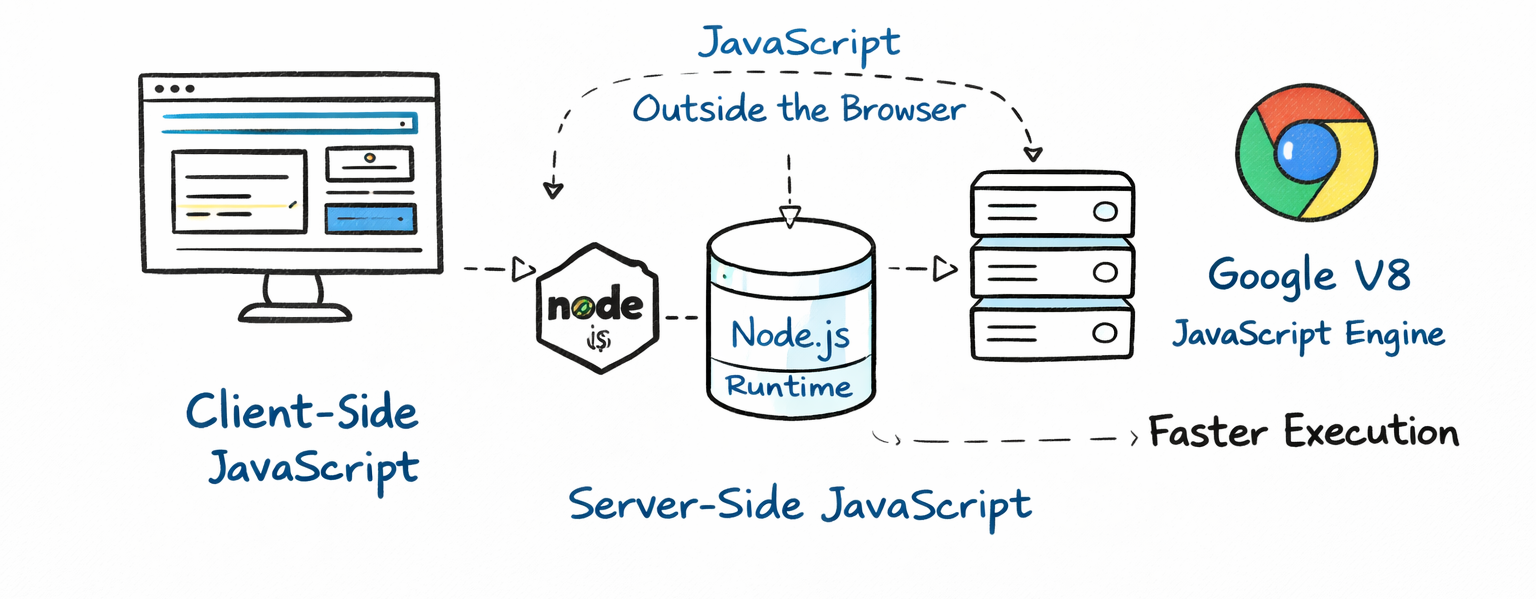
Before exploring why you should learn Node.js, it is important to understand what Node.js actually represents in the software development ecosystem. Node.js is a runtime environment that allows JavaScript to run outside the browser.
Traditionally, JavaScript was primarily used for client-side development, where it powered interactive features in web browsers. Node.js expanded JavaScript’s capabilities by enabling developers to build server-side applications using the same language.
Node.js runs on Google’s V8 JavaScript engine, which compiles JavaScript into machine code for faster execution. This architecture allows Node.js applications to deliver high performance while handling large numbers of concurrent connections.
By allowing developers to use JavaScript across both frontend and backend development, Node.js simplifies the process of building complete web applications.
Become a Node.js Developer
Node.js is a powerful JavaScript runtime built for creating fast, scalable applications. This Skill Path gives you a comprehensive foundation, starting with core Node.js concepts like HTTP, databases, JWT, and WebSockets. Then, you’ll dive into Express.js to build RESTful APIs, implement authentication, validation, real-time communication, and structured logging. Next, you’ll build full stack applications with the MERN stack (MongoDB, Express, React, Node). Finally, you’ll learn Node.js design patterns to architect robust, maintainable back-end systems with confidence.
The Growing Popularity Of Node.js#
Before you start learning Node.js, it helps to examine how widely it is used across the technology industry. Many large technology companies rely on Node.js to power applications used by millions of users.
Companies such as Netflix, PayPal, Uber, and LinkedIn have adopted Node.js for parts of their infrastructure. These companies value Node.js because it enables fast application performance and efficient handling of large numbers of user requests.
The open-source community has also contributed significantly to Node.js adoption. Thousands of libraries and frameworks built around Node.js make it easier for developers to build applications quickly.
As organizations increasingly move toward cloud-native architectures, the demand for Node.js developers continues to grow.
Key Advantages Of Learning Node.js#
Understanding why learn Node.js requires examining the advantages it offers to developers building modern applications. Node.js introduces several architectural benefits that make it particularly suitable for scalable systems.
One major advantage involves asynchronous programming. Node.js uses a non-blocking architecture that allows the system to process many requests simultaneously without waiting for operations to complete.
Another advantage involves using JavaScript as a full-stack language. Developers can use the same programming language for frontend interfaces and backend servers, which simplifies development workflows.
The Node.js ecosystem also provides extensive libraries and tools through npm, the Node Package Manager. This ecosystem allows developers to reuse existing solutions instead of building everything from scratch.
Node.js Architecture And Performance Benefits#
One of the primary reasons developers research why you should learn Node.js involves its performance architecture. Node.js uses an event-driven model that handles requests asynchronously.
Traditional server architectures often assign a dedicated thread to each incoming request. This approach can consume large amounts of system resources when traffic increases.
Node.js uses a single-threaded event loop that processes tasks asynchronously. Instead of waiting for operations such as database queries or file reads to complete, the system continues handling other requests.
The table below illustrates the architectural differences between traditional servers and Node.js.
Feature | Traditional Server Model | Node.js Model |
Threading | Multi-threaded | Single-threaded |
Request Handling | Blocking | Non-blocking |
Resource Usage | Higher Memory Consumption | Efficient Resource Usage |
Scalability | Limited By Threads | Highly Scalable |
This architecture enables Node.js applications to support large numbers of concurrent users with efficient resource utilization.
The Node.js Ecosystem And Package Manager#
Another important reason why you should learn Node.js is the extensive ecosystem surrounding the runtime environment. Node.js includes npm, which is one of the largest software package repositories in the world.
The Node Package Manager provides access to thousands of open-source libraries that developers can use to accelerate application development. These libraries support tasks such as authentication, database connectivity, API creation, and real-time communication.
Using npm packages allows developers to avoid reinventing solutions for common problems. Instead of writing large amounts of custom code, developers can integrate well-tested libraries into their applications.
The table below highlights several widely used Node.js packages.
Package | Purpose |
Express | Web Application Framework |
Mongoose | MongoDB Object Modeling |
Real-Time Communication | |
Passport | Authentication Middleware |
Axios | HTTP Request Handling |
These packages allow developers to build sophisticated applications quickly and efficiently.
Node.js For Full Stack Development#
Another important aspect of why learn Node.js is its ability to support full-stack development using JavaScript. Traditionally, web development required different programming languages for frontend and backend systems.
For example, developers often use JavaScript for frontend interfaces while relying on languages such as Java, PHP, or Python for backend services. This separation increased complexity and required developers to learn multiple languages.
Node.js allows developers to write both frontend and backend code using JavaScript. This unified approach simplifies application architecture and improves collaboration between development teams.
Many modern web development stacks rely on Node.js as their backend component. One common example is the MERN stack, which includes MongoDB, Express, React, and Node.js.
This stack allows developers to build complete applications using a consistent technology ecosystem.
Real World Applications Built With Node.js#
Understanding why to learn Node.js also involves examining real-world applications that rely on this technology. Node.js is commonly used for building web servers, APIs, real-time platforms, and data-intensive applications.
Streaming services represent one area where Node.js performs particularly well. Because Node.js handles asynchronous data streams efficiently, it is often used for video and audio streaming platforms.
Real-time applications such as messaging systems and collaborative tools also benefit from Node.js architecture. The event-driven model allows applications to deliver instant updates without delays.
The table below illustrates several common application types built with Node.js.
Application Type | Example Use Case |
Web Servers | Backend Infrastructure For Websites |
APIs | RESTful Services For Mobile Applications |
Real-Time Systems | Chat Applications And Collaboration Tools |
Streaming Platforms | Video And Music Streaming Services |
These use cases demonstrate the versatility of Node.js across different industries.
Career Opportunities For Node.js Developers#
Another important factor when evaluating why you should learn Node.js involves the career opportunities associated with this technology. Node.js developers are in high demand across the software industry.
Organizations building modern web platforms often require backend developers who can design scalable APIs and distributed systems. Node.js skills allow developers to contribute to these systems effectively.
Node.js expertise is particularly valuable for developers interested in full-stack development. Many companies prefer hiring developers who can work across both frontend and backend systems.
Because JavaScript remains one of the most widely used programming languages in the world, developers who master Node.js gain access to a large job market.
Learning Node.js also opens opportunities in cloud computing environments where scalable microservices architectures are increasingly common.
Node.js In Cloud And Microservices Architectures#
Modern application architectures often rely on microservices rather than monolithic systems. In microservices architectures, applications are divided into smaller, independent services that communicate through APIs.
Node.js is well-suited for this architecture because it handles network communication efficiently. Developers can create lightweight services that process requests quickly and scale easily.
Cloud platforms also support Node.js extensively. Services such as AWS Lambda, Google Cloud Functions, and Azure Functions allow developers to deploy serverless applications using Node.js runtimes.
Because of these capabilities, Node.js plays an important role in modern cloud-native application development.
Learning Node.js As A Beginner#
For developers exploring why to learn Node.js, the learning process is relatively accessible compared to many backend technologies. Developers who already understand JavaScript can begin learning Node.js quickly.
The first step involves understanding how JavaScript works outside the browser environment. Developers must learn how Node.js interacts with the operating system and handles asynchronous operations.
After mastering the basics, developers often explore frameworks such as Express that simplify server development. Building simple APIs and web servers helps reinforce fundamental Node.js concepts.
As experience grows, developers can explore advanced topics such as authentication systems, database integrations, and scalable API design.
Because Node.js shares the same language as frontend development, it provides a smooth transition into backend programming.
Challenges Developers May Encounter#
Although there are many reasons to learn Node.js, developers should also be aware of certain challenges associated with the technology. One limitation involves CPU-intensive tasks that require heavy computation.
Node.js is optimized for asynchronous operations rather than heavy computational workloads. Applications requiring intensive data processing may require alternative architectures or worker threads.
Another challenge involves managing asynchronous code effectively. Although modern JavaScript features such as promises and async functions have simplified asynchronous programming, developers must still understand event-driven design patterns.
Despite these challenges, Node.js remains highly effective for applications focused on network communication and scalable APIs.
Node.js And The Future Of Web Development#
The future of web development continues to emphasize scalable infrastructure, real-time communication, and distributed application architectures. Node.js aligns well with these trends because it enables efficient handling of concurrent connections.
Many organizations building modern applications adopt Node.js as part of their technology stack. Its lightweight architecture and extensive ecosystem allow teams to build and deploy services quickly.
Node.js also integrates well with modern frontend frameworks such as React, Angular, and Vue. This compatibility strengthens its position within full-stack development workflows.
As cloud computing and microservices architectures continue evolving, Node.js will likely remain an important technology for backend development.
Final Thoughts#
Understanding why to learn Node.js reveals why this technology has become a cornerstone of modern web development. By enabling JavaScript to run on servers, Node.js allows developers to build scalable backend systems using a familiar programming language.
Its event-driven architecture, large ecosystem of packages, and compatibility with modern development frameworks make it an attractive option for developers building APIs, web servers, and real-time applications.
For developers interested in full-stack development, learning Node.js provides a powerful tool for building complete applications from frontend interfaces to backend services. As the demand for scalable web infrastructure continues to grow, Node.js will remain an essential technology for modern software development.