Linked List Cycle
Explore how to determine if a linked list has a cycle by using fast and slow pointers. Learn to identify cycles efficiently, understand their implications, and practice implementing solutions in Go to prepare for coding interviews.
We'll cover the following...
Statement
Given the head of a linked list, determine whether the list contains a cycle. A cycle exists if a node in the list can be revisited by continuously following the next pointers. Return TRUE if a cycle is present; otherwise, return FALSE.
Constraints:
Let n be the number of nodes in a linked list.
-
n -
Node.Value
Examples
Understand the problem
Let’s take a moment to make sure you’ve correctly understood the problem. The quiz below helps you check if you’re solving the correct problem:
Linked List Cycle
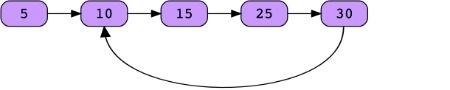
What is the output if the following linked list is given as an input?
TRUE
FALSE
Figure it out!
We have a game for you to play. Rearrange the logical building blocks to develop a clearer understanding of how to solve this problem.
Try it yourself
Implement your solution in the following coding playground.
// The first input of the test case is an array of values representing a linked list.// The second input is the index where the tail connects to form a cycle (or −1 if there's no cycle).// This index is used only to construct the linked list and is not passed to the function.// Definition for a Linked List node// type ListNode struct {// Val int// Next *ListNode// }package mainimport (. "golang-test-code/ds_v1/LinkedList")func detectCycle(head *ListNode) bool {// Replace this placeholder return statement with your codereturn false}