Generative AI interviews in 2025 test three things simultaneously: grounded knowledge (LLM fundamentals and when to use RAG vs. fine-tuning), reasoned judgment (trade-offs, evaluation, risk mitigation), and engineering rigor (building reliable, scalable pipelines). You’ll be asked to explain why models hallucinate, and design retrieval flows that actually reduce these hallucinations. Then, you’ll choose between fine-tuning techniques and justify prompt strategies beyond just “make it longer.”
Generative AI Essentials

Generative AI is rapidly reshaping how software is built, how decisions are made, and how humans interact with machines. From large language models to multimodal systems, understanding generative AI is becoming a foundational skill. This course focuses on generative AI essentials, giving you the conceptual clarity and practical perspective needed to navigate this fast-moving space with confidence. I built this course from my work in adaptive AI systems, intelligent tutoring platforms, and teaching complex machine learning concepts at scale. A recurring challenge I observed was that learners could use generative AI tools, but lacked a clear mental model of how these systems actually work. This course addresses that gap by breaking generative AI down into its core principles and connecting them to real-world applications. You’ll begin with the fundamentals of generative AI, including its evolution, key architectures, and language representations. From there, you’ll explore foundation models, pretraining, fine-tuning, and optimization strategies that power modern systems. The course also covers large language models, multimodal AI (vision and audio), and how context is constructed within neural systems. Throughout, you’ll develop the ability to interpret, guide, and effectively interact with AI systems. If you want to master generative AI essentials and build a strong foundation for working with modern AI systems, this course provides a clear, structured path to get there.
This guide is a practical playbook for junior–mid AI/ML engineers. We’ll map how generative AI interviews have evolved, and distill the core topics you must master (LLMs, prompting, evaluation, PEFT, RAG, vector DBs, agentic patterns). We’ll also introduce a clear, repeatable framework to tackle open-ended questions under time pressure. You’ll also get realistic mock scenarios, common pitfalls, and an interviewer’s perspective on what “good” looks like, so you can communicate clearly, make sound trade-offs, and build systems that work in production.
What we’ll cover:
How GenAI interviews have evolved: A brief history of generative AI interviews and how they differ from traditional ML interviews.
Foundational concepts to master: LLM fundamentals, prompt engineering, evaluation metrics (perplexity, BLEU, ROUGE), and hallucinations.
Fine-tuning and PEFT: When to use full fine-tuning vs. Parameter-Efficient Fine-Tuning (Adapters, LoRA, QLoRA, DoRA, etc.), and why these techniques matter.
Retrieval-augmented generation (RAG) and embeddings: How RAG works, the role of vector databases, and using embeddings as external memory.
Agents and orchestration patterns: Agentic RAG, tool-using agents, and patterns like ReAct and plan-and-execute for complex tasks.
Mock interview scenarios: Example questions (e.g., design a RAG pipeline, debug a hallucinating summarizer) with guidance on approaching them.
Pitfalls to avoid: Common mistakes (generic answers, skipping evaluation, ignoring edge cases) and how to avoid them.
Interviewer’s perspective: Insight into what top companies value in generative AI interviews, from technical depth and creativity to clear communication and a sound awareness of trade-offs.
Generative AI interview process#
Before discussing how interviews have changed and what concepts you need to master, let’s map out the interview loop from start to finish.
Recruiter screen#
The interview journey usually begins with a recruiter screen, a short 30-minute conversation meant to confirm your background and motivation. Nobody is asking you to derive equations or design architectures at this stage. Instead, they want to hear a story. A recruiter might ask, “Tell me about a project where you applied LLMs” or “How do you stay up to date with new GenAI techniques?” The best answers here are clear, concrete, and framed like a short case study: what problem did you solve, what tools did you use, and what was the outcome? This round is relatively straightforward if you have one well-rehearsed example of a GenAI project ready.
Technical phone screen#
If you move forward, the next stop is the technical phone screen. This is typically forty-five to sixty minutes long and your first real chance to showcase depth. Expect questions like “What causes hallucinations in LLMs?” or “When would you use LoRA instead of full fine-tuning?” or even a mini design prompt: “Explain RAG to a junior engineer and sketch how you’d implement it.” The key here is not memorization, but clarity. Interviewers want to hear that you understand trade-offs, can reason about when to use RAG vs. fine-tuning, and explain ideas in plain language. It’s akin to the experience of teaching a colleague, as it’s the tone that needs to land well.
On-site / Virtual on-site#
The on-site stage usually spans three to five rounds. You may be asked to explain transformer attention or design prompts for summarization. You can also be tested by comparing full fine-tuning and LoRA or QLoRA (for a 13B model on limited GPUs). Similarly, you may be asked to diagram or outline a RAG system, such as a legal chatbot, covering embeddings, vector databases, and evaluation. Some companies also include debugging a hallucinating model or designing an agent that plans, calls tools, and manages memory.
Behavioral round#
Finally, no interview loop is complete without a behavioral round. These conversations aren’t simply fluff. They test how you handle responsibility. You might hear, “Tell me about a time you raised an ethical concern in an AI project” or “How do you ensure reliability when shipping AI systems quickly?” Good answers here show self-awareness, judgment, and the ability to balance speed with safety.
How generative AI interviews have evolved#
From niche to mainstream: Early AI/ML interviews focused on supervised learning and basic models, and generative AI was a minor part of these interviews at best. However, with GPT-3 and ChatGPT, generative AI topics became central and are now tested in dedicated rounds on LLMs, prompting, and fine-tuning.
Rising technical bar: Generative AI interviews have evolved from basic checks to demanding, structured assessments. Candidates are now expected to understand complex concepts like attention mechanisms, model differences (GPT-3 vs. BERT), and reasons for LLM inaccuracies. Interviewers will question not just proposed solutions, but the rationale behind choices, such as RAG vs. fine-tuning, or LoRA vs. full training.
Blending with System Design: Candidates must place models in product contexts (e.g., real-time translation with APIs, latency, caching, monitoring) to show scalable system thinking.
Reasoning and adaptability: Interviews test flexibility under new constraints, like handling sensitive data in on-device chatbots, stressing design and adaptability.
Year / Era | Typical Interview Focus | Example Questions | What Was Missing |
2018–2019 | Classical ML (logistic regression, CNNs, RNNs) | “Explain gradient descent” or “How does CNN differ from RNN?” | No focus on transformers or prompting |
2020–2021 | Early transformers and NLP | “Explain attention mechanism” | No practical RAG or fine-tuning discussion |
2022–2023 | LLM basics and prompt engineering | “Design a summarizer with GPT-3” | Evaluation metrics, hallucination handling |
In short, generative AI interviews have evolved from casual chats to rigorous evaluations of both your AI knowledge and System Design skills. Understanding this evolution is key to preparing effectively. Now, let’s examine the core concepts you should master before walking into that interview room.
4 Steps to Ace Generative AI Interviews#
1. Foundational generative AI concepts that you must know#
Before tackling strategy and frameworks, ensure that you have a solid grip on the fundamental knowledge areas. Generative AI interviews will frequently cover the core topics mentioned below.
LLM fundamentals: How LLMs are built and operate (transformer architecture, pretraining, etc.), and the basics of how they “think.”
Prompt engineering: Techniques for crafting prompts to steer LLM behavior, including few-shot prompting, role prompts, and ensuring clarity. Knowledge of advanced prompting techniques like chain-of-thought prompting.
Evaluation metrics: This involves the evaluation of generative model outputs by using tools such as perplexity for language models, BLEU/ROUGE for translations and summaries, and identifying and discussing hallucinations..
Fine-tuning vs. Parameter-Efficient Fine-Tuning: Understanding when to fine-tune an entire model vs. use PEFT methods like adapters, LoRA, QLoRA, or DoRA, including the pros, cons, and use-cases of each.
Retrieval-augmented generation (RAG): What it is, why it’s used to mitigate LLM limitations, and how to design a RAG pipeline (embeddings, vector databases, retrievers).
Vector databases and embeddings: The role of embeddings in representing knowledge, and how specialized vector databases store and search these embeddings to give LLMs a “long-term memory.”
Agentic systems: Using LLMs as “agents” that can plan actions or use tools (e.g. search engines or code execution). These include patterns like ReAct and plan-and-execute for orchestrating complex tasks.
Gaining proficiency in these topics will not only help you answer direct questions, but also give you the vocabulary and confidence to discuss any unseen problem that comes your way. Let’s break down each of these in a bit more detail.
1. LLM fundamentals: How LLMs work#
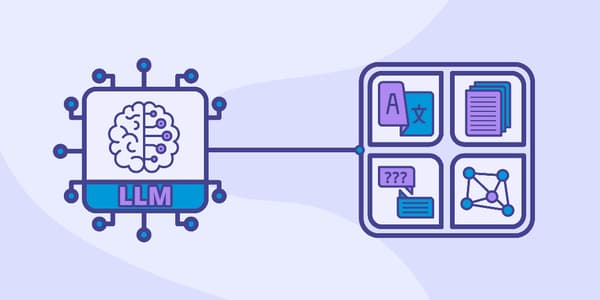
LLMs are massive neural networks (billions of parameters) trained on vast text datasets to predict the next word. Modern LLMs utilize the transformer architecture and self-attention to understand word relationships. This means that they essentially act as statistical machines that learn language patterns from diverse sources like Wikipedia, books, and code.
Essentials of Large Language Models: A Beginner’s Journey
Large language models (LLMs) are at the core of today’s AI transformation, powering everything from conversational agents to code generation and enterprise automation. As adoption accelerates, understanding how LLMs actually work, and how to use them effectively in real systems, is no longer optional for developers and data professionals. I built this course from my work in neural networks and intelligent systems, where LLMs represent a shift from traditional modeling to probabilistic reasoning at scale. A recurring pattern I observed was that many practitioners could use APIs but lacked a clear mental model of how LLMs process language, make decisions, and fail in edge cases. This course is designed to bridge that gap with a systems-level perspective. You’ll learn LLM fundamentals from first principles, covering architecture, tokenization, embeddings, attention, and training dynamics, before moving into practical workflows like prompting, retrieval-augmented generation (RAG), and tool integration. Each concept is tied to how LLMs are actually deployed in production systems. Engineers and researchers are already building on these foundations to create real-world AI applications. If you want to go beyond surface-level usage of LLMs, this is where you begin.
Some key points to know are mentioned below.
Transformers and attention: Transformers, introduced in 2017, use self-attention to weigh word importance, allowing models like GPT to maintain context and handle complex sentences.


Pretraining and fine-tuning: LLMs are pretrained on generic data (e.g., predicting missing words) and then fine-tuned for specific tasks or human alignment (e.g., ChatGPT with RLHF). Pretraining builds broad language knowledge, while fine-tuning enables instruction following or narrower task performance.


Tokens and context window: LLMs use subword units (tokens) and have a limited context window (e.g., GPT-4: 8K or 32K tokens). Interviewers may inquire about handling inputs exceeding this limit (e.g., via summarization, chunking, or retrieval).
Strengths and limitations: LLMs generate fluent text and reason, but lack grounded knowledge beyond training data, leading to hallucinations (making up facts). They also lack persistence and can be inefficient due to size.

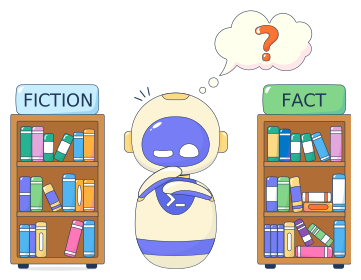
Explaining LLM fundamentals simply is key. For example, you could say: "LLMs are deep neural networks (usually transformers) trained on vast text datasets to predict text. They store knowledge implicitly in their parameters, so when prompted, they statistically continue the text. Lacking an explicit fact database, they can be convincingly wrong, which is addressed by techniques like retrieval or fine-tuning." This demonstrates understanding of both LLM mechanics and practical challenges.
Example interview question: “What makes transformers different from older architectures like RNNs?”
A strong answer would be something like this:
“Transformers use self-attention, which lets them weigh relationships between words regardless of distance in the sequence. Unlike RNNs, which process sequentially, transformers can handle context in parallel and capture long-range dependencies more effectively. That’s why models like GPT scale so well.”
Interview tip: Keep it simple. Explain transformers in plain language first (“they pay attention to important words in context”), then add technical depth if probed.
2. Prompt engineering: Crafting effective prompts#
With LLMs, prompt engineering is crucial because how you ask a question significantly alters the answer. Interviewers might assess your knowledge of these techniques, or how to improve model performance without altering its code.
Key principles and techniques are mentioned below.
Clarity and context: A prompt should be clear about what is being asked. Providing context can dramatically improve relevance. For example, instead of “Explain climate change impacts,” a better prompt might be, “You are a climate scientist. Explain the impacts of climate change on coastal cities in simple terms for a high school presentation.” By setting a role and context, you guide the model’s style and depth.
Specificity: Be specific about the format or details that you want. If you need a bulleted list, say “List 3 key points…”. If you want an answer under 100 words, specify that constraint. Interviewers appreciate when candidates mention this, because it shows you know how to program the model via prompts.
Prompt types: Be aware of common prompt techniques: zero-shot (no examples, just instruction), one-shot (provide examples), or few-shot prompting. The interviewer might ask something like, “How would you improve this prompt to reduce irrelevant answers?” expecting you to add context or constraints.


Advanced prompting techniques go beyond simple instructions, guiding models to reason, explore, or act in structured ways.
Chain-of-thought (CoT): Prompt “think step-by-step.” This boosts multi-step reasoning (math/logic), and larger models benefit the most. Use phrasing like: “First, let’s analyze the problem…”
Tree-of-thought (ToT): Explore multiple reasoning branches, evaluate, and then pick the best one. This is more research-focused, and can be mentioned for awareness, not day-to-day use.
ReAct: Structured loop of Thought → Action (tool) → Observation; this combines reasoning with tool use (search, code, calculator).


Other patterns: Role prompts, self-critique (“check your answer”), and few-shot scratchpads.
Iterative refinement: Highlight that prompt engineering is an iterative process. You try a prompt, see what the model does, and refine. In an interview scenario, if you propose a solution involving an LLM and the interviewer asks, “The output is not good enough, what can you do?,” a good answer might be, “We could refine the prompt: maybe explicitly instruct the model to cite sources, or break the task into steps via a chain-of-thought prompt.”
Example interview question: “Our chatbot keeps giving vague answers. Without retraining, how could you improve this?”
A strong answer would be something like this:
“I’d refine the prompt. For example, add role/context (‘You are a financial advisor…’) and specify the format (‘List 3 bullet points under 100 words’). These constraints make outputs clearer and more consistent. If reasoning is the issue, I’d add Chain-of-Thought prompting: ‘Let’s solve step-by-step.’”
Interview tip: If a model reasons incorrectly, say “Show your reasoning step by step before the final answer.” CoT often cuts errors by forcing explicit reasoning.
Interviewers assess your ability to systematically improve prompts, and not just find a “correct” one. Discuss strategies like adding context, specifying format, or using few-shot examples, and explain their benefits. While prompt engineering may evolve with better models, emphasize its current importance for reliable outputs, showing that you’re aware of trends, but practical.
3. Evaluation metrics: Measuring LLM performance and outputs#
Generative AI is tricky to evaluate. Unlike a classifier that gets an accuracy score, a text generator’s output quality is subjective and multifaceted. That said, there are established metrics and approaches to evaluation that you should know, especially if the role involves improving model performance or monitoring output quality.

Some of the important metrics and concepts are given below.
Perplexity: Perplexity is a core metric for language models, measuring how well a model predicts text. Lower perplexity means the model finds the text less “surprising,” so it fits the data better.
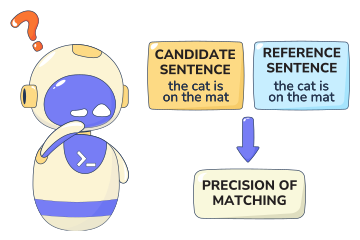
BLEU score: BLEU (Bilingual Evaluation Understudy) measures text generation quality by checking n-gram overlap between model output and a reference. It’s essentially a precision score with penalties for overly short outputs. Scores range from 0 to 1 (often shown as 0–100), with higher being better.
ROUGE score: ROUGE (Recall-Oriented Understudy for Gisting Evaluation) is mainly used in summarization. It measures recall, i.e., how much of the reference content appears in the output. Variants include ROUGE-N (n-gram recall) and ROUGE-L (longest common subsequence).
Hallucination: Hallucination rate tracks how often a model outputs information that isn’t supported by the input or reference. It’s especially important in tasks like summarization or QA.
Other metrics: Depending on the role, emphasize measuring toxicity and bias for user-facing chatbots. Emerging metrics include BERTScore for embedding similarity and using LLMs like GPT-4 as judges. While specific names may not be crucial in an interview, demonstrating awareness of multi-axis LLM evaluation (correctness, relevance, coherence, style, safety) is important.
Example interview question: “How would you evaluate a summarization model?”
A strong answer would be something like this:
“I’d use ROUGE-1, ROUGE-2, and ROUGE-L to measure overlap with reference summaries. However I’d also consider human evaluation or newer embedding-based metrics like BERTScore for semantic similarity, as overlap alone doesn’t guarantee quality.”
Interview tip: When explaining each metric, it’s good to mention what type of task it’s typically used for (e.g., BLEU/ROUGE for generation, precision/recall/F1 for classification, perplexity for language modeling) and how it’s calculated or interpreted.
4. Fine-tuning vs. Parameter-Efficient Fine-Tuning (adapters, LoRA, etc.)#
Not every generative AI question will be about building models, many are about adapting them. “Should we fine-tune this model or just prompt it?” is a common strategic question, or “We have a base model, how do we make it better for our task without breaking the bank?” To answer these, you need to know the difference between full fine-tuning and Parameter-Efficient Fine-Tuning (PEFT) techniques, and when to use each.
Full fine-tuning: This means taking a pretrained model (like a 7B or 70B parameter LLM) and updating all its weights on domain-specific or task-specific data. It’s powerful as the model can truly learn the nuances of your task. However, it’s extremely expensive in terms of compute (imagine tweaking 70 billion parameters; this would require GPUs and time) and it risks overfitting or forgetting original capabilities if you’re not careful. You would also need lots of data typically. In practice, full fine-tuning is often done when you own the model, have unique data, and you need maximum performance.


PEFT (Parameter-Efficient Fine-Tuning): PEFT techniques allow fine-tuning large models by training only a small fraction of parameters. Key methods are mentioned below.
Adapters: Add small bottleneck layers; only adapter weights are trained, reducing trainable parameters.
LoRA (Low-Rank Adaptation): Represents weight updates as low-rank matrices (A*B) which are trained while original weights are frozen. Memory-efficient and effective, these updates can be merged at inference time.
QLoRA (Quantized LoRA): Extends LoRA by quantizing model weights to lower precision (e.g., 4-bit) before applying LoRA. This enables the fine-tuning of very large models on single GPUs with good performance.
DoRA (Weight-Decomposed Adaption): This is a NVIDIA innovation that builds on LoRA by decomposing weight matrices into magnitude and direction. LoRA is applied solely to the directional component, enhancing performance and stability, and often narrowing the gap to full fine-tuning.


Other PEFT methods exist (prefix-tuning, prompt-tuning), but these cover the main ones. Generally, PEFT is crucial for fine-tuning large models with limited data or compute by training <1% of parameters.
Example interview question: “We have a proprietary dataset of medical dialogues but only 5k examples, and we want to adapt a 7B LLM. What would you do?”
A strong answer would be something like this:
“Full fine-tuning risks overfitting and is expensive. With limited data, I’d use PEFT techniques, so we preserve the base model’s knowledge and cheaply specialize it. LoRA might require training tens of millions of parameters instead of billions, which is far more practical.”
This shows both technical knowledge and practical judgment.
Interview tip: Don’t just list PEFT methods. Ask yourself (and say out loud): “Do we really need fine-tuning, or could prompting, RAG, or even a smaller model solve this?” If fine-tuning is warranted, explain why and then choose between full fine-tuning vs. PEFT, based on data size, budget, and performance needs. This demonstrates that you can balance trade-offs, not just recall techniques.
5. Retrieval-augmented generation (RAG): Grounding LLMs with external knowledge#
Retrieval-augmented generation (RAG) improves LLM performance, especially factual accuracy and up-to-date answers. RAG provides the model with relevant information from a retrieval system, rather than relying solely on the model’s inherent knowledge.
In practice, a RAG system works like this:
Question/prompt comes in from the user.
The system uses a retriever (often based on vector similarity search using embeddings) to fetch documents or snippets related to the question from a knowledge source (e.g., company docs, Wikipedia, manuals).
Those retrieved passages and the original question are given as the augmented prompt to the LLM.
The LLM generates an answer that hopefully uses the provided information to stay accurate.
Sometimes, the LLM is even asked to output citations or highlight which source supports each part of its answer.
Why is this so powerful?
This is because LLMs on their own have a fixed knowledge cutoff and they can hallucinate details. With RAG, the model is “grounded” by real data sources. It’s like an open-book exam instead of a closed-book exam for AI. Patrick Lewis et al. coined the term around 2020, and it’s gained a lot of traction across applications.
When discussing RAG, remember the points mentioned below.
Reducing hallucination: RAG feeds the LLM relevant docs, grounding outputs and reducing fabrication. In an interview, if you’re asked “How do you stop the model from making things up?” a solid answer is: “I’d use retrieval-augmented generation so the model cites retrieved facts instead of guessing.”
Up-to-date information: As LLMs can be outdated, RAG lets them query fresh sources (e.g., Bing’s search-assisted chatbots).
Architecture: Mention core components, such as vector DB/index, embedding model, retriever, and generator (LLM). Use terms like retrieval pipeline or knowledge base when outlining designs.
Use cases: Open-domain QA with citations, customer support bots, product FAQs.
Trade-offs: Adds complexity (corpus + index), depends on retriever quality, and struggles with contradictions. Acknowledging these shows depth.


#
Example interview question: “How would you implement RAG?”
A strong answer would be something like this:
Corpus: “Collect and index a domain corpus (e.g., product manuals) in a database.”
Retrieval: “Embed the user’s query and do a similarity search to fetch top-k relevant chunks.”
Prompting: “Prepend those chunks to the prompt, using a template like ‘Using the info below, answer the question…’.”
Generation: “Have the LLM generate an answer grounded in those sources, ideally with citations for transparency.”
This checklist format keeps your answer structured and memorable.
Interview tip: When discussing RAG, go beyond the mechanics. Show that you can weigh trade-offs: “I’d use RAG to ground the model with fresh, domain data instead of retraining. It reduces hallucination and handles knowledge cutoffs, but it adds retrieval complexity and depends on source quality.” This framing tells interviewers that you understand both the why and the limits, which is what they really want to hear.
6. Vector databases and embeddings: The “external memory” of LLMs#
Closely tied to RAG is the concept of vector embeddings and vector databases. In fact, they underlie most retrieval systems for LLMs. Let’s unpack this in simple terms, as you might need to explain it to an interviewer who prompts, for example, “How would you store and search through a million documents to support an LLM’s answers?”
Embeddings: An embedding is a numerical representation of data (like text or images) in a high-dimensional space. LLMs convert data into vectors (e.g., 768 or 1536 dimensions) where similar meanings result in geometrically close vectors. This captures semantic meaning, enabling semantic search by meaning rather than keywords. For instance, “kitten” and “cat” embeddings are close, unlike “banana.”


Vector database: A vector database stores embeddings and quickly performs similarity searches, unlike traditional databases. They act as “knowledge bases” or external memory for generative AI systems, enabling retrieval by embedding similarity and reducing the need for LLMs to store all facts internally.
Don’t forget to mention the following key points.
Why not just use keywords? Vector search, using semantic embeddings, finds relevant information even if wording differs. For example, it would match “fix a paper jam” with “clearing a printer jam” which a keyword search might miss.
Scale and performance: Vector databases excel at scalable, fast similarity lookups for millions or billions of vectors. This efficiency, crucial for nearest neighbor search in high dimensions (curse of dimensionality), is achieved through specialized indexes and approximate nearest neighbor (ANN) search techniques.
Metadata and filtering: Vector DBs often let you store metadata (like IDs, tags) with vectors, enabling filtered searches (e.g., searching only “2023” documents). This is helpful for multi-domain or time-bound queries.
Examples: You could mention a popular stack: e.g., use OpenAI’s text-embedding-ada model to embed text, store in Chroma, retrieve top matches for a query, and feed to GPT-4. This combo is widely used. Mentioning specific tools shows practical awareness, but only if you’re comfortable (don’t just name-drop without any real understanding).
Example interview question: “What happens if our knowledge base grows to a billion entries? Can we still do RAG?”
The expected answer:
“Yes, but you’d rely on a robust vector database to handle it. They are built to index high-dimensional vectors and retrieve nearest neighbors efficiently.”
You might add that with that many entries, one also needs to keep embeddings updated if new data comes in (mentioning that indexing pipeline shows depth).
Additionally, connect it back to solving hallucinations as vector DBs give LLMs an extended memory and address the LLM’s limitation of a frozen knowledge base. This is done by letting it fetch fresh or detailed info as needed, hence, reducing hallucinations.
Interview tip: Highlight why vectors outperform keyword search (semantic similarity). Mention scaling (millions/billions of vectors) and metadata filtering for depth.
By covering RAG and vector databases, you’ve essentially addressed how to give LLMs tools to overcome their weaknesses (stale knowledge and hallucination). Up next, we’ll explore giving LLMs even more capabilities, like taking actions or planning steps through agentic patterns.
7. Agentic AI and orchestration patterns #
Before moving onto orchestration, let’s clarify what an AI agent actually is. Unlike a plain LLM that just takes an input prompt and produces an output, an agent can perform a number of actions, mentioned below.
Decide: Reason step-by-step about what action to take.
Act: Call tools, APIs, or external systems (e.g., a calculator, a database, a search engine).
Observe: Take in the results of that action.
Loop: Use those results to decide the next action until the goal is reached.


Think of it as the difference between a student writing an answer on an exam (LLM) vs. a research assistant who can look things up, run experiments, and revise their answer as they go (agent).
In interviews, you might be asked something like:
“How can an LLM solve a complex task that involves multiple steps or external tools?”
This is where you bring up agent frameworks and patterns.
Two prominent patterns to know are ReAct and plan-and-execute:
ReAct (reasoning and acting loop): The ReAct pattern guides LLMs to think step-by-step by interleaving thoughts and actions. The model generates a thought, then an action (e.g., Search\[query\]), followed by an observation (the action’s result). This cycle continues until a final answer is produced. This pseudo-dialogue allows the LLM to break down problems, utilize tools like web search, and effectively control external resources to gather information. When asked how an AI agent looks up information, one can explain this using ReAct; the model is given actions, reasons step-by-step, executes queries, receives observations, and repeats until it has sufficient information to answer.


Plan-and-execute: Another method involves an LLM planning and then executing a sequence of steps. In this plan-and-execute approach, the LLM creates a plan (e.g., “Step 1: search X; Step 2: summarize result”), which is then executed by the same, or another agent. This separation can enhance strategy coherence, especially for complex tasks, by ensuring a plan is made before action. Tools like LangChain support this.


Agentic RAG: The term “agentic RAG” might be used to describe when an LLM agent uses retrieval as one of its tools (maybe multiple times). For example, the model might search a vector DB, read something, and then decide that it needs another search, etc. This essentially combines the power of RAG with a more flexible agent loop. If the question is something like “How would you design an agent that can answer questions by browsing the internet and using an internal knowledge base?,” you’d describe a ReAct-based agent with a search tool and a vector DB tool, for instance.


Even if you haven’t implemented these yourself, understanding the concept in itself is key. Many top companies are exploring agentic AI (like an AI that can use a database or write code by itself to solve a problem).
Example interview question: “How would you design an AI agent that can use external tools to answer questions?”
Strong answer:
“I’d use the ReAct pattern. The LLM produces a thought (‘I need more info’), an Action (‘Search[query]’), then receives an observation (search result). This loop continues until it can form a final answer. Alternatively, in plan-and-execute, the LLM first drafts a plan (‘Step 1: search, Step 2: summarize’) and then executes. For a robust system, I’d combine retrieval with these patterns, which will eventually become an Agentic RAG setup.”
Interview tip: Even if you haven’t built agents, explain the concept clearly: LLMs can reason step-by-step, call tools, and refine answers iteratively.
2. Mock interview scenarios and how to tackle them#
Let’s explore a couple of example interview questions and outline how to solve them, using the concepts we’ve discussed. These will serve as mock interview questions and model answers in brief.
Example 1: Design a RAG-powered Q&A system#
Question: “Our company has a huge internal wiki. We want to build an AI assistant that employees can query to get answers based on the wiki content. How would you design this?”
What the interviewer is looking for: They want to see if you know how to implement RAG end-to-end. They expect you to mention vector embeddings, open-source libraries or tools, and how to ensure that the answers are accurate. You’re also expected to know how to scale as the wiki grows, and how to update content, etc.
Approach (brief):
Clarify requirements: I’d confirm it’s an internal wiki (mostly text), security-sensitive (data must stay in-org), and accuracy is key. Updates could be nightly if real-time isn’t needed.
Solution outline: I’d build a retrieval-augmented Q and A system. Along with that, I’d chunk wiki articles, embed them, and store them in a vector DB. For each question, I’d embed it, fetch top 3–5 chunks, and feed them and the question into an LLM with instructions like “Answer using the info below”. The model should also cite the article/section for trust.
Model choice: For safety, I’d favor an internal model (e.g., LLaMA-2 7B/13B) but could use an external API like GPT-4 if the policy allows for that.
Accuracy and evaluation: I’d add instructions like “Say you don’t know if the answer isn’t in the text.” Optionally, I’d add a verification stage where an LLM or script checks if each answer fact matches retrieved chunks. Then, I’d evaluate using known Q and A pairs.
Scaling and updates: I’d use FAISS or Pinecone for the vector DB, re-embed updated wiki sections daily (or real-time with webhooks), and keep chunks small to fit context. Multi-step queries may need more chunks or iterative retrieval, but I’d start simple.
Answer format: I’d return answers with citations or wiki links. If retrieval confidence is low, I’d fallback to “Not sure, this may not be documented” rather than hallucinating.
This answer touches on vector DB, embeddings, RAG prompt, citations, updates, etc. It demonstrates an understanding of the full pipeline and practical details.
Example 2: Handling hallucinations in a summarization model#
Question: “We have a summarization system for news articles using an LLM, but sometimes it includes facts that aren’t in the original article (i.e. hallucinations). How can we reduce these hallucinations?”
What the interviewer is looking for: They’re testing if you know why hallucinations happen and are knowledgeable around the techniques involved to mitigate them. Specifically for summarization, they might expect answers like: constrain the model or post-check it against the source, or incorporate retrieval (though in this case, the source is the article itself). You could also mention using a model fine-tuned for summarization, or adding a verification step to ensure the summary content aligns with the original.
Approach (brief):
Acknowledge the problem: “Hallucination in summaries is a known issue. The model might inject plausible information that wasn’t actually in the article. It’s dangerous for news.”
Possible solutions:
Prompting/settings: I’d reinforce instructions like “Only use the article, don’t add anything” and lower the temperature (e.g., 0) to reduce creativity.
Chunk and summarize: I’d break long articles into sections, summarize each, and then combine. This helps with focus, but may miss cross-context.
Retrieval/highlighting: I’d recommend using extractive methods or key-sentence highlights as scaffolding so the summary stays grounded.
Fine-tuning: If data is available, I’d fine-tune on articles, and ground-truth summaries or use summarization-specialized models (e.g., PEGASUS, T5).
Post-verification: After generation, I’d check each summary sentence against the source (string match or embedding similarity). Then, I’d flag or regenerate unsupported parts.
Concrete plan: I’d start with an extractive step (pull key sentences), feed them into the LLM with strict instructions, and then run a verification pass on outputs. If hallucination remains, I’d move to fine-tuning.
Trade-offs: Reducing hallucination can make summaries more conservative or verbose, but for news, factuality outweighs creativity. I’d evaluate this with ROUGE and manual consistency checks.
This answer demonstrates multiple approaches and a clear priority: factual accuracy. It touches on prompt, fine-tuning, and verification, demonstrating a layered approach.
Example 3: Coding task: Implementing a simple embedding search#
Question:“You’re given a set of 10,000 text snippets and a query. Implement a function in Python that retrieves the top-3 most similar snippets using cosine similarity on embeddings. Assume you already have an embed(text) function that returns a vector for any string.”
What the interviewer is looking for:They want to see if you can translate high-level retrieval concepts (embeddings, similarity) into working code. It tests both coding fluency and whether you really understand how retrieval pipelines operate.
Model answer:
“I’d embed the query, compute cosine similarity with each snippet, and sort by similarity. For real-world scale (10k+ docs), I’d use a vector DB like FAISS or Pinecone for efficiency. However, this code shows the principle clearly:
Start simple, then mention improvements: “For larger datasets, I’d use approximate nearest neighbor search to scale efficiently.” This shows both coding fluency and real-world awareness.
3. Avoid common pitfalls in generative AI interviews#
Even strong candidates stumble due to avoidable mistakes. Watch out for these.
Providing generic or vague answers: If asked about a specific scenario (like improving a model’s accuracy or designing a system), don’t stay at a fluffy high level. Use the terminology and concepts you know. For example, instead of “I’d try to reduce errors,” say “I would analyze the types of errors and perhaps incorporate a chain-of-thought prompting if they are reasoning mistakes, or add a retrieval step if they are knowledge gaps.” Not demonstrating your specialized knowledge is a missed opportunity.
Not addressing evaluation: Many candidates eagerly explain a solution but forget to say how they’d verify that it works. Interviewers often have to ask, “How would you know your approach is successful?” If you pre-empt that by discussing evaluation metrics, you show a results-oriented mindset. Skipping this can make it seem like you don’t think about the endgame.
Ignoring constraints and feasibility: It’s exciting to talk about fancy models, but in an interview, you should consider practical constraints. If the question offers a hint like “limited budget” or “real-time system,” heed that. For instance, don’t propose using a gigantic model in production without addressing how to deploy it. Or if the data is scarce, don’t just say “I’d train a new model from scratch.” This shows that you missed the constraint. Always align your solution to the given context.
Overlooking edge cases: A common evaluator’s note is “the candidate’s solution would fail if X.” Try to proactively mention edge cases and failure modes. If summarizing, what if the article is super long or a list of numbers (maybe summarization doesn’t even apply)? By mentioning these, you demonstrate thoroughness. Not doing so might leave the interviewer thinking you’re prone to oversights.
Too much jargon without explanation: It’s great to use terms like LoRA, RAG, etc., but make sure you demonstrate real-world understanding. If you mention them, explain briefly what they mean within a specific context. Sometimes candidates name-drop papers or algorithms incorrectly, which is worse than not mentioning them.
Not engaging in dialogue: In these interviews, it’s often interactive. If the interviewer challenges an aspect of your approach (“What if the user asks something not in the wiki?”), don’t panic or get defensive. That’s an invitation to refine your answer. It’s fine to say, “Good point, in that case I would…” or even admit a limitation: “If we truly can’t handle it, we might have to fail gracefully by apologizing or escalating to a human.” Not engaging or giving one-word answers to their follow-up questions is a no-no. Show your reasoning as it evolves.
Time management and structure: Rambling without structure is a pitfall. In a typical 30–45 min interview, aim to spend a few minutes gathering thoughts (it’s okay to say “let me think for a moment”), then present your plan clearly. If you feel that time is short, prioritize the most important parts of the answer. For example, it’s better to explain fewer points well (covering basics like model choice, retrieval, evaluation) than to list every metric possible with no depth. Interviewers often prefer depth over breadth when you handle a critical issue.
Neglecting the why: Don’t just say what you would do, explain why it addresses the problem. If you say “I’d use RAG,” connect it: “because the model currently lacks up-to-date information, RAG will provide real-time knowledge and reduce hallucinations.” Similarly, if you propose “use QLoRA,” explain the rationale behind it. The interviewer might not ask “why” explicitly, but if you answer it preemptively, you appear more insightful and not just as someone who copies solutions uncritically.
Forgetting the user perspective: Particularly for product-focused roles, don’t lose sight of the end user. Sometimes, candidates get lost in technical details and forget the solution’s main purpose. A quick remark like “... and this way the support agent saves time because they only have to do light edits to the draft” ties your solution to value, which is powerful.


By staying mindful of these pitfalls, you can refine your answers to be both technically strong and pragmatically relevant.
4. Understand what interviewers are looking for #
Let’s step into the interviewer’s shoes for a moment. When companies like Google, OpenAI, or Meta are hiring for generative AI roles, what do they value in a candidate’s interview performance?
Structured problem-solving: They want to see that you can tackle open-ended problems in a clear, and organized way. This is why frameworks (even if you don’t name them explicitly) are so helpful. If you systematically break down a question, it gives the impression of someone who’s a logical thinker. Interviewers know that on the job, AI problems are often ambiguous; a top candidate brings clarity and structure to chaos, rather than rushing in haphazardly.
Depth of knowledge: Generative AI is a fast-moving field. A strong candidate shows mastery of fundamentals and an awareness of recent advances. Top companies prize people who stay curious and up-to-date as it suggests you’ll keep innovating on the job.
Practical experience and intuition: It’s one thing to read about tools, and another to have used them. Interviewers often probe to see if you have hands-on intuition. If you talk about fine-tuning, they might ask if you’ve done it and what challenges you faced (like “did you have to deal with mode collapse or the model just parroting training data?”). If you haven’t actually done something, it’s okay; lean on conceptual understanding instead. However, if you do have experience, share brief anecdotes or concrete numbers. That concreteness signals real experience.
Awareness of trade-offs and constraints: No solution is perfect. Interviewers often deliberately push you by adding constraints. They want to see if you consider alternatives and make smart compromises. They appreciate when you say things like, “If latency is critical, maybe we can use a smaller distilled model in production and keep the big one offline for periodic improvement.” Or “If data can’t leave, we use an on-prem model even if it’s slightly less powerful than an API.” This shows that you can adapt your ideal solution to real-world needs.
Communication and clarity: Especially in mentor-style interviews, you’re expected to explain your thinking clearly enough for someone without deep generative AI expertise to be able to follow the logic easily. For example, after proposing a fine-tuned summarizer, you might ask, “Should I go deeper into the evaluation setup or latency considerations?” That invites collaboration.
Creativity and originality: Generative AI is new, but don’t be afraid to pitch fresh ideas. For example: “What if we combine a fact-focused model with a style-focused one and merge outputs for balance?” Even if it’s unconventional, justified ideas show originality.
Knowledge of company context: If you’re interviewing at a specific company, leverage what you know about their products or research. For example, if you’re interviewing at OpenAI, you might reference how InstructGPT was fine-tuned. If you’re at Google, maybe mention that you know about their UL2 or PaLM models when relevant. However, don’t overdo it or assume internal details. Remember that subtle nods to their work indicate enthusiasm and that you did your homework. Interviewers appreciate that.
Confidence with humility: Be confident but humble. If unsure, admit it and explain your reasoning, as this demonstrates honesty and problem-solving. Don’t undersell yourself; if your solution is solid, stand by it. Speak with considered confidence: “I would use approach X because of Y, and I’d watch out for Z.”
Adaptability: Interviewers often alter scenarios (e.g., “Now, how would your design change if we needed to support voice input?”). They want to see you adapt smoothly, articulating your thought process as you consider design modifications. This assesses quick thinking and your grasp of the core design.
Remember, interviewers want you to succeed, viewing you as a potential colleague. They seek assurance that you can be trusted to design future AI features, thoughtfully cover all aspects, communicate effectively, and handle setbacks. Your preparation, from fundamentals to frameworks, should provide these signals.
Conclusion#
Preparing for a generative AI interview is about blending strong technical knowledge with clear problem-solving and communication. These interviews now have high expectations, but you can meet them by mastering key topics like LLMs, prompting, and RAG, and by giving structured, well-reasoned answers.
Think of the interview as a conversation where you and the interviewer are collaboratively designing or troubleshooting an AI system. If you explain concepts clearly, walk through decisions, and acknowledge trade-offs, you’ll show both technical strength and that you’d be a great teammate.
Generative AI is one of the most exciting fields today, and companies want engineers who can harness these models effectively. With preparation and practice, you’ll be ready to ace your interview. Good luck, and enjoy sharing your passion as much as your proficiency.
For deeper practice with mock questions, detailed solutions, and structured prep, check out the following course:
This course prepares candidates to confidently tackle AI interviews by covering the most relevant and in-demand topics. You’ll explore neural network training (gradient descent, transfer learning, and model compression), language processing (tokenization, embeddings, and decoding), and transformer attention mechanisms (self-attention, cross-attention, and flash attention). You’ll gain a solid understanding of evaluation metrics like perplexity, BLEU, and ROUGE, and dive into modern AI challenges, including hallucinations, jailbreaks, and interpretability. You’ll also learn cutting-edge methods such as RAG, few-shot learning, and chain-of-thought prompting. You’ll explore efficiency, scalability, Mixture of Experts, vector databases, and agentic AI behaviors.