Best practices for automating time series analysis in Python
This blog shows the best practices for automating time series analysis in Python by building consistent, scalable pipelines that handle the full workflow from data to model monitoring.
You’ve probably been in this situation before. You receive a dataset with timestamps—sales over time, website traffic, sensor readings—and you start analyzing it manually. You clean the data, resample it, build a model, evaluate the results, and maybe generate a report. The first time, it feels manageable. The second time, it feels repetitive. By the tenth time, it becomes a burden.
As the data grows or updates regularly, manual workflows start to break down. Small inconsistencies creep in. You forget a preprocessing step, use slightly different parameters, or evaluate models differently across runs. What once worked as a quick analysis becomes fragile and difficult to maintain.
This is where the question becomes critical: What are the best practices for automating time series analysis in Python? Automation is no longer a convenience—it is essential for building workflows that are consistent, scalable, and reliable in real-world environments.
This course is an introduction to time series data analysis and forecasting with Python. Time series data is prevalent in many fields, including finance, economics, and meteorology. In this course, you will learn how to use Python's popular pandas and NumPy libraries to manipulate, visualize, and analyze time series data. The course covers topics such as time series decomposition, stationary and non-stationary data, autocorrelation and partial autocorrelation, and modeling techniques like ARIMA. You will learn how to implement these techniques in Python and how to use them to make forecasts. Moreover, you will also be introduced to some advanced techniques including machine learning algorithms. By the end of the course, you will have a solid understanding of time series data analysis and forecasting with Python. You will be able to import, clean, and manipulate time series data, use statistical modeling techniques to make forecasts, and apply machine learning algorithms to time series data.
Understanding the time series analysis pipeline#
To automate time series analysis effectively, you first need to understand the full pipeline. Time series workflows are not just about modeling—they are about a sequence of interconnected steps that transform raw data into actionable insights. Each step depends on the correctness of the previous one.
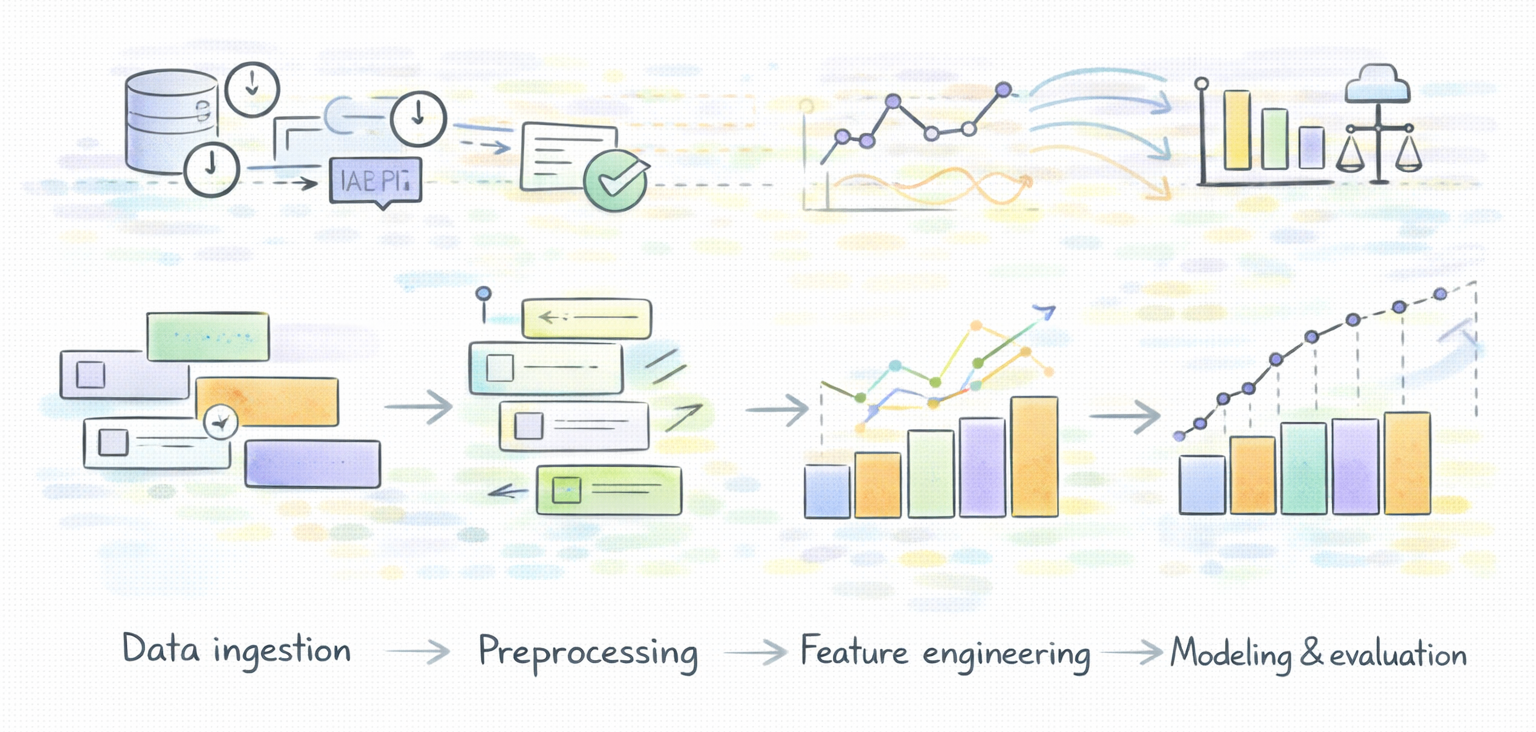
A typical pipeline begins with data ingestion, where you collect time-stamped data from sources such as databases, APIs, or files. This is followed by preprocessing, where you handle missing values, align timestamps, and ensure the data is consistent. After that comes feature engineering, where you extract patterns such as trends, seasonality, and lag-based relationships. Finally, you train models and evaluate their performance using appropriate metrics.
Consider a scenario where you are forecasting daily sales for a retail company. You ingest data from a transactional database, clean and aggregate it to daily frequency, generate lag features to capture recent trends, and train a forecasting model. If any of these steps are inconsistent across runs, your results become unreliable. Automation must therefore cover the entire pipeline, not just individual steps.
Why automation in time series analysis is challenging#
Time series data introduces complexities that make automation non-trivial. Unlike static datasets, time series data evolves over time, often exhibiting patterns such as seasonality, trends, and irregular fluctuations. These patterns are not always stable, which means your pipeline must adapt to changing conditions.
Missing data is another major challenge. In real-world datasets, timestamps may be irregular, values may be missing, or entire segments may be absent. Automating how you handle these issues requires careful design, because incorrect assumptions can lead to misleading results. For example, blindly filling missing values without understanding the underlying pattern can distort your analysis.
Additionally, time dependencies make validation more complex. You cannot randomly split time series data into training and testing sets without risking data leakage. Automation must respect the temporal order of data, which adds another layer of complexity. This is why naive automation—simply scripting steps without deeper consideration—often leads to flawed outcomes.
What are the best practices for automating time series analysis in Python?#
The answer is not about writing a few scripts. It is about designing a system that ensures consistency, correctness, and adaptability across the entire workflow.
Automation should focus on repeatability. Every time your pipeline runs, it should produce results based on the same logic and assumptions. This requires structuring your code in a way that avoids manual intervention and reduces the risk of human error. At the same time, automation must include validation mechanisms to ensure that each step behaves as expected.
Equally important is adaptability. Time series data changes, and your pipeline must be able to handle new patterns without breaking. This means designing workflows that are modular, where individual components—such as preprocessing or modeling—can be updated independently. In this sense, automation is less about convenience and more about building a resilient system.
Designing a reproducible data pipeline#
A reproducible pipeline begins with structured data ingestion. Instead of manually loading data each time, you should define a consistent process that retrieves data from its source in a predictable format. This ensures that your pipeline starts with a reliable foundation.
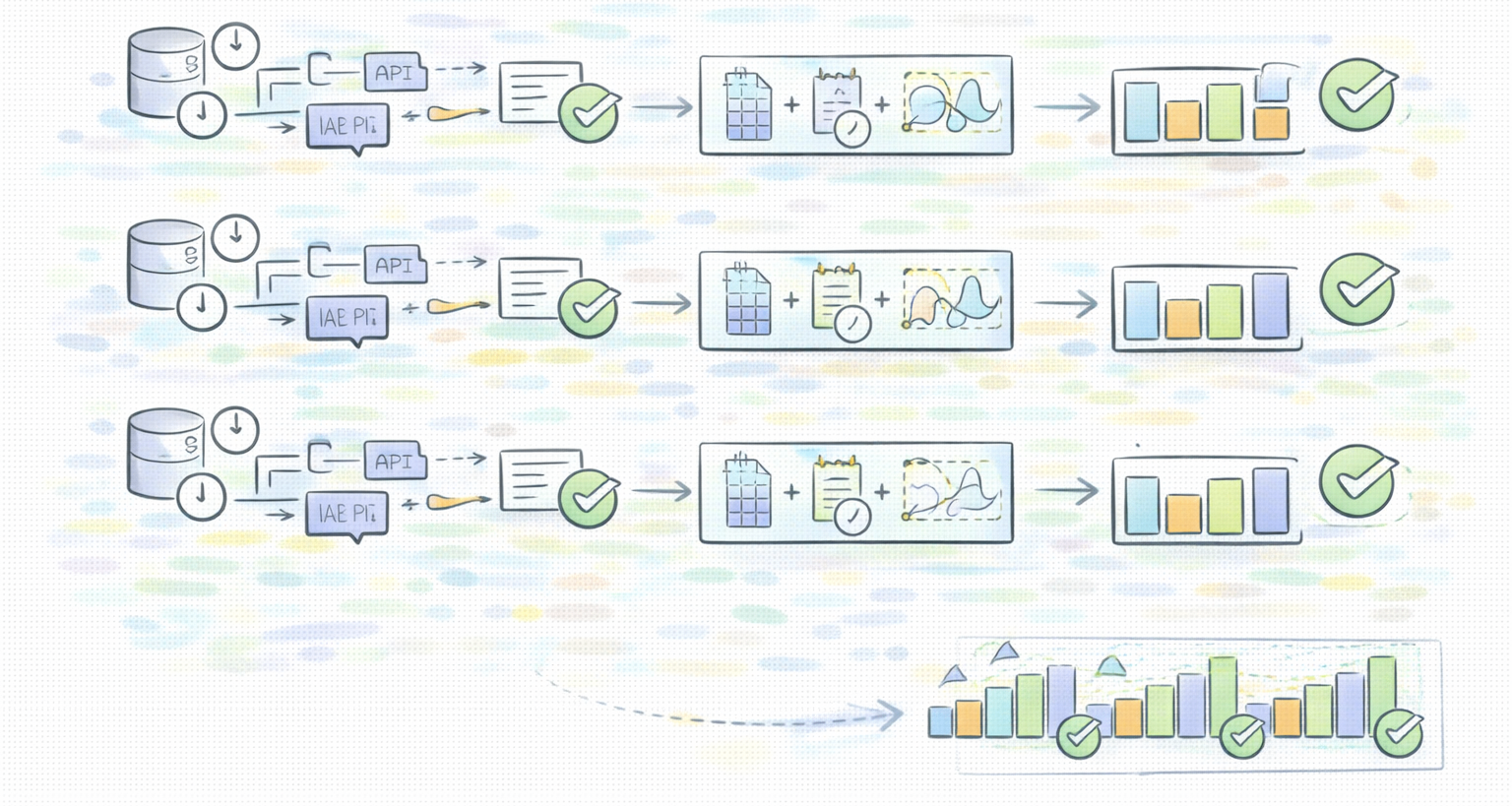
Preprocessing is where many inconsistencies arise. Handling missing values, resampling data to a fixed frequency, and normalizing values must all be done in a consistent manner. Automating these steps means defining clear rules—for example, how to interpolate missing values or how to handle outliers—so that every run follows the same logic.
Consistency across runs is critical. If your preprocessing changes slightly between executions, your model results will also change, making it difficult to compare performance over time. By encapsulating preprocessing logic into reusable functions or pipelines, you ensure that your workflow remains stable and reproducible.
Automating feature engineering for time series#
Feature engineering is one of the most important—and often most manual—parts of time series analysis. Features such as lag values, rolling averages, and seasonal indicators provide the context that models need to make accurate predictions.
Automating feature engineering involves creating reusable transformations. Instead of manually calculating features for each dataset, you define functions or pipelines that generate these features consistently. For example, you might create a function that adds lag features for the past seven days or computes rolling statistics over a fixed window.
This approach reduces errors and improves efficiency. More importantly, it ensures that your features are generated in the same way every time, which is essential for maintaining model performance. Over time, these reusable components become building blocks that you can apply across different datasets and use cases.
Model selection and training workflows#
Automating model training involves more than just fitting a single model. In practice, you often need to evaluate multiple models and compare their performance. This requires a structured approach to model selection.
Time series data demands careful validation strategies. Instead of random splits, you use time-based splits that respect the chronological order of data. Automating this process ensures that your evaluation remains consistent and avoids data leakage.
It is also important to manage model configurations systematically. By defining parameters and training procedures in a structured way, you can experiment with different models without introducing inconsistencies. This allows your pipeline to scale as you explore more advanced techniques, from classical statistical models to machine learning approaches.
Evaluation and monitoring#
Evaluation is not a one-time step—it is an ongoing process. Automating evaluation means consistently calculating metrics such as mean absolute error or root mean squared error across all models and datasets.
Monitoring becomes especially important in real-world applications. As new data arrives, model performance may degrade due to changing patterns. Automated monitoring allows you to detect these changes early and take corrective action.
For example, imagine a forecasting model that performs well initially but starts to drift as seasonal patterns change. Without monitoring, this issue might go unnoticed. With automation, you can track performance over time and trigger alerts when metrics fall below a certain threshold.
Comparison of manual vs automated workflows#
Aspect | Manual workflow | Automated workflow |
Consistency | Varies between runs | Standardized across runs |
Efficiency | Time-consuming | Faster and repeatable |
Error handling | Prone to human error | Built-in validation |
Scalability | Limited | Easily scalable |
This comparison highlights how automation transforms the workflow. In a manual setup, each step depends on human input, which introduces variability and increases the risk of errors. As datasets grow or analyses become more frequent, this approach becomes unsustainable.
An automated workflow, by contrast, ensures that each step is executed consistently. It reduces manual effort, improves reliability, and allows you to scale your analysis without compromising quality. The trade-off is the upfront effort required to design the pipeline, but this investment pays off over time.
Tools and libraries in Python for automation#
Python provides a rich ecosystem for building automated time series pipelines. Libraries like pandas allow you to handle data ingestion and preprocessing with powerful and flexible operations. By combining these operations into reusable functions, you can standardize your data preparation process.
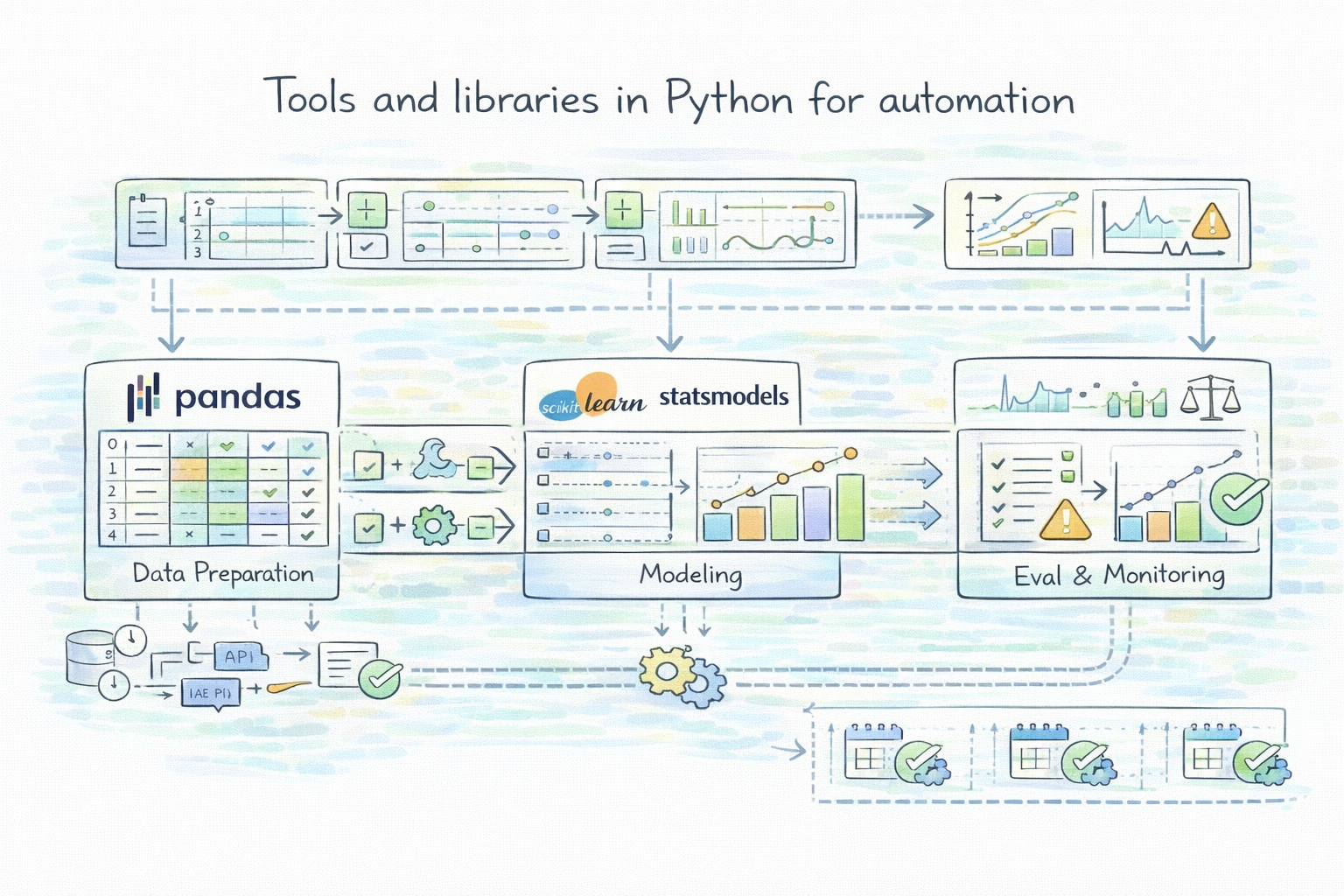
For modeling, libraries such as statsmodels and scikit-learn provide tools for both classical and machine learning approaches. These libraries can be integrated into automated workflows, allowing you to train and evaluate models systematically. The key is not the individual tools, but how they are combined into a cohesive system.

This comprehensive course is designed to develop the knowledge and skills to effectively utilize the scikit-learn library in Python for machine learning tasks. It is an excellent resource to help you develop practical machine learning applications using Python and scikit-learn. In this course, you’ll learn fundamental concepts such as supervised and unsupervised learning, data preprocessing, and model evaluation. You’ll also learn how to implement popular machine learning algorithms, including regression, classification, and clustering, using scikit-learn’s user-friendly API. The course also introduces advanced topics such as ensemble methods, model interpretation, and hyperparameter optimization. After taking this course, you’ll gain hands-on experience in applying machine learning techniques to solve diverse data-driven problems. You’ll also be equipped with the expertise to confidently leverage scikit-learn for a wide range of machine learning applications in industry as well as academia.
Automation often involves orchestrating multiple tools together. For example, you might use pandas for preprocessing, scikit-learn for modeling, and custom scripts for evaluation and monitoring. When these components are connected through a structured pipeline, they form a reliable system for time series analysis.
Common mistakes in automating time series analysis#
One common mistake is ignoring temporal dependencies. Treating time series data like regular tabular data can lead to incorrect validation and misleading results. Automation must always respect the chronological nature of the data.
Another issue is overfitting during automated model selection. When you test many models without proper validation, you risk selecting a model that performs well on historical data but fails in practice. This is why structured validation strategies are essential.
A third mistake is failing to validate the pipeline itself. Automation does not guarantee correctness. Without checks and balances, errors can propagate silently through the system. Building validation steps into your pipeline ensures that issues are detected early.
Scaling automated workflows#
As your data grows, your automation strategy must evolve. What works for small datasets may not scale to larger ones. This requires thinking about performance, resource management, and integration with data systems.
Scheduling becomes an important factor. Automated pipelines are often run at regular intervals, such as daily or hourly. Integrating your workflow with scheduling tools ensures that your analysis stays up to date without manual intervention.
Maintainability is equally important. As your pipeline becomes more complex, it must remain easy to update and debug. Modular design and clear documentation help ensure that your system remains robust as it scales.
Final words#
Automating time series analysis in Python are not just about writing scripts—they are about designing a structured, reliable system that handles the entire pipeline from data ingestion to monitoring. Effective automation requires careful consideration of reproducibility, validation, and adaptability.
Understanding what the best practices for automating time series analysis in Python means, thinking beyond individual steps and focusing on the workflow as a whole. When done correctly, automation transforms time series analysis from a repetitive task into a scalable, dependable process.
Happy learning!