What a cloud computing solution architect does in System Design
A cloud solution architect designs and manages entire cloud systems—balancing scalability, reliability, and cost—by thinking in systems, not just services or code.
You’ve probably experienced this shift yourself. You start by deploying a backend service to the cloud, maybe using a managed database and a couple of APIs. Everything works well at first, and the system feels manageable. But as traffic grows and features expand, the system begins to evolve in ways that are harder to reason about. Suddenly, you’re dealing with multiple services, asynchronous workflows, scaling bottlenecks, and unpredictable failures.
At this point, cloud computing stops feeling like a simple deployment platform and starts revealing its true nature: a distributed system environment with moving parts that interact in complex ways. You realize that building reliable systems is no longer about writing good code alone. It becomes about designing how components communicate, how failures are handled, and how the system behaves under stress. This is where architecture—not just implementation—becomes the core challenge.

We are surrounded by the technology that we utilize daily. Most of it makes use of cloud computing. Cloud is not a nuance anymore; it’s the norm. As software practitioners, it’s imperative to have a good understanding of cloud computing concepts. In this course, you will learn the fundamental concepts of cloud computing. Next, you’ll familiarize yourself with cloud’s standard services. You’ll also learn about various service models available in cloud computing. You’ll learn the concepts of clustering and its relevance in cloud computing. You’ll explore storage and deployment concepts in the cloud. You’ll wrap up with a hands-on experience of how to pick a cloud platform and start your cloud journey. In the end, you’ll have plenty of resources to continue your cloud learning journey. By the end of this course, you’ll have a deeper understanding of the basic concepts of cloud computing and the services and products that cloud platforms offer.
This is exactly where the cloud computing solution architect comes in. Instead of focusing on individual services or tools, this role is centered on designing entire systems that operate cohesively in the cloud. The goal is not just to make things work, but to make them scalable, resilient, and cost-efficient over time. As highlighted in your draft , this role represents a shift from building components to shaping complete systems that evolve with real-world demands.
What does a cloud computing solution architect actually do?#
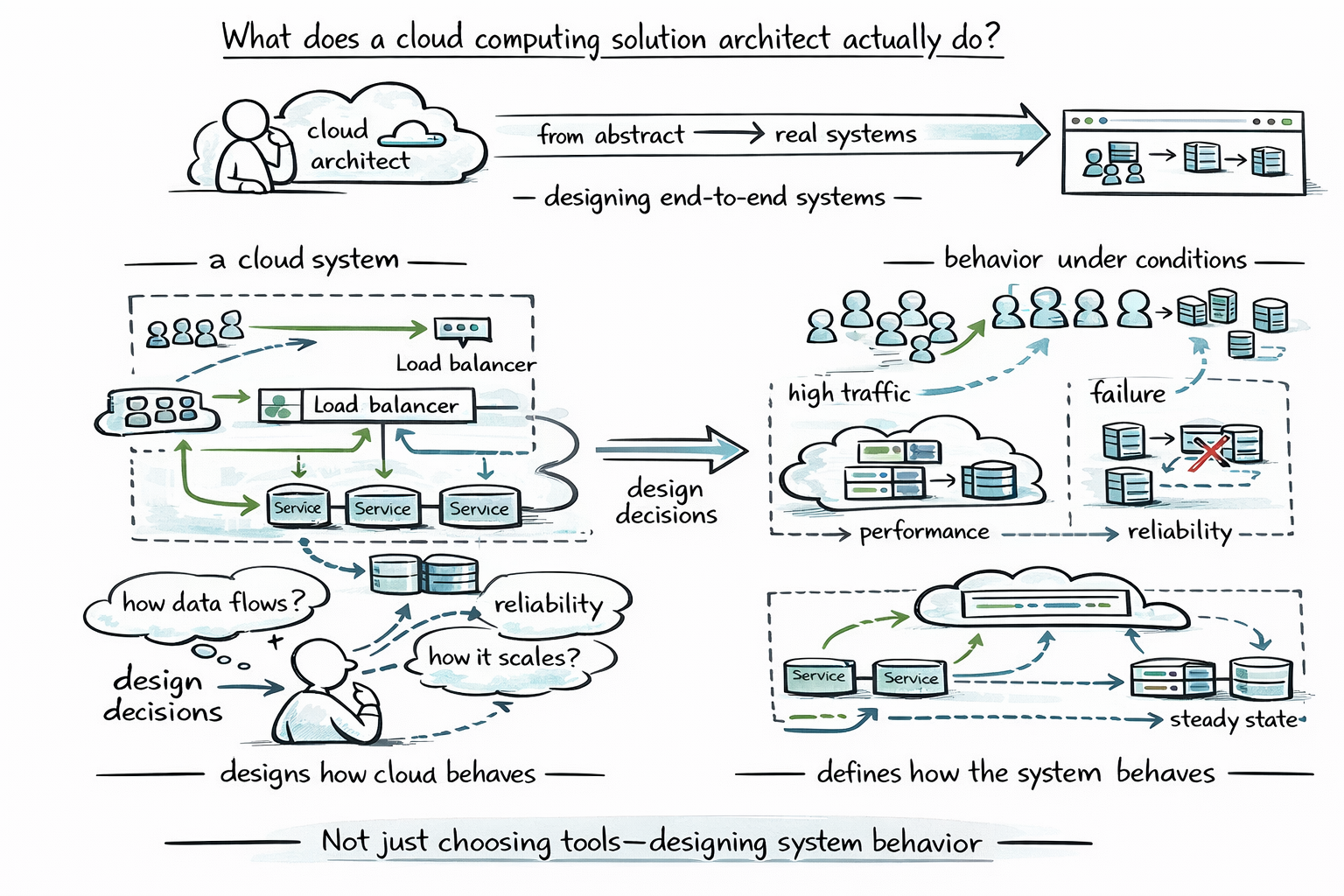
At a high level, a cloud computing solution architect is responsible for designing end-to-end systems that run on cloud infrastructure. But that description can feel abstract until you ground it in real decisions. In practice, this role involves thinking about how data flows through a system, how services interact, and how each component contributes to overall performance and reliability. You are not just choosing tools—you are defining how the system behaves under different conditions.
This hands-on course empowers you with the skills to design, deploy, and manage robust cloud solutions on Microsoft Azure. Azure offers various services enabling organizations to scale up and accelerate their digital transformation. In this course, you’ll explore the core principles of cloud architecture and learn industry best practices. You’ll be introduced to cloud computing basics, followed by topics like SLAs, databases, app services, and VMs. Next, you’ll learn about various automation services like Azure WebJobs, Azure Service Bus, and Azure Queue Storage. Cost management and monitoring tools like Azure Log Analytics, Azure Dashboards, Application Insights, and Azure Monitor are also covered. The course discusses securing the data and VMs using tools and services like Microsoft Entra ID, IAM, and administrative units. After completing this course, you can complete Microsoft’s Azure Solutions Architect Expert certification and be ready for cloud and IT management and consulting roles.
Imagine you’re designing a video streaming platform. You don’t start by picking services; you start by understanding user behavior. How many users will watch simultaneously? What happens when a video goes viral? How do you ensure low latency across regions? From there, you begin shaping the architecture—deciding how content is stored, how requests are routed, and how scaling is handled dynamically. Each decision influences not just performance, but also cost and operational complexity.
The role also requires continuous evaluation. Systems are never static, and neither are their requirements. As traffic patterns change or new features are introduced, the architecture must evolve. This means revisiting earlier decisions, identifying bottlenecks, and redesigning parts of the system without disrupting the whole. In this sense, the architect operates as both a designer and a long-term steward of the system.
Cloud architecture has become a core skill for modern engineers. Whether you're building backend systems, deploying microservices, or scaling global applications, understanding how to design on AWS is no longer optional. The challenge is that AWS is an ecosystem. Without a clear structure, it’s easy to get lost in services without understanding how to use them together to build secure, reliable systems. I built this course from my experience working on Azure’s Fabric Controller and Remote Desktop services for Windows Server. In those environments, we dealt with real-world problems around availability, fault tolerance, and large-scale system management. The pattern I’ve seen with learners is similar: they can learn individual services, but struggle to connect them into a complete architecture. This course is designed to help you think in systems, not just services. We focus on the core pillars of AWS architecture, security, reliability, performance, and cost optimization, and show how they come together in practical designs. You’ll learn how to secure accounts and resources, design for high availability using load balancing and replication, and choose the right storage and analytics services for performance. The course also includes hands-on Cloud Labs so you can deploy and interact with real AWS resources, along with practice exams aligned to the SAA-C03 certification. This approach has helped many learners build confidence in AWS and successfully prepare for certification. If you’re aiming to become an AWS Certified Solutions Architect Associate and design systems the right way, this course gives you a clear and structured path.
How cloud computing transforms system architecture#
Cloud computing fundamentally changes how systems are designed by introducing elasticity and programmability at the infrastructure level. In traditional environments, infrastructure was fixed and provisioning resources required manual intervention. In the cloud, infrastructure becomes dynamic, allowing systems to scale up or down automatically based on demand. This shift forces you to think differently about capacity planning and resource utilization.
Instead of designing for peak capacity, you design for variability. Systems must handle sudden spikes in traffic without degrading performance, while also avoiding unnecessary costs during low usage periods. This leads to architectures that rely on distributed components, load balancing, and event-driven communication. The system is no longer a monolith—it becomes a collection of loosely coupled services that interact through well-defined interfaces.
This transformation also changes how failures are perceived. In cloud environments, failure is not an exception—it is expected. Instances can terminate, networks can partition, and services can degrade. As a result, architecture must embrace failure as a design constraint. You begin to design systems that recover gracefully, reroute traffic, and maintain availability even when parts of the system break.
Understanding the cloud computing solution architect role in practice#
The cloud computing solution architect role is ultimately defined by decision-making across the entire system lifecycle. You are constantly balancing competing priorities, and there is rarely a single “correct” answer. Every architectural choice involves trade-offs, and understanding those trade-offs is what separates good design from fragile systems.
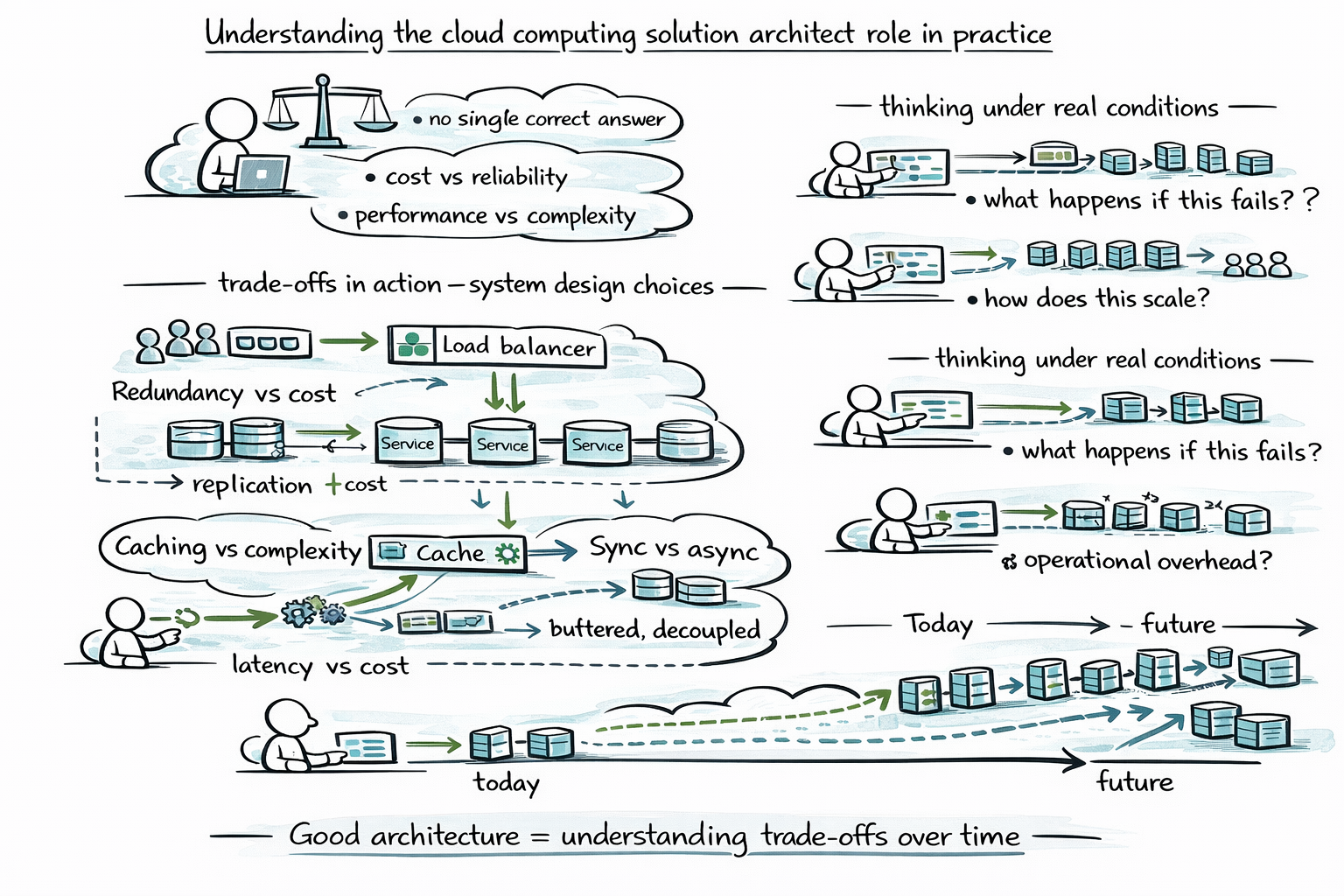
For example, increasing redundancy improves reliability but also increases cost. Introducing caching can improve performance but adds complexity and potential consistency issues. Choosing between synchronous and asynchronous communication affects both latency and system coupling. These are not theoretical concerns—they directly impact how your system behaves in production.
In practice, this means you are always asking questions like: What happens when this component fails? How does this decision scale over time? What is the operational overhead of this design? The role requires you to think beyond immediate requirements and consider how the system will evolve months or even years down the line.
Designing end-to-end cloud systems#
Designing an end-to-end system starts with understanding boundaries. You need to define where responsibilities lie, how services interact, and how data moves across the system. This involves identifying core components, such as APIs, data stores, processing layers, and external integrations, and then determining how they connect to form a cohesive architecture.
Consider a multi-service e-commerce platform. You might separate user management, product catalog, order processing, and payment handling into distinct services. Each service has its own responsibilities, but they must work together seamlessly. The challenge is not just building these services—it’s designing the interactions between them so that the system remains consistent and responsive.
You also need to think about data flow. How does data move from one service to another? Is communication synchronous or event-driven? How do you ensure data consistency across distributed components? These decisions shape the system’s behavior under load and influence how easily it can adapt to new requirements.
Managing scalability, reliability, and failure#
Scalability is not just about handling more users—it’s about maintaining performance as the system grows. This requires designing systems that can distribute load effectively, whether through horizontal scaling, load balancing, or partitioning strategies. The goal is to ensure that no single component becomes a bottleneck.
Reliability, on the other hand, focuses on ensuring the system continues to function even when things go wrong. This involves introducing redundancy, isolating failures, and implementing fallback mechanisms. For example, if one service becomes unavailable, the system should degrade gracefully rather than fail completely. This requires careful planning and a deep understanding of system dependencies.
Failure management ties everything together. In cloud systems, failures are inevitable, so you design for recovery. This might involve retry mechanisms, circuit breakers, or automated failover strategies. The key is to ensure that failures are contained and do not cascade across the system, preserving overall stability.
Comparison of roles in cloud-based systems#
Role | Primary focus | Scope of responsibility | Decision-making level |
Cloud Computing Solution Architect | System-wide design and architecture | End-to-end system behavior, scalability, reliability | Strategic and system-level |
Cloud Engineer | Implementation of cloud services | Deployment, configuration, and maintenance of components | Tactical and service-level |
DevOps Engineer | Automation and operations | CI/CD pipelines, monitoring, and infrastructure automation | Operational and process-level |
While these roles often overlap, their perspectives differ significantly. The cloud computing solution architect focuses on the big picture, ensuring that all components fit together in a way that supports long-term goals. This involves making decisions that affect the entire system, from data flow to failure handling.
Cloud engineers, in contrast, are more focused on implementing and managing specific components. They work with the services and infrastructure defined by the architecture, ensuring that everything is configured correctly and operates efficiently. Their work is essential, but it operates within the boundaries set by architectural decisions.
DevOps engineers bridge the gap between development and operations, focusing on automation and system reliability. They ensure that systems can be deployed consistently and monitored effectively. While they contribute to system design, their primary focus is on operational excellence rather than architectural strategy.
Balancing cost, performance, and complexity#
One of the most challenging aspects of architecture is balancing competing priorities. Improving performance often requires additional resources, which increases cost. Simplifying a system can reduce operational overhead but may limit scalability. Every decision involves trade-offs, and understanding these trade-offs is critical.
For example, you might introduce caching to reduce latency and improve user experience. While this improves performance, it also adds complexity in terms of cache invalidation and consistency. Similarly, adopting a microservices architecture can improve scalability but increases the complexity of managing inter-service communication.
A good architect learns to evaluate these trade-offs in context. Instead of optimizing for a single metric, you aim for a balanced system that meets business requirements while remaining maintainable. This requires continuous iteration, as the “right” balance changes over time.
Collaboration across teams and stakeholders#
Architecture does not happen in isolation. You are constantly working with developers, operations teams, and business stakeholders to align technical decisions with business goals. This requires clear communication and the ability to translate abstract requirements into concrete system designs.
For example, a business requirement might be to support rapid growth in a new market. As an architect, you need to translate that into technical decisions, such as multi-region deployment, data replication strategies, and latency optimization. These decisions must be communicated clearly so that implementation teams can execute effectively.
Collaboration also involves feedback loops. Developers may encounter constraints during implementation, and operations teams may identify issues in production. Incorporating this feedback into the architecture ensures that the system evolves in a way that reflects real-world usage.
Common misconceptions about the role#
One common misconception is that the role is about knowing every cloud service. In reality, tools are only a small part of the equation. What matters more is understanding how systems behave and how different components interact. You can learn tools quickly, but developing architectural intuition takes time and experience.
Another misconception is that the role is less technical than development. In fact, it requires a deep understanding of distributed systems, networking, and system behavior. You are not just writing code—you are designing the environment in which that code runs, which often requires a broader and deeper technical perspective.
Finally, many people assume the role is limited to high-level diagrams. While diagrams are useful, they are only a starting point. Real architecture involves detailed reasoning about system behavior, edge cases, and long-term evolution. It is as much about thinking as it is about documentation.
How to prepare for a cloud computing solution architect role#
Preparing for this role is less about memorizing tools and more about developing a systems mindset. You need to understand how distributed systems work, how data flows through a system, and how different components interact under various conditions. This requires studying System Design fundamentals and applying them in real-world scenarios.
For a decade, when developers talked about how to prepare for System Design Interviews, the answer was always Grokking System Design. This is that course — updated for the current tech landscape. As AI handles more of the routine work, engineers at every level are expected to operate with the architectural fluency that used to belong to Staff engineers. That's why System Design Interviews still determine starting level and compensation, and the bar keeps rising. I built this course from my experience building global-scale distributed systems at Microsoft and Meta — and from interviewing hundreds of candidates at both companies. The failure pattern I kept seeing wasn't a lack of technical knowledge. Even strong coders would hit a wall, because System Design Interviews don't test what you can build; they test whether you can reason through an ambiguous problem, communicate ideas clearly, and defend trade-offs in real time (all skills that matter more than ever now in the AI era). RESHADED is the framework I developed to fix that: a repeatable 45-minute roadmap through any open-ended System Design problem. The course covers the distributed systems fundamentals that appear in every interview – databases, caches, load balancers, CDNs, messaging queues, and more – then applies them across 13+ real-world case studies: YouTube, WhatsApp, Uber, Twitter, Google Maps, and modern systems like ChatGPT and AI/ML infrastructure. Then put your knowledge to the test with AI Mock Interviews designed to simulate the real interview experience. Hundreds of thousands of candidates have already used this course to land SWE, TPM, and EM roles at top companies. If you're serious about acing your next System Design Interview, this is the best place to start.
One effective approach is to build systems yourself. Start with a simple application and gradually introduce complexity—add caching, implement load balancing, or simulate failures. Each step helps you understand how systems behave and how architectural decisions impact performance and reliability.
Over time, you begin to see patterns. You recognize common challenges and develop strategies for addressing them. This experience forms the foundation of architectural thinking, allowing you to design systems that are not just functional, but robust and scalable.
Final words#
The cloud computing solution architect role is ultimately about designing systems that work in the real world. It requires you to think beyond individual components and consider how everything fits together as a cohesive whole. This involves making informed decisions, understanding trade-offs, and continuously adapting to changing requirements.
As you grow in your career, you’ll find that mastering tools is only part of the journey. What truly matters is your ability to reason about systems, anticipate challenges, and design solutions that stand the test of time. This is what defines a cloud computing solution architect—not the tools they use, but the systems they create.
Happy learning!