Data leakage in machine learning explained
Struggling with models that perform well in testing but fail in production? Learn what data leakage in machine learning is, why it happens, and how to prevent it to build reliable, real-world ML systems.

When developers and data scientists begin building predictive models, they quickly learn that the quality of the data pipeline can be just as important as the machine learning algorithm itself. During this process, many practitioners start asking what is data leakage in machine learning because they encounter situations where a model appears to perform extremely well during evaluation but fails when deployed in real-world environments.
Machine learning systems rely heavily on properly structured datasets and carefully designed training procedures. If information that should not be available during training accidentally enters the model’s learning process, the model may appear to perform better than it actually will in practice. This misleading performance often creates false confidence in the model’s predictive capability.
Data leakage is one of the most common pitfalls in machine learning workflows. It occurs when information from outside the training dataset influences the training process in ways that would not be possible in real-world prediction scenarios. As a result, models trained on leaked data can achieve artificially high accuracy during evaluation while failing to generalize effectively when deployed.
Grokking the Machine Learning Interview
Machine learning interviews at top tech companies now focus more on open-ended system design problems. “Design a recommendation system.” “Design a search ranking system.” “Design an ad prediction pipeline.” These questions evaluate your ability to reason about machine learning systems end-to-end. However, most candidates prepare for isolated concepts instead of system-level design. This course focuses specifically on building that System Design muscle. You’ll work through 9 real-world ML System Design problems (the same questions asked at Meta, Google, Amazon, and Microsoft) and learn a repeatable methodology for breaking each one down: defining the problem, choosing metrics, selecting model architectures, designing data pipelines, and evaluating trade-offs. Each system you design builds on practical ML techniques covered earlier in the course: embeddings, transfer learning, online experimentation, model debugging, and performance considerations. By the time you’re designing your third or fourth system, you'll have the technical vocabulary and judgment to explain why your design choices work. This is exactly what interviewers are looking for. The course also includes 6 mock interviews so you can practice articulating your designs under realistic conditions. If you have an ML or System Design interview coming up at any major tech company, this course will help you walk in with a clear framework for tackling whatever they throw at you.
Understanding this problem is essential for anyone building machine learning systems because preventing leakage ensures that evaluation results accurately reflect real-world performance.
What is data leakage in machine learning?#
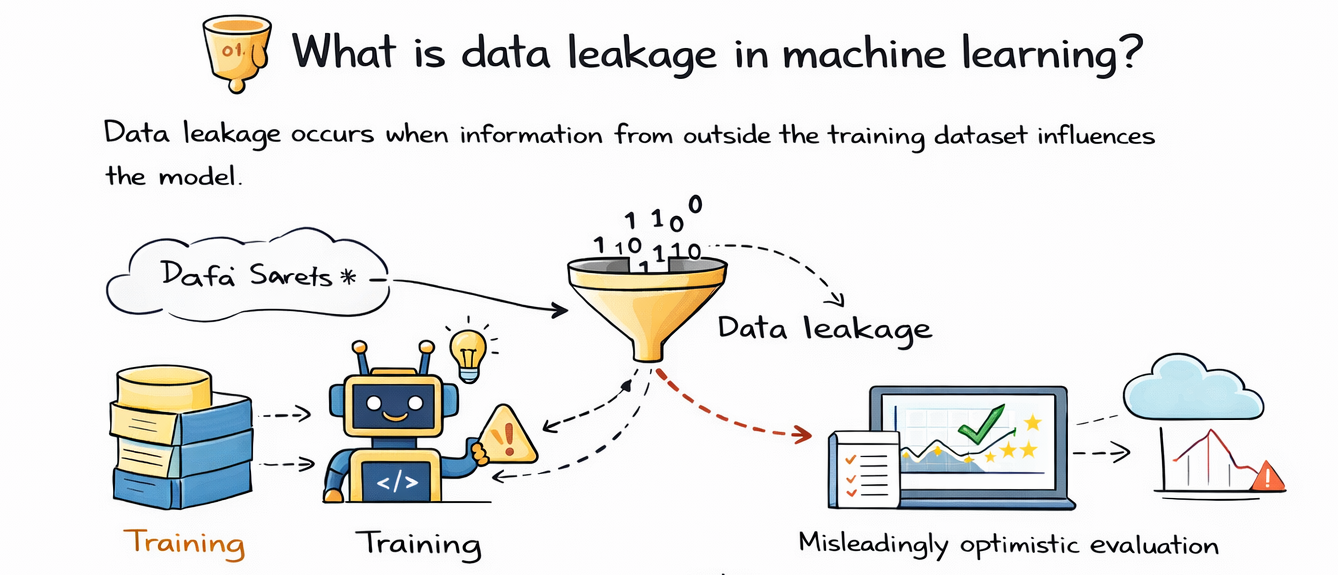
Data leakage occurs when information from outside the training dataset unintentionally influences the model during training. This information may come from the test dataset, from the target variable itself, or from future data that would not be available when making predictions.
In a typical machine learning workflow, datasets are divided into training and testing portions. The training data teaches the model to recognize patterns, while the testing data evaluates how well the model performs on unseen examples. When leakage occurs, the model gains access to information that should be restricted to the evaluation stage or to future observations.
The result is a misleadingly optimistic evaluation. Because the model has indirectly seen information about the correct outcomes, it can produce highly accurate predictions during testing. However, once deployed in a real environment where that information is unavailable, performance often declines dramatically.
For practitioners learning what is data leakage in machine learning, the key insight is that leakage introduces hidden shortcuts that allow the model to cheat during training.
Fundamentals of Machine Learning for Software Engineers
Machine learning is the future for the next generation of software professionals. This course serves as a guide to machine learning for software engineers. You’ll be introduced to three of the most relevant components of the AI/ML discipline; supervised learning, neural networks, and deep learning. You’ll grasp the differences between traditional programming and machine learning by hands-on development in supervised learning before building out complex distributed applications with neural networks. You’ll go even further by layering networks to create deep learning systems. You’ll work with complex real-world datasets to explore machine behavior from scratch at each phase. By the end of this course, you’ll have a working knowledge of modern machine learning techniques. Using software engineering, you’ll be prepared to build complex neural networks and wrangle real-world data challenges.
Data leakage overview#
Concept | Description |
Data leakage | When information from outside the training dataset influences model training |
Impact | Artificially high accuracy during model evaluation |
Common causes | Improper preprocessing, target leakage, and incorrect train-test splits |
Result | Models that perform poorly in real-world deployment |
Recognizing these risks is essential during model development because leakage often remains hidden until the model is tested in production environments. By carefully designing training pipelines and validation strategies, developers can ensure that model performance reflects realistic prediction conditions and prevent data leakage.
Types of data leakage#
Several common forms of leakage appear in machine learning workflows, and understanding these patterns helps practitioners detect and prevent them.
Target leakage#
Target leakage occurs when input features include information that directly reveals the outcome variable the model is attempting to predict. For example, if a dataset contains variables that are recorded only after the target event occurs, the model may learn to rely on those variables instead of identifying meaningful predictive patterns. This situation can produce extremely high accuracy during training while making the model useless in real-world predictions.
Train-test contamination#
Train-test contamination occurs when information from the testing dataset accidentally enters the training process. This can happen when preprocessing steps such as scaling, normalization, or feature selection are performed before splitting the dataset into training and testing subsets. Because the model indirectly learns from information derived from the testing data, the evaluation metrics become overly optimistic.
Temporal leakage#
Temporal leakage occurs in time-based datasets when future information is used to predict past events. In many real-world systems, such as financial forecasting or predictive maintenance, models must only use information available up to the time of prediction. If future data points are included during training, the model learns patterns that would not exist during actual deployment.
Understanding these different forms of leakage helps clarify what is data leakage in machine learning and why careful dataset preparation is essential.
Real-world example of data leakage#
Consider a machine learning model designed to predict whether a customer will cancel a subscription service. The goal of the model is to identify users who are likely to leave so that the company can take preventive action.
During feature engineering, the dataset may include variables such as the number of support tickets submitted by the customer, the time since their last login, and whether their account has been flagged for cancellation.
If a feature such as “account cancellation processed” or “final billing issued” is included in the dataset, the model may learn to rely on this information when predicting churn. However, these variables are only available after the cancellation has already occurred. During training, the model may appear to achieve very high accuracy because the outcome is indirectly revealed through these features.
When deployed in production, the model no longer has access to this information because those events have not yet occurred. As a result, the model’s predictive accuracy drops significantly, demonstrating the harmful effects of leakage.
How data leakage occurs during machine learning workflows#
Data leakage can appear at several stages in the machine learning pipeline if developers are not careful about data separation and preprocessing procedures.
One common source occurs when data preprocessing is performed before the train-test split. For example, calculating normalization statistics across the entire dataset allows information from the test set to influence the training process.
Another source occurs during feature engineering when new variables are created using information that includes the target variable or future outcomes. Leakage can also arise from improper cross-validation techniques. If validation folds are not properly separated, models may inadvertently learn patterns from evaluation data.
Finally, leakage may occur when developers compute scaling or normalization parameters using the entire dataset, rather than restricting those calculations to the training subset. Each of these issues highlights the importance of designing machine learning workflows that maintain strict separation between training and evaluation data.
How to prevent data leakage#
Preventing leakage requires careful design of data pipelines and validation procedures throughout the machine learning lifecycle.
One important strategy is performing the train-test split before preprocessing. This ensures that transformations such as scaling, normalization, and feature selection are calculated only using the training data.
Another effective practice involves using proper cross-validation techniques. Cross-validation should maintain strict separation between training and validation folds to ensure that evaluation metrics reflect realistic model performance. Developers should also conduct careful feature reviews to ensure that input variables do not contain information that directly reveals the target outcome.
Finally, maintaining strict data separation between training, validation, and testing datasets helps prevent accidental contamination during model development. By following these practices, practitioners can significantly reduce the risk of leakage and produce more reliable models.
Tools and techniques that help detect data leakage#
Although prevention is the most effective approach, several techniques can help detect leakage when it occurs.
Feature importance analysis can reveal whether a model relies heavily on variables that appear suspiciously correlated with the target variable.
Data validation pipelines can enforce strict rules about dataset separation and ensure that preprocessing steps occur in the correct order.
Developers may also examine model evaluation metrics carefully. If a model achieves unusually high accuracy during training but performs poorly during real-world testing, this discrepancy may indicate the presence of leakage.
Detecting these warning signs early allows developers to correct data pipelines before deploying models in production environments.
FAQ#
Why is data leakage harmful in machine learning models?#
Data leakage is harmful because it produces misleading evaluation results. When models learn from information that would not be available during real-world predictions, they appear to perform better than they actually will in production environments. This discrepancy can lead organizations to deploy unreliable models that fail when applied to real-world data.
How can beginners avoid data leakage?#
Beginners can reduce the risk of leakage by carefully structuring their machine learning workflows. Performing train-test splits before preprocessing, reviewing features for potential target information, and using reliable cross-validation techniques all help maintain proper separation between training and evaluation datasets.
Does cross-validation prevent leakage?#
Cross-validation can help detect overfitting and improve evaluation reliability, but it does not automatically prevent leakage. If preprocessing steps are performed incorrectly before cross-validation, leakage can still occur. Proper pipeline design is essential for ensuring that cross-validation produces valid results.
Can automated ML tools still suffer from leakage?#
Yes, automated machine learning tools can still suffer from leakage if the input data or preprocessing steps are not properly managed. Even automated systems rely on well-structured datasets, so developers must ensure that data pipelines maintain strict separation between training and evaluation data.
Final words#
Data leakage is one of the most subtle yet damaging problems in machine learning development. When information that should remain hidden during training accidentally enters the modeling process, evaluation metrics become misleading, and models fail to generalize effectively.
Understanding what is data leakage in machine learning allows developers and data scientists to design more reliable training pipelines, apply proper validation techniques, and carefully review feature engineering processes. By maintaining strict data separation and following strong data engineering practices, practitioners can build predictive systems that perform reliably in real-world applications.