How to build a multi-agent AI system
This blog shows how to build a multi agent ai system by organizing specialized agents that plan tasks, retrieve information, execute operations, and validate results within a coordinated architecture.
Modern AI applications increasingly rely on collaboration between multiple specialized components rather than a single model attempting to perform every task. As language models become more capable, developers are experimenting with architectures where several AI agents coordinate their actions to complete complex workflows. Instead of treating a model as a standalone assistant, these systems organize multiple agents that plan tasks, retrieve information, perform reasoning, and validate outputs.
This shift has led many developers to investigate how to build a multi agent ai system capable of handling larger workflows than a single model can reliably manage. By distributing responsibilities across specialized agents, these systems can handle tasks that involve multiple reasoning steps, data retrieval, iterative planning, and validation.
Multi-agent architectures offer a promising approach for building scalable AI systems that resemble collaborative teams of digital assistants working together to solve complex problems.
Agentic system design is rapidly redefining how modern AI systems are built, moving from single-model interactions to autonomous, multi-step systems that can reason, plan, and act. As large language models evolve, the real challenge is no longer just using them, but orchestrating them into reliable, goal-driven agents that operate safely and effectively in real-world environments. I built this course from my work in adaptive AI and intelligent systems, where designing autonomous behavior requires more than model accuracy. It demands structured reasoning, control, and safety. A recurring pattern I observed was that teams could experiment with LLMs, but struggled to design cohesive agentic systems that could handle ambiguity, coordinate tasks, and remain aligned with user intent. This course is designed to bring that structure. You will study real-world examples, including the Multi-Agent Conversational Recommender System (MACRS), NVIDIA’s Eureka for reward generation, and advanced agents navigating live websites and creating complex images. Drawing on insights from industry deployments and cutting-edge research, you will gain the foundational knowledge to confidently start designing your agent-based systems. Engineers and researchers are already using these patterns to build next-generation AI systems. If you want to design agents that go beyond prompts and into action, this is where to begin.
Overview of multi-agent AI systems#
A multi-agent AI system consists of multiple intelligent agents that interact with each other to complete a shared objective. Each agent operates as a specialized unit within the broader system, focusing on a particular task or capability. Rather than relying on a single language model to handle every part of a workflow, developers divide responsibilities among several agents.
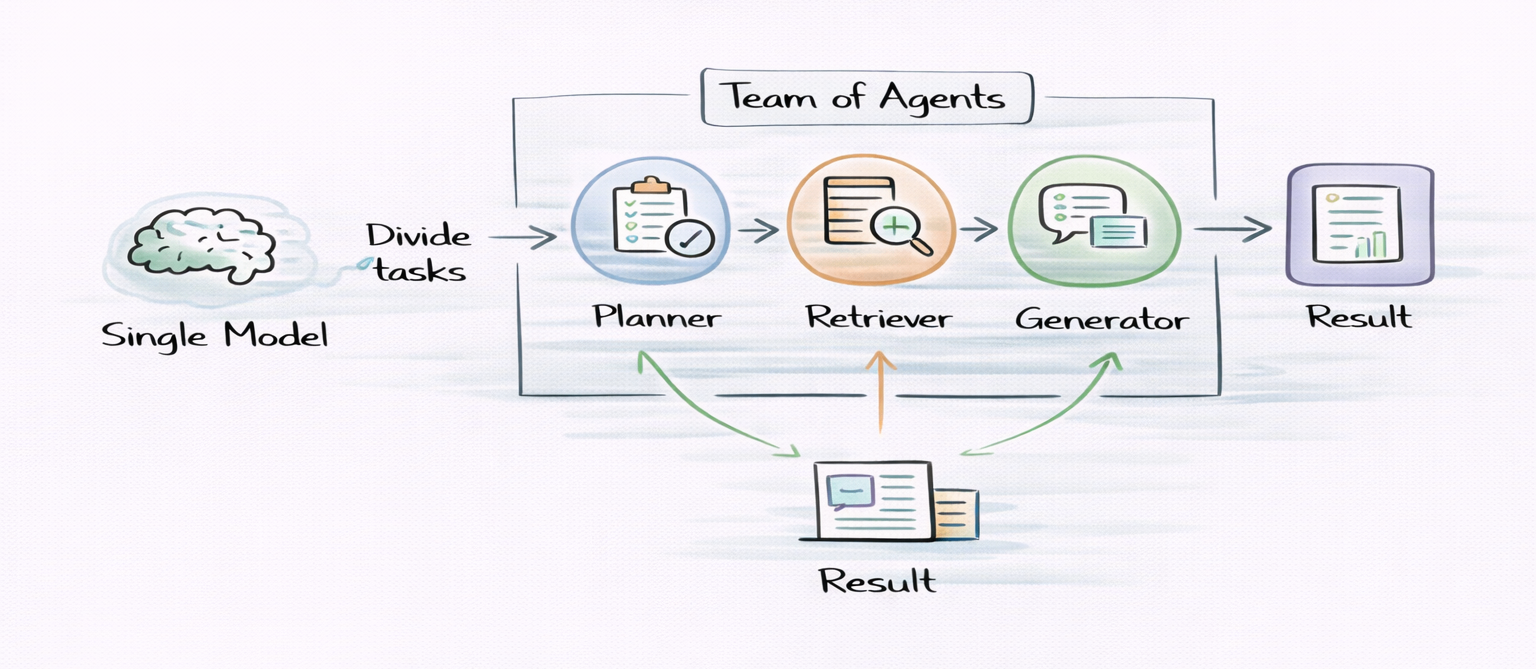
This collaborative structure enables the system to handle more complex workflows by distributing tasks across specialized components. For example, one agent may focus on task planning, while another retrieves information from external databases, and a third generates written output.
Multi-agent systems are especially useful for workflows that involve several stages of reasoning or analysis. These systems are often used for tasks that require complex reasoning, structured planning, information retrieval, or iterative decision making.
By assigning different responsibilities to specialized agents, developers can design systems that are more flexible and modular. This architecture also makes it easier to modify individual components without redesigning the entire system.
Building AI agents and multi-agent systems with CrewAI is quickly becoming a core capability for developers working with modern LLM-powered applications. As workflows grow more complex, the shift is no longer about single prompts, but about orchestrating multiple agents that can collaborate, delegate tasks, and operate as coordinated systems. I built this course from my work in adaptive AI and intelligent orchestration, where designing agentic workflows requires structure, coordination, and control. A recurring pattern I observed was that developers could build individual agents, but struggled to scale them into reliable multi-agent systems. CrewAI provides a practical framework for this, and this course is designed to make it actionable. You’ll learn how to build AI agents and multi-agent systems with CrewAI through hands-on workflows, starting with core agent concepts, then progressing into task delegation, hierarchical orchestration, and human-in-the-loop systems. You’ll implement real automation pipelines and explore advanced features like conditional tasks, monitoring, and scalable agent operations. Developers are already using CrewAI to build coordinated AI systems at scale. If you want to move from single agents to fully orchestrated AI workflows, this is where you begin.
Architecture breakdown section#
When developers explore how to build a multi agent ai system, they typically design an architecture composed of several interacting layers. Each layer plays a distinct role in coordinating agents and managing communication between components.
The task orchestration layer acts as the central coordinator of the system. This layer receives the initial request from the user and determines how the workflow should proceed. It may involve a planner agent or orchestration framework that manages the execution sequence.
The agent execution layer contains the individual AI agents responsible for performing specific tasks. These agents may use large language models, specialized tools, or hybrid systems that combine reasoning with external APIs.
A communication framework enables agents to exchange information during the workflow. This communication can take the form of structured messages, shared memory systems, or event-based messaging.
Memory or knowledge storage systems provide agents with access to relevant context. These systems may store documents, conversation history, or intermediate results generated by other agents.
External tools and APIs extend the capabilities of agents by providing access to databases, search engines, computational tools, or software development environments.
Together, these components form the foundation of most multi-agent AI architectures.
Agent roles #
Defining clear agent roles is one of the most important design steps when building multi-agent systems. Each agent should have a clearly defined responsibility that contributes to the overall workflow.

Planner agent#
The planner agent is responsible for interpreting the user’s request and determining how the system should approach the task. This agent often breaks complex tasks into smaller subtasks that can be handled by other agents in the system.
For example, a research assistant system might use a planner agent to divide a request into information retrieval, summarization, and report generation.
Worker agents#
Worker agents perform the individual tasks assigned by the planner. These agents typically execute specific operations such as generating text, writing code, analyzing data, or summarizing documents.
Because worker agents focus on narrower tasks, they can often produce more accurate outputs than a single agent attempting to handle the entire workflow.
Retrieval agents#
Retrieval agents gather relevant information from external sources. These sources may include search engines, document databases, knowledge graphs, or internal data repositories.
By retrieving relevant information before generating responses, these agents help reduce hallucinations and improve the accuracy of generated outputs.
Evaluator agents#
Evaluator agents assess the outputs generated by other agents. Their role is to verify whether the results meet quality standards or satisfy the original task requirements.
In many systems, evaluator agents detect errors, request revisions from worker agents, or trigger additional reasoning steps before producing the final output.
Multi-agent system architecture table#
The following table illustrates a simplified example of how different agents function within a multi-agent architecture.
Component | Role | Function |
Planner agent | Task coordination | Breaks tasks into subtasks |
Worker agents | Execution | Perform individual operations |
Retrieval agents | Knowledge access | Gather external information |
Evaluator agent | Validation | Check accuracy of outputs |
This structure represents a common architecture developers design when exploring how to build a multi agent ai system that supports complex workflows.
Step-by-step development workflow#
Building a multi-agent AI system requires careful planning and incremental development. The following steps illustrate a typical development workflow.
Step 1: Define the problem and workflow#
The first step is to clearly define the task the AI system should perform. Developers must determine whether the task benefits from a multi-agent architecture or whether a single-agent system is sufficient.
Tasks that involve multiple stages of reasoning, information gathering, and validation often benefit from multi-agent systems.
Step 2: Design agent roles#
Once the workflow is defined, developers identify the specialized roles required within the system. Each agent should have a clear responsibility and a well-defined interface for communicating with other agents.
This step is critical when learning how to build a multi agent ai system because poorly defined roles can lead to confusion and unreliable outputs.
Step 3: Implement communication between agents#
Agents must exchange intermediate results as the workflow progresses. Developers typically implement communication using structured messages, shared memory systems, or centralized orchestration frameworks.
Clear communication protocols help ensure that agents interpret each other’s outputs correctly.
Step 4: Integrate external tools and data sources#
Many agents rely on external tools to perform their tasks effectively. These tools may include search APIs, document retrieval systems, code execution environments, or specialized analysis software.
Integrating these tools allows agents to access up-to-date information and perform complex operations beyond the capabilities of a language model alone.
Step 5: Implement evaluation and validation mechanisms#
Reliable systems include mechanisms for verifying outputs before presenting results to the user. Evaluation agents or validation pipelines can detect errors and trigger additional reasoning steps when necessary.
This validation layer is an important safeguard against cascading errors in multi-agent workflows.
Practical development considerations #
Developers building multi-agent systems must consider several engineering challenges that arise when coordinating multiple AI agents.
Maintaining consistent context across agents is often difficult. Each agent may operate with slightly different information, which can lead to inconsistent reasoning if the context is not carefully managed. Preventing cascading errors is another major concern. If one agent generates incorrect information, downstream agents may rely on that information, amplifying the error throughout the workflow.
Designing stable communication protocols is also essential. Ambiguous or poorly structured messages can lead to misunderstandings between agents. System latency and computational cost must also be considered. Multi-agent workflows may require several model calls and tool invocations, which can increase response time and infrastructure costs.
Addressing these challenges requires careful architecture design, monitoring systems, and iterative testing during development.
Real-world applications #
Multi-agent AI architectures are increasingly used in real-world systems that require complex reasoning and multi-stage workflows.
AI research assistants are one example. These systems may use retrieval agents to gather research papers, worker agents to summarize findings, and evaluator agents to verify the accuracy of the results.
Software development copilots represent another application. These systems may include planning agents that break development tasks into steps, coding agents that generate code, and testing agents that verify functionality.
Data analysis pipelines also benefit from multi-agent architectures. Retrieval agents gather datasets, analysis agents perform calculations, and reporting agents generate structured summaries.
Enterprise automation platforms are also exploring multi-agent systems for managing business workflows, analyzing documents, and supporting decision making.
These examples demonstrate why many developers are increasingly interested in understanding how to build a multi agent ai system that can handle sophisticated tasks.
Final words#
Multi-agent architectures represent an important evolution in AI system design. By distributing responsibilities across specialized agents, developers can build systems capable of handling complex workflows that involve planning, retrieval, reasoning, and validation.
However, building these systems requires careful attention to architecture, communication protocols, and validation mechanisms. Developers must define clear agent roles, design robust communication frameworks, and implement safeguards that prevent cascading errors.
Understanding how to build a multi agent ai system allows developers to create scalable AI architectures that leverage collaboration between specialized agents to solve complex problems more effectively.
Happy learning!