How to improve your SQL query skills with books and tutorials
Stuck at the SQL plateau? Discover how to combine books and hands-on tutorials to build real query intuition, avoid common pitfalls, and write cleaner, faster SQL. Start improving your SQL skills today with a smarter learning approach.
Many developers and analysts reach a frustrating plateau with SQL. You learn the basics, you can write queries that run, and yet your work still feels fragile. Joins surprise you. Aggregations don’t quite line up with expectations. Performance issues seem mysterious. That’s usually the point where people ask: How do I improve my SQL query skills with books and tutorials?
The short answer is that improving SQL is not about collecting more syntax. It’s about changing how you reason about data. Books and tutorials can help, but only if you use them for the right purpose and in the right order. This post explains what “better SQL” actually means, how books and tutorials complement each other, and how to use them together to make steady, visible progress.
An Introductory Guide to SQL
The ability to work SQL is becoming an increasingly in-demand skill, both for software developers and people in less technical roles. If you’re interested in learning SQL and have no prior experience with it, then this course will be your light in a dark tunnel. You’ll start by covering the basics of SQL such as how to create a database, how to insert, query, and update data. You’ll also learn fundamental concepts that developers and data scientists use everyday such as multi-table operations, nested queries, and how to set up views. Throughout, you’ll get to execute SQL queries in your browser and see results in real-time - you won’t need to worry about set-up. At the end of this course, you’ll also get some hands-on practice with common SQL interview questions, so when the time comes, you’ll be ready and confident to answer any question that comes your way. Let’s get started!
Why people plateau after learning basic SQL#
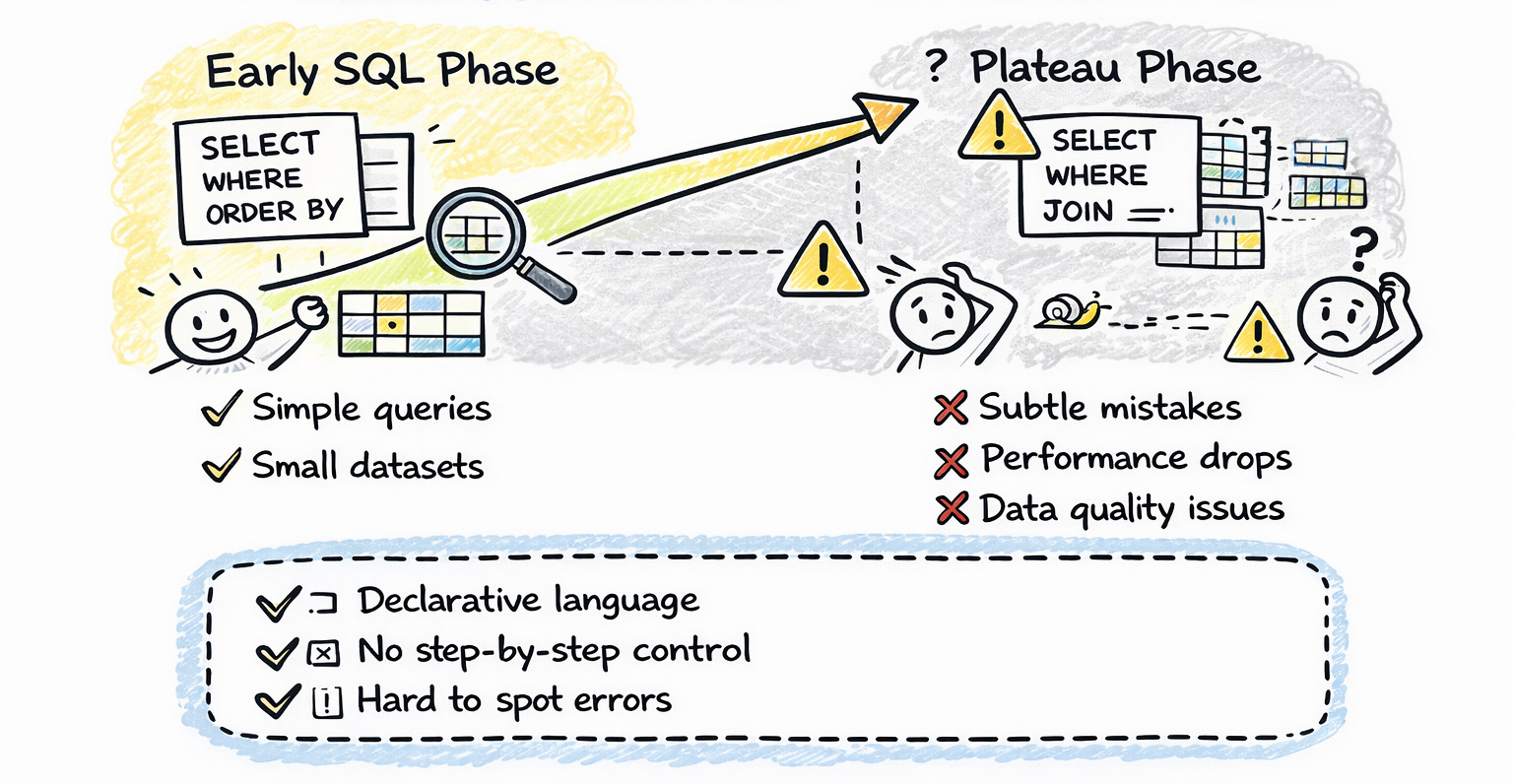
The early phase of choosing a database and learning SQL is forgiving. You learn SELECT, WHERE, and maybe ORDER BY. Queries are short, datasets are small, and mistakes are obvious.
Then the problems change.
You start writing queries that look correct but return subtly wrong results. Joins duplicate rows. Aggregations mask data quality issues. Queries that worked yesterday become slow today. Nothing in basic SQL lessons prepares you for this shift.
The plateau happens because SQL is declarative. You don’t control execution step by step. You describe the result you want, and the database decides how to get there. That requires a mental model of how data is shaped, combined, and filtered. Syntax alone doesn’t provide that model.
Books and tutorials can help you build it, but only if they force you to think, not just type.
Learn SQL

Learn SQL basics with our beginner-friendly guide to understanding the language of data. You’ll start by learning to talk to a database: asking questions and getting meaningful answers using SQL. With AI-assisted guidance, you’ll explore the essentials—selecting columns, filtering rows, sorting results, and applying logic to uncover patterns in raw data. As your questions become more precise, you’ll explore grouping, aggregation, and subqueries to extract deeper insights. Then you’ll shift gears and learn how to create tables, insert and edit data, and design simple relational schemas. Finally, you’ll tackle real-world scenarios using joins, building multi-table queries, and designing interactive dashboards. You’ll complete hands-on challenges and projects like a student tracker and a game leaderboard. No prior experience with databases or programming is needed—this course is your friendly introduction to the language of data.
What “good SQL query skills” actually look like#
Good SQL is not defined by clever queries or obscure features. It’s defined by predictability and clarity.
When your SQL skills improve, you start to predict query behavior before running it. You know roughly how many rows should come back and why. When results look wrong, you have a structured way to debug them.
You also start writing SQL that other people can read. Table aliases are meaningful. Logic is explicit. Queries express intent, not just mechanics.
Performance awareness is another marker. You don’t need to be an expert in query planners, but you understand why some queries scale poorly and how small structural changes can matter.
This is the kind of improvement that can help you ace the SQL interview questions.
Books vs tutorials: how each helps differently#
Books and tutorials teach different parts of the skill, and neither is sufficient on its own.
Books are good at slowing you down. They explain concepts in depth and help you build mental models. A good SQL book makes you think about why queries work, not just how to write them. This is especially valuable once you already know the basics.
Tutorials, especially interactive ones, are good at practice. They force you to write queries, see results, and iterate. They surface gaps in understanding quickly. However, many tutorials move fast and don’t always explain deeper tradeoffs.
Used together, books provide the “why” and tutorials provide the “how.” Used in isolation, each has blind spots.
Improvement happens when you connect explanation to execution, not when you consume more material.
This is why mixing books and tutorials intentionally works better than committing to one format.
Recommended books and tutorials#
There are a few resources that experienced developers repeatedly return to because they focus on reasoning, not shortcuts.
Educative – Learn SQL online
Educative’s SQL course is particularly useful as part of a serious practice routine. It combines structured lessons with hands-on querying in the browser. Concepts are introduced gradually, and exercises push you to think about why a query behaves the way it does.
What makes it effective for improvement is the progression. Earlier ideas are revisited in more complex contexts, which mirrors how SQL skills actually develop on the job. It’s well-suited for moving beyond basic familiarity into confident query writing.
On the book side, SQL for Smarties by Joe Celko is widely referenced for its focus on relational thinking. It’s not a beginner book in the “hello world” sense, but it’s excellent for understanding set-based logic and why certain query patterns are more robust than others.
Another commonly cited resource is Learning SQL by Alan Beaulieu. It bridges syntax and reasoning well and works nicely alongside hands-on practice.
For performance-focused thinking, Use the Index, Luke! is often recommended. It’s narrow in scope but helps build intuition about how databases execute queries, which directly improves how you write them.
In the middle of working through these resources, many learners revisit the question How do I improve my SQL query skills with books and tutorials? and realize the answer is less about choosing one and more about sequencing them well.
Comparison table of resources#
Resource | Primary focus | Strengths | Gaps |
Educative – Learn SQL online | Structured practice | Progressive difficulty, interactivity | Requires focused time |
Learning SQL (Beaulieu) | Foundations | Clear explanations | Limited depth on performance |
SQL for Smarties (Celko) | Relational thinking | Deep reasoning | Steep learning curve |
Use the Index, Luke! | Performance | Execution intuition | Narrow scope |
This table isn’t a ranking. It’s a guide to what each resource helps you practice.
One realistic improvement plan#
If you already know basic SQL and want to get better, a realistic plan looks like this:
Use an interactive tutorial like Educative to surface gaps in your understanding
Read a book alongside it to deepen the “why” behind what you’re practicing
Rewrite queries you’ve already written, focusing on clarity and intent
Test your assumptions by predicting results before running queries
Periodically step away from tutorials and apply SQL to your own datasets
This approach keeps learning grounded in practice while steadily strengthening your mental model.
Conclusion#
Improving SQL query skills is not about learning more commands. It’s about learning to reason clearly about data, relationships, and consequences.
Books and tutorials are both valuable, but only when used deliberately. Tutorials like Educative provide structured practice and feedback. Books provide the conceptual depth that makes that practice meaningful. Together, they help you move past the plateau that syntax-first learning creates.