How to pass the AWS Cloud Practitioner exam
Want to break into cloud computing? Learn how to pass the AWS Cloud Practitioner exam with this step-by-step guide covering study strategies, exam topics, and preparation techniques that help beginners earn their first AWS certification.
Cloud computing has become the backbone of modern software infrastructure, and Amazon Web Services continues to dominate the global cloud market. For beginners entering the cloud ecosystem, the AWS Cloud Practitioner certification is often the first step toward understanding cloud architecture, AWS services, and modern infrastructure practices.
Many candidates preparing for certification begin with a simple but important question: How to pass AWS Cloud Practitioner exam without wasting months studying the wrong topics. The exam may appear introductory on the surface, but it still requires structured preparation and familiarity with core AWS exam topics.
Master AWS Certified Cloud Practitioner CLF-C02 Exam
Cloud computing has become the foundation of modern software, and AWS continues to lead that shift. For many engineers and aspiring technologists, the AWS Certified Cloud Practitioner certification is the first step toward understanding how cloud systems are designed, managed, and scaled. The challenge is building a clear mental model of how everything fits together. I built this course around a common pattern I’ve seen: learners often approach AWS as a collection of tools rather than a system. When preparing for the AWS Certified Cloud Practitioner exam, they can recall services but struggle to explain how they work together in real scenarios. This course is designed to make those connections clear from the start. We begin with the fundamentals of cloud computing, then move into core AWS services across compute, storage, networking, and databases. From there, we explore analytics, machine learning, pricing, and billing, tying each concept back to real-world usage. You’ll also work through monitoring, security, and compliance practices, with hands-on Cloud Labs to reinforce your understanding. If you’re starting your journey as a cloud practitioner, this course gives you a structured path to pass the exam and build a strong foundation in AWS.
This blog explains how to pass the AWS Cloud Practitioner exam by understanding the exam structure, learning the most important AWS services, building a realistic study plan, and using practice exams effectively. Whether you are a developer, a student, or a professional transitioning into cloud computing, this guide will help you prepare efficiently.
Understanding The AWS Cloud Practitioner Certification#
The AWS Certified Cloud Practitioner certification is designed as a foundational credential that validates basic knowledge of cloud computing and AWS services. Unlike advanced certifications that test architecture design or infrastructure automation, this exam focuses on conceptual understanding rather than hands-on engineering expertise.
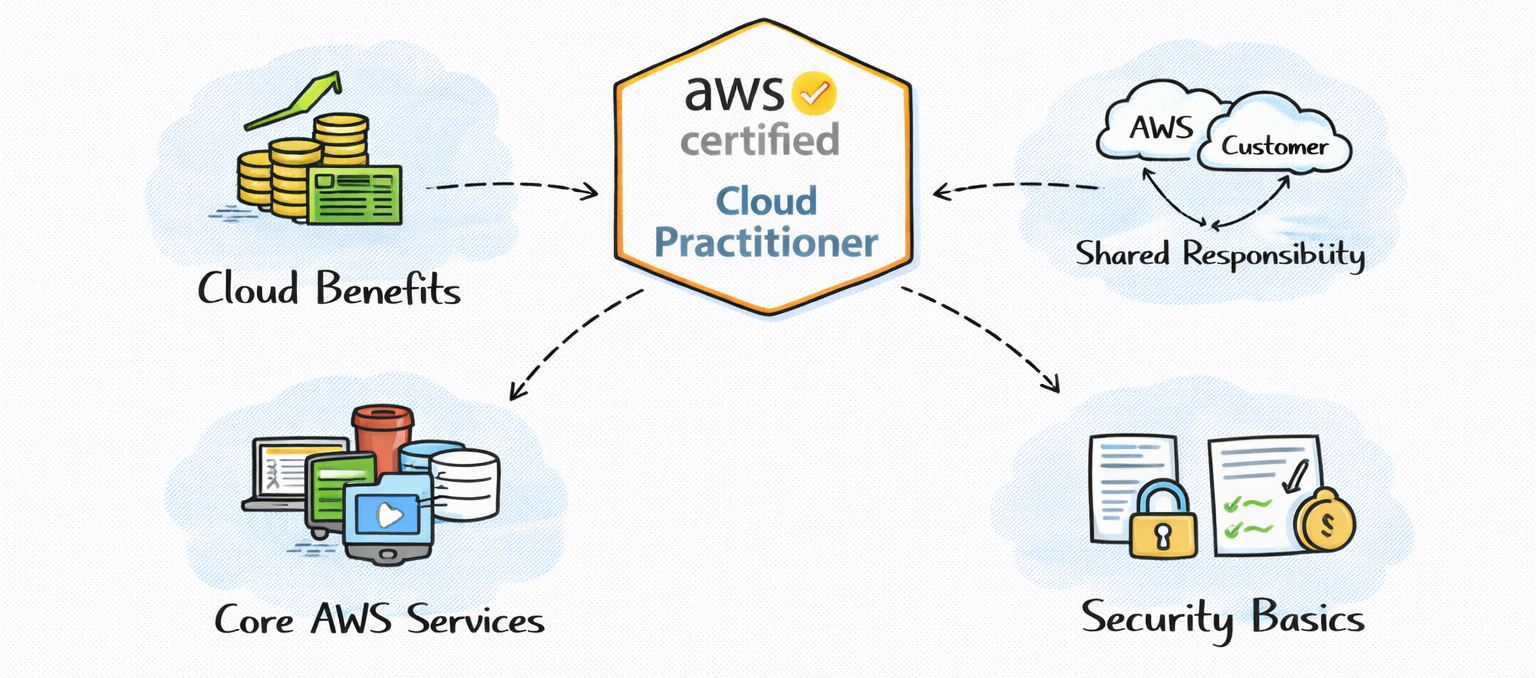
Candidates are expected to understand the value of cloud computing, the shared responsibility model, core AWS services, pricing structures, and security fundamentals, as these are part of what Cloud Practitioners do. The certification ensures that professionals across technical and non-technical roles can understand how AWS works.
This certification is often pursued by developers beginning their cloud journey, business professionals working with cloud teams, and project managers involved in cloud-based initiatives. Because of its broad focus, the exam serves as a gateway into deeper AWS certifications.
Learn the A to Z of Amazon Web Services (AWS)

Learn about the core AWS's services like compute, storage, networking services and how they work with other services like Identity, Mobile, Routing, and Security. This course provides you with a good grasp an all you need to know of AWS services. This course has been designed by three AWS Solution Certified Architects who have a combined industry experience of 17 years. We aim to provide you with just the right depth of knowledge you need to have.
AWS Cloud Practitioner Exam Format And Structure#
Understanding the structure of the exam is one of the most important steps in learning how to pass the AWS Cloud Practitioner exam effectively. The exam tests conceptual knowledge across multiple domains related to AWS services and cloud computing principles.
The exam consists of multiple-choice and multiple-response questions designed to evaluate a candidate’s understanding of AWS fundamentals.
Exam Component | Details |
Certification Name | AWS Certified Cloud Practitioner |
Exam Duration | 90 Minutes |
Number Of Questions | 65 Questions |
Passing Score | Approximately 700 Out Of 1000 |
Exam Cost | $100 USD |
Exam Format | Multiple Choice And Multiple Response |
Delivery Method | Online Proctored Or Testing Center |
The questions are scenario-based and often require selecting the most appropriate AWS service or architecture concept. Instead of testing memorization, the exam evaluates whether candidates understand how AWS services fit into real-world cloud environments.
Why The AWS Cloud Practitioner Certification Matters#
Although the Cloud Practitioner certification is considered an entry-level credential, it plays a significant role in building cloud literacy across the technology industry. Many organizations expect employees to understand cloud infrastructure even if they are not directly responsible for managing it.
Cloud computing has transformed how applications are developed, deployed, and scaled. Understanding AWS fundamentals allows professionals to collaborate effectively with cloud engineers and architects.
Another reason the certification matters is that it creates a structured introduction to AWS services. Candidates who pass the exam often find it easier to progress toward more advanced certifications, such as AWS Solutions Architect Associate or AWS Developer Associate.
Because of this progression path, the Cloud Practitioner certification serves as a foundation for long-term cloud learning.
Core Domains Covered In The Exam#
To understand how to pass the AWS Cloud Practitioner exam, candidates must first become familiar with the domains that appear in the certification blueprint. AWS organizes the exam content into several major knowledge areas.
These domains represent the conceptual knowledge required to understand AWS infrastructure and cloud computing practices.
Exam Domain | Approximate Weight |
Cloud Concepts | 24 Percent |
Security And Compliance | 30 Percent |
Technology | 34 Percent |
Billing And Pricing | 12 Percent |
The Cloud Concepts domain focuses on cloud benefits such as scalability, elasticity, and fault tolerance. Security and Compliance evaluates understanding of identity management, data protection, and the AWS shared responsibility model.
The Technology domain includes knowledge of major AWS services such as compute, storage, and networking. The Billing and Pricing section tests understanding of cost management tools and AWS pricing models.
Studying these domains systematically is essential for passing the certification.
Creating A Study Plan For The Exam#
One of the most effective strategies for learning how to pass the AWS Cloud Practitioner exam is building a structured study plan that spreads preparation across several weeks. Attempting to study everything in a short time often leads to confusion and poor retention of key concepts.
A well-organized study schedule allows candidates to explore each domain carefully and revisit difficult topics. The most effective preparation plans combine theoretical study with practice questions and real AWS console exploration.
The following table illustrates a typical preparation timeline.
Week | Study Focus |
Week 1 | Cloud Computing Basics And AWS Global Infrastructure |
Week 2 | Core AWS Services Including EC2, S3, And Networking |
Week 3 | Security Concepts, IAM, And Compliance |
Week 4 | Pricing Models, Practice Exams, And Revision |
This structured timeline helps candidates build confidence gradually while reinforcing important concepts throughout the preparation process.
Essential AWS Services To Understand#
Although the certification is conceptual, candidates must still understand the purpose of many AWS services. Instead of memorizing dozens of services, preparation should focus on understanding the most commonly used AWS offerings.
Compute services form the foundation of many AWS architectures. Amazon EC2 provides virtual servers, while AWS Lambda allows developers to run code without managing servers.
Storage services are another important exam topic. Amazon S3 offers scalable object storage, while Amazon EBS provides block storage for EC2 instances.
Networking services such as Amazon VPC allow organizations to create secure virtual networks within AWS. Understanding how these services interact is critical when answering scenario-based exam questions.
Understanding AWS Global Infrastructure#
Another key concept that frequently appears in the exam is the AWS global infrastructure model. AWS operates data centers around the world to provide reliable and scalable cloud services.
The infrastructure is organized into regions, availability zones, and edge locations. Regions represent geographic locations containing multiple data centers, while availability zones provide isolated infrastructure within a region.
Edge locations support content delivery services such as Amazon CloudFront. Understanding this infrastructure model helps candidates answer questions related to high availability and disaster recovery.
These architectural concepts form the backbone of AWS cloud design principles.
Learning The AWS Shared Responsibility Model#
Security plays a significant role in the certification exam, and one of the most important concepts candidates must understand is the shared responsibility model. This model explains how security responsibilities are divided between AWS and the customer.
AWS is responsible for protecting the underlying cloud infrastructure, including physical data centers, hardware, and networking components. Customers are responsible for securing their applications, operating systems, and data stored within AWS services.
Understanding this distinction helps candidates answer security-related questions accurately. Many exam questions test whether candidates know which party is responsible for specific security tasks.
Mastering this concept is essential when preparing for the certification.
Understanding AWS Pricing And Cost Management#
Another topic that often surprises candidates preparing for the exam is AWS pricing models. Cloud computing offers flexible pricing structures that differ from traditional infrastructure purchasing.
AWS provides several pricing options, including on-demand pricing, reserved instances, and savings plans. Each model offers different cost advantages depending on usage patterns and workload predictability.
Candidates should also understand cost management tools such as AWS Cost Explorer and AWS Budgets. These services allow organizations to monitor spending and optimize cloud expenses.
Understanding AWS billing concepts helps candidates navigate the pricing and billing domain of the exam.
Using Practice Exams Effectively#
Practice exams play an important role in learning how to pass the AWS Cloud Practitioner exam because they simulate the real testing environment. Attempting mock exams helps candidates become familiar with the question format and time constraints.
Practice questions also reveal knowledge gaps that may not appear during passive studying. When candidates review incorrect answers carefully, they often gain a deeper understanding of AWS concepts.
Effective preparation involves taking multiple practice exams while reviewing explanations for both correct and incorrect answers. This approach builds confidence and reduces anxiety on exam day.
By the time candidates take the real exam, they should feel comfortable navigating scenario-based questions.
Common Mistakes Candidates Make During Preparation#
Many candidates preparing for the certification assume that the exam only requires memorizing AWS service names. This misunderstanding often leads to weak conceptual knowledge and poor performance on scenario-based questions.
Another common mistake involves ignoring the billing and pricing domain. Because this topic appears less technical, candidates sometimes underestimate its importance.
Some candidates also delay taking practice exams until the final days before the test. Early practice testing is often more effective because it identifies weak areas that require additional study time.
Avoiding these preparation mistakes significantly improves the chances of passing the certification on the first attempt.
Exam Day Strategies For Success#
Preparing for the exam is only part of the process of learning how to pass the AWS Cloud Practitioner exam successfully. Candidates must also approach the exam with a calm and strategic mindset.
Reading each question carefully is essential because AWS exam questions often include subtle wording differences. Candidates should identify the key requirement within each scenario before selecting an answer.
Time management is also important during the exam. Because the exam includes 65 questions, candidates should maintain a steady pace without spending too much time on a single question.
If uncertain about an answer, candidates can mark the question for review and revisit it later. This strategy helps maintain momentum during the exam.
Long-Term Benefits Of AWS Certification#
Earning the AWS Cloud Practitioner certification offers benefits that extend beyond simply passing an exam. The preparation process introduces candidates to cloud architecture concepts that are increasingly important in modern software development.
Professionals who understand AWS fundamentals often communicate more effectively with infrastructure teams and cloud architects. This knowledge improves collaboration across engineering, operations, and product development teams.
The certification also opens pathways toward more advanced AWS certifications. Many professionals who begin with the Cloud Practitioner exam eventually pursue specialized certifications in architecture, development, or DevOps.
Because of this progression, the certification often marks the beginning of a long-term cloud learning journey.
Final Thoughts#
Learning how to pass the AWS Cloud Practitioner exam requires more than memorizing AWS terminology. Candidates must understand cloud computing principles, security concepts, pricing models, and the core AWS services that power modern applications.
With a structured study plan, hands-on experimentation with AWS services, and consistent practice exams, most candidates can prepare successfully within a few weeks. The certification provides a valuable introduction to cloud computing and lays the groundwork for deeper AWS expertise.
As organizations continue to adopt cloud infrastructure at a rapid pace, professionals who understand AWS fundamentals will remain highly valuable in the technology workforce. Passing the Cloud Practitioner exam represents the first step toward mastering cloud architecture and building a career in cloud engineering.
