Developers preparing for coding interviews or studying advanced algorithms often encounter dynamic programming problems that initially seem confusing or overwhelming.
Unlike simple iterative or recursive algorithms, dynamic programming problems require recognizing hidden patterns within a problem. Instead of solving the entire problem at once, developers must identify smaller subproblems and determine how those subproblems relate to each other. Once these relationships are understood, the algorithm can reuse previously computed results rather than recomputing them repeatedly.
Although dynamic programming may seem difficult at first, mastering it is less about memorizing individual problems and more about developing a systematic approach. When developers learn how to break problems into states, define transitions, and store intermediate results, they begin to see recurring patterns across many different algorithmic challenges.
Some of the toughest questions in technical interviews require dynamic programming solutions. Dynamic programming (DP) is an advanced optimization technique applied to recursive solutions. However, DP is not a one-size-fits-all technique, and it requires practice to develop the ability to identify the underlying DP patterns. With a strategic approach, coding interview prep for DP problems shouldn’t take more than a few weeks. This course starts with an introduction to DP and thoroughly discusses five DP patterns. You’ll learn to apply each pattern to several related problems, with a visual representation of the working of the pattern, and learn to appreciate the advantages of DP solutions over naive solutions. After completing this course, you will have the skills you need to unlock even the most challenging questions, grok the coding interview, and level up your career with confidence. This course is also available in C++, JavaScript, and Python—with more coming soon!
Understanding the structure of dynamic programming problems#
Most dynamic programming problems share two fundamental characteristics that make them suitable for this technique.
The first characteristic is overlapping subproblems. In many recursive algorithms, the same smaller problem appears repeatedly during computation. If each instance is solved independently, the algorithm performs redundant work and becomes inefficient. Dynamic programming addresses this by storing previously computed results and reusing them when needed.
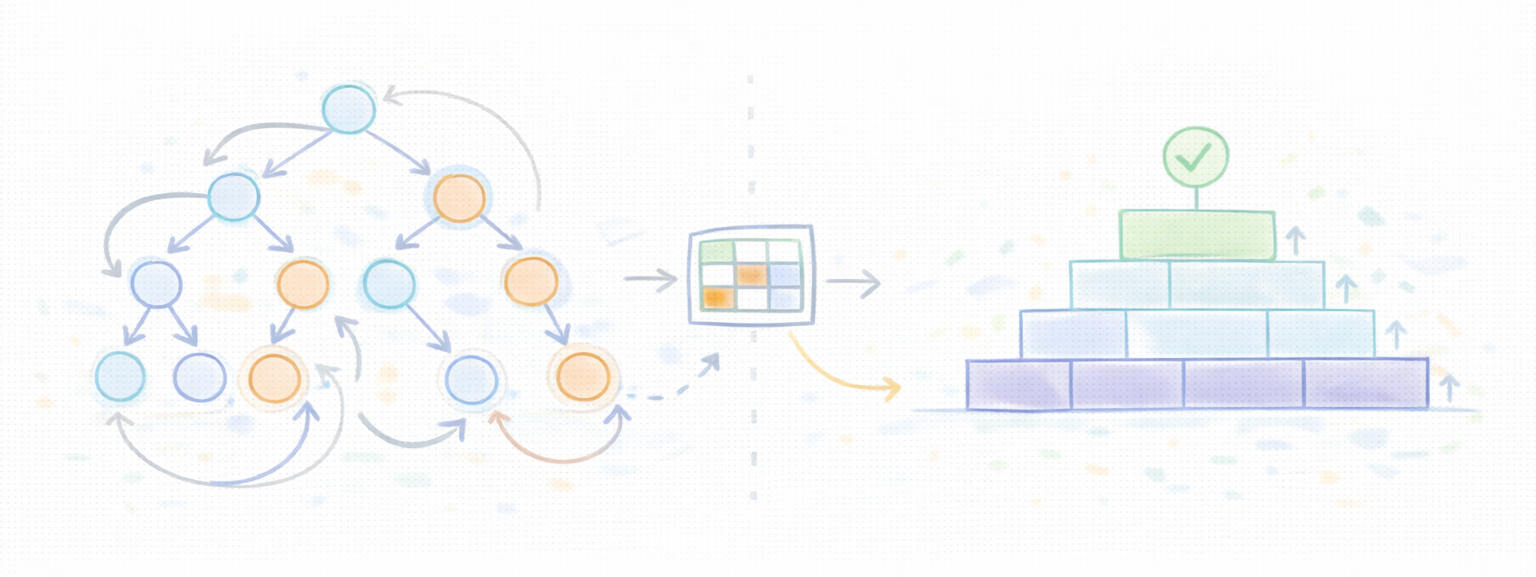
The second characteristic is optimal substructure. This property means that the optimal solution to a problem can be constructed from optimal solutions to smaller subproblems. When this condition is satisfied, solving the smaller components correctly leads to the correct overall solution.
Recognizing these properties helps developers determine whether dynamic programming is the appropriate strategy when considering how to solve dynamic programming problems.
Dynamic programming workflow#
Step | Description |
Understand the problem | Carefully interpret the requirements and constraints |
Identify subproblems | Break the problem into smaller components |
Define the state | Determine how to represent each subproblem |
Determine the transition | Define how states relate to each other |
Implement and optimize | Build the solution using memoization or tabulation |
This workflow provides a structured method for designing dynamic programming algorithms. Developers first analyze the problem and identify repeating patterns. Next, they define states that represent the subproblems and determine how those states interact. Finally, they implement the algorithm using either top-down recursion with memoization or bottom-up tabulation.
Following this process helps developers consistently apply dynamic programming techniques across many types of problems.
Step-by-step method for solving dynamic programming problems#
When developers encounter a dynamic programming challenge, they can follow a systematic approach to design an efficient solution.
Step 1: Define the state#
The state represents the minimal set of variables required to describe a subproblem. Choosing the right state representation is one of the most important steps in solving dynamic programming problems.
For example, a problem involving arrays might define the state using an index representing the current position. Other problems may require multiple parameters such as remaining capacity, sequence length, or partial results.
Clearly defining the state ensures that each subproblem can be uniquely identified and solved independently.
Step 2: Determine the recurrence relation#
The recurrence relation describes how a state depends on smaller states. It defines how the solution to a larger problem can be constructed from previously solved subproblems.
For instance, in the Fibonacci sequence, each number depends on the two preceding numbers. In more complex problems, the recurrence relation may involve multiple decisions or transitions.
Understanding this relationship is essential when learning how to solve dynamic programming problems effectively.
Step 3: Choose memoization or tabulation#
Dynamic programming solutions can typically be implemented in two ways.
The memoization approach uses recursion combined with caching. When a recursive call solves a subproblem, the result is stored so that it can be reused later.
The tabulation approach builds the solution iteratively using a table or array. Instead of recursion, the algorithm fills the table starting from the smallest subproblems and gradually builds the final result.
Both approaches solve the same problem but differ in how the computation is organized.
Step 4: Identify base cases#
Every dynamic programming solution must include base cases that terminate recursion or initialize the table.
Base cases define the smallest possible subproblems that can be solved directly without further decomposition. These values form the foundation for solving larger subproblems.
Step 5: Analyze time and space complexity#
Once the algorithm is implemented, developers analyze its efficiency. Dynamic programming often reduces exponential time complexity to polynomial time by eliminating repeated computations.
Understanding these improvements helps developers appreciate why dynamic programming is such a powerful algorithmic technique.
Example problem: Fibonacci sequence#
The Fibonacci sequence provides a classic example that illustrates the transition from recursion to dynamic programming.
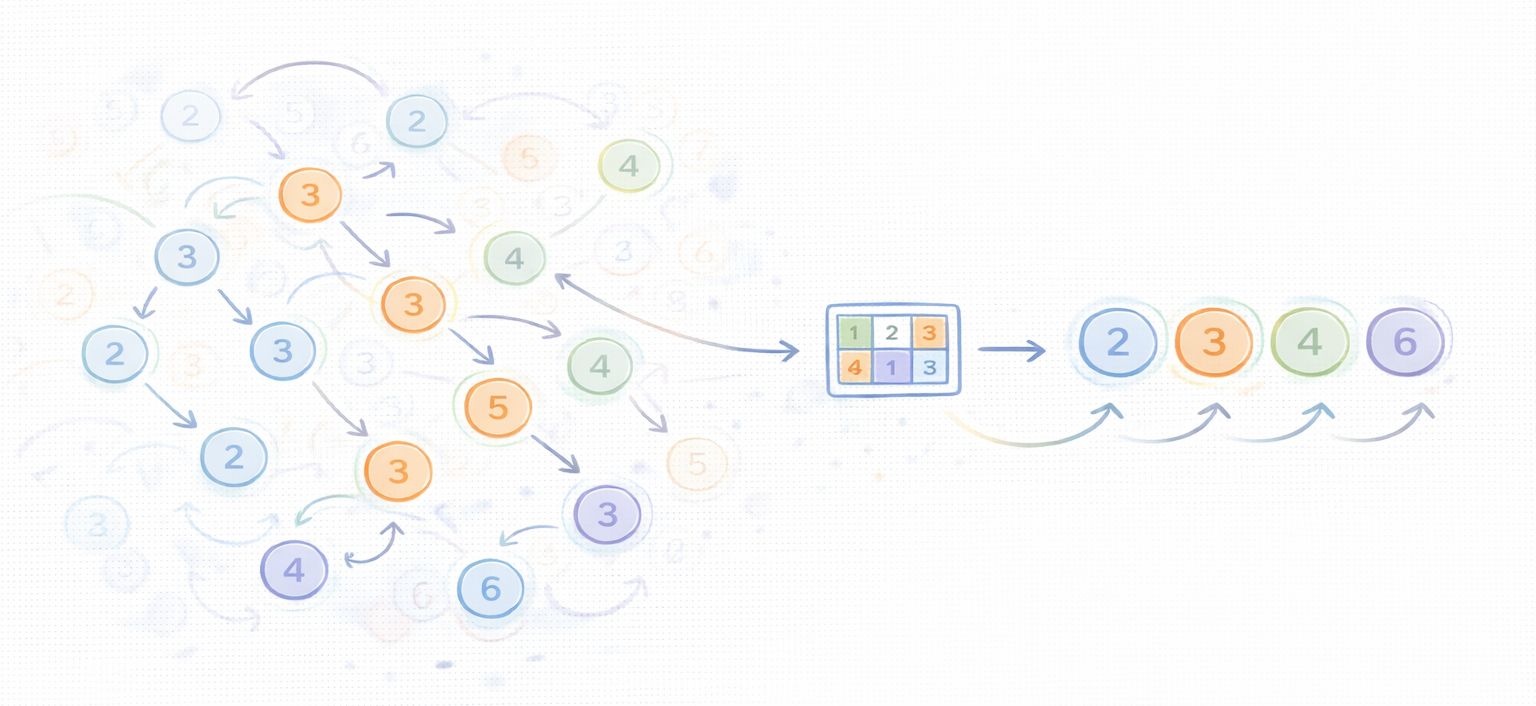
In a naive recursive implementation, computing the Fibonacci number for a given value requires repeatedly recalculating smaller Fibonacci numbers. For example, computing the tenth Fibonacci number requires computing the ninth and eighth numbers, which again require earlier values.
This repeated computation causes exponential growth in the number of recursive calls, making the algorithm inefficient. Dynamic programming solves this issue by storing previously computed Fibonacci values so that each value is calculated only once.
Code example using dynamic programming#
The following Python implementation demonstrates a bottom-up dynamic programming approach for calculating Fibonacci numbers.
def fibonacci(n):dp = [0] * (n + 1)dp[1] = 1for i in range(2, n + 1):dp[i] = dp[i-1] + dp[i-2]return dp[n]
In this implementation, the array dp stores Fibonacci numbers as they are computed. The algorithm begins with the base cases and then iteratively calculates each subsequent value using the two preceding values.
Because each value is computed only once, this approach avoids the repeated calculations that occur in naive recursive solutions. This example illustrates one of the core principles behind how to solve dynamic programming problems efficiently.
Recognizing common dynamic programming patterns#
Many dynamic programming problems follow recurring structural patterns. Recognizing these patterns makes it easier to solve new problems because similar strategies can often be applied.
One common pattern involves Fibonacci-style recurrence, where each value depends on one or two previous values. Another pattern appears in knapsack problems, where decisions must be made about including or excluding items while respecting constraints such as weight or capacity.
Longest subsequence problems form another important category. These problems involve finding the longest sequence that satisfies certain conditions within a larger dataset.
Finally, grid traversal problems involve moving through a grid while minimizing cost or maximizing some objective. Learning these patterns helps developers recognize when dynamic programming techniques can be applied.
Practical tips for mastering dynamic programming#
Developing dynamic programming skills requires practice and consistent exposure to algorithmic patterns. One effective strategy involves solving classic dynamic programming problems repeatedly. Problems such as Fibonacci, coin change, knapsack optimization, and longest common subsequence help build foundational understanding.
Another useful approach involves writing a recursive solution first and then optimizing it using dynamic programming techniques. This process helps developers understand how memoization removes redundant computations.
Visualizing state transitions can also improve comprehension. Drawing diagrams or tables that represent subproblem relationships often makes the structure of the algorithm clearer. Over time, these techniques help developers develop intuition about how to solve dynamic programming problems and recognize patterns more quickly.
Why are dynamic programming problems common in technical interviews?#
Dynamic programming problems appear frequently in technical interviews because they test a developer’s ability to analyze complex problems, identify patterns, and design efficient algorithms. These skills are important when building scalable software systems.
How long does it take to become comfortable with DP problems?#
The learning curve varies depending on experience and practice frequency. Many developers begin to feel comfortable after solving several classic problems and recognizing recurring dynamic programming patterns.
Should beginners learn recursion before dynamic programming?#
Yes, learning recursion first is often helpful because dynamic programming builds upon recursive problem decomposition. Understanding recursion makes it easier to recognize overlapping subproblems and optimize solutions using memoization.
What are the best resources for practicing DP problems?#
Many developers practice dynamic programming using algorithm problem platforms, coding interview preparation resources, and competitive programming challenges. Solving a variety of problems helps build familiarity with different dynamic programming patterns.
Final words#
Dynamic programming is a powerful technique for solving problems that involve repeated subproblems and optimization decisions. By breaking problems into smaller states, defining transitions between those states, and storing intermediate results, developers can design algorithms that avoid redundant computations.
Learning how to solve dynamic programming problems requires patience, structured thinking, and regular practice. As developers gain experience with common patterns and systematic workflows, they become better equipped to tackle complex algorithmic challenges efficiently.
