How to study SQL: A structured approach to database querying
Not sure how to study SQL? Follow a structured roadmap, master core concepts, and practice with real datasets to build strong query skills and succeed in data-driven roles like analytics and backend development.
Many people beginning careers in data analysis, backend development, or business intelligence eventually seek guidance on how to study SQL as they build their database skills. SQL remains one of the most widely used technologies for working with structured data because it allows professionals to retrieve, manipulate, and analyze information stored in relational databases. From customer records to financial transactions, large organizations rely on SQL-based systems to manage the data that drives decision-making.
Learning SQL effectively requires more than memorizing query syntax. Real database work involves understanding how data is organized, how tables relate to each other, and how queries retrieve meaningful insights from large datasets. A structured learning approach helps learners move beyond simple examples and develop the practical skills needed to work with real-world data systems.
Learn SQL

Learn SQL basics with our beginner-friendly guide to understanding the language of data. You’ll start by learning to talk to a database: asking questions and getting meaningful answers using SQL. With AI-assisted guidance, you’ll explore the essentials—selecting columns, filtering rows, sorting results, and applying logic to uncover patterns in raw data. As your questions become more precise, you’ll explore grouping, aggregation, and subqueries to extract deeper insights. Then you’ll shift gears and learn how to create tables, insert and edit data, and design simple relational schemas. Finally, you’ll tackle real-world scenarios using joins, building multi-table queries, and designing interactive dashboards. You’ll complete hands-on challenges and projects like a student tracker and a game leaderboard. No prior experience with databases or programming is needed—this course is your friendly introduction to the language of data.
Why SQL is an essential skill#
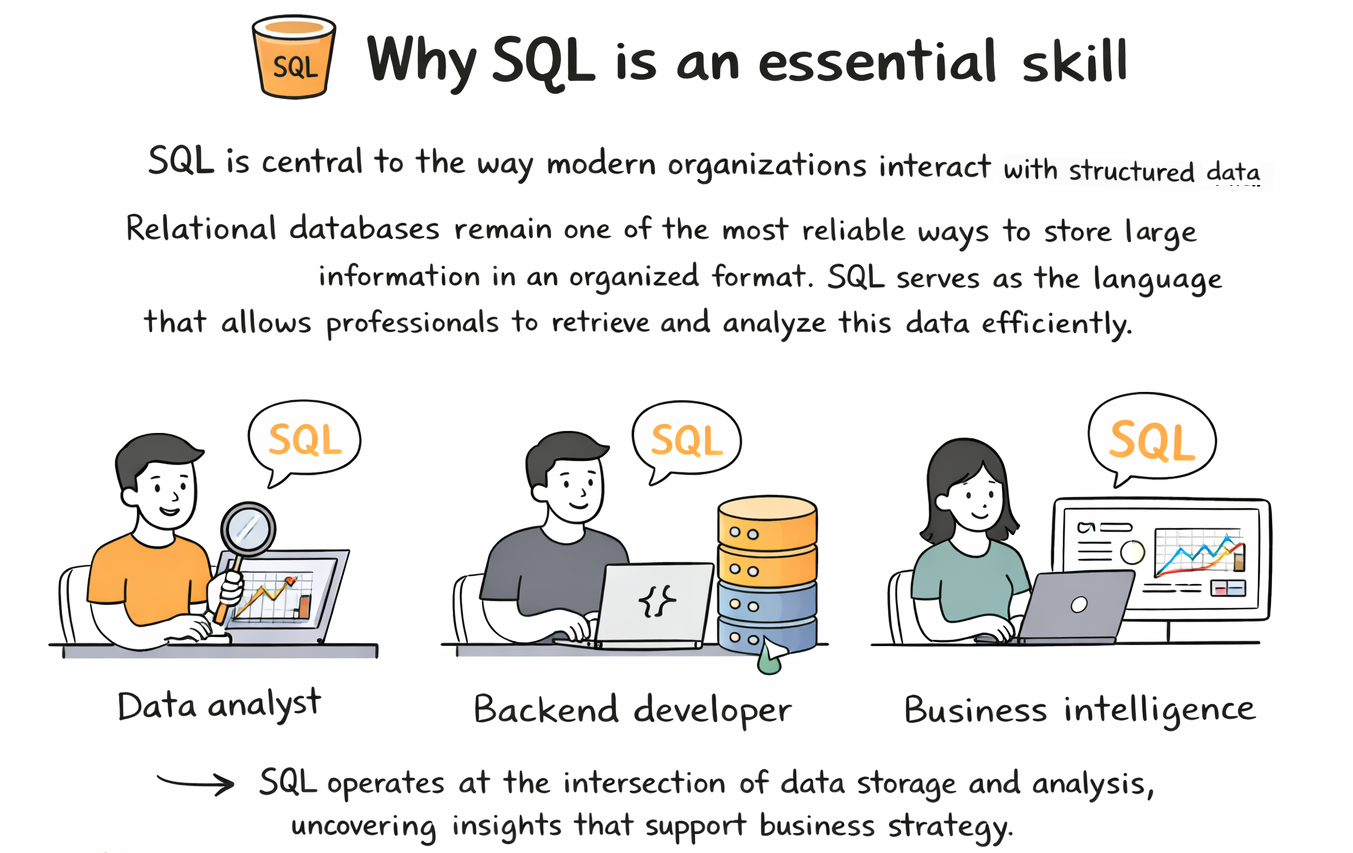
SQL is central to the way modern organizations interact with structured data. Relational databases remain one of the most reliable ways to store large volumes of information in an organized format. SQL serves as the language that allows professionals to retrieve and analyze this data efficiently.
Many technology roles rely on SQL as a daily tool. Data analysts use SQL queries to extract datasets for reporting and analysis. Backend developers use SQL to connect applications with databases. Database administrators rely on SQL for managing database structures and ensuring data integrity. Business intelligence specialists frequently write SQL queries to power dashboards and analytics systems.
Because SQL operates at the intersection of data storage and analysis, professionals who understand how to work with relational databases can uncover insights that support business strategy and operational decision-making.
An Introductory Guide to SQL
The ability to work SQL is becoming an increasingly in-demand skill, both for software developers and people in less technical roles. If you’re interested in learning SQL and have no prior experience with it, then this course will be your light in a dark tunnel. You’ll start by covering the basics of SQL such as how to create a database, how to insert, query, and update data. You’ll also learn fundamental concepts that developers and data scientists use everyday such as multi-table operations, nested queries, and how to set up views. Throughout, you’ll get to execute SQL queries in your browser and see results in real-time - you won’t need to worry about set-up. At the end of this course, you’ll also get some hands-on practice with common SQL interview questions, so when the time comes, you’ll be ready and confident to answer any question that comes your way. Let’s get started!
A structured roadmap for studying SQL#
Developing SQL proficiency becomes easier when learners follow a structured learning path. SQL concepts build upon each other, which means beginners benefit from progressing through increasingly complex topics.
Learning Stage | Skills Developed |
Beginner | Basic SELECT queries, filtering data, and sorting results |
Intermediate | Working with joins, grouping results, and aggregating data |
Advanced | Writing subqueries, optimizing queries, and understanding database design |
At the beginner stage, learners focus on simple data retrieval. This includes selecting columns from tables, filtering records with conditions, and organizing results using sorting techniques.
Intermediate learners begin working with multiple tables. They learn how joins connect related datasets and how grouping operations summarize information across large data collections.
Advanced learners expand their understanding by exploring nested queries, performance considerations, and relational database design. At this stage, SQL becomes a powerful analytical tool capable of handling complex data relationships.
Following a roadmap like this provides clarity for learners who are deciding how to study SQL without becoming overwhelmed by advanced topics too early and ace their SQL interview questions.
Grokking the SQL Interview Patterns

Prepare for roles like Data Scientist, AI/ML Engineer, Data Engineer, and Data Analyst by mastering the SQL patterns top tech companies expect. Solve real-world problems, apply proven strategies, and deepen your conceptual understanding to stand out in competitive interviews. Instead of focusing on syntax drills, this course teaches you to recognize structured SQL patterns, map them to real-world use cases, and tackle interview scenarios with clarity and precision. Strengthen your problem-solving skills by working through LeetCode-style challenges, analyzing business case studies, and implementing performance optimization techniques used across leading tech firms, fintech startups, and data-driven organizations.
Core SQL concepts every learner should master#
Effective SQL study begins with a strong understanding of foundational concepts that appear in most database queries. These core ideas form the building blocks for more complex database interactions.
The most fundamental operation involves retrieving information using the SELECT statement. This command allows users to specify which columns of data they want to view from a particular table.
Filtering results using the WHERE clause is another essential concept. This allows analysts to isolate records that match specific conditions, such as transactions within a certain date range or customers from a particular region.
Sorting results using the ORDER BY clause helps organize output in meaningful ways. Analysts frequently sort datasets to identify trends, rank results, or analyze performance metrics.
Aggregation functions such as COUNT, SUM, and AVG allow users to summarize large datasets. These operations are essential for reporting tasks such as calculating total revenue, average order values, or customer counts.
Together, these foundational operations form the basis of most SQL queries used in professional environments.
Practicing SQL with real datasets#
Hands-on practice is one of the most effective ways to develop SQL skills. While theoretical knowledge helps learners understand query syntax, real-world datasets provide the context necessary to apply SQL effectively.
Working with practical datasets allows learners to see how database queries interact with structured information. For example, a learner might explore a customer database to identify purchasing patterns or analyze a set of transaction records to determine sales trends.
Practical exercises may include querying a database to retrieve customer orders, filtering transaction data based on specific conditions, or combining tables using joins to analyze relationships between datasets.
Repeated practice strengthens both technical understanding and problem-solving ability. Over time, learners develop the intuition needed to design queries that answer meaningful questions about the data.
Building more advanced query skills#
Once learners understand basic SQL syntax, they can begin exploring more complex query techniques that support advanced data analysis.
Nested queries, also known as subqueries, allow a query to operate within another query. These structures help analysts perform multi-step operations that involve filtering or aggregating intermediate results.
Working with multiple joins enables learners to analyze relationships between several tables simultaneously. This skill is particularly useful in environments where data is distributed across multiple database structures.
Aggregation queries play a key role in reporting and analytics. These queries summarize large datasets into meaningful insights that can be used for decision-making.
Understanding query performance and optimization becomes increasingly important as datasets grow larger. Efficient queries help reduce processing time and improve the responsiveness of database systems.
Developing these advanced skills transforms SQL from a simple querying tool into a powerful analytical language.
Common mistakes beginners make while studying SQL#
Many beginners encounter challenges during the early stages of learning SQL. Recognizing these mistakes can help learners avoid frustration and improve their learning process.
One common mistake involves memorizing syntax without understanding how relational data works. SQL queries operate within the structure of tables and relationships, so understanding the database schema is essential for writing effective queries.
Another mistake involves avoiding hands-on practice. Reading about SQL concepts without writing queries rarely leads to strong technical skills. Practical exercises provide the experience needed to understand how queries behave in real datasets.
Some learners also attempt advanced query techniques before mastering the basics. This approach can create confusion because advanced concepts rely on a clear understanding of fundamental SQL operations.
By focusing on foundational concepts and consistent practice, learners can build strong SQL skills more efficiently.
Developing long-term SQL proficiency#
SQL expertise develops gradually through consistent exposure to data and continuous practice. Professionals who regularly work with databases become more efficient at writing queries and analyzing results.
Studying real database schemas helps learners understand how large data systems are structured. Observing how tables connect through primary and foreign keys improves the ability to design effective joins and queries.
Reading queries written by experienced developers can also broaden a learner’s understanding of SQL techniques. Different programmers often approach problems in unique ways, which helps learners discover alternative strategies for solving database challenges.
Experimenting with different query approaches is another valuable learning technique. Testing variations of a query allows learners to observe how small changes affect the output and performance of the query.
Developing these habits helps learners build long-term database expertise.
FAQ#
How long does it take to learn SQL effectively?#
The time required to learn SQL depends on the learner’s background and study habits. Beginners who practice consistently often develop foundational SQL skills within several weeks, while mastering advanced query techniques may require several months of continued practice.
Is SQL difficult for beginners to understand?#
SQL is generally considered beginner-friendly compared with many programming languages. Its syntax is relatively readable, and many database concepts follow logical patterns that are easy to understand once learners become familiar with relational data structures.
Do data analysts need advanced SQL skills?#
Many data analysts rely heavily on SQL for retrieving and transforming datasets. While basic SQL knowledge is sufficient for some tasks, advanced query techniques such as joins, aggregations, and subqueries are often required for more complex analysis.
What tools can beginners use to practice SQL queries?#
Beginners can practice SQL using online coding platforms, local database installations, or interactive learning environments. Many platforms provide built-in datasets and query editors that allow learners to experiment with SQL queries safely.
Final words#
SQL remains one of the most valuable skills for professionals working with structured data. Whether someone is entering data analysis, backend development, or business intelligence, the ability to write effective database queries is essential.
Understanding how to study SQL allows learners to approach database learning with a structured strategy that combines conceptual understanding with hands-on practice. By focusing on core database concepts, practicing with real datasets, and gradually expanding query complexity, learners can build the SQL proficiency required for modern data-driven careers.
Happy learning!