Meta ML System Design Interview
Master Meta ML system design by learning to architect scalable data pipelines, feature stores, distributed training, low-latency inference, and feedback loops with safety and privacy built in. Design end-to-end ML platforms and stand out in your Meta interview
Preparing for the Meta ML System Design interview means stepping into one of the most advanced machine learning ecosystems in the world. Meta’s products, including Facebook, Instagram, WhatsApp, and Threads, run on ML-powered systems that personalize feed ranking, recommendations, ad targeting, search, integrity detection, vision models, and large-scale representation learning.
Unlike traditional ML interviews that focus on modeling techniques or algorithms, the Meta ML System Design interview evaluates your ability to architect full-stack ML pipelines: ingestion → labeling → feature generation → model training → model deployment → inference → monitoring → feedback loops. Everything must be designed to operate at a billions-of-users scale, under strict latency, privacy, and reliability constraints.
Grokking Modern System Design Interview
For a decade, when developers talked about how to prepare for System Design Interviews, the answer was always Grokking System Design. This is that course — updated for the current tech landscape. As AI handles more of the routine work, engineers at every level are expected to operate with the architectural fluency that used to belong to Staff engineers. That's why System Design Interviews still determine starting level and compensation, and the bar keeps rising. I built this course from my experience building global-scale distributed systems at Microsoft and Meta — and from interviewing hundreds of candidates at both companies. The failure pattern I kept seeing wasn't a lack of technical knowledge. Even strong coders would hit a wall, because System Design Interviews don't test what you can build; they test whether you can reason through an ambiguous problem, communicate ideas clearly, and defend trade-offs in real time (all skills that matter ore than never now in the AI era). RESHADED is the framework I developed to fix that: a repeatable 45-minute roadmap through any open-ended System Design problem. The course covers the distributed systems fundamentals that appear in every interview – databases, caches, load balancers, CDNs, messaging queues, and more – then applies them across 13+ real-world case studies: YouTube, WhatsApp, Uber, Twitter, Google Maps, and modern systems like ChatGPT and AI/ML infrastructure. Then put your knowledge to the test with AI Mock Interviews designed to simulate the real interview experience. Hundreds of thousands of candidates have already used this course to land SWE, TPM, and EM roles at top companies. If you're serious about acing your next System Design Interview, this is the best place to start.
If you want to stand out in the Meta ML System Design interview questions, you need to demonstrate a deep understanding of ML infrastructure, distributed systems, real-time personalization, model lifecycle management, and data quality reasoning. This guide gives you the structure and depth you need to present senior-level answers.
Understanding What Meta Evaluates#
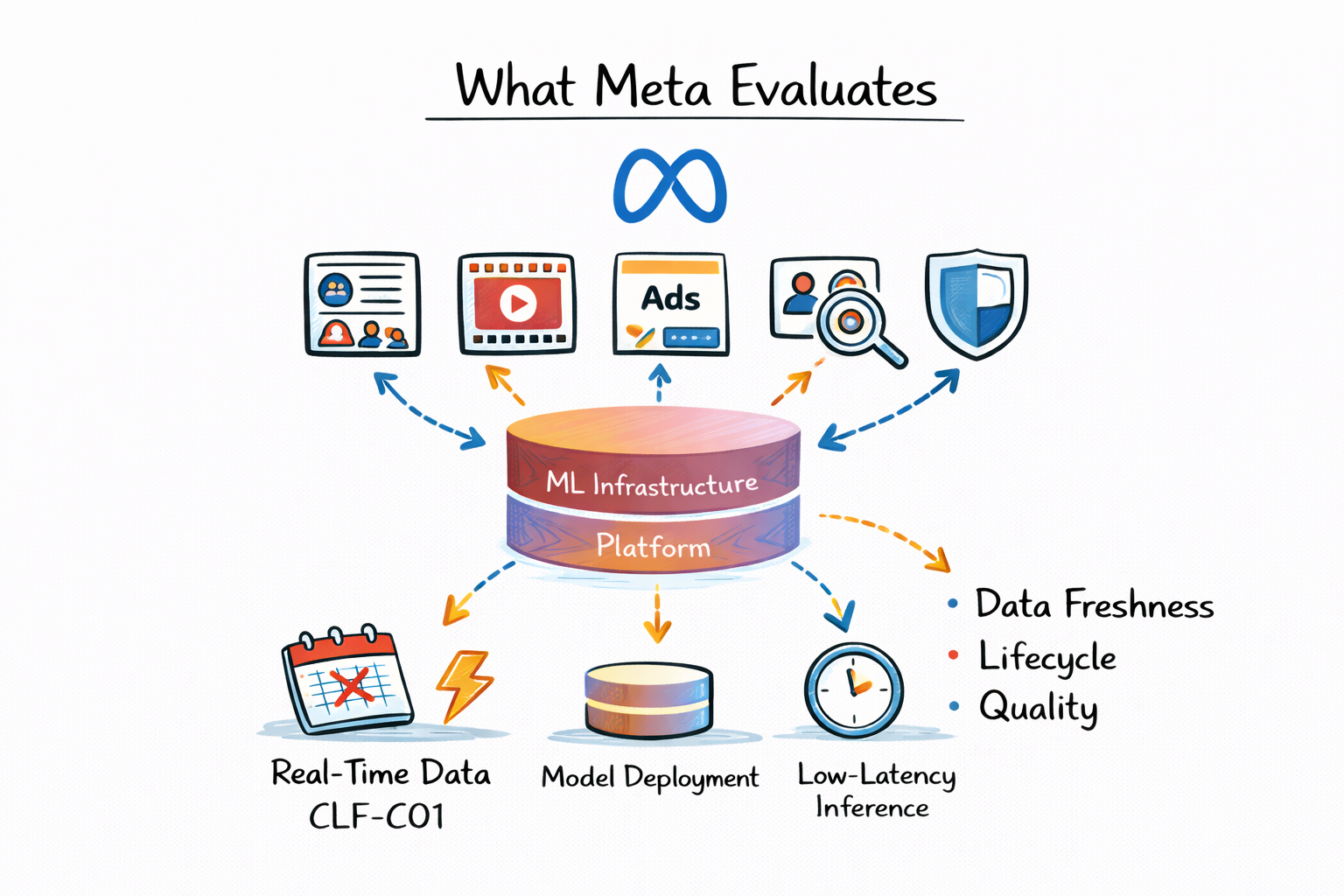
At Meta, ML is not an add-on capability but a foundational infrastructure layer powering nearly every product surface. Feed ranking, reels recommendations, ads targeting, search ranking, integrity detection, and multimodal understanding all depend on large-scale ML systems.
Interviewers assess whether you can design systems that combine massive real-time data ingestion with reliable model deployment and low-latency inference. They want to see strong reasoning about data quality, freshness, and lifecycle management rather than purely modeling knowledge.
Grokking the Machine Learning System Design Interview
Machine learning is changing what companies expect from senior engineers. Building a model is only one part of the job. Senior engineers are expected to design ML systems that scale in production while accounting for data quality, infrastructure, latency, reliability, cost, and business requirements. ML system design is a core skill for senior AI and machine learning roles. I created this course based on my experience designing large-scale systems at Microsoft and Meta, where I worked on infrastructure and real-time analytics, and interviewed hundreds of candidates. The biggest pattern I saw was that even strong engineers struggled to structure ambiguous ML system design problems and communicate trade-offs clearly. This course introduces the 6-step framework I developed to solve that gap. In this course, you'll master a 6-step ML system design framework that covers everything from problem formulation and requirements gathering to data strategy, model architecture, evaluation, and production deployment. You'll work through real-world case studies spanning recommendation systems, fraud detection, semantic search, content moderation, and LLM-powered applications, tackling the exact challenges faced in interviews. If you're serious about mastering ML system design interviews, this is the best place to start.
Core Domains in the ML System Design Interview#
The following domains frequently appear in Meta ML system design discussions.
Domain | Real-World Examples | Architectural Emphasis |
Data ingestion | User clicks, likes, watch time logs | Event streaming, reliability, and freshness |
Feature engineering | Embeddings, engagement signals | Online/offline consistency |
Model training | Distributed GPU training | Scalability, sampling, evaluation |
Model serving | Real-time feed scoring | Sub-10ms latency, versioning |
Ranking systems | Feed, reels, ads | Multi-stage ranking pipelines |
Feedback loops | Model retraining, drift detection | Monitoring and iteration |
Safety & privacy | Integrity detection, GDPR compliance | Fairness, logging, secure usage |
This table helps frame your answer in terms of the platform Meta actually operates.
Scalability & System Design for Developers
As you progress in your career as a developer, you'll be increasingly expected to think about software architecture. Can you design systems and make trade-offs at scale? Developing that skill is a great way to set yourself apart from the pack. In this Skill Path, you'll cover everything you need to know to design scalable systems for enterprise-level software.
Large-Scale Data Ingestion and Processing#
Meta collects enormous volumes of interaction data from billions of users. These signals include clicks, impressions, watch time, comments, shares, and contextual information such as device type and session metadata.
A robust ingestion layer must support distributed logging and real-time event streaming. Systems such as Kafka-like pipelines allow event buffering, deduplication, and validation before downstream processing.
Data Validation and Freshness#
High-quality ML systems depend on clean and reliable data. Validation services must detect schema violations, corrupted events, and anomalies before features are computed.
Freshness is critical because ranking systems rely on up-to-date engagement signals. Delayed or stale data can degrade personalization quality and user experience.
Feature Engineering Infrastructure#
Meta’s ML systems depend on features derived from user behavior, social graph relationships, embeddings, and contextual signals. These features must be available both in offline training environments and online serving systems.
Maintaining consistency between offline and online features is one of the most important system design challenges. If features differ between training and inference, model performance can degrade significantly.
Designing a Feature Store#
A well-designed feature store ensures point-in-time correctness and low-latency retrieval.
Feature Type | Purpose | Design Requirement |
Offline features | Training datasets | Point-in-time correctness, backfills |
Online features | Real-time inference | Low latency, caching, high QPS |
Embedding features | Similarity search | Efficient vector storage |
Aggregated signals | CTR, engagement counts | Incremental updates |
The feature store must support schema evolution and monitoring to detect drift or unexpected distribution changes.
Model Training Infrastructure#
Training models at the Meta scale requires distributed GPU clusters capable of handling massive datasets and model sizes. Auto-sharding and parallel data loaders are essential to prevent bottlenecks.
Training pipelines should support hyperparameter sweeps and evaluation metrics tracking. Model comparison frameworks help determine whether new models outperform previous versions.
Data Sampling and Deduplication#
Large-scale training data often contains redundancy and imbalance. Sampling strategies help manage skew and improve model generalization.
Deduplication ensures training data does not overweight repeated content, which is especially important in social platforms where viral posts generate repetitive signals.
Online Inference and Model Serving#
Inference systems at Meta often operate under strict latency budgets, frequently below ten milliseconds. These systems must be globally distributed and resilient.
To achieve this, models may be quantized, pruned, or distilled into smaller versions suitable for real-time serving.
Model Serving Architecture#
Component | Function | Key Design Concern |
Inference service | Score requests | Latency optimization |
Model registry | Store versions | Safe rollbacks |
Caching layer | Reuse predictions | Consistency |
A/B testing framework | Experimentation | Controlled rollout |
Monitoring system | Detect anomalies | Drift and failures |
Serving systems must support versioning and safe deployment strategies, including shadow testing before full rollout.
Ranking and Recommendation Systems#
Feed ranking typically uses multi-stage pipelines. The first stage generates thousands of candidate posts using embedding similarity.
Subsequent stages apply increasingly complex models to refine rankings. This reduces computational cost while maintaining high personalization quality.
Candidate Generation#
Embedding stores allow efficient retrieval of content based on similarity to user vectors. These embedding systems must support high QPS and near real-time updates.
Contextual features such as time of day, device type, and session signals enhance personalization.
Feedback Loops and Monitoring#
ML systems at Meta rely on constant iteration. User feedback is logged and fed into retraining pipelines.
Monitoring dashboards track engagement metrics, distribution shifts, and anomalies.
Drift Detection#
Model drift occurs when input data distributions change over time. Detection systems monitor feature statistics and performance metrics to trigger retraining.
Automated retraining pipelines help maintain freshness while controlling costs.
Safety, Fairness, and Privacy#
Content moderation models classify harmful or policy-violating content. These systems often combine NLP and computer vision embeddings.
Precision and recall tuning must balance user experience with safety requirements.
Privacy and Compliance#
Meta operates under strict regulatory frameworks such as GDPR and CCPA. Data access must be auditable and secure.
Feature pipelines must respect regional data restrictions and enforce policy-based filtering.
Structuring Your Interview Answer#
Step 1: Clarify Requirements#
Begin by asking about latency targets, retraining frequency, feature freshness, privacy constraints, and success metrics.
This demonstrates product awareness and ML intuition.
Step 2: Identify Non-Functional Requirements#
Discuss global distribution, inference latency, online-offline consistency, privacy compliance, and cost efficiency.
These constraints shape architectural decisions.
Step 3: Estimate Scale#
Assume billions of daily events and millions of predictions per second. Mention petabyte-scale storage and distributed GPU clusters.
Scale awareness signals senior-level thinking.
Step 4: Present High-Level Architecture#
Your architecture should include ingestion pipelines, a feature store, a training system, a model registry, serving infrastructure, experimentation layer, and monitoring loop.
Explain how data flows end-to-end from user interaction to model improvement.
Step 5: Deep Dive into a Core Component#
Choose one subsystem, such as ranking, feature store, or inference. Discuss technical depth, bottlenecks, and operational concerns.
Depth matters more than breadth.
Step 6: Handle Failure Scenarios#
Address stale features, model drift, inference overload, corrupted ingestion data, or regional outages.
Resilience planning separates strong candidates from average ones.
Step 7: Discuss Trade-Offs#
Explain trade-offs such as model complexity versus latency, retraining frequency versus cost, and global consistency versus personalization.
Well-reasoned trade-offs demonstrate maturity.
Example: Designing a Feed Ranking System#
A feed ranking system begins with event ingestion, where user interactions are logged through streaming pipelines. Features are computed and stored in both online and offline feature stores.
Candidate retrieval uses embeddings to fetch relevant posts. Multi-stage ranking refines scores with increasingly complex models before safety filters remove policy-violating content.
Experimentation frameworks compare ranking strategies while monitoring dashboards track engagement and drift. This layered design reflects real Meta systems operating at massive scale.
Final Thoughts#
The Meta ML System Design interview requires you to think beyond models and into full-stack ML infrastructure. Strong candidates demonstrate fluency in data ingestion, feature engineering, distributed training, inference serving, monitoring, and safety.
If you present structured reasoning, quantify scale, justify trade-offs, and ground your design in ML engineering principles, you will position yourself strongly for success.
