System Abstractions: Simplifying Complex Architectures
System abstraction is what allows you to think clearly about complex systems. Instead of getting lost in details, you focus on components, interactions, and layers.
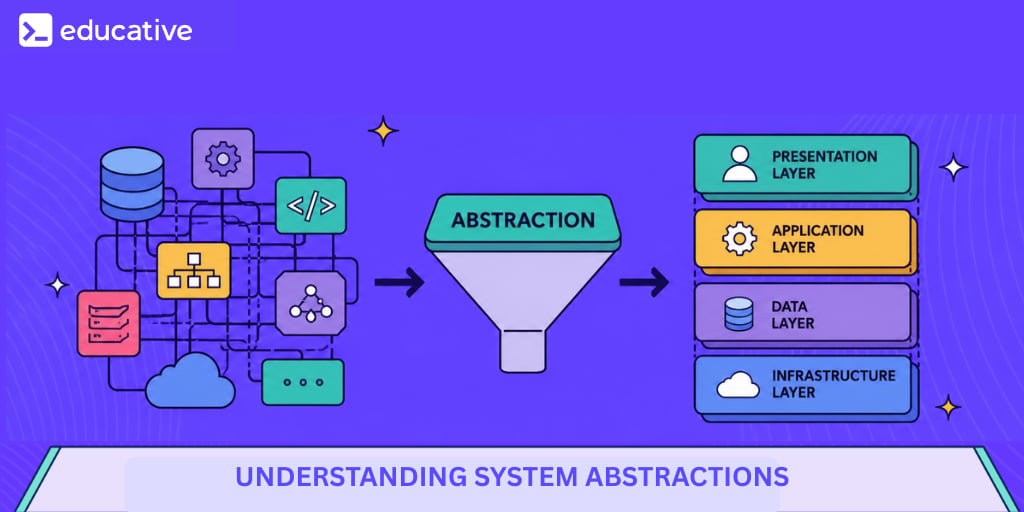
When you first start thinking about large systems, everything feels connected to everything else. A simple feature quickly expands into multiple services, data flows, failure modes, and scaling concerns. You’re no longer just writing code—you’re trying to reason about behavior across an entire system. This is where System Design starts to feel overwhelming, not because the concepts are impossible, but because the number of moving parts grows faster than your ability to track them.
The challenge isn’t just technical complexity—it’s cognitive complexity. You’re trying to hold too many details in your head at once. Every component has its own logic, every interaction has edge cases, and every decision seems to ripple across the system. Without a way to simplify what you’re looking at, the system quickly becomes unmanageable in your mind.
This is exactly where abstraction becomes essential. Not as a buzzword, and not as something theoretical, but as a practical way to reduce the mental load of understanding systems. Abstraction allows you to step back, ignore unnecessary details, and focus on the structure that actually matters.
In system abstractions, you start to see that abstraction isn’t about hiding complexity for the sake of it—it’s about making systems understandable. It gives you a way to reason about large architectures without getting lost in the details.

For a decade, when developers talked about how to prepare for System Design Interviews, the answer was always Grokking System Design. This is that course — updated for the current tech landscape. As AI handles more of the routine work, engineers at every level are expected to operate with the architectural fluency that used to belong to Staff engineers. That's why System Design Interviews still determine starting level and compensation, and the bar keeps rising. I built this course from my experience building global-scale distributed systems at Microsoft and Meta — and from interviewing hundreds of candidates at both companies. The failure pattern I kept seeing wasn't a lack of technical knowledge. Even strong coders would hit a wall, because System Design Interviews don't test what you can build; they test whether you can reason through an ambiguous problem, communicate ideas clearly, and defend trade-offs in real time (all skills that matter more than ever now in the AI era). RESHADED is the framework I developed to fix that: a repeatable 45-minute roadmap through any open-ended System Design problem. The course covers the distributed systems fundamentals that appear in every interview – databases, caches, load balancers, CDNs, messaging queues, and more – then applies them across 13+ real-world case studies: YouTube, WhatsApp, Uber, Twitter, Google Maps, and modern systems like ChatGPT and AI/ML infrastructure. Then put your knowledge to the test with AI Mock Interviews designed to simulate the real interview experience. Hundreds of thousands of candidates have already used this course to land SWE, TPM, and EM roles at top companies. If you're serious about acing your next System Design Interview, this is the best place to start.
What abstraction really means in System Design#
When people first hear “abstraction,” they often think of it as simply hiding details. While that’s technically correct, it misses the deeper point. In System Design, abstraction is about choosing the right level of detail for the problem you’re solving. It’s not just about what you hide, but what you intentionally keep visible.
Think about an API. You don’t need to know how the database query is optimized or how caching is implemented internally. What matters is the contract: what goes in, what comes out, and how the system behaves. That’s abstraction in action. It removes noise so you can focus on behavior.

This is important because systems are layered with decisions. If you tried to reason about every layer at once—network protocols, storage engines, service orchestration—you’d never get anywhere. Abstraction gives you a lens. It lets you zoom in when needed and zoom out when necessary.
In System Design thinking, abstraction is what allows you to move from “how is this implemented?” to “what does this component do?” That shift is critical. It’s the difference between getting stuck in details and actually understanding the system.
Why abstraction is essential for simplifying architectures#
As systems grow, the number of components increases, but more importantly, the number of interactions grows even faster. Without abstraction, every new component adds exponential complexity to your mental model. You’re no longer thinking clearly—you’re just reacting to complexity.
Abstraction reduces this cognitive load. It groups related details into meaningful units so you don’t have to think about everything at once. Instead of reasoning about individual functions or queries, you reason about services, interfaces, and data flows.
This is what makes large-scale System Design possible. You’re not expected to understand every detail simultaneously. You’re expected to understand how parts of the system behave at the right level of abstraction. That’s how engineers can design systems with millions of users without getting overwhelmed.
In system abstractions, abstraction becomes less about simplification and more about clarity. It allows you to see structure where there would otherwise be chaos. And once you see that structure, reasoning becomes much more manageable.
Layers of abstraction in real-world systems#
Real-world systems are not built as a single flat structure. They are layered, with each layer responsible for a specific set of concerns. This layering is not accidental—it’s a direct result of applying abstraction.
At the lowest level, you might have infrastructure—servers, networking, storage. On top of that, you have services that interact with this infrastructure. Above that, you have APIs that expose functionality. And finally, you have clients that consume those APIs. Each layer builds on the one below it, but doesn’t expose all its details.
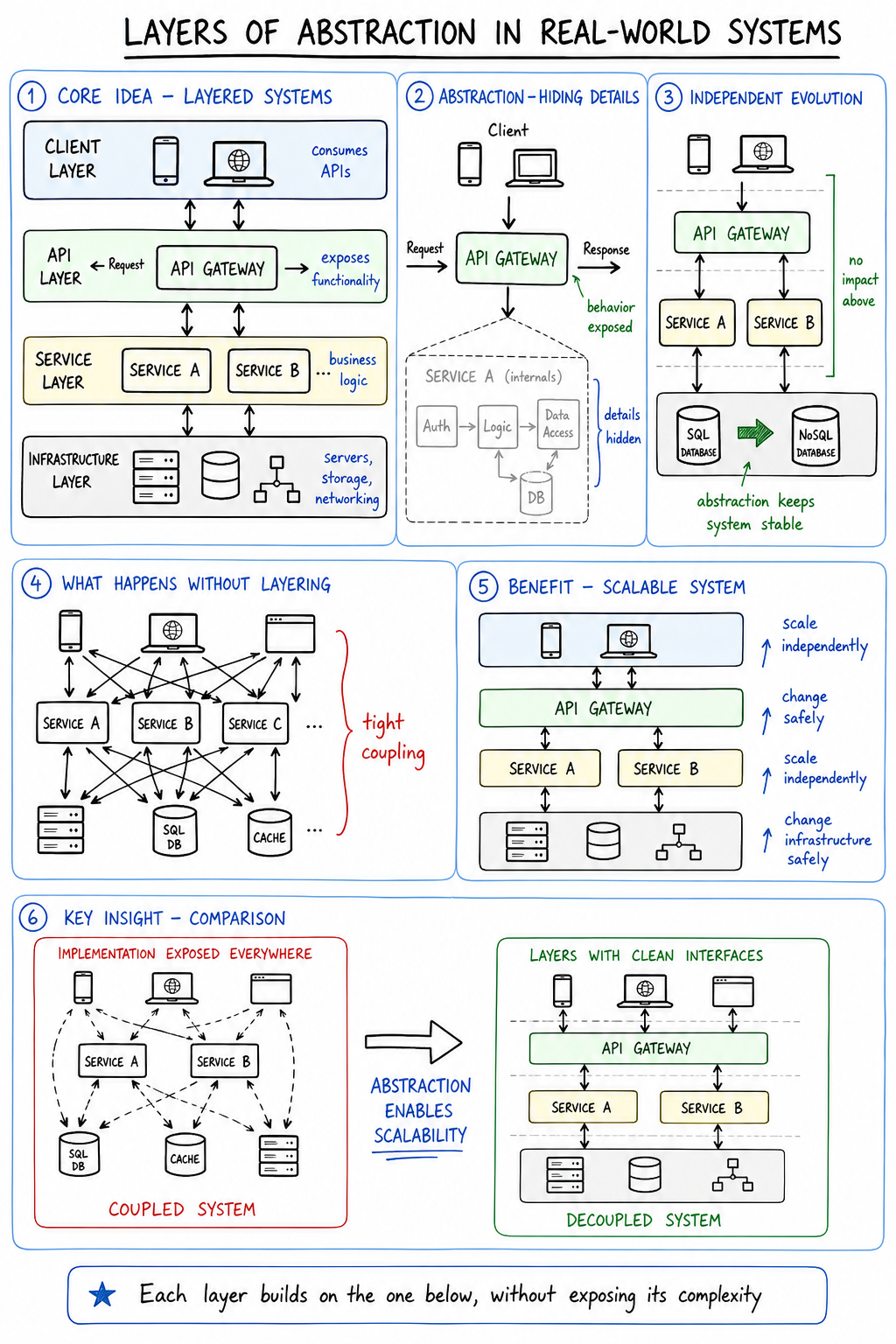
This layered approach is what allows systems to scale. Each layer can evolve independently as long as its abstraction remains consistent. You don’t need to redesign the entire system when one part changes—you only need to ensure that the abstraction holds.
For example, a database can switch from SQL to NoSQL internally, but as long as the service layer exposes the same behavior, the rest of the system doesn’t need to change. That’s the power of abstraction—it decouples implementation from interaction.
Abstraction as a tool for communication#
One of the most underrated aspects of abstraction is how it improves communication. System Design is not just about building systems—it’s about explaining them. Whether you’re talking to teammates or discussing a design in an interview, clarity matters.
Abstraction gives you a shared language. Instead of diving into low-level details, you can describe systems in terms of components and interactions. This makes conversations more efficient and more meaningful.
For example, saying “we have a service that handles user authentication” is much clearer than explaining every function inside that service. The abstraction communicates intent without overwhelming the listener.
In collaborative environments, this becomes even more important. Teams need to align on how systems behave, not just how they’re implemented. Abstraction creates that alignment by focusing on behavior and contracts rather than internal complexity.
Trade-offs in using abstraction#
Abstraction is powerful, but it’s not free. Every time you hide detail, you’re making a trade-off. You’re choosing clarity over completeness, simplicity over precision.
One trade-off is between simplicity and loss of detail. While abstraction makes systems easier to understand, it can also hide important nuances. If you’re not careful, you might miss edge cases or performance bottlenecks that are hidden beneath the abstraction.
Another trade-off is flexibility versus control. Highly abstracted systems are easier to work with, but they can limit how much control you have over specific behaviors. This is often seen in frameworks that simplify development but restrict customization.
There’s also the balance between clarity and hidden complexity. A system might look simple from the outside, but internally it could be very complex. This hidden complexity doesn’t disappear—it just moves out of sight. Good System Design requires knowing when to rely on abstraction and when to look deeper.
Comparison table#
Aspect | Poor abstraction | Well-defined abstraction layers |
Complexity | High and scattered | Structured and manageable |
Ease of understanding | Difficult to reason about | Clear mental model |
Scalability | Hard to extend | Easier to scale components |
Maintainability | Fragile and error-prone | Modular and adaptable |
Communication clarity | Confusing explanations | Clear and concise discussions |
When abstraction is poorly defined, systems feel chaotic. Every change requires understanding too many details, and communication becomes difficult. Engineers struggle not because the system is inherently complex, but because that complexity is exposed everywhere.
With well-defined abstraction layers, complexity doesn’t disappear—it’s organized. You can reason about each part independently, which makes both design and communication significantly easier. This is what enables scalable thinking in System Design.
Common misconceptions about abstraction#
One common misconception is that abstraction removes complexity entirely. It doesn’t. It simply reorganizes complexity so that it’s easier to manage. The underlying system is still complex—you’re just interacting with it at a higher level.
Another misconception is that more abstraction is always better. In reality, too much abstraction can make systems harder to understand. If everything is abstracted, you lose the ability to reason about what’s actually happening.
There’s also the belief that abstraction replaces understanding. This is particularly dangerous. Abstraction is a tool, not a shortcut. You still need to understand what’s behind the abstraction, especially when debugging or optimizing systems. Understanding these misconceptions helps you use abstraction more effectively. It’s not about hiding everything—it’s about revealing the right things.
Abstraction in System Design interviews#
In System Design interviews, abstraction is one of the most important tools you have. Not because you’re expected to hide details, but because you’re expected to structure your thinking clearly.
When you break down a problem, you’re essentially creating layers of abstraction. You start with a high-level view—what the system does—and then gradually refine it into components and interactions. This approach makes your reasoning easier to follow.
Interviewers are not looking for every detail. They’re looking for how you think. Abstraction allows you to demonstrate that thinking by organizing your ideas in a clear and logical way.
It also helps you manage time and complexity during the conversation. Instead of getting stuck in implementation details, you can focus on the bigger picture and dive deeper only when necessary.
How abstraction shapes scalable thinking#
Scalability in System Design comes from the ability to operate at multiple levels of abstraction. You need to zoom out to understand the overall architecture, and zoom in to analyze specific components.
Abstraction makes this possible. It allows you to switch perspectives without losing context. At a high level, you think about services and data flow. At a lower level, you think about performance and edge cases.
This ability to move between levels is what separates surface-level understanding from deep system thinking. You’re not just seeing the system—you’re navigating it. In system abstractions, this becomes the key insight: abstraction is not just a tool for simplifying systems—it’s a tool for thinking about them at scale.
Final words#
At its core, abstraction is not about hiding complexity—it’s about managing it. It gives you a way to think about systems without getting overwhelmed by details. It allows you to focus on structure, behavior, and interaction.
As systems grow, this ability becomes essential. You can’t rely on raw detail to understand large architectures. You need a way to see the system as a whole while still being able to dive into specifics when needed.
Understanding system abstractions is really about developing this mindset. It’s about learning to think in systems rather than in isolated details. And once you start thinking this way, complex architectures stop feeling overwhelming. They start feeling structured, navigable, and ultimately, understandable.
Happy learning!