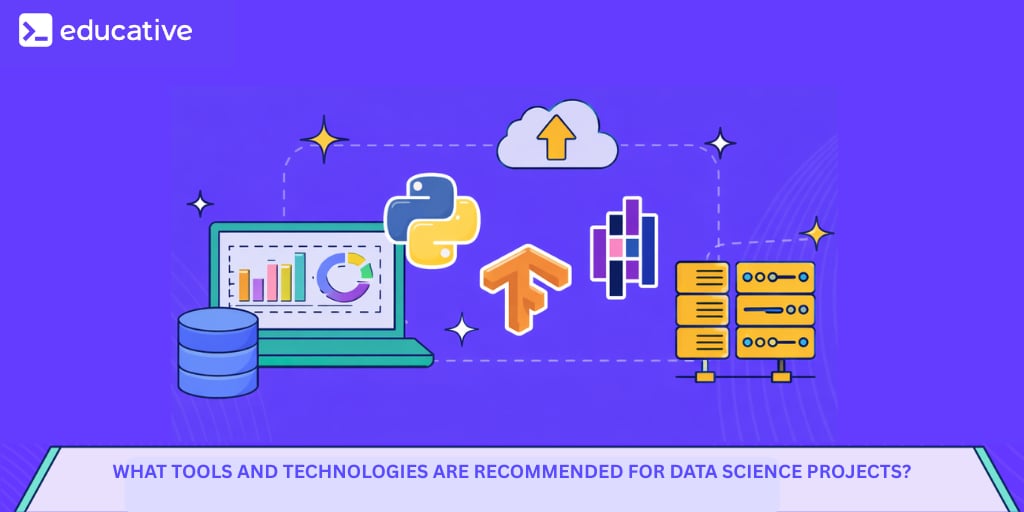
Data science projects rarely rely on a single programming language or software library. Instead, they involve a combination of tools that support different stages of the analytical workflow, from data collection and preprocessing to model development and deployment. Because the ecosystem of data science technologies continues to evolve rapidly, many practitioners frequently ask a practical question: What tools and technologies are recommended for data science projects?
A typical data science workflow includes several layers of technology. Engineers and analysts use programming environments to explore datasets, specialized libraries to manipulate and analyze data, machine learning frameworks to build predictive models, and visualization tools to communicate insights. In addition, modern data science systems often rely on distributed processing platforms and cloud infrastructure to handle large datasets.
Understanding how these tools fit together allows developers and data professionals to design efficient workflows and select the technologies that best match the requirements of a specific project.

As data becomes central to decision-making across industries, the ability to learn data science is quickly becoming a foundational skill. From product decisions to healthcare insights, data science drives how organizations understand and act on information. This course is designed to help you move beyond surface-level exposure and build a practical, structured understanding of data science. I built this course from my experience teaching data-driven thinking and working with intelligent systems, where I consistently saw beginners struggle to connect tools with real problem-solving. The challenge was the lack of a clear starting point. This course addresses that by guiding you step by step, focusing on how to think through data science problems, not just execute them. You’ll start with core concepts and real-world use cases, then work with data using SQL and Python (pandas). You’ll clean, explore, and visualize datasets before building simple machine learning models to generate predictions and insights. If you want to learn data science in a practical, beginner-friendly way, this course provides a clear path to get started.
Core programming languages used in data science#
Two programming languages dominate most modern data science environments: Python and R. Each language provides a rich ecosystem of libraries designed for statistical analysis, machine learning, and data visualization.
Python has become the most widely used language for data science projects because of its versatility and extensive library ecosystem. It supports tasks such as data preprocessing, machine learning model development, automation, and production deployment. Libraries such as Pandas, NumPy, and Scikit-learn make it easier to manipulate datasets and build predictive models.
R remains widely used in academic research and statistical analysis. The language offers powerful packages for statistical modeling, visualization, and exploratory data analysis. Researchers and statisticians often rely on R when performing advanced statistical analysis or developing experimental models.
Both languages play important roles in answering the question many practitioners ask when beginning a new project: What tools and technologies are recommended for data science projects?
Python has become the foundation for everything from data science and automation to modern AI workflows. Yet many beginners struggle to learn Python because they spend too much time watching and not enough time building. This course is designed for a different kind of learner, one who wants to learn Python by doing, not just observing, and to build skills that remain relevant in an AI-driven development landscape. I built this course from my experience teaching and designing interactive learning systems at Educative. Across classrooms and platforms, I saw the same pattern: learners could follow tutorials, but struggled to apply concepts independently. The problem was the approach. This course is built on a simple principle: you learn Python best when you write, test, and refine code continuously. You’ll start with core fundamentals, variables, control flow, functions, and data structures, through hands-on exercises that reinforce real understanding. As you progress, you’ll build practical projects like a chatbot and an expense tracker. The course also introduces how to learn Python alongside AI tools, including prompting, debugging, and validating generated code in real workflows. If your goal is to learn Python in a way that prepares you to build real applications and work effectively with AI, this course gives you that foundation from day one.

In today’s data-driven world, the ability to analyze large datasets is becoming a vital skill across industries. R, one of the most powerful languages for data analysis. This interactive R course is designed for beginners, with no prior knowledge of R programming required. You will begin with fundamental concepts, such as R variables, data types in R, and basic functions like R print and R cat. As you progress, you will dive into more complex topics, including R vectors, lists, arrays, matrices, and data frames in R programming. You’ll also learn how to perform operations using arithmetic operators in R, relational operators in R, and logical operators in R. Further, the course covers advanced features like if statements in R, switch statements in R, loops in R, and recursion in R. Finally, you’ll gain hands-on experience with file handling in R, exception handling with try and except in R, and object-oriented programming using S3 and S4 classes in R.
Essential tools and technologies#
Modern data science workflows rely on a variety of specialized tools designed to handle different stages of the analytical pipeline.
Category | Tools | Purpose |
Programming | Python, R | Data analysis and modeling |
Data processing | Pandas, NumPy | Data manipulation |
Machine learning | Scikit-learn, TensorFlow, PyTorch | Model training |
Big data tools | Apache Spark | Large-scale data processing |
Visualization | Matplotlib, Seaborn, Tableau | Data visualization |
Programming languages such as Python and R provide the foundation for data science workflows. These languages allow practitioners to write scripts that perform data analysis, develop machine learning models, and automate processing tasks.
Data processing libraries such as Pandas and NumPy provide tools for manipulating structured datasets. Pandas enables developers to work with tabular data efficiently, while NumPy supports numerical computation and array processing.
Machine learning frameworks such as Scikit-learn, TensorFlow, and PyTorch support the development of predictive models. Scikit-learn is commonly used for classical machine learning algorithms, while TensorFlow and PyTorch support deep learning workflows.
Big data tools such as Apache Spark allow engineers to process massive datasets across clusters of machines. These tools become necessary when datasets exceed the memory capacity of a single machine.
Visualization platforms such as Matplotlib, Seaborn, and Tableau help analysts communicate insights by transforming complex datasets into visual representations that are easier to interpret.
These technologies represent many of the most widely used answers to the question What tools and technologies are recommended for data science projects?
Scikit-Learn is a powerful library that provides a handful of supervised and unsupervised learning algorithms. If you’re serious about having a career in machine learning, then scikit-learn is a must know. In this course, you will start by learning the various built-in datasets that scikit-learn offers, such as iris and mnist. You will then learn about feature engineering and more specifically, feature selection, feature extraction, and dimension reduction. In the latter half of the course, you will dive into linear and logistic regression where you’ll work through a few challenges to test your understanding. Lastly, you will focus on unsupervised learning and deep learning where you’ll get into k-means clustering and neural networks. By the end of this course, you will have a great new skill to add to your resume, and you’ll be ready to start working on your own projects that will utilize scikit-learn.
Typical data science technology stack#
In a typical data science project, multiple tools work together to form a complete technology stack. Each component supports a different stage of the analytical workflow.
The process often begins with data collection and storage. Data may be gathered from APIs, databases, log files, or external datasets and stored in relational databases, cloud storage systems, or data warehouses.
Next comes data cleaning and transformation. Data scientists use libraries such as Pandas to remove inconsistencies, handle missing values, and restructure datasets into formats suitable for analysis.
Model training and evaluation follow once the dataset has been prepared. Machine learning frameworks provide algorithms that can learn patterns within the data and generate predictive models. During this stage, practitioners evaluate model performance using validation techniques and performance metrics.
Visualization and reporting allow teams to interpret model outputs and communicate findings to stakeholders. Visualization tools transform numerical results into charts, graphs, and dashboards that highlight meaningful patterns.
Finally, deployment and monitoring ensure that models continue to perform effectively once integrated into production systems. In many organizations, deployed models operate within applications that continuously process new data.
Understanding how these layers interact helps clarify what tools and technologies are recommended for data science projects in real-world environments.
Recommended workflow for data science projects#
A structured workflow helps data science teams move from raw datasets to actionable insights.
Collecting and exploring dataData science projects often begin with gathering datasets from multiple sources. Exploratory analysis helps practitioners understand the structure of the data, identify patterns, and detect anomalies.
Cleaning and preprocessing datasetsRaw data often contains inconsistencies, missing values, or formatting issues. Preprocessing ensures that datasets are structured and reliable before model training begins.
Building predictive modelsMachine learning frameworks allow practitioners to train models that identify patterns and relationships within the data. Choosing the appropriate algorithm depends on the nature of the problem and the structure of the dataset.
Evaluating model performanceOnce models are trained, evaluation techniques measure their accuracy and reliability. Practitioners analyze metrics such as precision, recall, and error rates to determine whether the model performs effectively.
Deploying models in productionThe final stage involves integrating models into applications or analytics systems. Deployment ensures that the model can process new data and generate predictions in real-world environments.
This workflow demonstrates how the various tools and technologies interact throughout the lifecycle of a data science project.
Which programming language is best for beginners?#
Python is often recommended for beginners because of its readability, extensive library ecosystem, and strong community support. It provides tools for both data analysis and machine learning development.
Do data science projects require big data tools?#
Not every project requires distributed computing frameworks. Many projects can be completed using standard data processing libraries when working with moderate-sized datasets. Big data tools become important when datasets grow beyond the capacity of a single machine.
Are cloud platforms necessary for machine learning projects?#
Cloud platforms are not always required, but they provide scalable infrastructure that supports large datasets, distributed processing, and production deployment.
What tools are best for visualization?#
Visualization tools such as Matplotlib and Seaborn are widely used for programmatic visualization in Python environments, while platforms such as Tableau support interactive dashboards and business reporting.
Final words#
Data science projects rely on a diverse set of technologies that support each stage of the analytical workflow. Programming languages, data processing libraries, machine learning frameworks, visualization platforms, and distributed processing tools all play essential roles in transforming raw data into meaningful insights.
For professionals exploring what tools and technologies are recommended for data science projects, the most effective approach involves understanding how these technologies work together rather than focusing on a single tool. By selecting the right combination of technologies for each stage of the workflow, developers and data scientists can build scalable and efficient analytical systems that support real-world applications.