Yes, Java is excellent for coding interviews. It’s a popular and widely used programming language in the industry and effectively supports core data structures and algorithms. Java’s strong typing and object-oriented features help write clear, maintainable code, making it a solid choice for technical interviews.
Updated yesterday
AI-powered learning
Save this course
Grokking the Coding Interview Patterns
Grokking the Coding Interview saves you countless hours of grinding LeetCode. Master the 28 coding patterns behind most coding interview problems. Developed by and for MAANG engineers.
4.9
1125 lessons
17 AI mock interviews
85h
Created by Fahim ul Haq
Select your Language
Select your Language

What's included
- 1125 lessons across 31 modules
- 579 quizzes with instant feedback
- 17 AI mock interviews with scoring rubrics
- AI Tutor on every lesson
Why this course
- Ace Coding InterviewsDemonstrate the ability to solve coding interview problems using established patterns and strategies, showcasing technical proficiency.
- Optimize Algorithm PerformanceImplement efficient algorithms and data structures to improve performance in real-world coding scenarios, ensuring timely problem resolution.
- Master Problem-Solving TechniquesApply a variety of problem-solving techniques, including dynamic programming and graph algorithms, to address complex coding challenges.
- Communicate Technical SolutionsEffectively articulate technical solutions and reasoning during interviews, demonstrating clarity in thought and approach.
Who wrote it
Fahim ul Haq
Software Engineer, Distributed Storage at Meta and Microsoft, Educative (Co-founder & CEO)
Fahim ul Haq is the co-founder and CEO of Educative, a hands-on learning platform for software engineers. He spent nearly a decade as a software engineer at Microsoft and Meta, where he gained deep experience building large-scale distributed systems. His work spanned Project Red Dog at Microsoft, which evolved into Microsoft Azure, and Scuba, Meta's real-time data analytics engine. In 2015, Fahim co-founded Educative to help developers get hands-on with new skills. Fahim's courses have helped hundreds of thousands of engineers learn System Design and prepare for technical interviews. Fahim earned his M.S. in Computer Science from the University of Washington in 2015.
Join 3.1 million developers at
What You'll Learn
- Identify and apply coding interview patterns to solve algorithmic problems effectively
- Utilize data structures such as arrays, linked lists, stacks, and queues in coding challenges
- Implement sorting and searching algorithms to optimize problem-solving efficiency
- Analyze and apply dynamic programming techniques to tackle complex problems
- Employ graph algorithms to solve connectivity and traversal challenges
- Develop proficiency in string manipulation and pattern recognition for coding interviews
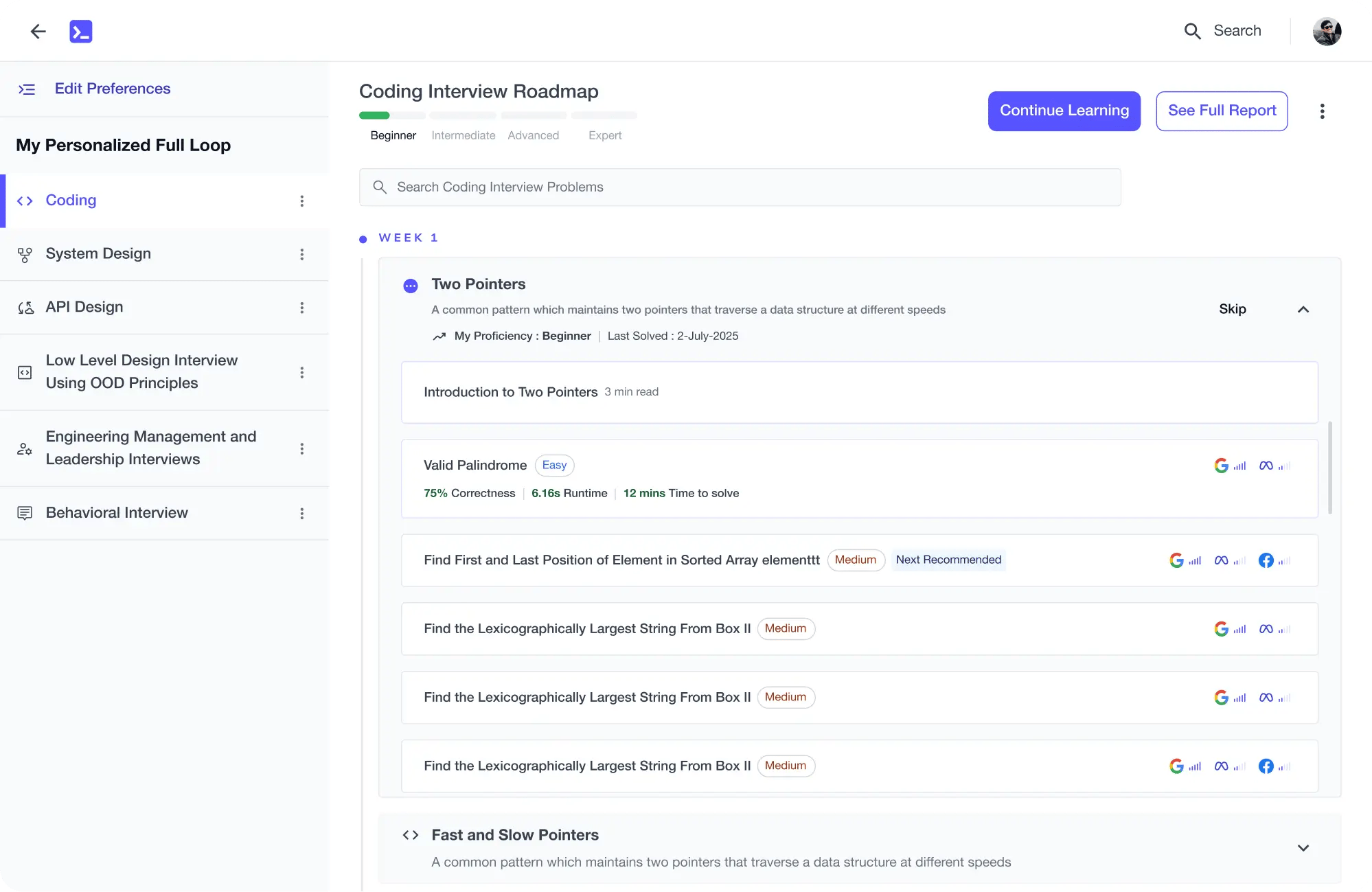
Learning Roadmap
1.
Two Pointers
The Two Pointers pattern uses two coordinated pointers or iterators to traverse data efficiently.
Introduction to Two Pointers
Valid Palindrome
3Sum
med
Remove nth Node from End of List
med
Sort Colors
med
Reverse Words in a String
med
Valid Word Abbreviation
Valid Palindrome II
Lowest Common Ancestor of a Binary Tree III
med
Strobogrammatic Number
Minimum Number of Moves to Make Palindrome
hard
Next Palindrome Using Same Digits
hard
Count Subarrays With Fixed Bounds
hard
Find the Lexicographically Largest String From Box II
hard
Get the Maximum Score
hard
Create Maximum Number
hard
Append Characters to String to Make Subsequence
med
Squares of a Sorted Array
Reverse String
Intersection of Two Linked Lists
Partition Labels
med
Remove Element
String Compression
med
Rotate Array
med
Next Permutation
med
Remove Duplicates from Sorted Array
Reverse Vowels of a String
Is Subsequence
Merge Strings Alternately
Compare Version Numbers
med
Move Zeroes
med
Longest Subarray of 1's After Deleting One Element
med
Backspace String Compare
med
Next Greater Element III
med
Rotating the Box
med
Count the Number of Fair Pairs
med
Remove Duplicates from Sorted List II
med
Sum of Square Numbers
med
Shuffle the Array
med
Rotate String
med
Max Number of K-Sum Pairs
med
Repeated Substring Pattern
med
Reverse Words in a String III
med
3Sum Closest
med
Push Dominoes
med
Rearrange Array Elements by Sign
med
Reverse String II
med
Sort Array By Parity
med
Long Pressed Name
med
Valid Mountain Array
med
Remove Duplicates from Sorted Array II
med
Two Sum II - Input Array Is Sorted
med
Swap Adjacent in LR String
med
Expressive Words
med
Last Substring in Lexicographical Order
med
Bag of Tokens
med
Check If String Is a Prefix of Array
med
Reformat Phone Number
med
K-diff Pairs in an Array
med
Longest Mountain in Array
med
Meeting Scheduler
med
Maximize Greatness of an Array
med
Find the Original Typed String I
med
Find Beautiful Indices in the Given Array II
med
Zigzag Iterator
med
Length of Last Word
med
Capitalize the Title
med
Number of Distinct Averages
med
Apply Operations to an Array
med
Maximum Enemy Forts That Can Be Captured
med
Minimum Common Value
med
Merge Two 2D Arrays by Summing Values
med
Remove Trailing Zeros From a String
med
Lexicographically Smallest Palindrome
med
Check if a String Is an Acronym of Words
med
Substring Matching Pattern
med
Generate Tag for Video Caption
med
Reverse String Prefix
med
The k Strongest Values in an Array
med
Ways to Split Array Into Three Subarrays
med
Minimize Maximum Pair Sum in Array
med
Adding Spaces to a String
med
Watering Plants II
med
Partition Array According to Given Pivot
med
Move Pieces to Obtain a String
med
Check if All A's Appears Before All B's
med
2.
Fast and Slow Pointers
Master the steps to use fast and slow pointers for cycle detection and mid-point identification.
3.
Sliding Window
Uses a window, either fixed or dynamic, to optimize the analysis of sequential data (substring or subarray) through iterative processing, minimizing the need for nested loops.
4.
Intervals
Solve problems in merging intervals, inserting and finding intersections of intervals, scheduler tasks, and determining employee free time.
5.
In-Place Manipulation of a Linked List
6.
Two Heaps
A heap is a specific data structure with a fixed ordering (min or max), while a priority queue is an abstract data type that handles custom priority requirements for elements.
7.
K-way Merge
Learn how to use k-way merge for efficient data merging and finding k-th small elements.
8.
Top K Elements
9.
Modified Binary Search
It applies a binary search technique with variations to efficiently solve problems like finding specific targets, peaks (first/last occurrence), or rotated array elements by reducing the search space.
10.
Subsets
Grasp the fundamentals of generating subsets, permutations, and combinations.
11.
Greedy Techniques
Makes locally optimal choices at each step, aiming for a globally optimal solution in problem-solving scenarios, often without reassessment.
12.
Backtracking
13.
Dynamic Programming
Solves complex problems by breaking them into smaller overlapping subproblems and storing results to avoid redundant computations, optimizing time and space.
14.
Cyclic Sort
Step through cyclic sort concepts to efficiently handle various missing and corrupt number scenarios.
15.
Topological Sort
Determines a valid linear ordering of nodes in a directed acyclic graph that has dependencies on each other, crucial in tasks like scheduling or dependency resolution.
16.
Sort and Search
Combines sorting and searching techniques to effectively process and retrieve data, often using sorting algorithms and binary search to optimize problem-solving in datasets that can be ordered.
17.
Matrices
18.
Stacks
Operates on a last-in, first-out principle, where elements are added and removed from the same end, facilitating ordered data processing and retrieval.
19.
Graphs
TBA
20.
Tree Depth-First Search
Traverses a tree by exploring as deeply as possible along each branch before backtracking, which is useful for tasks like traversal, pathfinding, or search operations.
21.
Tree Breadth-First Search
Explores nodes of a tree level by level, ensuring each level is processed before moving to the next, often using a queue to manage traversal.
22.
Trie
23.
Hash Maps
Utilizes a data structure that maps keys to values, enabling efficient insertion, deletion, and retrieval operations for associative arrays.
24.
Knowing What to Track
The Knowing What to Track pattern focuses on identifying and maintaining only the key variables or states necessary to solve a problem efficiently.
25.
Union Find
Maintains disjoint sets, supporting operations to determine the set to which an element belongs (find) and merge two sets (union).
26.
Custom Data Structures
27.
Bitwise Manipulation
It uses binary operations to efficiently perform calculations, comparisons, or transformations directly on bits, optimizing for low-level data control.
28.
Math and Geometry
Applies mathematical concepts and geometric properties to solve problems efficiently, often involving calculations, number properties, coordinate geometry, or transformations.
29.
Challenge Yourself
Test your understanding of various coding challenges focusing on algorithm efficiency.
Course Author:
About this course
WHY I WROTE THIS COURSE
I created Grokking the Coding Interview because I watched too many talented engineers fail interviews they should have passed. At Microsoft and Meta, I saw firsthand what separated the candidates who succeeded from the ones who didn't. It wasn't how many LeetCode problems they'd solved. It was whether they could look at an unfamiliar problem and know how to approach it the right way.
That's what this course teaches. Rather than throwing hundreds of disconnected problems at you, we organize the entire coding interview around 28 fundamental patterns. Each pattern is a reusable strategy. Once you understand two pointers, for example, you can apply them to dozens of problems you've never seen before.
The course walks you through each pattern step by step, starting with the intuition behind it, then building through increasingly complex applications. As with every course on Educative, you will practice in a hands-on way with 500+ challenges, 17 mock interviews, and detailed explanations for every solution.
The course is available in Python, Java, JavaScript, Go, C++, and C#, so you can prep in the language you'll actually use in your interview. Whether you're preparing for your first FAANG loop or brushing up after a few years away from interviewing, this course will give you a repeatable framework for cracking the coding interview.
ABOUT THE AUTHOR
Fahim ul Haq
Software Engineer, Distributed Storage at Meta and Microsoft, Educative (Co-founder & CEO)
Trusted by 3.1 million developers working at companies
V
Vlad
Learner
A
Abayomi O
Learner
A
Abayomi O
Learner
A
Abayomi O
Learner
J
John Tang
Learner
A
Anant Rao
Learner
M
Md. A. Barik
Learner
Frequently Asked Questions
Is Java good for coding interviews?
How to crack Java coding interviews?
How can I prepare for a Java interview fast?
What are the coding patterns?
Which coding platform is best for interviews?
Is Grokking the Coding Interview still relevant in 2026?
Is it worth practicing coding interview questions in 2026?
Built for 10x Developers
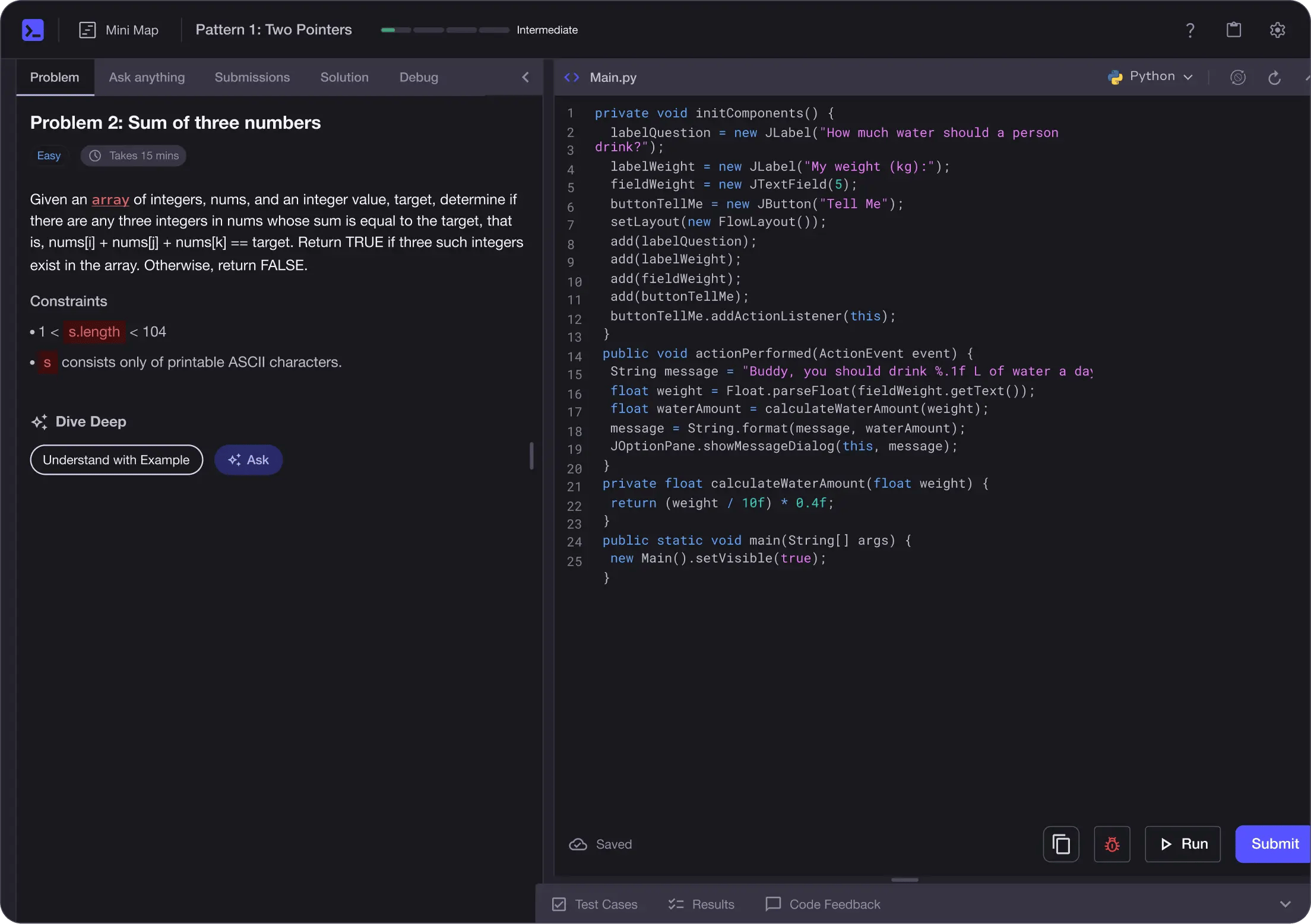
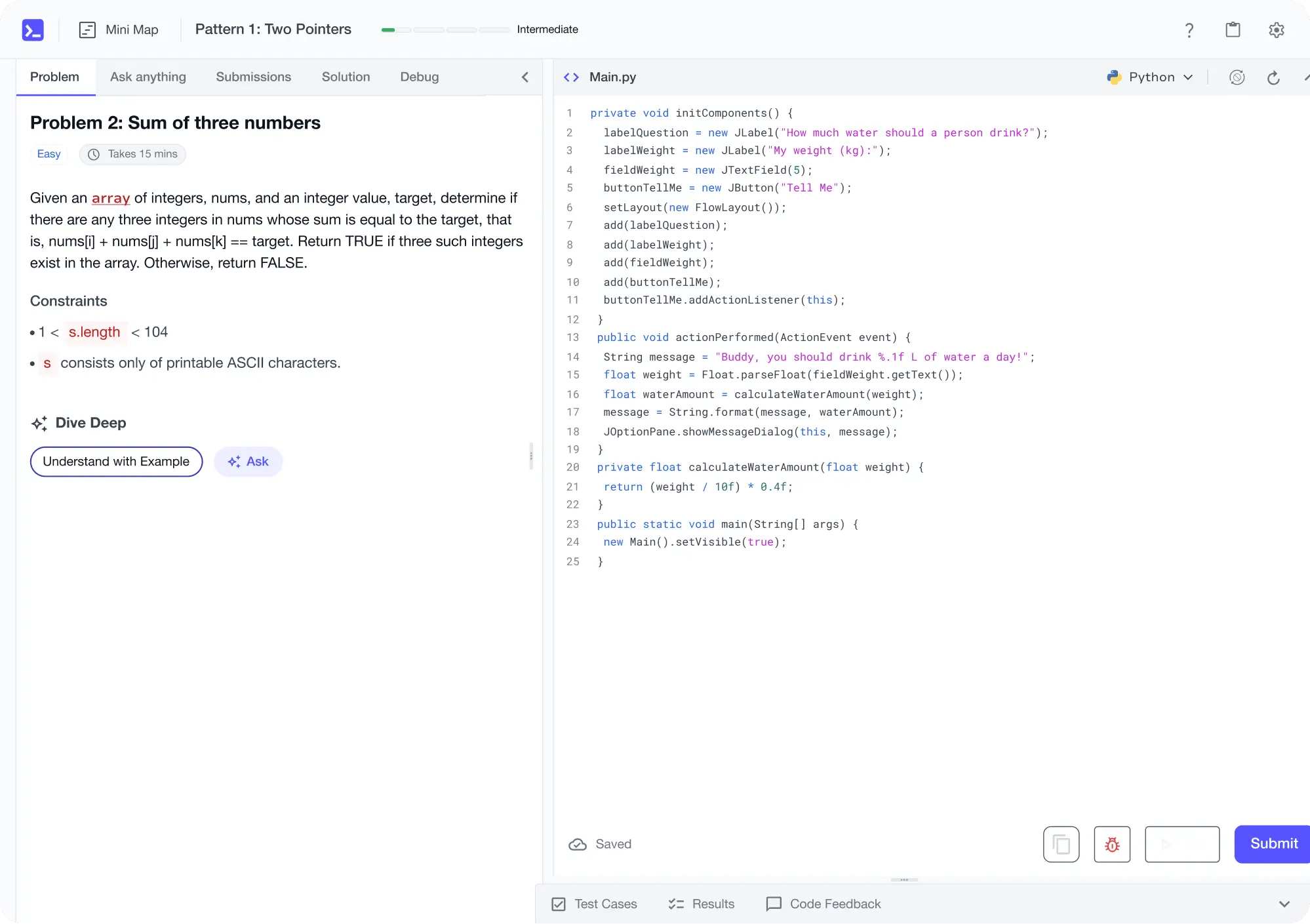
No Passive Learning
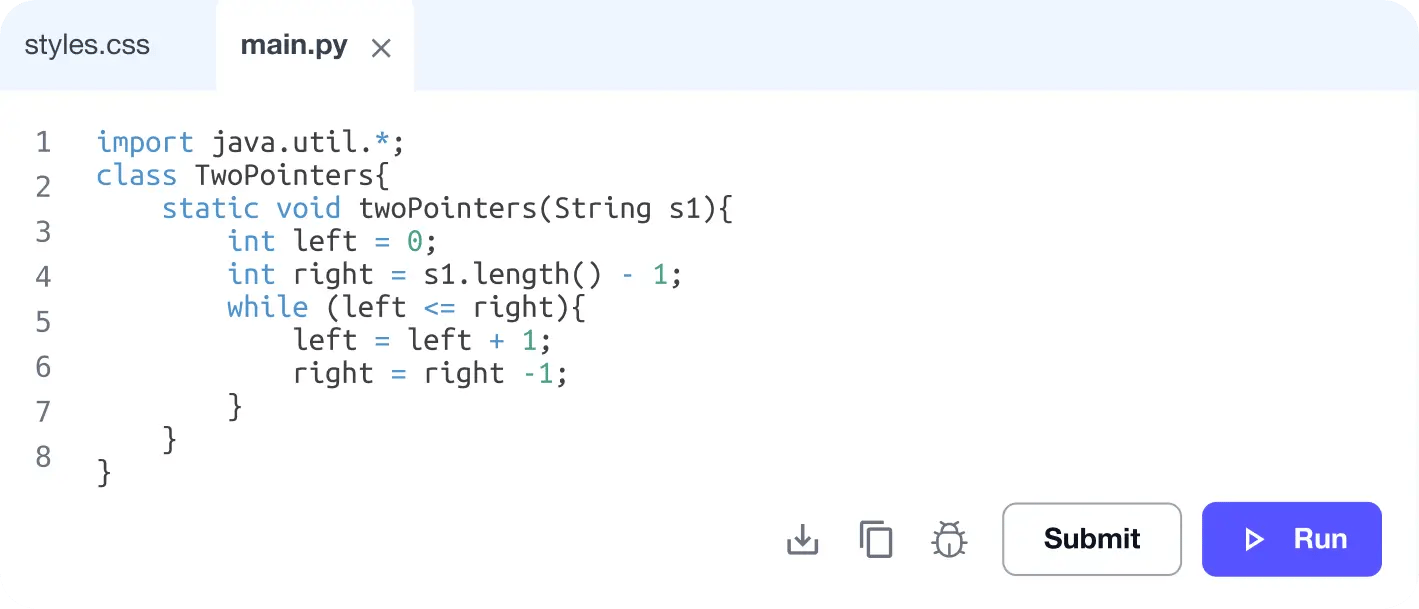
Learn by building with project-based lessons and in-browser code editor
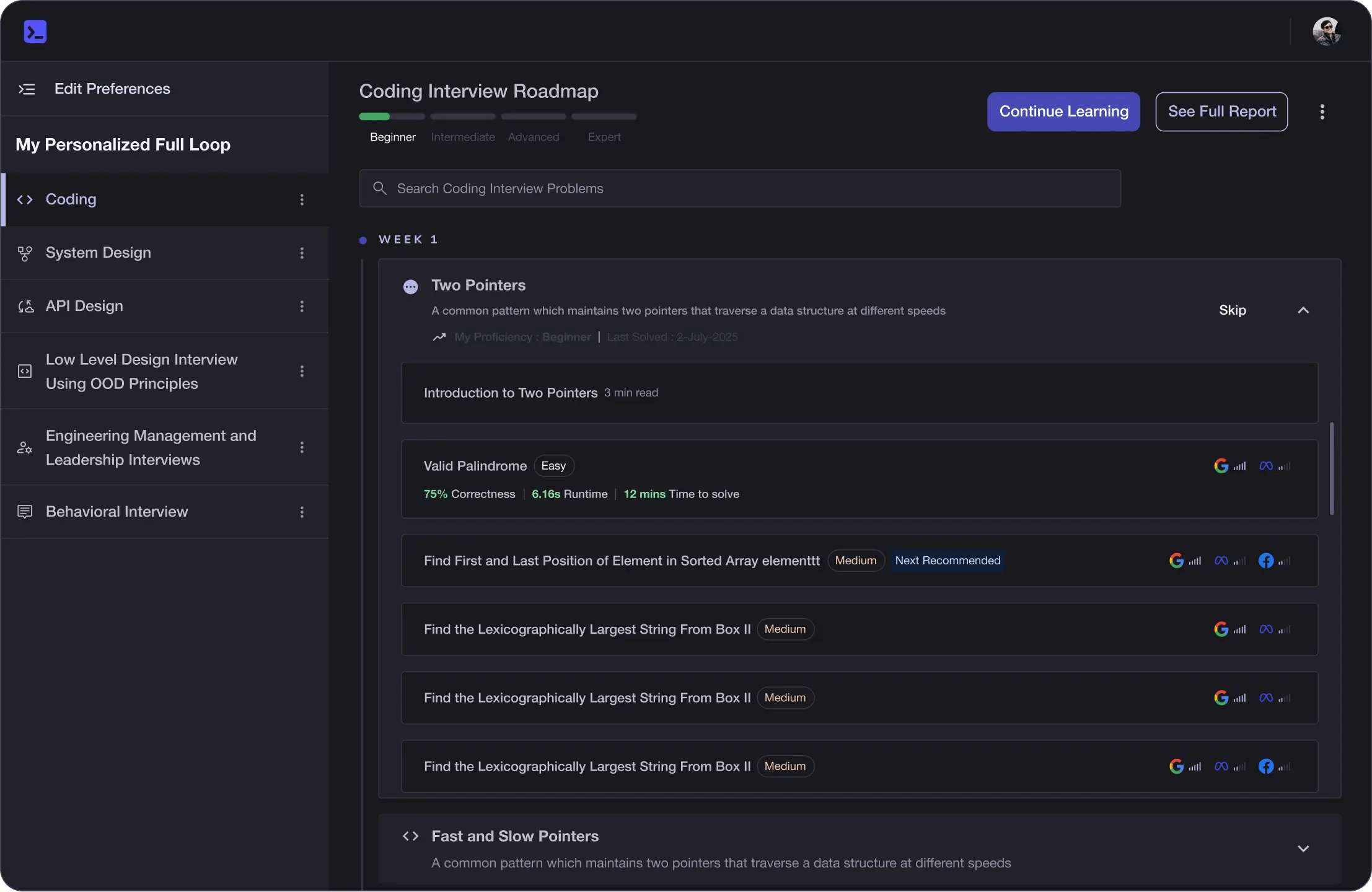
Personalized Roadmaps
The platform adapts to your strengths & skills gaps as you go
Future-proof Your Career
Get hands-on with in-demand skills
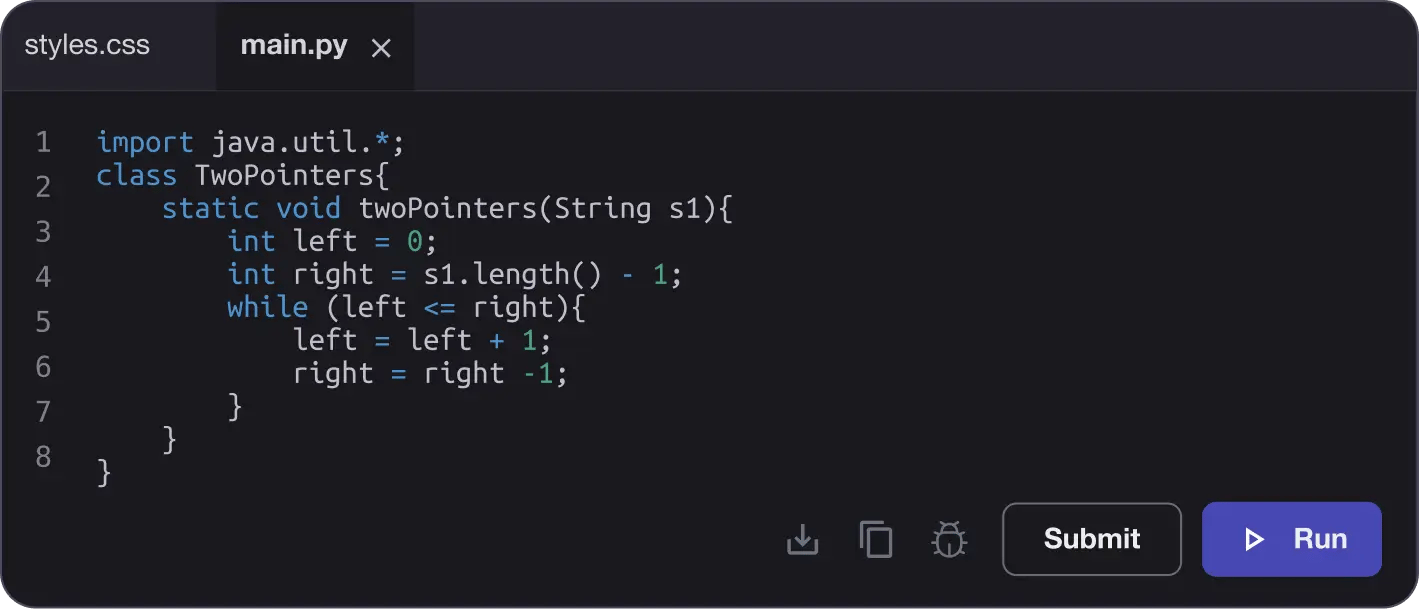
AI Code Mentor
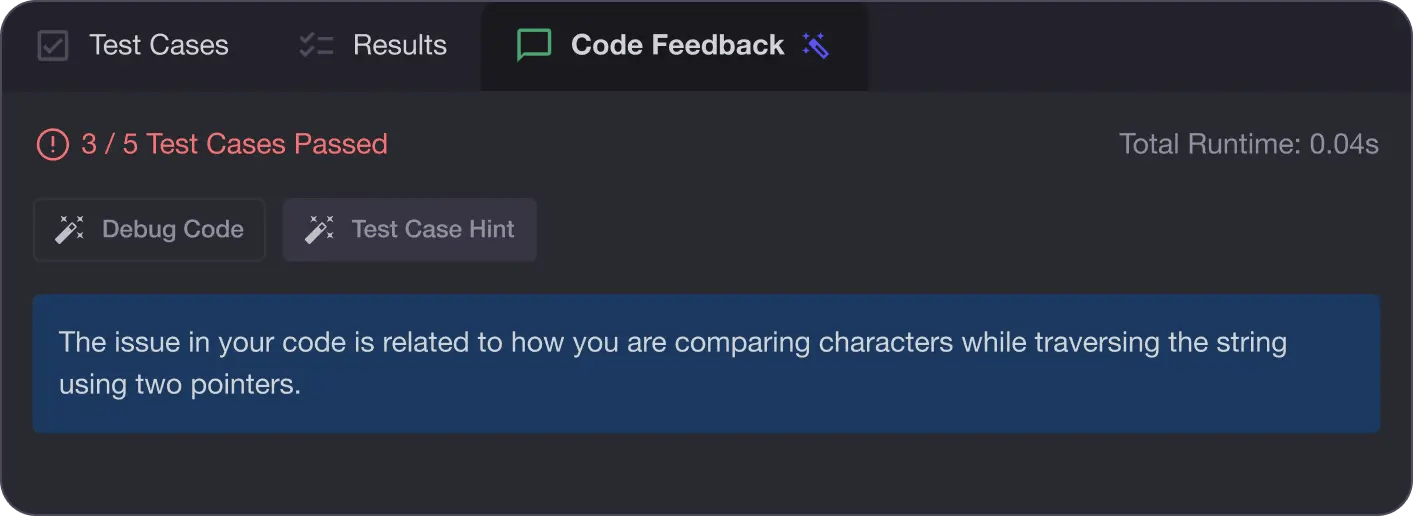
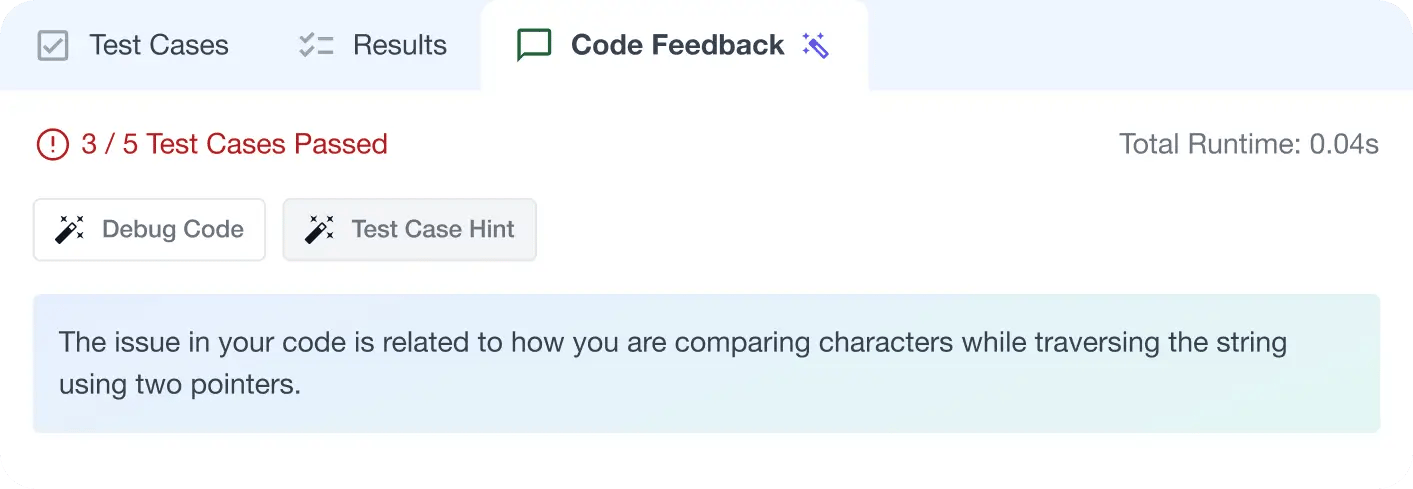
Write better code with AI feedback, smart debugging, and "Ask AI"
MAANG+ Interview Prep
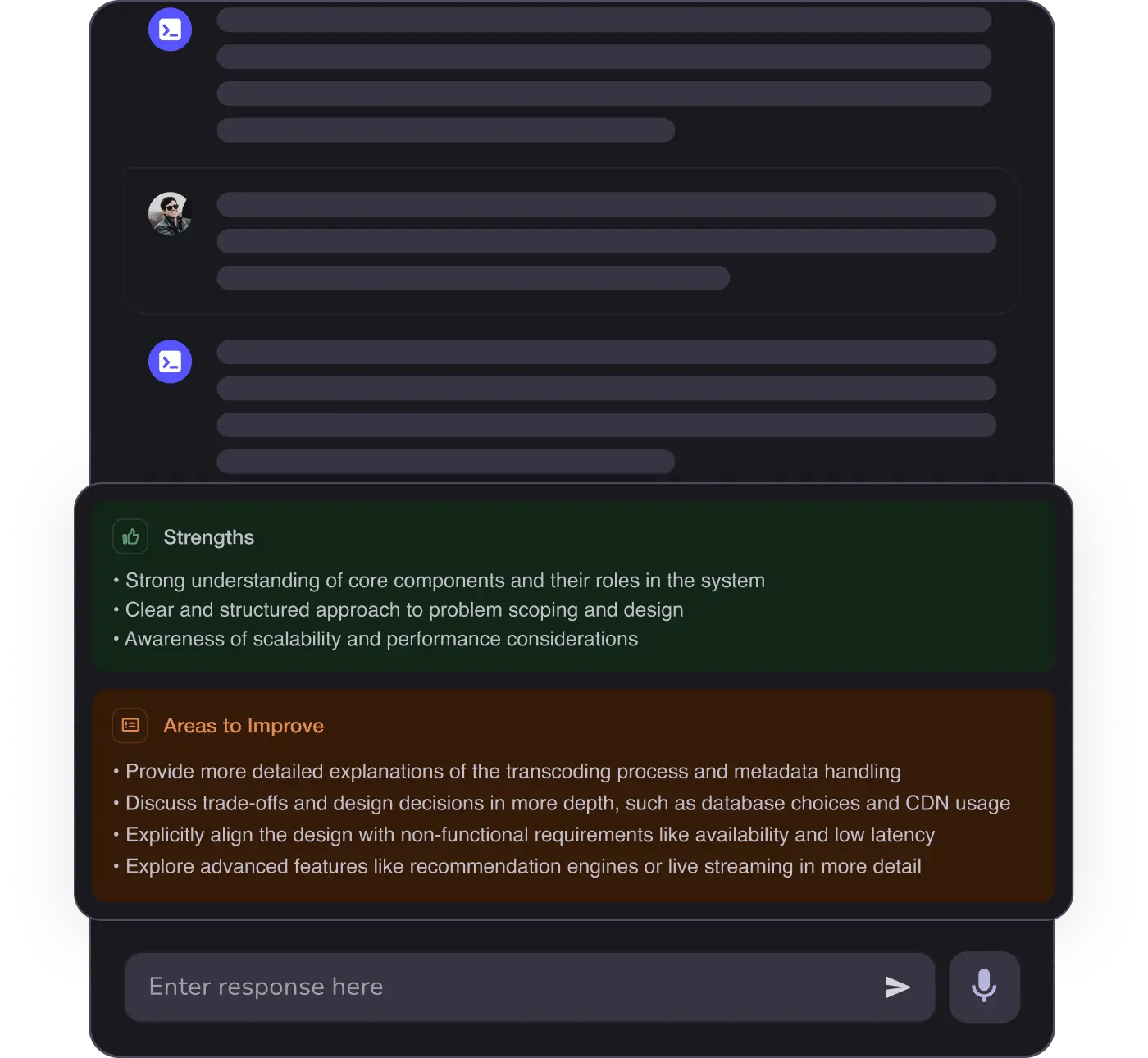
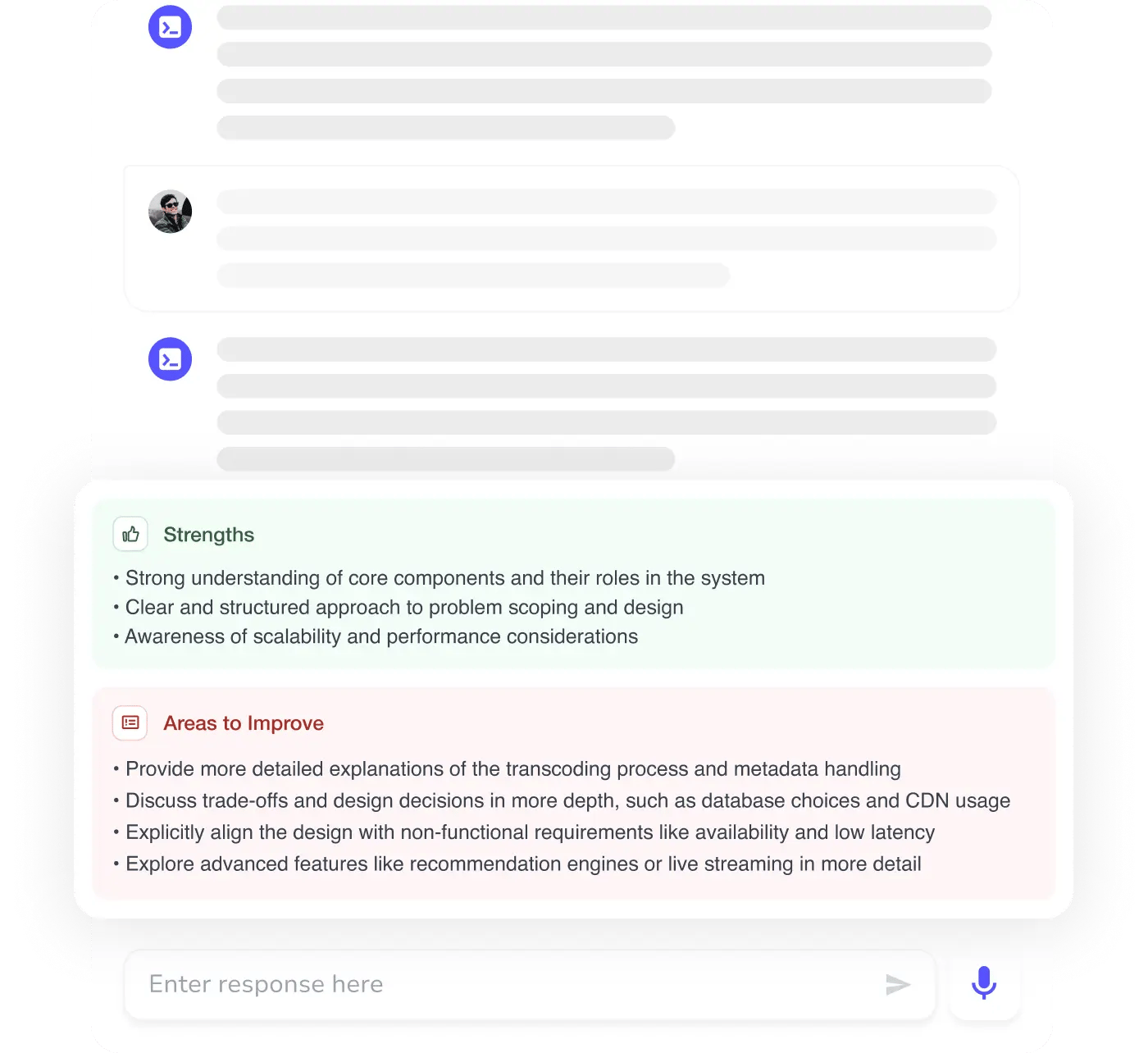
AI Mock Interviews simulate every technical loop at top companies
Free Resources
cheatsheet
cheatsheet