The best AWS Cloud Practitioner study tools
Looking for the best AWS Cloud Practitioner study tools? This in-depth blog covers courses, flashcards, practice exams, notes, and strategies to help you prepare smarter and pass on your first attempt.
When you start preparing for the AWS Certified Cloud Practitioner exam, it feels deceptively simple. The exam is labeled “foundational,” the concepts sound familiar, and most people tell you it’s the easiest AWS certification. Then you open the exam guide and realize how broad it really is.
Cloud concepts.
Core AWS services.
Security and compliance.
Pricing models.
Nothing is deeply technical, but everything matters.
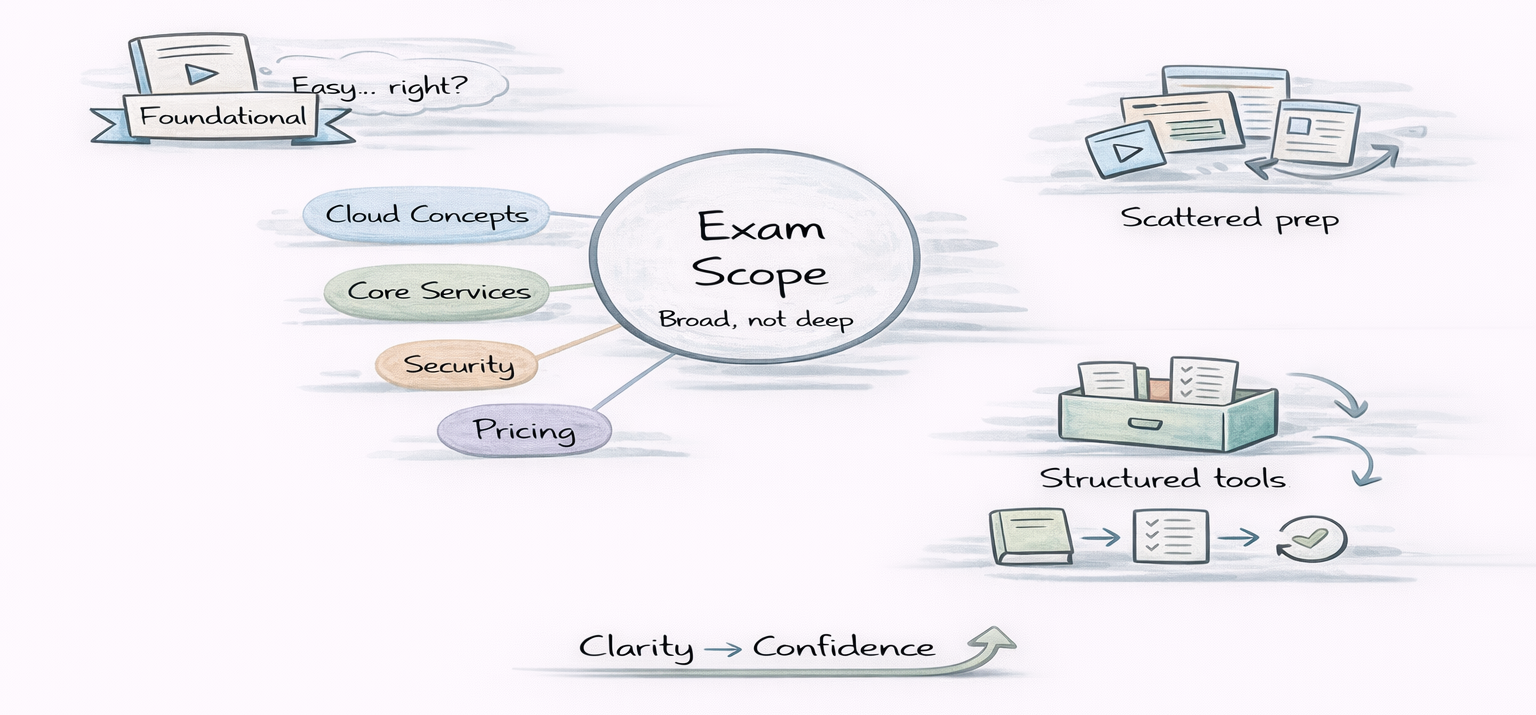
This is where the right study tools make a real difference. Not because the exam is hard, but because preparing inefficiently makes it feel harder than it needs to be. Reading random blog posts, watching disconnected videos, and jumping between resources often leads to surface-level understanding and unnecessary anxiety.
This blog walks you through the AWS Cloud Practitioner study tools that actually work, how to use them together, and how to avoid the common traps that slow most learners down. Whether you are new to cloud computing, transitioning careers, or adding AWS fundamentals to your resume, this is designed to help you prepare with clarity and confidence.
Cloud computing has become the foundation of modern software, and AWS continues to lead that shift. For many engineers and aspiring technologists, the AWS Certified Cloud Practitioner certification is the first step toward understanding how cloud systems are designed, managed, and scaled. The challenge is building a clear mental model of how everything fits together. I built this course around a common pattern I’ve seen: learners often approach AWS as a collection of tools rather than a system. When preparing for the AWS Certified Cloud Practitioner exam, they can recall services but struggle to explain how they work together in real scenarios. This course is designed to make those connections clear from the start. We begin with the fundamentals of cloud computing, then move into core AWS services across compute, storage, networking, and databases. From there, we explore analytics, machine learning, pricing, and billing, tying each concept back to real-world usage. You’ll also work through monitoring, security, and compliance practices, with hands-on Cloud Labs to reinforce your understanding. If you’re starting your journey as a cloud practitioner, this course gives you a structured path to pass the exam and build a strong foundation in AWS.
Why choosing the right AWS Cloud Practitioner study tools matters#
The Cloud Practitioner exam is not about deep engineering skill. It is about conceptual clarity and correct interpretation. Most exam questions test whether you recognize the right service, responsibility, or pricing model in a given situation.
That means your study tools need to support three things.
They need to teach you concepts clearly without overwhelming detail.
They need to help you retain information over time.
They need to train your brain to recognize AWS terminology the way the exam presents it.
Using the wrong tools often leads to one of two extremes. Either you overstudy technical details you do not need, or you underprepare and miss easy points because definitions blur together.
The right tools strike a balance between understanding and recall.
Understanding the AWS Cloud Practitioner exam structure before choosing tools#
Before diving into tools, it helps to understand what the exam actually expects from you.
The AWS Cloud Practitioner exam focuses on four main domains: cloud computing fundamentals, security and compliance, technology, and billing and pricing. Questions are mostly scenario-based but short. You are rarely asked “what is X” directly. Instead, you are asked to identify the correct concept or service in context.
This structure explains why some study tools work better than others. Tools that focus only on passive learning tend to fall short. Tools that reinforce recognition and recall tend to perform better.
Your study tools should mirror how the exam tests you, not just how AWS documentation is written.

We are surrounded by the technology that we utilize daily. Most of it makes use of cloud computing. Cloud is not a nuance anymore; it’s the norm. As software practitioners, it’s imperative to have a good understanding of cloud computing concepts. In this course, you will learn the fundamental concepts of cloud computing. Next, you’ll familiarize yourself with cloud’s standard services. You’ll also learn about various service models available in cloud computing. You’ll learn the concepts of clustering and its relevance in cloud computing. You’ll explore storage and deployment concepts in the cloud. You’ll wrap up with a hands-on experience of how to pick a cloud platform and start your cloud journey. In the end, you’ll have plenty of resources to continue your cloud learning journey. By the end of this course, you’ll have a deeper understanding of the basic concepts of cloud computing and the services and products that cloud platforms offer.
Courses as foundational AWS Cloud Practitioner study tools#
Most candidates start with a course, and for good reason. A well-structured course provides context, narrative, and progression. It helps you understand not just what AWS services exist, but why they exist.
Good Cloud Practitioner courses explain cloud computing in simple terms, introduce AWS services gradually, and connect technical concepts to real-world use cases. They also align their content closely with the official AWS exam guide.
The problem arises when learners rely solely on courses. Watching videos or reading lessons feels productive, but retention drops quickly without reinforcement. This is why courses work best as the foundation, not the entire strategy.
A strong course sets the stage. Other study tools help lock the knowledge in.
Flashcards as recall-focused AWS Cloud Practitioner study tools#
Flashcards are one of the most underrated tools for this exam. The Cloud Practitioner certification rewards quick recognition more than deep reasoning, and flashcards train exactly that skill.
When you consistently review flashcards, you build familiarity with AWS service names, pricing models, and responsibility boundaries. Over time, answers feel obvious rather than uncertain.
Flashcards work especially well for distinguishing similar services, remembering which pricing model applies where, and reinforcing security concepts. They also help expose weak spots early, giving you time to fix them before exam day.
Digital flashcards with spaced repetition tend to be the most effective because they prioritize what you are about to forget rather than what you already know.
Practice exams and question banks as validation tools#
Practice exams are where most candidates discover whether their study approach is working. They serve a different purpose than courses or flashcards.
A good practice exam does not just test knowledge. It teaches you how AWS frames questions, how distractors are written, and how subtle wording changes affect the correct answer.
The best AWS Cloud Practitioner practice exams closely match the difficulty and style of the real test. They include explanations for both correct and incorrect answers, helping you understand why something is right, not just that it is right.
Practice exams should not be taken too early. If you attempt them before learning the material, they become discouraging. When used after the initial study, they become one of the most powerful tools in your preparation.
Notes and summaries as consolidation tools#
Notes are often misunderstood as a passive activity, but when used correctly, they are a powerful consolidation tool.
The act of summarizing forces you to process information and decide what matters. For the Cloud Practitioner exam, good notes focus on relationships rather than raw definitions. They explain how services differ, how responsibilities are divided, and how pricing models compare.
Notes work best when they are concise and revisited regularly. Long, copied notes from documentation rarely help. Short, personalized summaries that reflect your understanding tend to stick.
Many learners combine notes with flashcards, turning confusing topics into quick recall prompts.
Visual tools and diagrams for AWS concepts#
Visual study tools often get overlooked, but they play an important role, especially for cloud beginners.
Diagrams help you understand AWS global infrastructure, networking basics, and service interactions without getting lost in text. Seeing how regions, availability zones, and edge locations relate to each other builds intuitive understanding.
For the Cloud Practitioner exam, visuals are most useful for conceptual clarity rather than memorization. They help you form a mental model of AWS rather than a list of services.
When paired with explanations, visuals reduce cognitive load and improve long-term retention.
Comparing common AWS Cloud Practitioner study tools#
To help you see how different tools fit together, the table below compares common study tools based on their primary benefit and ideal usage stage.
Study tool | Primary benefit | Best time to use | Common mistake |
Courses | Conceptual understanding | Early preparation | Using as the only tool |
Flashcards | Recall and retention | Throughout preparation | Memorizing without understanding |
Practice exams | Exam readiness validation | Mid to late preparation | Taking too early |
Notes | Knowledge consolidation | After learning topics | Writing too much |
Diagrams | Mental modeling | Early to mid preparation | Treating as standalone |
This comparison highlights an important idea. No single tool is enough on its own. The most effective preparation strategies combine tools intentionally.
How to combine AWS Cloud Practitioner study tools into a clear plan#
Successful candidates rarely use one tool in isolation. Instead, they build a simple system.
You start with a structured course to learn the material. As you progress, you reinforce key ideas with flashcards. You take notes to clarify confusing topics. Once you feel comfortable, you validate your knowledge with practice exams. Throughout the process, visuals help anchor your understanding.
This layered approach prevents overload while maximizing retention. Each tool supports a different stage of learning, and together they create momentum rather than stress.
Common mistakes when choosing AWS Cloud Practitioner study tools#
One common mistake is over-collecting resources. Many learners download multiple courses, subscribe to multiple platforms, and bookmark dozens of articles. This creates decision fatigue and slows progress.
Another mistake is focusing too much on technical depth. The Cloud Practitioner exam does not require deep dives into service internals. Overstudying can actually hurt by blurring key distinctions.
Some learners also delay practice exams too long. Waiting until the last moment leaves no time to fix gaps. Practice exams are diagnostic tools, not final tests.
Choosing fewer tools and using them consistently almost always leads to better outcomes.
How study tools reduce exam anxiety#
Exam anxiety is often a symptom of uncertainty, not lack of intelligence. When you are unsure whether your preparation is working, stress builds.
Good study tools provide feedback. Flashcards show what you remember and what you do not. Practice exams reveal readiness. Notes reflect understanding. Together, they replace guesswork with evidence.
This psychological benefit is just as important as the knowledge itself. Confidence improves performance, especially on conceptual exams like Cloud Practitioner.
AWS Cloud Practitioner study tools for non-technical learners#
If you are coming from a non-technical background, study tools matter even more.
Courses that explain concepts in plain language are essential. Visual aids help bridge unfamiliar ideas. Flashcards reinforce new terminology. Practice exams help you adjust to technical phrasing.
The Cloud Practitioner exam is designed to be accessible, but only if you choose tools that respect your starting point. Avoid resources that assume prior AWS or IT experience unless you are comfortable filling in gaps yourself.
Long-term value of choosing the right study tools#
The Cloud Practitioner certification is often a starting point, not an endpoint. Many learners go on to pursue associate-level certifications or cloud-adjacent roles.
The study tools you use now shape how easily you progress later. Tools that emphasize understanding over memorization build a foundation that transfers forward.
Flashcards help retain terminology. Courses build conceptual frameworks. Practice exams develop confidence in interpretation. Together, they make future learning smoother.
Final thoughts on AWS Cloud Practitioner study tools#
Passing the AWS Cloud Practitioner exam is not about grinding endlessly. It is about choosing tools that match how the exam works and how you learn.
The right study tools help you focus on what matters, retain knowledge efficiently, and walk into the exam with confidence rather than doubt. When used intentionally, AWS Cloud Practitioner study tools turn preparation into a manageable, even enjoyable process.
