Key principles of machine learning every developer should know
This blog shows the key principles of machine learning every developer should understand by focusing on data, model evaluation, generalization, and core ML concepts.

Machine learning has become a central component of modern software systems. From recommendation engines that suggest products to fraud detection systems that monitor financial transactions, machine learning models increasingly shape how applications behave and make decisions. Because of this growing influence, many developers who begin exploring artificial intelligence eventually ask a foundational question: What are the key principles of machine learning I should understand?
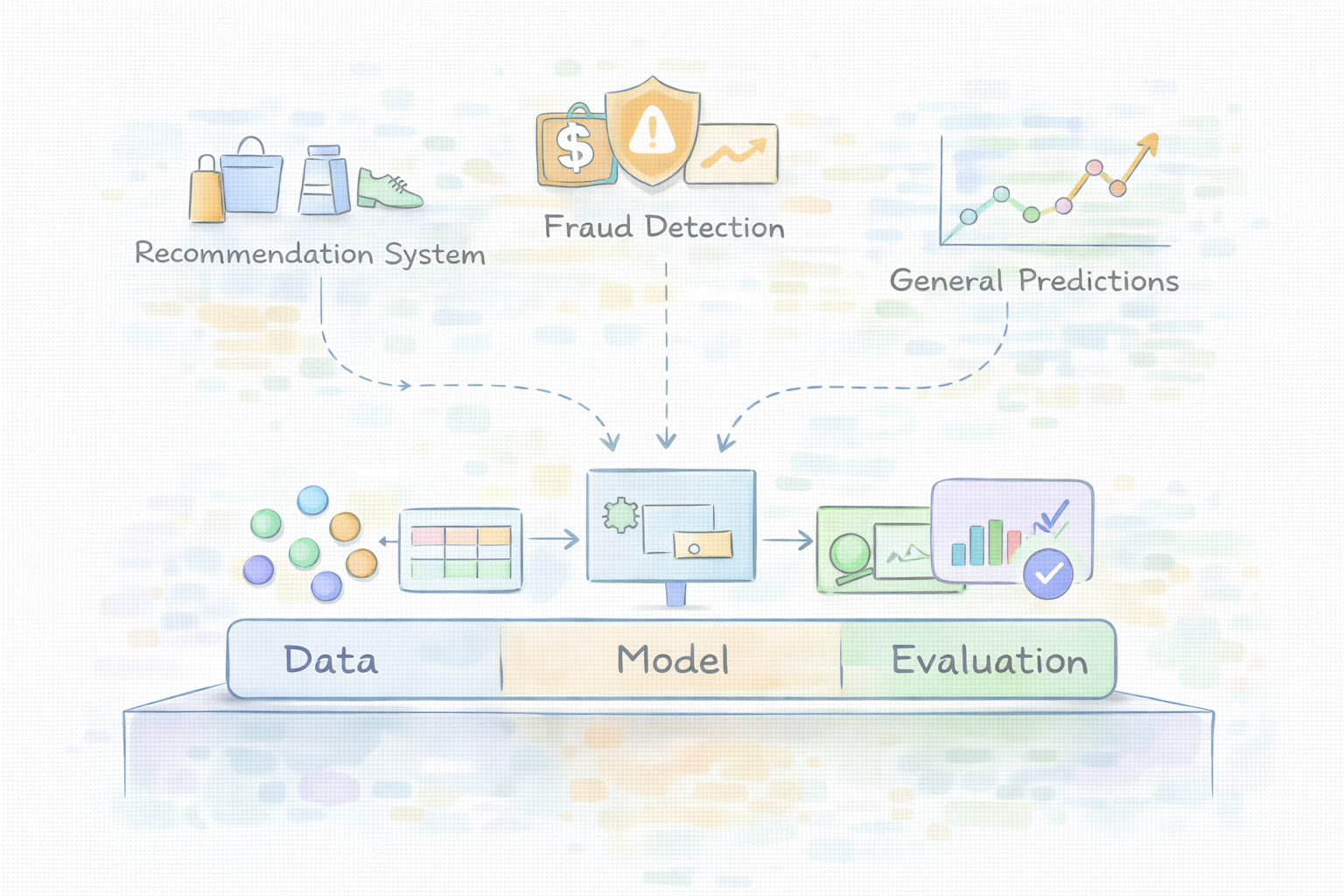
This question is important because machine learning is not simply about using a library or running a training script. Successful machine learning systems rely on understanding how models learn from data, how predictions are evaluated, and how different design choices affect performance.
Before building complex neural networks or deploying large-scale predictive systems, practitioners benefit from learning the principles that guide how machine learning works. These principles explain how data influences models, how models generalize to new inputs, and how developers can evaluate and improve predictive performance.
Understanding these ideas provides a strong conceptual foundation for anyone interested in building reliable machine learning systems.

Machine learning interviews at top tech companies now focus more on open-ended system design problems. “Design a recommendation system.” “Design a search ranking system.” “Design an ad prediction pipeline.” These questions evaluate your ability to reason about machine learning systems end-to-end. However, most candidates prepare for isolated concepts instead of system-level design. This course focuses specifically on building that System Design muscle. You’ll work through 9 real-world ML System Design problems (the same questions asked at Meta, Google, Amazon, and Microsoft) and learn a repeatable methodology for breaking each one down: defining the problem, choosing metrics, selecting model architectures, designing data pipelines, and evaluating trade-offs. Each system you design builds on practical ML techniques covered earlier in the course: embeddings, transfer learning, online experimentation, model debugging, and performance considerations. By the time you’re designing your third or fourth system, you'll have the technical vocabulary and judgment to explain why your design choices work. This is exactly what interviewers are looking for. The course also includes 6 mock interviews so you can practice articulating your designs under realistic conditions. If you have an ML or System Design interview coming up at any major tech company, this course will help you walk in with a clear framework for tackling whatever they throw at you.
What is machine learning?#
Machine learning refers to a class of algorithms that learn patterns from data rather than relying on explicitly programmed rules. Instead of defining every possible decision pathway in code, developers provide examples that allow models to discover relationships within datasets.
Traditional programming follows a rule-based approach. Developers write explicit instructions that determine how the system processes inputs and generates outputs. Machine learning systems reverse this process by allowing algorithms to infer rules directly from data.
For example, consider an email spam filter. A traditional rule-based system might look for specific keywords or sender addresses. A machine learning model, however, learns patterns across many examples of spam and legitimate emails, identifying statistical features that help distinguish between them.
Because these models rely heavily on data rather than hardcoded rules, understanding how datasets influence model behavior becomes critical. This is why learners often revisit the question What are the key principles of machine learning I should understand? as they deepen their knowledge.
Core principles of machine learning#
Several foundational principles guide how machine learning systems are developed and evaluated.
Principle | Description | Why It Matters |
Training data | Data used to teach the model patterns and relationships | Determines what the model learns |
Feature engineering | Process of selecting and transforming input variables | Influences model performance |
Bias–variance tradeoff | Balance between model simplicity and complexity | Prevents poor generalization |
Model evaluation | Methods for measuring predictive accuracy | Ensures models perform reliably |
Overfitting and underfitting | Conditions where models learn too much or too little from data | Affects predictive reliability |
Training data forms the foundation of every machine learning model. The examples used during training determine the patterns the model learns, which means the quality and diversity of the dataset directly influence model performance.
Feature engineering involves transforming raw data into meaningful inputs for the model. Features may include numerical variables, categorical values, or derived attributes that capture useful relationships within the data.
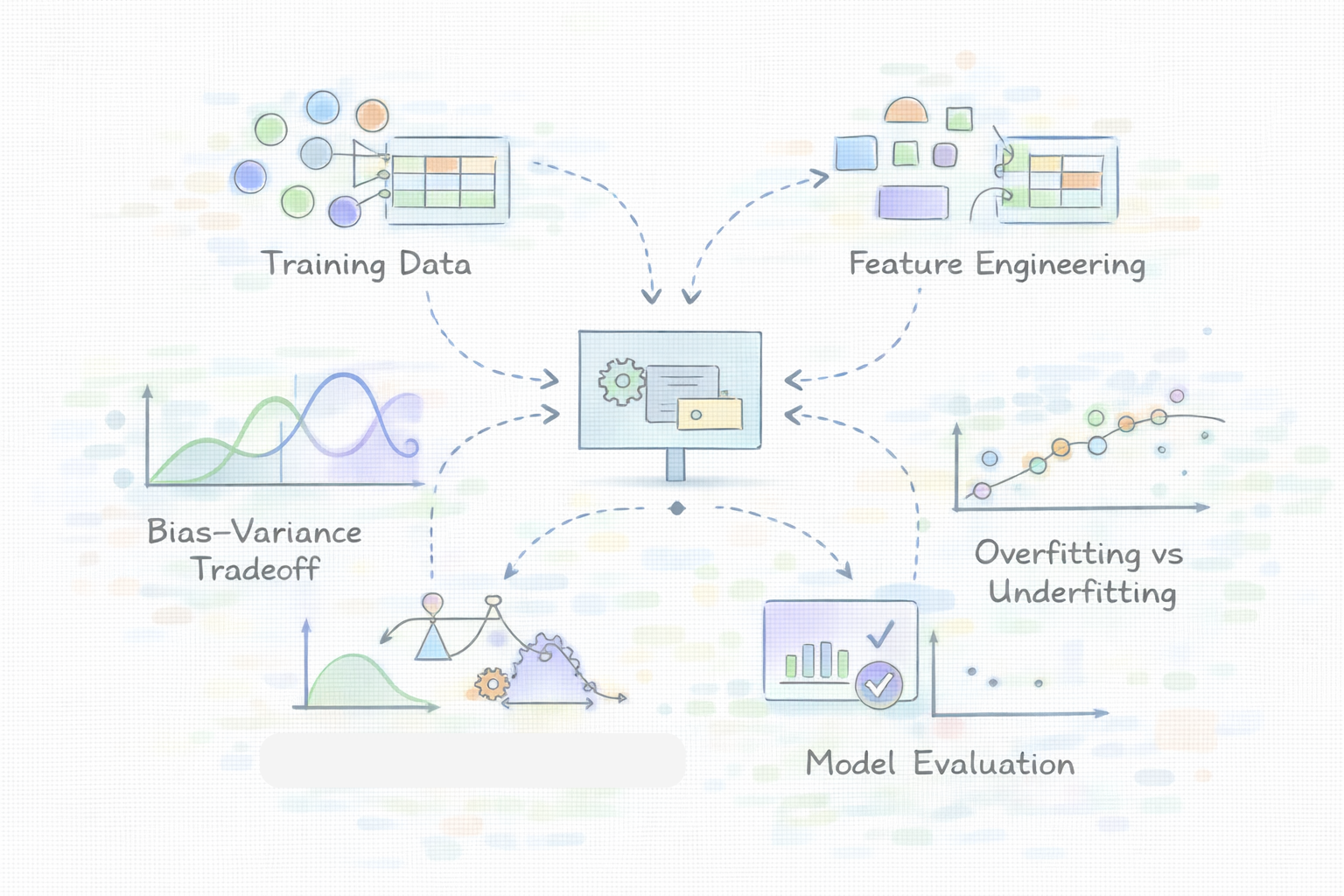
The bias–variance tradeoff describes the balance between model simplicity and flexibility. Simple models may fail to capture complex relationships, while overly complex models may memorize training data instead of generalizing.
Model evaluation helps determine whether a trained system performs well on new data. Metrics such as accuracy, precision, recall, and mean squared error provide quantitative measures of predictive quality.
Overfitting and underfitting represent two common challenges. Overfitting occurs when a model learns patterns specific to the training data but fails to generalize. Underfitting occurs when the model is too simple to capture meaningful relationships.
These principles collectively help answer the question what the key principles of machine learning you should understand.
Important concepts every practitioner should understand#
Several conceptual ideas complement the core principles of machine learning.
Supervised vs. unsupervised learning: Supervised learning uses labeled datasets where the desired output is known. Algorithms learn to map inputs to outputs by analyzing examples. Unsupervised learning, in contrast, works with unlabeled data and focuses on identifying hidden patterns or groupings.
Training and test datasets: Machine learning models are typically trained on one dataset and evaluated on another. Separating training and test data helps ensure that the model is evaluated on examples it has not seen before.
Model generalization: A successful machine learning model performs well on new data, not just the examples used during training. Generalization measures how effectively a model adapts to unseen inputs.
Cross-validation: Cross-validation divides data into multiple subsets that allow models to be trained and tested several times. This approach provides more reliable estimates of model performance.
Hyperparameter tuning: Hyperparameters control how algorithms learn from data. Adjusting these parameters can significantly influence model performance, making tuning an important step in model development.
Understanding these ideas strengthens the conceptual foundation required for answering the question What are the key principles of machine learning I should understand?
Typical machine learning workflow#
Although machine learning systems vary widely in complexity, most projects follow a similar workflow. The process begins with data collection. Relevant datasets must be gathered from sources such as databases, APIs, logs, or sensors.
Next comes data preprocessing. Raw data often contains inconsistencies, missing values, or formatting issues that must be cleaned before analysis. Feature engineering follows preprocessing. During this stage, developers transform raw variables into structured inputs that capture meaningful relationships within the data.
Model training then uses these features to build predictive algorithms. The model learns patterns that allow it to generate predictions based on input data. Model evaluation assesses the system's accuracy using metrics appropriate for the problem. Evaluation ensures that the model performs reliably on new data.
Finally, model deployment integrates the trained system into applications where it can generate predictions in real time or through batch processing. Understanding how these stages connect helps practitioners apply machine learning principles in real-world projects.
Real-world applications of machine learning principles#
The principles discussed earlier appear in many real-world systems that rely on predictive models.
Recommendation engines use machine learning to analyze user behavior and suggest relevant products, movies, or content. These systems rely heavily on training data and feature engineering to capture user preferences.
Fraud detection systems analyze transaction patterns to identify suspicious activity. These models must balance precision and recall to minimize both false positives and missed fraud cases.
Predictive analytics models help organizations forecast demand, optimize logistics, or anticipate customer behavior. Accurate predictions require careful model evaluation and generalization.
Natural language processing systems analyze text to perform tasks such as sentiment analysis, document classification, or language translation. These systems often combine traditional machine learning with deep learning architectures.
In each of these applications, the same underlying principles guide how models are trained, evaluated, and improved.
Do you need strong mathematics to understand machine learning principles?#
A basic understanding of statistics and linear algebra is helpful, but beginners can start learning practical concepts while gradually strengthening their mathematical background.
Which programming language is most common for machine learning?#
Python is the most widely used language because of its large ecosystem of machine learning libraries and frameworks.
What is the difference between machine learning and deep learning?#
Machine learning refers broadly to algorithms that learn from data, while deep learning focuses on neural network models with multiple layers that can learn complex patterns.
How long does it take to learn machine learning fundamentals?#
The timeline varies depending on prior experience, but many learners develop a solid foundation within several months of consistent study and experimentation.
Final words#
Machine learning has become a powerful tool for solving complex problems across many industries. However, effective machine learning systems depend on more than simply training models with large datasets.
Understanding the foundational ideas behind training data, feature engineering, model evaluation, and generalization helps practitioners design systems that produce reliable predictions. For developers and engineers entering the field, answering the question What are the key principles of machine learning I should understand? represents the first step toward building robust and effective machine learning solutions.