Stack vs Heap: What's the difference?

Writing effective code requires an awareness of stack and heap memory, making it a crucial component of learning programming. Not only that, but new programmers should also become fully acquainted with the distinctions between stack memory and heap memory in order to write effective and optimized code. This blog post will provide a comprehensive comparison of these two memory allocation techniques. We will have a thorough understanding of stack and heap memory by the conclusion of this article, allowing us to employ them effectively in our programming endeavors.
Memory allocation#
Memory serves as the foundation of computer programming. It provides the space to store the data and all the commands our program requires to operate efficiently. Allocating memory can be compared to designating a specific area within our computer’s memory for a distinct purpose, like accommodating variables or objects essential for our program’s functionality. Memory layout and organization of a program can vary according to the operating system and architecture being used. In general, however, memory may be divided into the following segments:


Global segment
Code segment
Stack
Heap
The global segment is responsible for storing global variables and static variables that have a lifetime equal to the entire duration of the program's execution.
The code segment, also known as the text segment, contains the actual machine code or instructions that make up our program, including functions and methods.
The stack segment is used for managing local variables, function arguments, and control information, such as return addresses.
The heap segment provides a flexible area for storing large data structures and objects with dynamic lifetimes. Heap memory may be allocated or deallocated during the program execution.
Note: It is important to note that stack and heap in the context of memory allocation should not be confused with the data structures stack and heap, which have different purposes and functionalities.


Every program has its own virtual memory layout, which is mapped onto physical memory by the operating system. The specific allocation to each segment depends on various factors, such as the following:
Size of the program's code.
Number and size of global variables.
Amount of dynamic memory allocation required by the program.
Size of the call stack used by the program.
The global variables declared outside of any function would reside in the global segment. The machine code or instructions for the program's functions and methods would be stored in the code segment. Let us see coding examples to help visualize how the global and code segments are used in memory:
In these code examples, we have a global variable globalVar with a value of 42, which is stored in the global segment. We also have a function add, which takes two integer arguments and returns their sum; this function is stored in the code segment. The main function (or the script in Python) calls the add function, passing the global variable and another integer value 10 as arguments.


It's crucial to emphasize that managing the stack and heap segments plays a significant role in the performance and efficiency of our code, making it a vital aspect of programming. Therefore, programmers should understand them fully before delving into their differences.
Stack memory: the orderly storage#
Think of stack memory as an organized and efficient storage unit. It uses a last in, first out (LIFO) approach, which means that the most recent data added gets removed first. The kernel, a central component of the operating system, manages stack memory automatically; we don't have to worry about allocating and deallocating memory. It just takes care of itself while our program runs.
The code instances below in different programming languages demonstrate the use of stack in various cases.
A block of memory called a stack frame is created when a function is called. The stack frame stores information related to local variables, parameters, and the return address of the function. This memory is created on the stack segment.
In the codes instances above, we created a function called add. This function takes two parameters as input integers and returns their sum. Inside the add function, we created a local variable called sum to store the result. This variable is stored in stack memory.
In the main function (or top-level script for Python), we create another local variable x and assign it the value 5. This variable is also stored in stack memory. Then, we call the add function with x and 10 as arguments. The function call and its arguments and return address are placed on the stack. Once the add function returns, the stack is popped, removing the function call and associated data, and we can print the result.
In the following explanation, we'll go over how the heap and stack change after running each important line of code. Although we're focusing on C++, the explanation for Python and Java also holds. We're only discussing the stack segment here.

Here is the explanation of the C++ code in the order of execution:
Line 10: The program starts with the
mainfunction, and a new stack frame is created for it.Line 12: The local variable
xis assigned the value5.Line 15: The
addthe function is called with the argumentsxand10.Line 4: A new stack frame is created for the
addfunction. The control is transferred to theaddfunction with local variables.a,b, andsum. Variablesaandbare assigned the values ofxand10, respectively.Line 6: The local variable
sumis assigned the value ofa + b(i.e., 5 + 10).Line 7: The
sumvariable's value (i.e., 15) is returned to the caller.Line 8: The
addfunction's stack frame is popped from the stack, and all local variables (a,b, andsum) are deallocated.Line 15: The local variable
resulton the stack frame of themainfunction is assigned the returned value (i.e., 15).Line 17: The value stored in the
resultvariable (i.e., 15) is printed to the console usingstd::cout.Line 19: The
mainfunction returns 0, signaling successful execution.Line 20: The
mainfunction's stack frame is popped from the stack, and all local variables (xandresult) are deallocated.
Visualizing stack frames and heap allocation#
Stack and heap memory become easier to understand when you see how they change during function calls. The stack stores function call information like local variables and return addresses, while the heap stores dynamically allocated data that can live beyond a single function call.
Think of the stack like a stack of trays: the newest function call goes on top and gets removed first. The heap is more like a storage warehouse: objects stay there until you explicitly remove them.
Code example#
#include <iostream>using namespace std;int* createNumber() {int local = 5; // Stored on the stackint* ptr = new int(42); // ptr is on stack, 42 is on heapreturn ptr; // Return address of heap object}int main() {int* result = createNumber();cout << *result << endl;delete result; // Frees heap memoryreturn 0;}
Stage 1: Program starts#
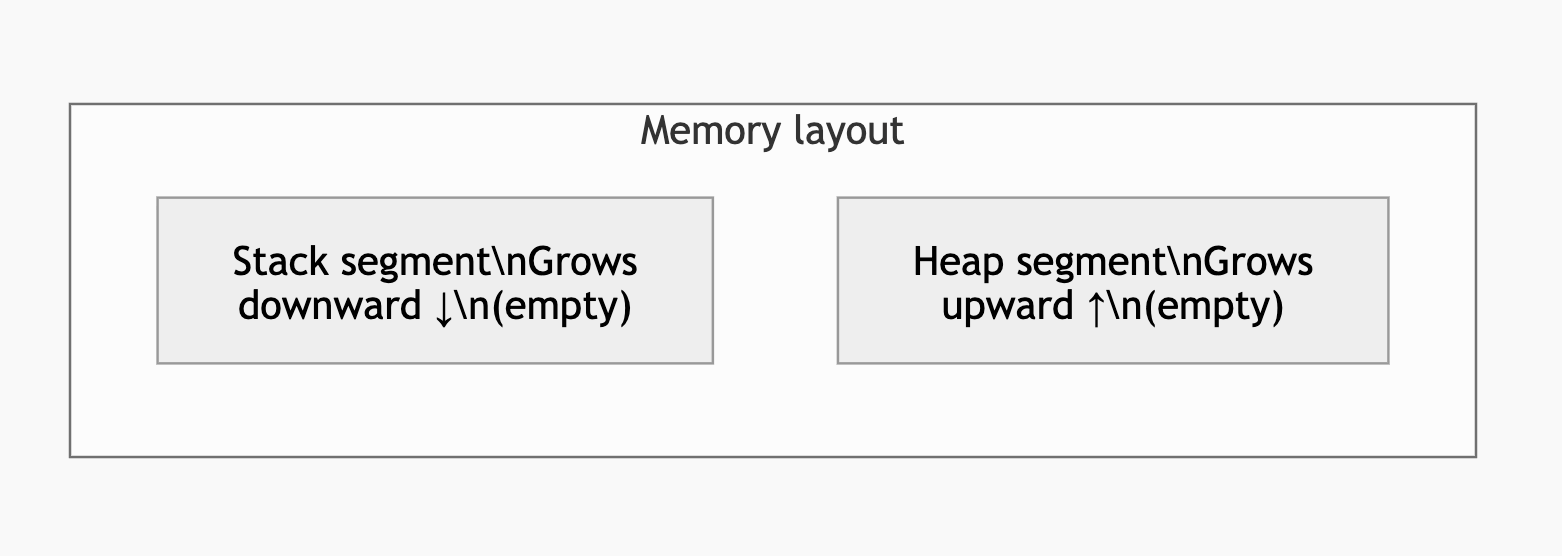
At the start, no function frames have been pushed yet. The stack and heap are both conceptually empty.
Stage 2: main() starts#
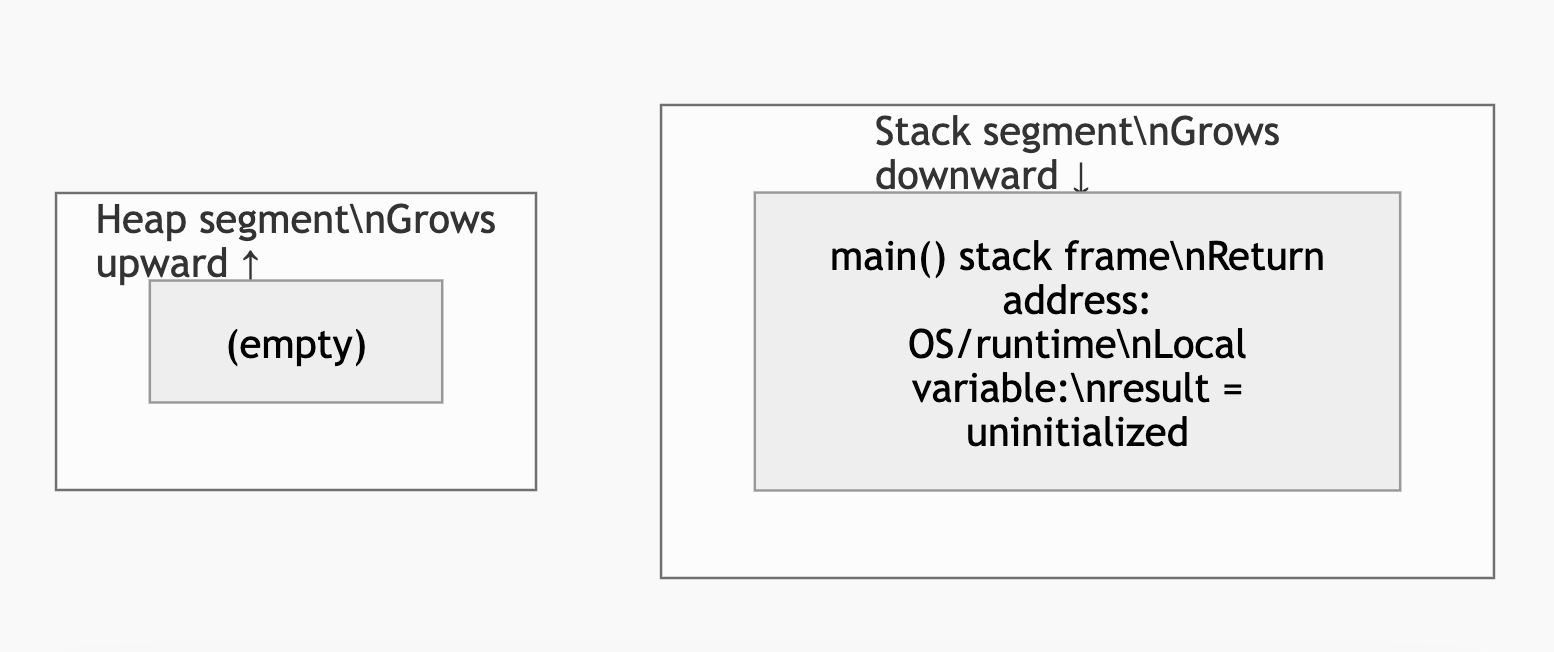
When main() begins, a stack frame is created. This frame stores main()’s local variable, result, and the return address used when main() finishes.
Stage 3: createNumber() is called#
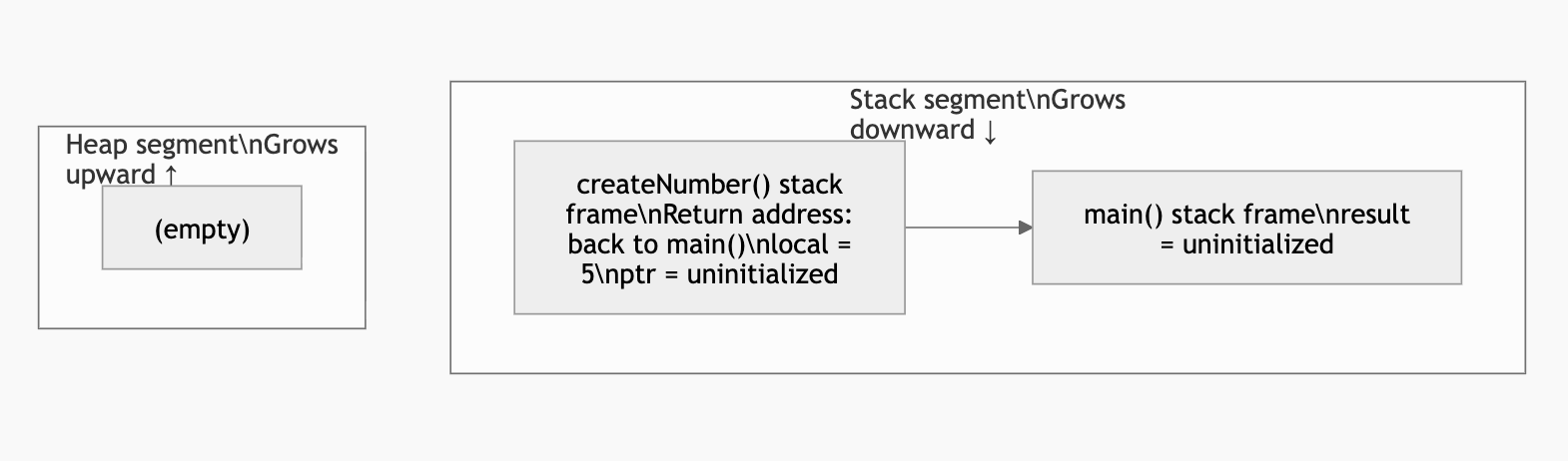
Calling createNumber() pushes a new stack frame on top of main()’s frame. The function’s local variable local and pointer variable ptr live inside this stack frame.
Stage 4: Heap allocation happens#
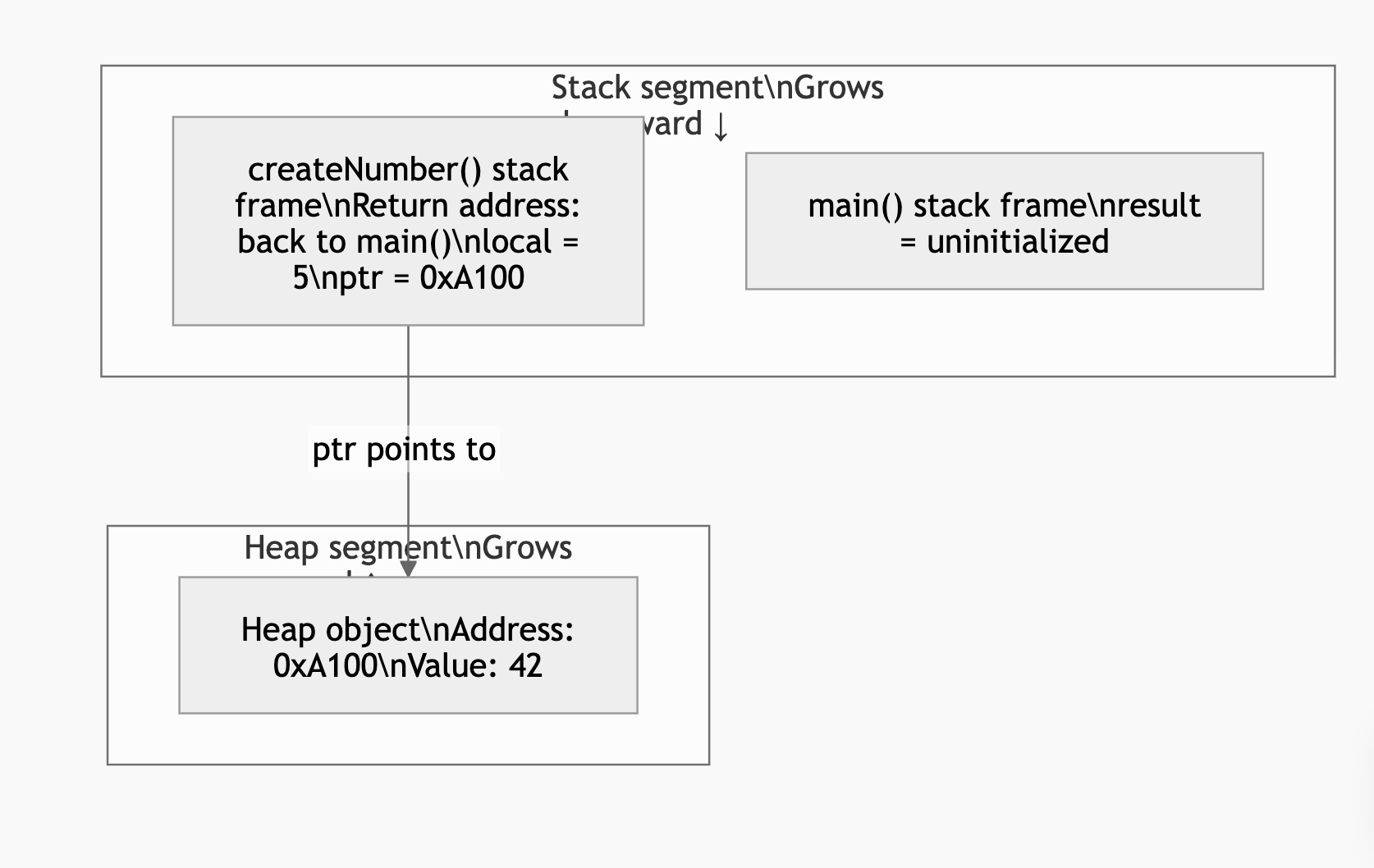
The line new int(42) creates an integer on the heap. The pointer variable ptr is still stored on the stack, but it contains the address of the heap object.
Stage 5: Function returns#
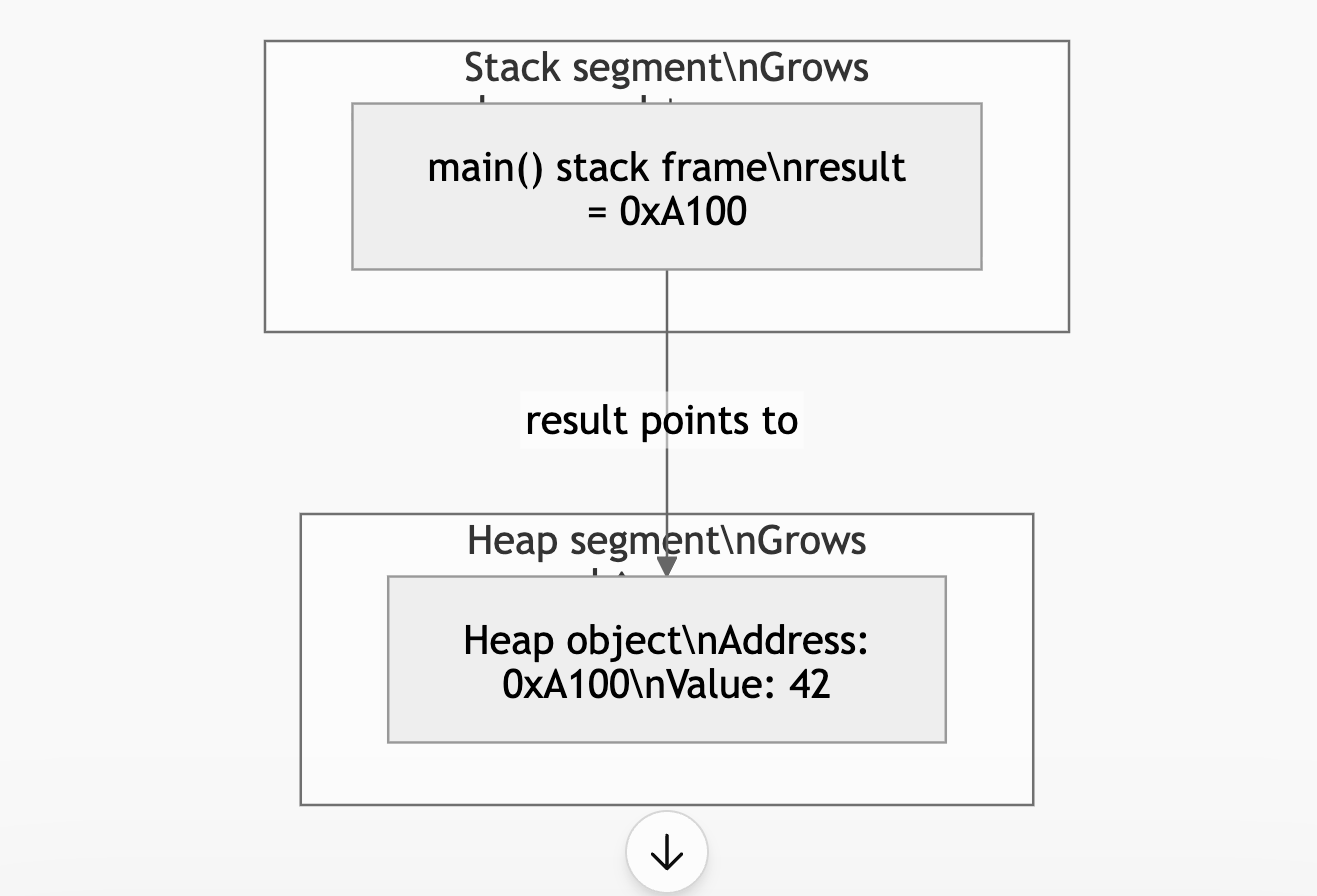
When createNumber() returns, its stack frame is popped. That means local and ptr disappear, but the heap object remains because heap memory is not automatically removed when a function ends.
The returned address is stored in result inside main().
Stage 6: Heap memory is freed#
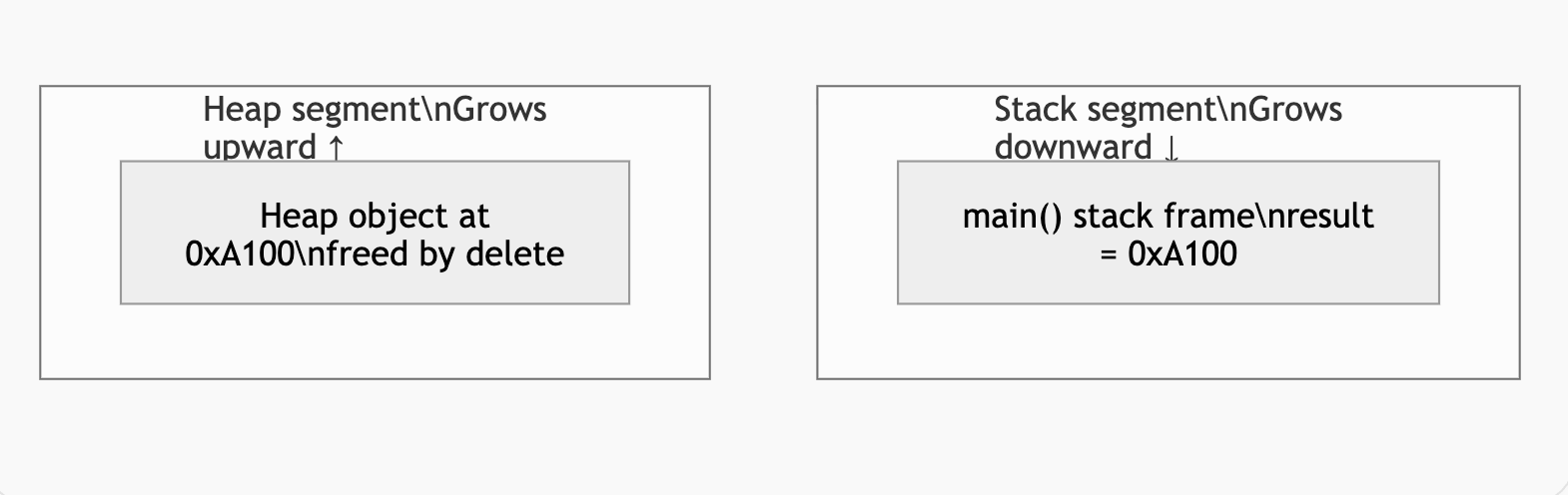
The line delete result; frees the heap memory. Without this step in C++, the heap object would remain allocated even though the program no longer needs it.
Execution walkthrough#
main()starts, so a stack frame is created formain().main()callscreateNumber(), so a second stack frame is pushed.localis stored insidecreateNumber()’s stack frame.new int(42)creates an integer on the heap.ptrstores the heap address and returns it tomain().createNumber()ends, so its stack frame is removed.The heap object survives because heap memory is managed separately.
delete resultfrees the heap object.
Key observations#
Stack memory is tied to function calls.
Each function call gets its own stack frame.
Local variables usually disappear when the function returns.
Heap memory can outlive the function that created it.
Pointer variables can live on the stack while pointing to objects on the heap.
In C++, heap memory created with
newmust be released withdelete.
What causes stack overflow and memory leaks?#
A stack overflow happens when the stack grows too large. This often occurs with deep or infinite recursion, where each recursive call adds another stack frame until the stack runs out of space.A memory leak happens when heap memory is allocated but never freed. In C++, this usually means calling new without a matching delete. Over time, leaked heap memory can slow down or crash a program.In short: the stack cleans itself up automatically when functions return, but heap memory must be managed carefully.
Key features of stack memory#
Here are some key aspects to consider about stack memory:
-
Fixed size: When it comes to stack memory, its size remains fixed and is determined right at the beginning of the program’s execution.
-
Speed advantage: Stack memory frames are contiguous. Therefore, allocating and deallocating memory in stack memory is incredibly quick. This is done through simple adjustment of references through stack pointers managed by the OS.


Storage for control info and variables: Stack memory is responsible for housing control information, local variables, and function arguments, including return addresses.
Limited accessibility: It's important to remember that data stored in stack memory can only be accessed during an active function call.
Automatic management: The efficient management of stack memory is handled by the system itself, requiring no additional effort on our part.
Heap memory: the dynamic storage#
Heap memory, also known as dynamic memory, is the wild child of memory allocation. The programmer has to manage it manually. Heap memory allows us to allocate and free up memory at any time during our program's execution. It's great for storing large data structures or objects whose sizes aren't known in advance.
The code instances below in different programming languages demonstrate the use of heap.
In these code examples, the goal is to store the value 42 in heap memory, which is a more permanent and flexible storage space. This is done by using a pointer or reference variable that resides in stack memory:
int* ptrin C++.An
Integerobjectptrin Java.A list with a single element
ptrin Python.
The value stored on the heap is then printed. In C++, it's necessary to manually release the memory allocated on the heap using the delete keyword. However, Python and Java manage memory deallocation automatically through garbage collection, eliminating the need for manual intervention.
Note: In Java and Python, garbage collection takes care of memory deallocation automatically, eliminating the need for manual memory release, as seen in C++.
In the following explanation, we'll go over how heap and stack change after running each important line of code. Although we're focusing on C++, the explanation also holds true for Python and Java. We're only discussing the stack and heap segments here.

Here is the explanation of the C++ code in the order of execution:
Line 3: The function
mainis called, and a new stack frame is created for it.Line 5: A local variable
valueon the stack frame is assigned the value42.Line 8: A pointer variable
ptris allocated the dynamically created memory for a single integer on the heap using thenewkeyword. Let's assume the address of this new memory on the heap to be 0x1000. The address of the allocated heap memory (0x1000) is stored in the pointer.ptr.Line 11: The integer value
42is assigned to the memory location pointed to byptr(heap address 0x1000).Line 12: The value stored at the memory location pointed to by
ptr(42) is printed to the console.Line 15: The memory allocated on the heap at address 0x1000 is deallocated using the
deletekeyword. After this line,ptrbecomes a dangling pointer because it still holds the address 0x1000, but that memory has been deallocated. However, we will not discuss dangling pointers in detail for this essential discussion.Line 17: The main function returns 0, signaling successful execution.
Line 18: The main function's stack frame is popped from the stack, and all local variables (
valueandptr) are deallocated.
Note: The C++ standard library also provides a range of smart pointers that can help automate the process of memory allocation and deallocation in the heap.
Key features of heap memory#
Here are some notable characteristics of heap memory to keep in mind:
Flexibility in size: Heap memory size can change throughout the program's execution.
Speed trade-off: Allocating and deallocating memory in a heap is slower because it involves finding a suitable memory frame and handling fragmentation.
Storage for dynamic objects: Heap memory stores objects and data structures with dynamic lifespans, like those created with the
newkeyword in Java or C++.Persistent data: Data stored in heap memory stays there until we manually deallocate it or the program ends.
Manual management: In some programming languages (for example, C and C++), heap memory must be managed manually. This can lead to memory leaks or inefficient use of resources if it's not done correctly.
Stack vs. heap: highlighting the differences#
Now that we thoroughly understand how stack and heap memory allocations work, we can distinguish between them. When comparing stack and heap memory, we must consider their unique characteristics to understand their differences:
Size management: Stack memory has a fixed size determined at the beginning of the program's execution, while heap memory is flexible and can change throughout the program's lifecycle.
Speed: Stack memory offers a speed advantage when allocating and deallocating memory because it only requires adjusting a reference. In contrast, heap memory operations are slower due to the need to locate suitable memory frames and manage fragmentation.
Storage purposes: Stack memory is designated for control information (such as function calls and return addresses), local variables, and function arguments, including return addresses. On the other hand, heap memory is used for storing objects and data structures with dynamic lifespans, such as those created with the
newkeyword in Java or C++.Data accessibility: Data in stack memory can only be accessed during an active function call, whereas data in heap memory remains accessible until it's manually deallocated or the program ends.
Memory management: The system automatically manages stack memory, optimizing its usage for fast and efficient memory referencing. In contrast, heap memory management is the programmer's responsibility, and improper handling can lead to memory leaks or inefficient use of resources.
This table summarizes the key differences between stack and heap memory across different aspects:
Aspect | Stack Memory | Heap Memory |
Size management | Fixed size, determined at the beginning of program | Flexible size, can change during program's lifecycle |
Speed | Faster, only requires adjusting a reference | Slower, involves locating suitable blocks and managing fragmentation |
Storage purposes | Control info, local variables, function arguments | Objects and data structures with dynamic lifespans |
Data accessibility | Accessible only during an active function call | Accessible until manually deallocated or program ends |
Memory management | Automatically managed by the system | Manually managed by the programmer |
How different programming languages handle stack and heap memory#
Stack and heap memory exist in almost every modern programming language, but the way they are used varies significantly depending on the language and runtime environment. Some languages give programmers direct memory control, while others automate most memory management behind the scenes.
Understanding these differences helps explain why languages like C and C++ are commonly used for operating systems and game engines, while languages like Java and Python prioritize developer productivity and memory safety for large-scale applications.
Stack vs heap memory across languages#
Language | Stack usage | Heap usage | Memory management style | Garbage collection? | Manual deallocation required? |
C | Local variables and function calls | Dynamic allocation using malloc() | Fully manual | No | Yes |
C++ | Local objects and function calls | Dynamic allocation using new | Mostly manual with RAII improvements | No | Usually yes |
Java | Primitive local variables and references | Objects allocated on heap | Automatic runtime management | Yes | No |
Python | References and function frames | Objects stored on heap | Fully automatic | Yes | No |
How C handles stack and heap memory#
C provides some of the lowest-level memory control available in mainstream programming languages. This flexibility makes C extremely powerful, but also more dangerous because programmers are responsible for managing memory manually.
Stack memory in C#
In C, local variables inside functions are typically stored on the stack.
Example:
#include <stdio.h>int main() {int number = 10;printf("%d\n", number);return 0;}
Here:
int number = 10;
creates a local variable stored in stack memory.
When the function exits, the stack frame is automatically removed.
Heap memory in C#
Heap memory is allocated manually using malloc().
#include <stdio.h>#include <stdlib.h>int main() {int *ptr = (int *)malloc(sizeof(int));*ptr = 25;printf("%d\n", *ptr);free(ptr);return 0;}
What happens here?#
malloc()allocates memory on the heapptrstores the heap memory addressfree(ptr)releases the memory manually
If free() is forgotten, the program creates a memory leak.
Important characteristics of C memory management#
C gives programmers:
Very high performance
Direct hardware-level control
Minimal runtime overhead
But it also introduces risks like:
Memory leaks
Dangling pointers
Buffer overflows
Double-free errors
This is one reason C is commonly used in:
Operating systems
Embedded systems
Device drivers
Performance-critical software
How C++ handles stack and heap memory#
C++ builds on C and uses similar stack and heap concepts, but it introduces features that make memory management safer and more structured.
Stack memory in C++#
C++ objects created locally are usually stored on the stack.
#include <iostream>int main() {int number = 10;std::cout << number << std::endl;return 0;}
Like C, the variable is automatically destroyed when the function exits.
Heap memory in C++#
Heap allocation commonly uses new.
#include <iostream>int main() {int* ptr = new int(25);std::cout << *ptr << std::endl;delete ptr;return 0;}
#include <iostream>#include <memory>int main() {std::unique_ptr<int> ptr = std::make_unique<int>(50);std::cout << *ptr << std::endl;return 0;}
Here, memory is automatically cleaned up when the smart pointer goes out of scope.
Important characteristics of C++ memory management#
C++ provides:
High performance
Strong memory control
Automatic cleanup tools
This balance makes C++ common in:
Game engines
High-performance systems
Graphics programming
Real-time applications
How Java handles stack and heap memory#
Java abstracts most memory management away from developers. Unlike C and C++, Java programs run inside the Java Virtual Machine (JVM), which handles memory allocation and garbage collection automatically.
Stack memory in Java#
Primitive local variables and object references are often stored on the stack.
Heap memory in Java#
Objects themselves are allocated on the heap.
public class Main {public static void main(String[] args) {String message = new String("Hello");System.out.println(message);}}
What happens here?#
The reference variable
messageis stored in stack memoryThe actual
Stringobject is allocated on the heap
This distinction between references and objects is important in Java.
Garbage collection in Java#
Java automatically frees unused heap memory using a garbage collector.
Developers do not manually call:
free()delete()
The JVM periodically identifies unused objects and reclaims memory automatically.
Important characteristics of Java memory management#
Java prioritizes:
Safety
Reliability
Developer productivity
Benefits include:
Fewer memory leaks
Reduced crash risk
Simpler application development
Trade-offs include:
Higher runtime overhead
Less direct memory control
Java is commonly used in:
Enterprise applications
Android development
Backend systems
Large-scale web services
How Python handles stack and heap memory#
Python provides one of the highest levels of memory abstraction among popular programming languages. Developers rarely interact with raw memory directly.
Everything in Python is an object#
In Python, almost everything—including integers and functions—is treated as an object.
Example:
numbers = [1, 2, 3]print(numbers)
What happens here?#
The list object:
[1, 2, 3]
is stored on the heap.
The variable:
numbers
acts as a reference pointing to that object.
Memory management in Python#
Python uses:
Reference counting
Automatic garbage collection
When objects are no longer referenced, Python eventually frees the memory automatically.
Developers usually do not manually manage allocation or deallocation.
Important characteristics of Python memory management#
Python prioritizes:
Simplicity
Productivity
Readability
Benefits include:
Easier development
Safer memory handling
Faster prototyping
Trade-offs include:
Higher memory usage
Slower runtime performance
Less low-level control
Python is widely used in:
AI and machine learning
Data science
Automation
Web development
Scripting
Why these differences matter#
Different memory management models affect how programs behave in real-world systems.
Performance#
Languages like C and C++ provide direct memory control with minimal runtime overhead. This makes them extremely fast.
Languages like Java and Python introduce additional runtime layers, which can reduce raw performance.
Memory safety#
Automatic garbage collection helps reduce:
Memory leaks
Dangling pointers
Invalid memory access
This makes Java and Python safer for many application-level use cases.
Developer productivity#
Manual memory management increases complexity.
Languages with automatic memory management allow developers to focus more on:
Business logic
Features
Application behavior
instead of low-level memory details.
Systems programming vs application development#
Low-level systems software often prioritizes:
Performance
Predictability
Memory control
Application development often prioritizes:
Productivity
Safety
Faster iteration
This is why:
Operating systems often use C/C++
Web applications often use Java or Python
AI systems frequently use Python with optimized C/C++ libraries underneath
Runtime overhead#
Garbage collectors and virtual machines improve convenience, but they also introduce:
Extra memory usage
Background cleanup work
Runtime pauses in some cases
This trade-off is important in performance-critical systems.
Which languages give the most memory control?#
Languages exist on a spectrum between:
Maximum control
Maximum convenience
C and C++: Highest control, highest responsibility#
C and C++ allow developers to:
Allocate memory manually
Control object lifetimes
Optimize memory layouts directly
This provides excellent performance, but also creates significant responsibility.
Programmers must carefully manage:
Allocation
Deallocation
Pointer safety
Resource ownership
Java and Python: Safer and easier memory management#
Java and Python automate most memory handling.
This makes development:
Faster
Safer
More beginner-friendly
However, developers sacrifice some:
Performance
Predictability
Low-level optimization control
Neither approach is universally “better.” The right choice depends on the type of software being built and the trade-offs that matter most for that system.
Garbage collection vs manual heap management#
Heap memory is used for dynamically allocated data that needs to live longer than a single function call. Unlike stack memory, heap memory is not cleaned up automatically when a function finishes running. That means allocated memory must eventually be released somehow.
Different programming languages solve this problem differently. Some languages require developers to manage heap memory manually, while others use garbage collection to clean up unused objects automatically.
A simple way to think about it is:
Manual memory management is like cleaning your room yourself.
Garbage collection is like having an automatic cleaning service that removes unused items for you.
Both approaches have advantages and trade-offs depending on the type of software being built.
The core idea behind heap memory management#
When a program allocates memory on the heap, that memory remains allocated until it is explicitly or automatically released.
If unused heap memory is never cleaned up:
Memory usage keeps growing
Programs become slower
Applications may crash
This is why heap memory management is such an important part of systems programming and runtime design.
Languages generally use one of two approaches:
Manual memory management
Garbage collection
Manual memory management#
Languages like C and traditional C++ require programmers to manage heap memory manually.
This means developers must:
Allocate memory explicitly
Use the memory safely
Release the memory when finished
If memory is not released properly, the program creates a memory leak.
Manual allocation in C#
Incorrect example: Memory leak#
#include <stdlib.h>int main() {int *ptr = (int *)malloc(sizeof(int));*ptr = 25;return 0;}
What’s the problem?#
The program allocates heap memory using:
malloc(sizeof(int))
but never releases it.
When the program loses access to the allocated memory, that memory becomes leaked.
Repeated leaks in large applications can eventually exhaust available memory.
Correct version with free()#
#include <stdlib.h>int main() {int *ptr = (int *)malloc(sizeof(int));*ptr = 25;free(ptr);return 0;}
What changed?#
The line:
free(ptr);
#include <iostream>int main() {int* number = new int(50);std::cout << *number << std::endl;return 0;}
Problem#
The heap memory allocated with:
new int(50)
#include <iostream>int main() {int* number = new int(50);std::cout << *number << std::endl;delete number;return 0;}
Why this matters#
Manual memory management gives developers:
Very high performance control
Precise allocation behavior
Minimal runtime overhead
But it also creates risks like:
Memory leaks
Dangling pointers
Double deletion bugs
Invalid memory access
This is one reason modern C++ increasingly encourages safer techniques like smart pointers and RAII.
Garbage-collected memory management#
Languages like Java and Python use garbage collection instead of manual deallocation.
In these languages:
Developers allocate objects normally
The runtime tracks object usage automatically
Unused objects are cleaned up later by the garbage collector
Developers usually do not manually free memory themselves.
Garbage collection in Java#
Example#
public class Main {public static void main(String[] args) {String message = new String("Hello");message = null;System.out.println("Object is no longer referenced.");}}
What happens here?#
Initially:
new String("Hello")
creates an object on the heap.
Later:
message = null;
numbers = [1, 2, 3]numbers = Noneprint("List is no longer referenced")
What happens here?#
The list object:
[1, 2, 3]
is stored on the heap.
After:
numbers = None
the original list no longer has an active reference.
Python’s runtime eventually detects that the object is unused and frees the memory automatically.
Python uses:
Reference counting
Garbage collection
to manage heap memory behind the scenes.
How garbage collection works conceptually#
Garbage collection is based on a simple idea:
Objects that are still reachable should stay in memory
Objects that are unreachable can be removed
The runtime continuously tracks references between objects.
Reachable objects#
Objects are considered reachable if:
Variables still reference them
Other active objects point to them
Running code can still access them
Unreachable objects#
If nothing references an object anymore, it becomes unreachable.
The garbage collector later identifies those unused objects and reclaims the memory automatically.
Conceptually, the runtime acts like a memory manager constantly checking:
“Is this object still needed?”
“Can this memory be safely reused?”
This greatly simplifies development because programmers no longer need to manually free most objects themselves.
Manual vs garbage-collected memory#
Aspect | Manual memory management | Garbage-collected memory |
Performance control | Very high | Moderate |
Ease of development | More difficult | Easier |
Memory safety | Lower | Higher |
Risk of leaks | High if unmanaged | Reduced |
Runtime overhead | Lower | Higher |
Debugging complexity | Higher | Lower overall |
Typical languages | C, C++ | Java, Python, Go |
Practical trade-offs#
Neither approach is universally better. Each exists because different software systems have different priorities.
Advantages of manual memory management#
Manual memory management provides:
Maximum performance control
Precise allocation behavior
Lower runtime overhead
Predictable execution timing
This is especially important in:
Operating systems
Embedded systems
Game engines
Real-time software
In these environments, developers often need complete control over memory layout and allocation timing.
Advantages of garbage collection#
Garbage collection improves:
Developer productivity
Memory safety
Maintainability
Faster application development
Because developers spend less time managing memory manually, they can focus more on application logic and features.
Garbage collection is especially useful in:
Web applications
Enterprise software
Backend systems
Large-scale cloud services
Why modern languages prefer garbage collection#
As software systems became larger and more complex, manually managing memory became increasingly difficult and error-prone.
Modern languages often prioritize:
Safety
Scalability
Faster development cycles
Reduced memory-related bugs
Garbage collection helps teams build large applications more reliably because it eliminates many common issues like:
Memory leaks from forgotten deallocation
Dangling pointers
Invalid memory access
This is one reason why languages like:
Java
Python
Go
JavaScript
became extremely popular for large-scale application development.
One important caution about garbage collection#
Garbage collection improves memory safety, but it does not eliminate all memory problems.
Applications can still:
Consume excessive memory
Hold unnecessary references
Create large object graphs
Suffer from poor memory usage patterns
In other words, garbage collection reduces many low-level memory bugs, but developers still need to think carefully about how their applications use memory overall.
Stack vs. heap memory: when to use each type#
We are now aware of the differences between stack and heap memory. Let’s now look at when to use each type of memory.
Stack is the default option for storing local variables and function arguments with a short, predictable lifespan in C++, Java, and Python. However, it is recommended to use heap memory in the following situations:
-
When there is a need to store objects, data structures, or dynamically allocated arrays with lifespans that can’t be predicted at compile time or during a function call.
-
When memory requirements are large or when we need to share data between different parts of our program.
-
When allocating memory that persists beyond the scope of a single function call is required.


Additionally, manual memory management is required in C++ (using delete), while in Java and Python, memory deallocation is primarily handled by garbage collection. Still, we should be mindful of memory usage patterns to avoid issues.
Conclusion#
Understanding the difference between stack and heap memory is crucial for any programmer seeking to write efficient and optimized code. Stack memory best suits temporary storage, local variables, and function arguments. Heap memory is ideal for large data structures and objects with dynamic lifespans. We need to choose the appropriate memory allocation method carefully; we can create programs that are efficient and perform well. Each type of memory comes with its own set of features, and it is essential to use them to ensure performance and resource utilization in our software.
Your next steps#
We highly recommend our curated selection of specialized courses on the Educative platform for a deeper understanding of concepts related to programming. These courses cover a wide range of programming-related topics, including basics to more advanced concepts. You can expand your knowledge of fundamental to advanced programming ideas such as data structures, algorithms, and memory management while gaining valuable skills that will benefit your career. Some outstanding courses from Educative include the following:
Don't miss this opportunity to enhance your knowledge and expertise. Take the first step towards becoming a proficient programmer and enrolling in Educative courses right away!