Python is a great choice for coding interviews because it is a popular programming language with all the core data structures and algorithms. Its clean syntax allows you to write code efficiently without worrying about time constraints during the interview.
AI-powered learning
Save this course
Grokking the Coding Interview Patterns in Python
The ultimate guide to coding interviews, developed by FAANG engineers. Learn patterns to tackle problems from top companies and get interview-ready in just a few hours.
4.7
1125 Lessons
17 Mock Interviews
85h
Updated 1 week ago
Select your Language
Select your Language
Join 3 million developers at
Join 3 million developers at
LEARNING OBJECTIVES
- Analyze and apply coding interview patterns to solve common algorithmic problems using Python.
- Implement efficient data structures such as stacks, queues, and hash maps to optimize problem-solving.
- Utilize dynamic programming techniques to tackle complex problems involving optimal substructure and overlapping subproblems.
- Employ graph traversal methods, including depth-first search and breadth-first search, to solve connectivity and pathfinding challenges.
- Master string manipulation techniques to efficiently handle and transform string data in coding interviews.
- Develop skills in mathematical reasoning and bitwise manipulation to solve numeric and geometric problems effectively.
KEY OUTCOMES
Ace Coding Interviews
Demonstrate proficiency in solving coding interview problems using established patterns and techniques, enhancing your job readiness.
Optimize Problem-Solving Skills
Apply efficient data structures and algorithms to improve your coding efficiency and performance in technical interviews.
Implement Dynamic Programming Solutions
Confidently tackle complex problems using dynamic programming, showcasing your ability to optimize solutions for real-world applications.
Navigate Graph Challenges
Effectively solve graph-based problems using traversal methods, demonstrating your understanding of connectivity and pathfinding.
Manipulate Strings with Confidence
Handle string-related challenges efficiently, showcasing your skills in string manipulation and transformation during interviews.
Apply Mathematical Techniques
Utilize mathematical reasoning and bitwise operations to solve numeric and geometric problems, enhancing your analytical skills.
Why choose this course?
Learn 28 Non-negotiable Coding Patterns
Begin your journey with core coding patterns like Two Pointers, Binary Search, and Linked List manipulation. Each problem is a paired challenge and solution: first implement your own approach, then study a step-by-step optimal solution.
Master Advanced Algorithms and Data Structures
Level up with complex topics such as Dynamic Programming, Graphs, Tries, and Union Find. These advanced patterns often appear in the toughest interviews and will prepare you to approach difficult questions with confidence and clarity.
Mock Interviews for Every Coding Pattern
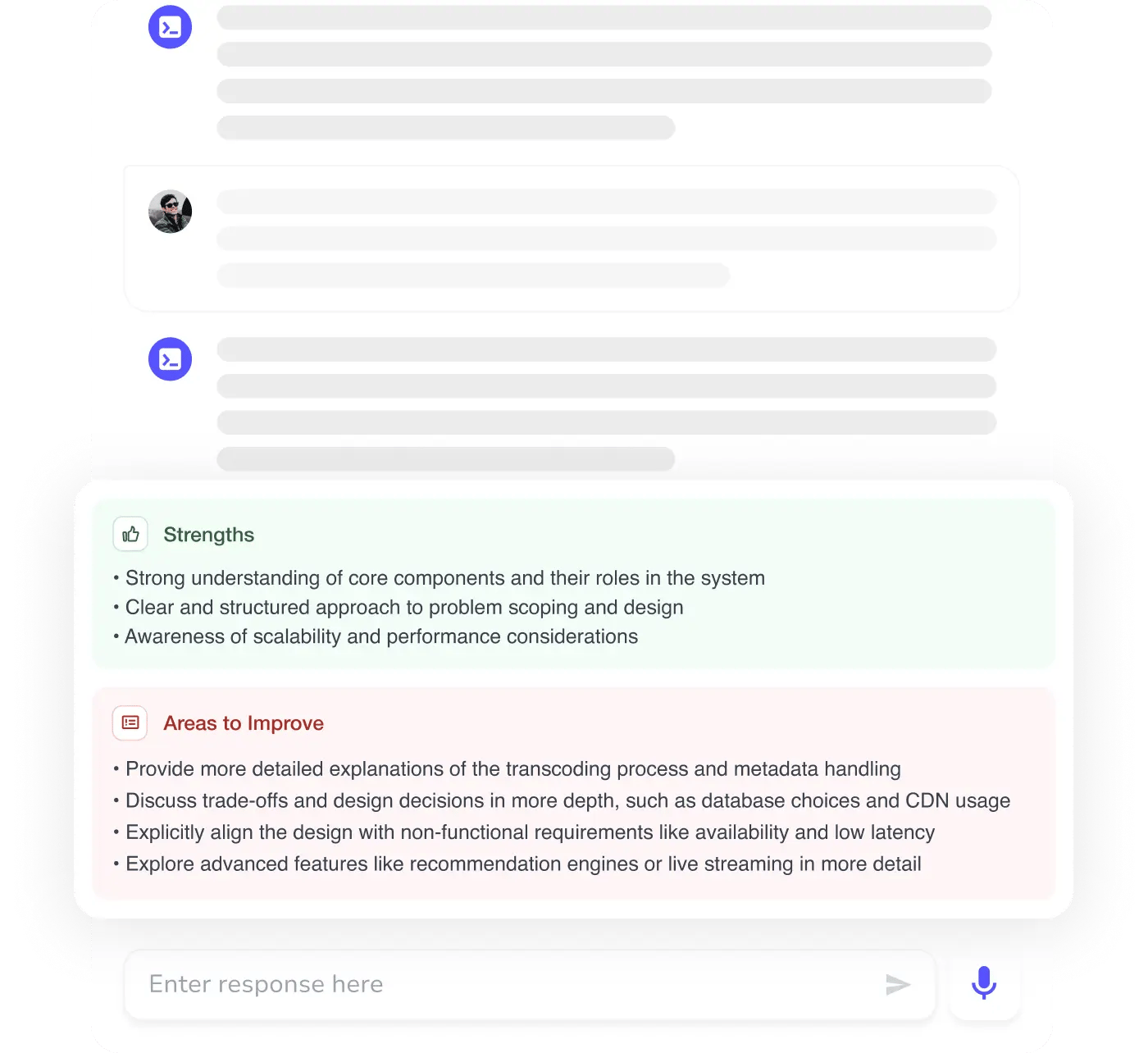
At the end of each chapter, take an AI-driven mock interview. Practice under real conditions and strengthen your ability to explain solutions clearly.
Put Your Skills to the Test
Wrap up your preparation in the Challenge Yourself section, where problems are presented without pattern labels. This sharpens your ability to recognize the right approach on your own, just like in a real interview.
Learning Roadmap
1.
Two Pointers
Introduction to Two Pointers
Valid Palindrome
3Sum
med
Remove nth Node from End of List
med
Sort Colors
med
Reverse Words in a String
med
Valid Word Abbreviation
Valid Palindrome II
Lowest Common Ancestor of a Binary Tree III
med
Strobogrammatic Number
Minimum Number of Moves to Make Palindrome
hard
Next Palindrome Using Same Digits
hard
Count Subarrays With Fixed Bounds
hard
Find the Lexicographically Largest String From Box II
hard
Get the Maximum Score
hard
Create Maximum Number
hard
Append Characters to String to Make Subsequence
med
Squares of a Sorted Array
Reverse String
Intersection of Two Linked Lists
Partition Labels
med
Remove Element
String Compression
med
Rotate Array
med
Next Permutation
med
Remove Duplicates from Sorted Array
Reverse Vowels of a String
Is Subsequence
Merge Strings Alternately
Compare Version Numbers
med
Move Zeroes
med
Longest Subarray of 1's After Deleting One Element
med
Backspace String Compare
med
Next Greater Element III
med
Rotating the Box
med
Count the Number of Fair Pairs
med
Remove Duplicates from Sorted List II
med
Sum of Square Numbers
med
2.
Fast and Slow Pointers
Master the steps to use fast and slow pointers for cycle detection and mid-point identification.
3.
Sliding Window
4.
Intervals
Solve problems in merging intervals, inserting and finding intersections of intervals, scheduler tasks, and determining employee free time.
5.
In-Place Manipulation of a Linked List
Tackle in-place linked list manipulations for efficient and memory-optimized operations.
6.
Two Heaps
7.
K-way Merge
Learn how to use k-way merge for efficient data merging and finding k-th small elements.
8.
Top K Elements
Walk through the top k elements pattern and learn efficient selection using heaps.
9.
Modified Binary Search
10.
Subsets
Grasp the fundamentals of generating subsets, permutations, and combinations.
11.
Greedy Techniques
12.
Backtracking
13.
Dynamic Programming
14.
Cyclic Sort
Step through cyclic sort concepts to efficiently handle various missing and corrupt number scenarios.
15.
Topological Sort
16.
Sort and Search
17.
Matrices
18.
Stacks
19.
Graphs
20.
Tree Depth-First Search
21.
Tree Breadth-First Search
22.
Trie
Step through efficient trie implementations to optimize search suggestions, word replacements, and common prefix finding.
23.
Hash Maps
24.
Knowing What to Track
25.
Union Find
Enhance your skills in Union-Find to address diverse graph and connectivity problems.
26.
Custom Data Structures
Dig into creating and implementing custom data structures for solving specialized problems efficiently.
27.
Bitwise Manipulation
28.
Math and Geometry
29.
Challenge Yourself
Test your understanding of various coding challenges focusing on algorithm efficiency.
Course Author:
Developed by MAANG Engineers
ABOUT THIS COURSE
For a long time, preparing for a coding interview has felt like an endless loop, with hundreds of problems, countless edge cases, and no clear sense of progress. But if you look closely at how top companies design their interviews, a pattern emerges. These interviews aren’t testing how many questions you’ve practiced. They’re testing whether you can recognize underlying structures and apply the right approach in real time.
That insight is what shaped Grokking the Coding Interview Patterns. The course is built around a simple idea: most coding interview questions are variations of a limited set of coding interview patterns. Instead of treating every problem as new, you learn how to group problems by pattern and solve them using a repeatable strategy. This shift, from memorization to recognition, is what allows candidates to move faster and think more clearly during interviews.
In Grokking the Coding Interview Patterns, each concept is introduced with its intuition first, then reinforced through progressively challenging problems. You’ll see how patterns like sliding window, two pointers, and fast & slow pointers show up across different question types.
The course is fully hands-on, with interactive exercises and implementations in JavaScript, C++, Java, and Go, so you can practice in the language you’ll actually use. This approach has helped a large number of developers prepare more efficiently and perform better across interview rounds at companies like Google, Meta, and Amazon. If you want a structured way to prepare and truly grok the coding interview, this course gives you a clear path forward.
ABOUT THE AUTHOR
Fahim ul Haq
Software Engineer, Distributed Storage at Meta and Microsoft, Educative (Co-founder & CEO)
Trusted by 3 million developers working at companies
H
Hitham basheir
Learner
M
Mina b.
Kona Software Lab Ltd
A
Ashraf
Learner
S
Sumit S
Learner
Built for 10x Developers
No Passive Learning
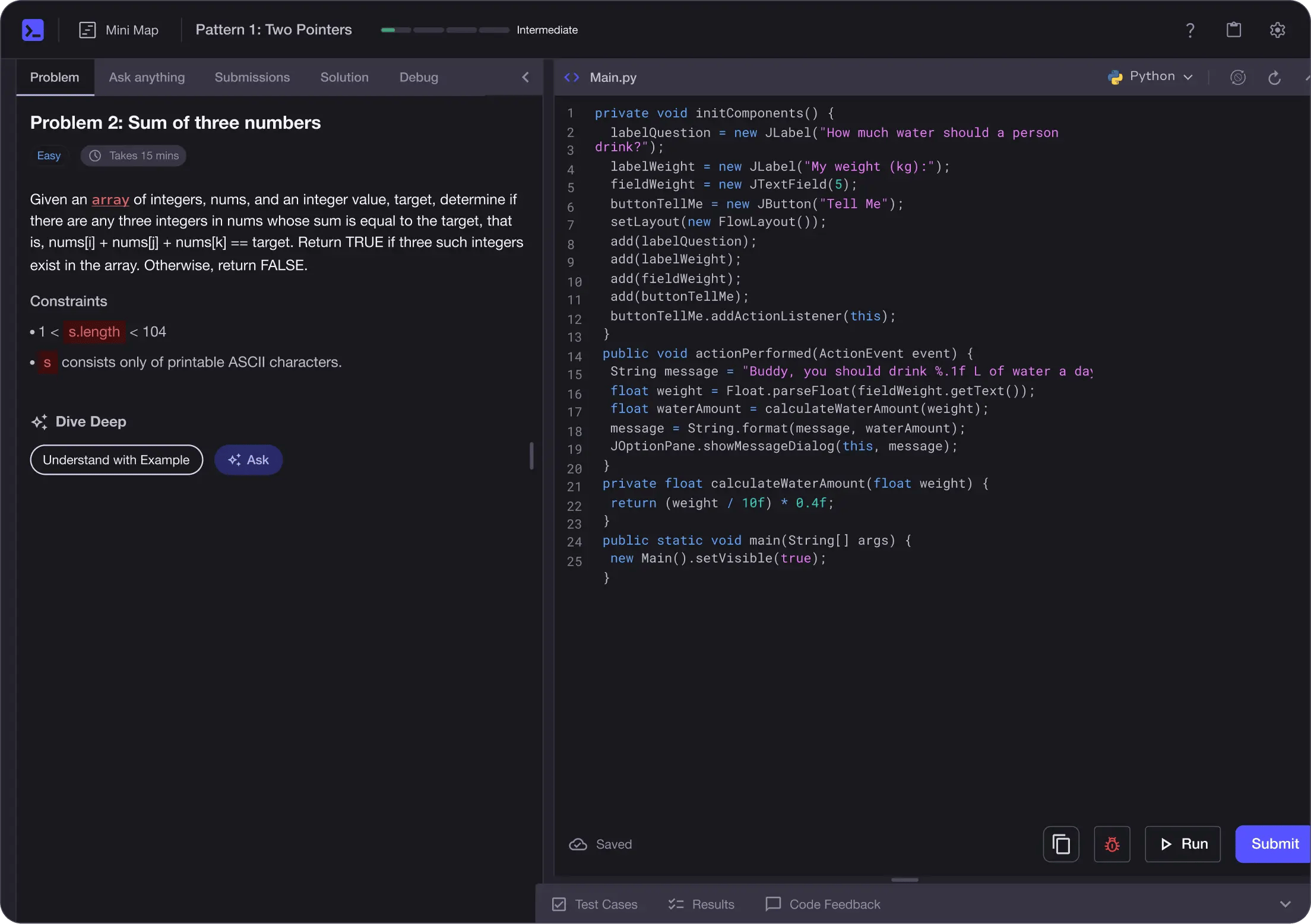
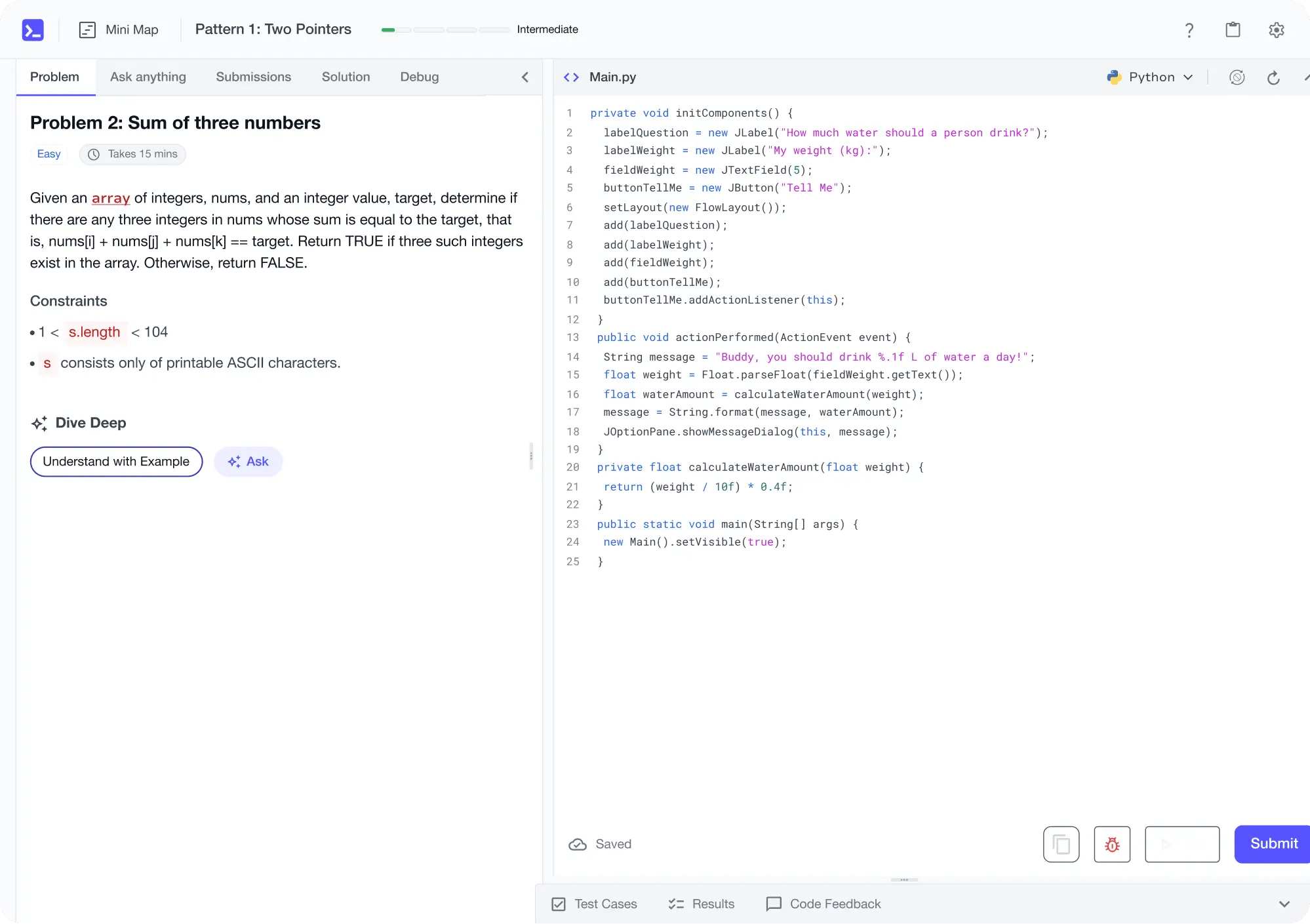
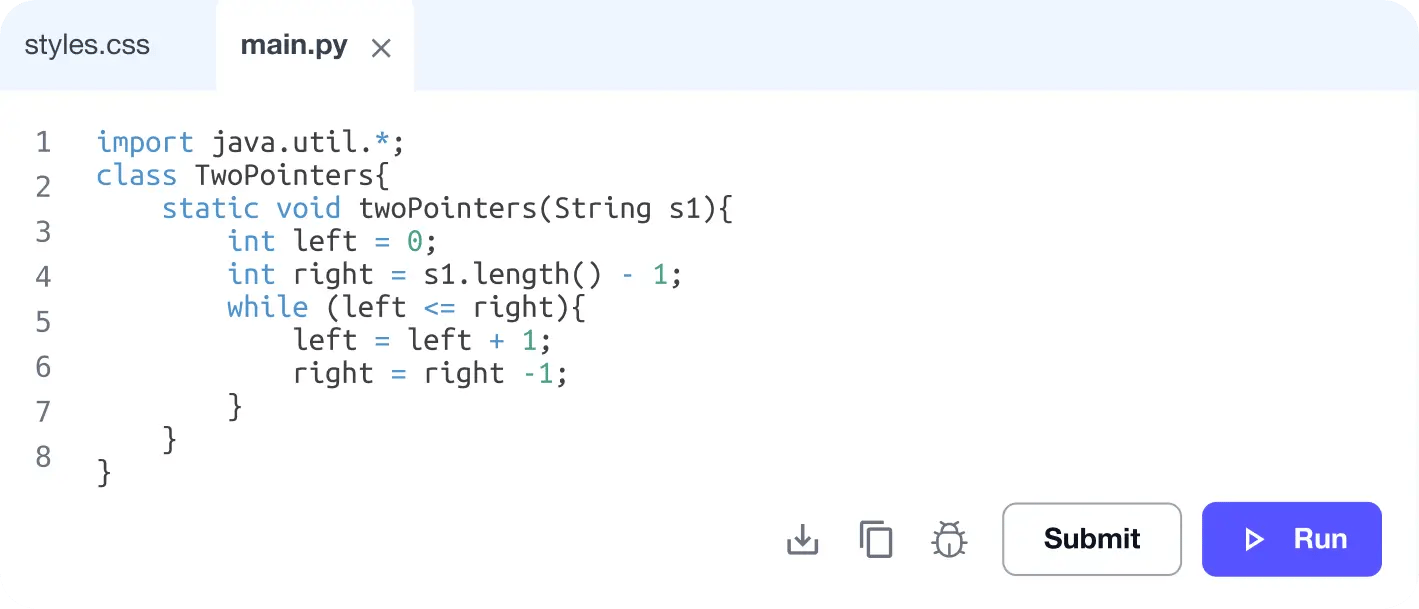
Learn by building with project-based lessons and in-browser code editor
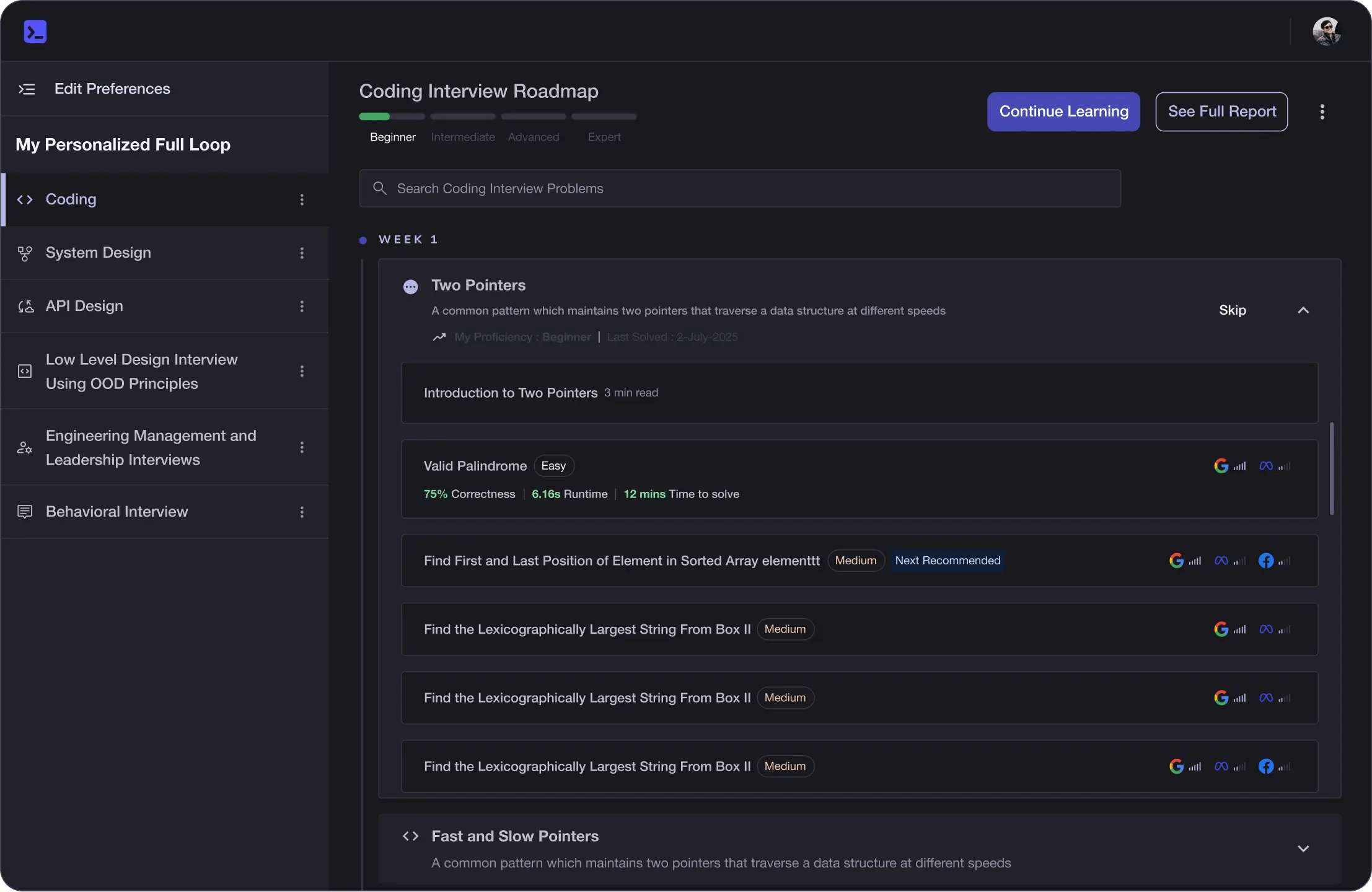
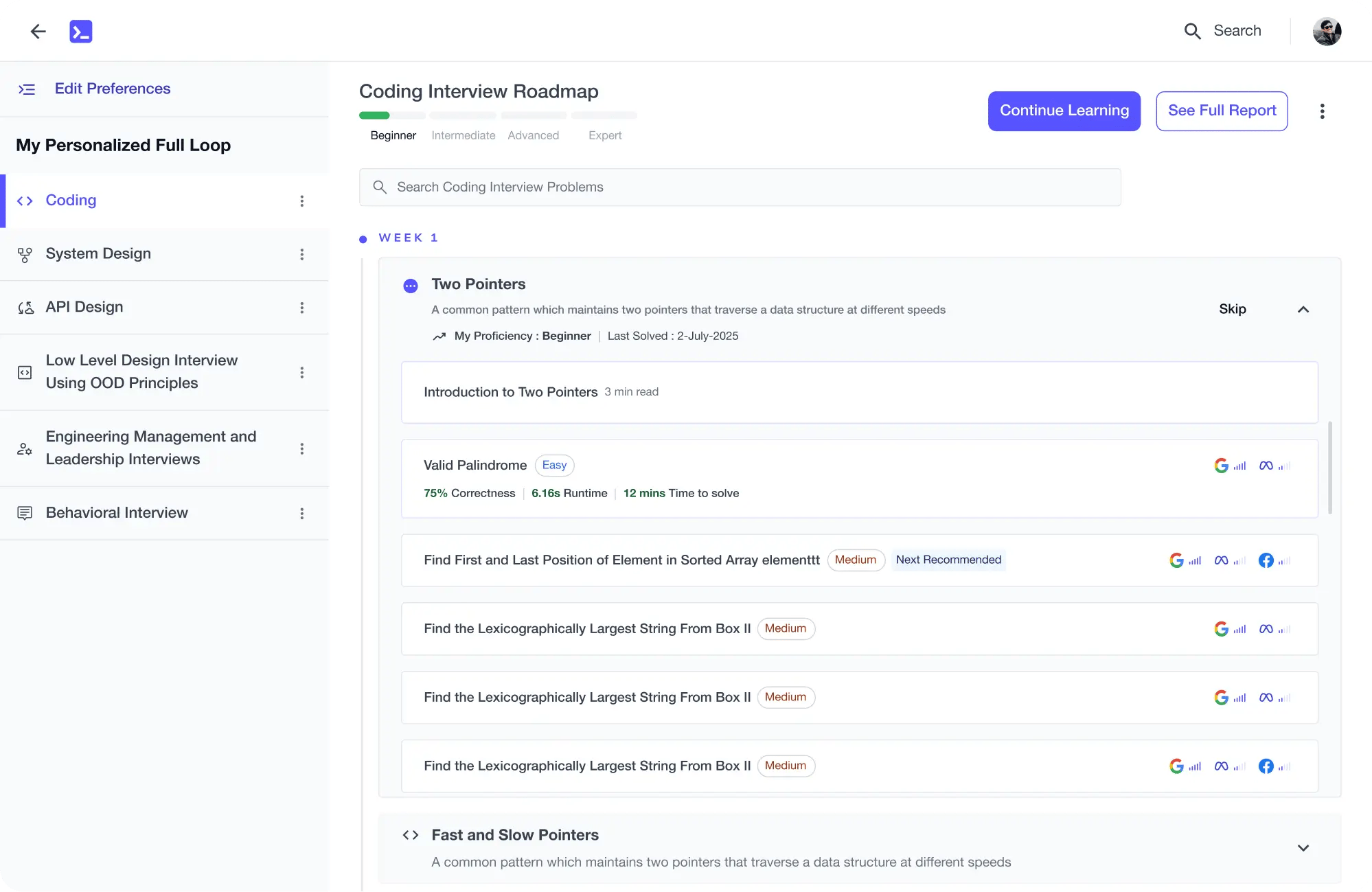
Personalized Roadmaps
The platform adapts to your strengths & skills gaps as you go
Future-proof Your Career
Get hands-on with in-demand skills
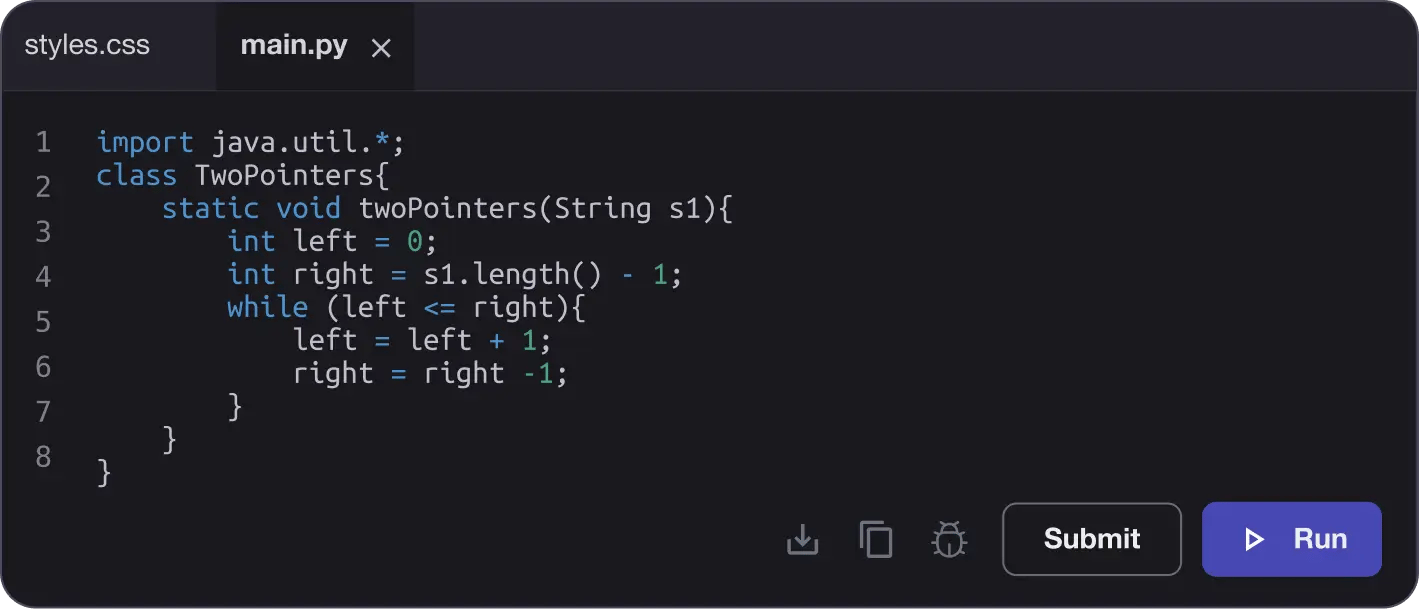
AI Code Mentor
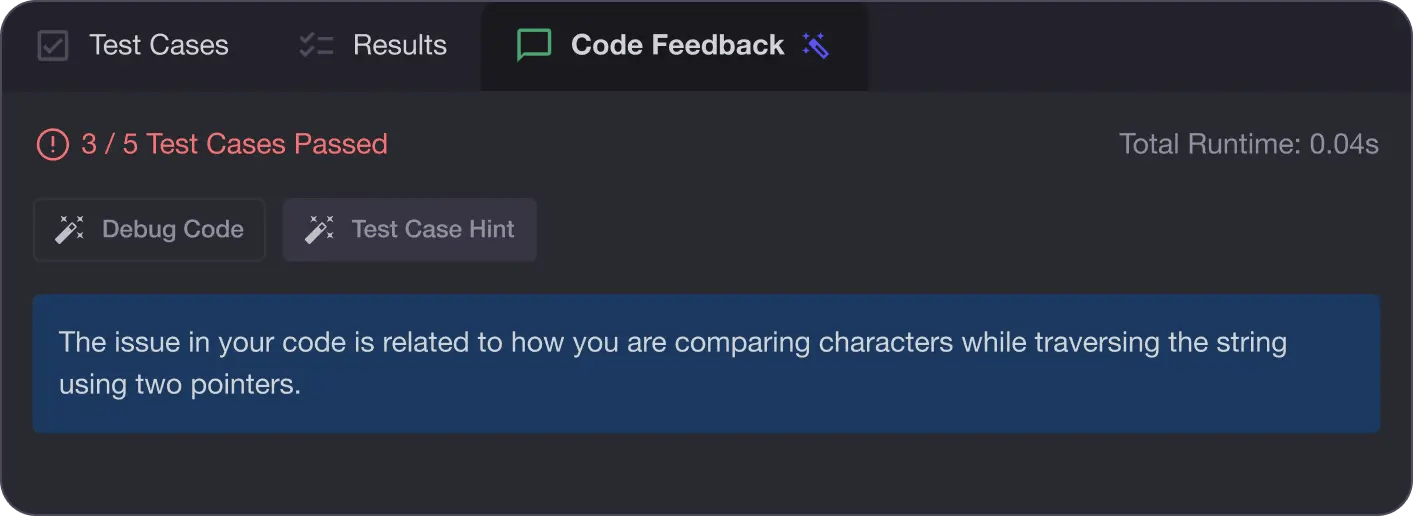
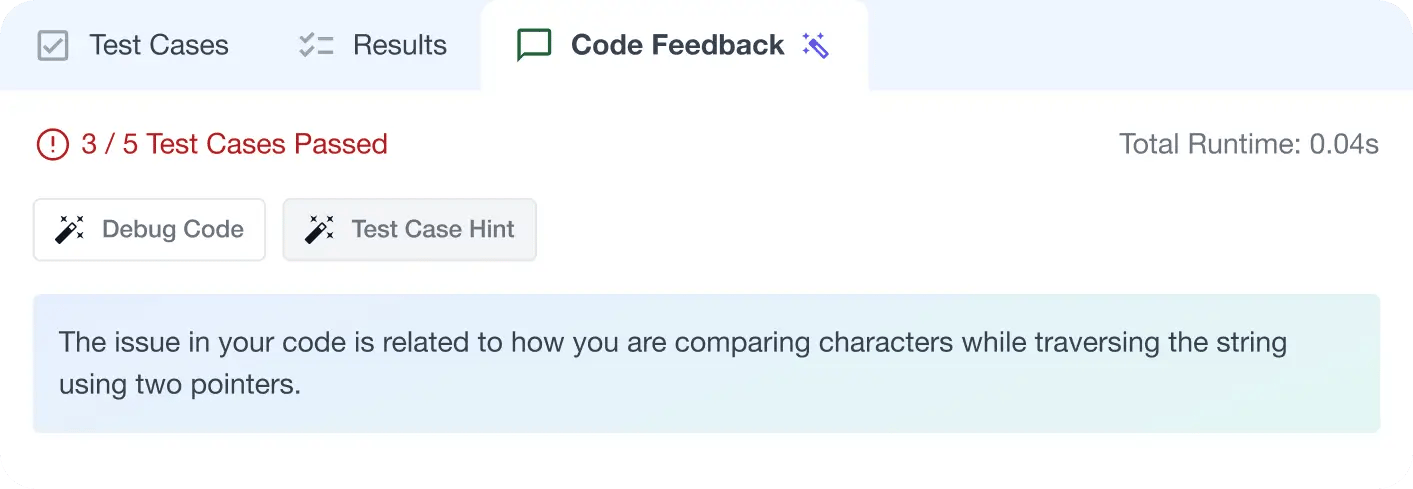
Write better code with AI feedback, smart debugging, and "Ask AI"
MAANG+ Interview Prep
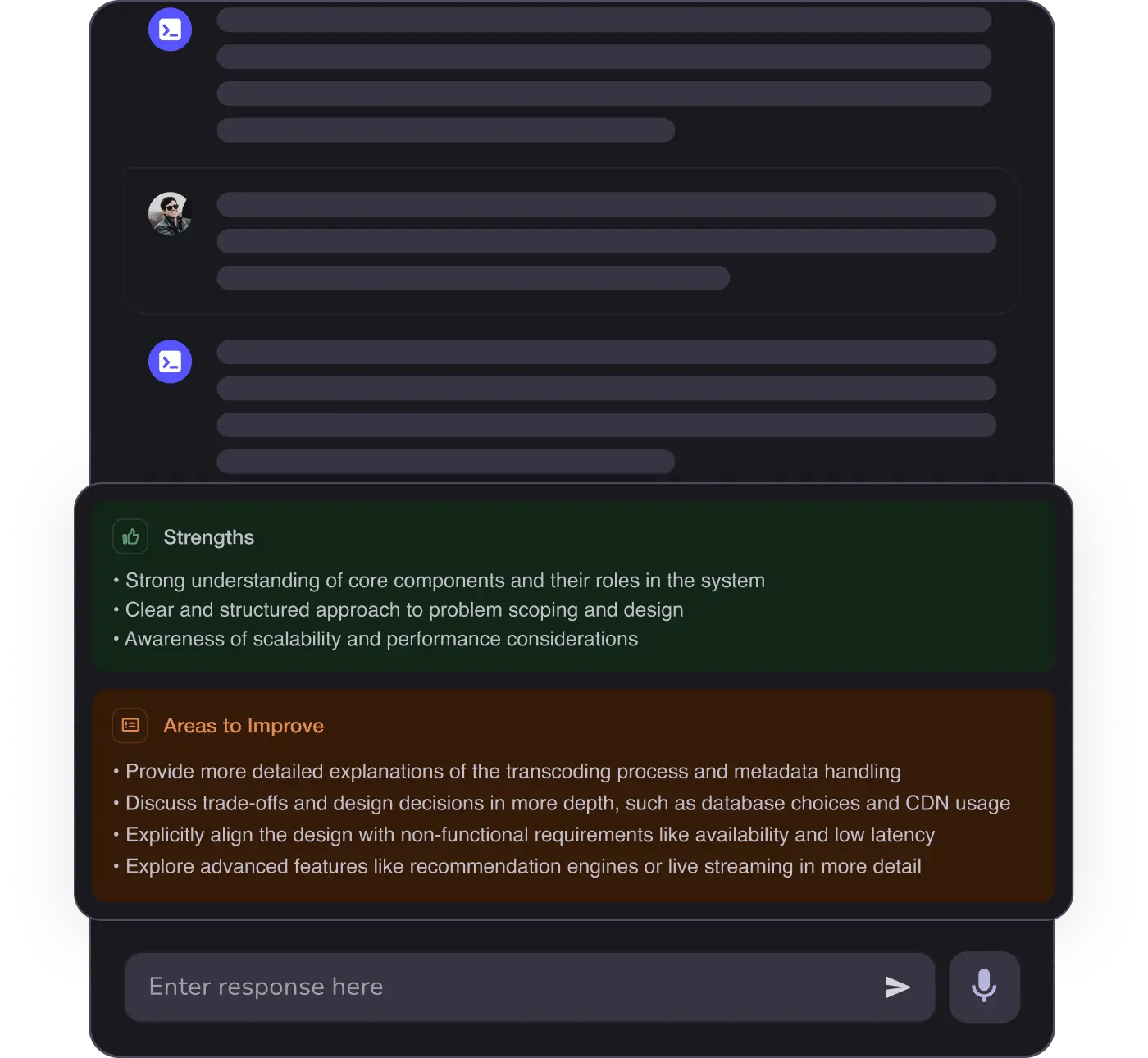
AI Mock Interviews simulate every technical loop at top companies
Free Resources
Frequently Asked Questions
Is Python good for coding interviews?
How to crack Python coding interviews?
Which is better for Python, HackerRank, or LeetCode?
Does Google allow Python in coding interviews?
How many problems are in grokking the coding interview?