Essential skills required for a Java full stack developer
This blog shows that the key skills for a Java full stack developer are understanding system behavior, data flow, and how frontend, backend, and databases work together.
When you first hear about full stack development, it’s easy to imagine it as “knowing everything.” You picture someone equally comfortable writing backend APIs in Java, building frontend interfaces, managing databases, and deploying systems. At first, it sounds like a checklist of technologies you need to master before you can call yourself a full stack developer.
But once you start working on real applications, that idea quickly breaks down. You realize that the role is not about mastering every tool in isolation, but about understanding how those tools connect to form a working system. The real challenge is not knowing everything—it’s knowing how everything works together.
The answers you are looking for lies in understanding how real systems are built, maintained, and evolved. In this article, we’ll explore that perspective by walking through how full-stack developers operate across the entire application lifecycle.
This course is your detailed guide to the fundamentals of the Java programming language. This course will get you on the fast track to becoming a proficient and modern Java developer. In this course, you will start by covering different programming paradigms like object-oriented and procedural programming. You will then cover the fundamentals of programming in Java such as: objects and data types, variables, arrays, and conditional statements. In the latter half of the course, you will cover iterative constructs, useful algorithms, and data structures. With over 100 problems, 11 quizzes, and 9 challenges, this course will get you prepared for a career in software development.
How a real Java full stack application works end-to-end#
To understand the role, you need to start with how a real application behaves. When a user interacts with a web application, their action—clicking a button or submitting a form—triggers a chain of events. The browser sends a request to the backend, the backend processes it, interacts with the database if needed, and then returns a response that updates the user interface.
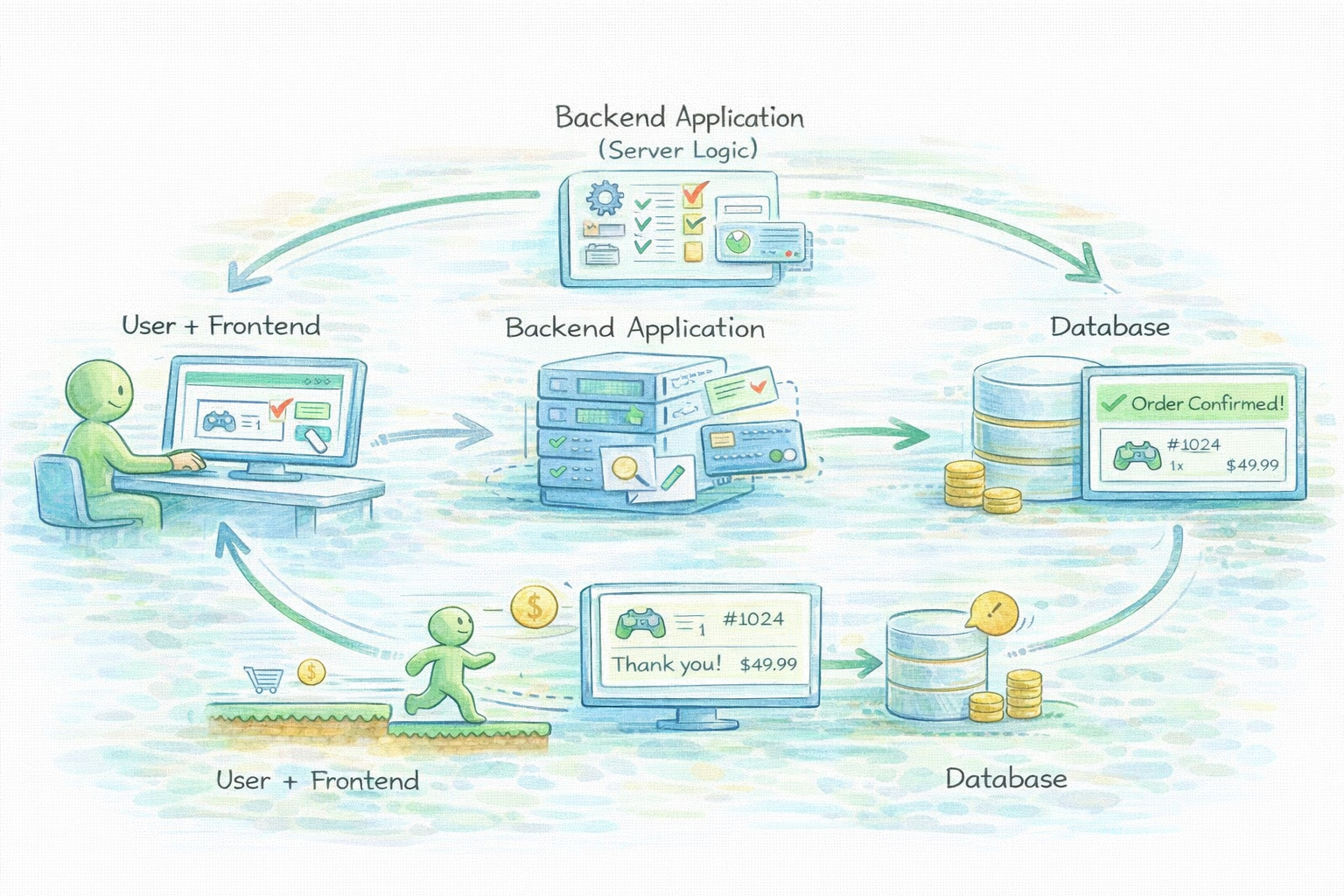
Each part of this flow contributes to the final experience. The frontend determines how intuitive and responsive the application feels. The backend ensures that the logic is correct and scalable. The database stores and retrieves information reliably. None of these layers operate independently—they are tightly connected.
Imagine a simple action like placing an order in an e-commerce app. The frontend captures the user’s input, the backend validates the order and processes payment logic, and the database records the transaction. If any part of this chain fails or behaves incorrectly, the entire experience breaks down. This interconnected flow is what defines full stack development.

This Skill Path begins with Java basics and explores topics like object-oriented programming and data structures. Next, you’ll cover Java programming, including core concepts and object-oriented principles. Finally, you’ll learn about algorithms, data structures, and software development practices. The Skill Path concludes with practical projects and coding challenges to prepare you for a programming career.
Understanding the essential skills required for a Java full-stack developer through workflow#
When you step back and look at the system as a whole, it becomes clear that skills emerge from responsibilities within a workflow. Instead of thinking in terms of frontend or backend skills, you start thinking in terms of how data flows through the system and how different layers interact.
You need to understand how user actions translate into backend operations, how those operations affect data, and how the results are presented back to the user. Each step requires a different kind of thinking, but they all connect.
The rest of your development journey builds on this idea. You are not just writing code—you are managing the flow of information and behavior across the system. This perspective helps you see beyond individual technologies and focus on how the system works as a whole.
In today’s digital world, web development skills unlock endless opportunities. This Skill Path is your step-by-step guide to becoming a full stack developer, from building responsive websites to creating dynamic web applications. You’ll start with HTML and CSS, mastering structure, layouts, and responsive design, then apply your skills by designing a movie order page. Next, you’ll explore JavaScript fundamentals, functions, arrays, objects, DOM, events, and async patterns, followed by Bootstrap 5 for grids, utilities, forms, and real-world projects like a registration form and health tracker. You’ll then dive into React, learning components, hooks, and routing, before moving on to Node.js and Express for servers and REST APIs, and MongoDB for data modeling and queries. Finally, you’ll bring it all together in full stack development, building scalable apps with authentication, and complete a capstone MERN e-learning platform to showcase your skills.
Writing backend logic that supports real use cases#
On the backend, your role is to implement business logic that reflects real-world requirements. Using Java, you define how the system processes requests, enforces rules, and interacts with other services. This is where frameworks come into play, shaping how your application is structured and how components interact.
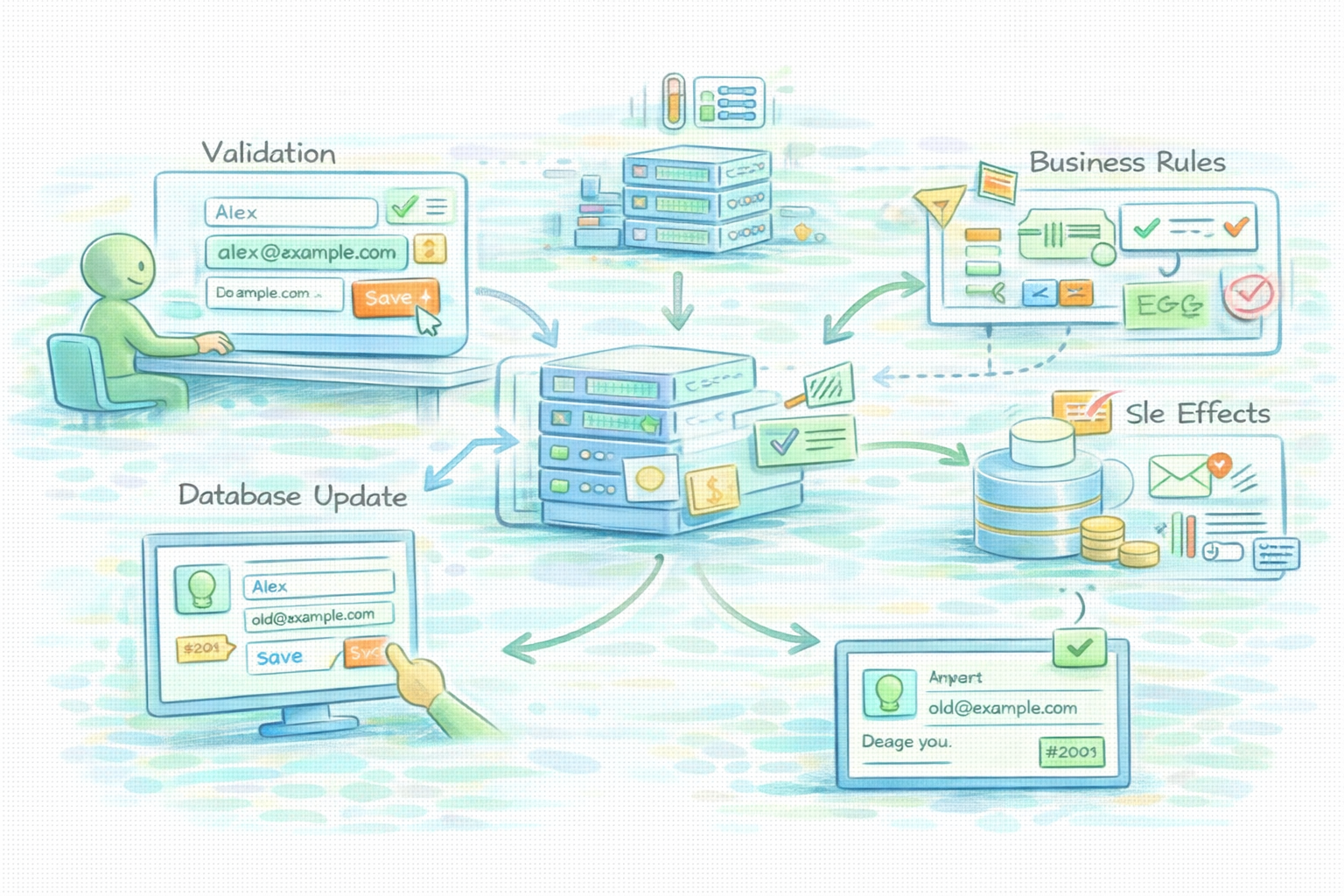
For example, consider a feature where users can update their profile information. The backend must validate the input, ensure that the data is consistent, and update the database accordingly. It might also trigger additional actions, such as sending notifications or logging changes.
What makes this challenging is not the code itself, but the context in which it operates. You need to consider how your logic handles edge cases, how it performs under load, and how it integrates with other parts of the system. This level of thinking is what distinguishes real-world backend development from simple coding exercises.
Handling user interaction and frontend behavior#
The frontend is where users experience your system, and it plays a critical role in shaping that experience. It translates user actions into requests that the backend can understand and processes responses to update the interface dynamically.
However, frontend development is not just about visuals. It involves understanding how users interact with the system and how those interactions affect the underlying logic. For example, a poorly designed form might lead to invalid inputs, increasing the complexity of backend validation.
This creates a feedback loop between frontend and backend. Decisions made on the frontend can simplify or complicate backend logic, and vice versa. As a full stack developer, you need to understand both sides of this relationship to build systems that are efficient and user-friendly.
Managing data flow and persistence#
Data is at the core of any application, and managing it effectively is a critical part of full stack development. You need to understand how data is stored, retrieved, and updated across the system, as well as how it flows between different components.
This involves more than just writing database queries. You need to think about data consistency, relationships between entities, and how changes propagate through the system. For example, updating a user’s profile might affect multiple tables or services.
Consider a scenario where a user updates their email address. The change must be reflected in the database, validated across the system, and possibly propagated to other services. Handling this correctly requires a clear understanding of how data moves through the system and how different layers interact.
Workflow comparison across responsibilities#
Responsibility | Focus | Key concern |
Handling user interaction | Capturing and responding to user input | Usability and responsiveness |
Processing backend logic | Implementing business rules and workflows | Correctness and scalability |
Managing data and persistence | Storing and retrieving information | Consistency and reliability |
This table highlights how different responsibilities focus on different aspects of the system. While each area has its own priorities, they are deeply interconnected. A change in one layer often affects the others, requiring you to think across boundaries.
As a full stack developer, you move between these areas regularly. You might start by adjusting a frontend component, then update backend logic to support it, and finally modify the database schema. This fluid movement is what defines the role and requires a holistic understanding of the system.
Debugging and problem-solving across the stack#
One of the most important aspects of full stack development is debugging. Problems rarely exist in isolation—they often span multiple layers of the system. A bug might appear in the UI, but its root cause could be in the backend or database.
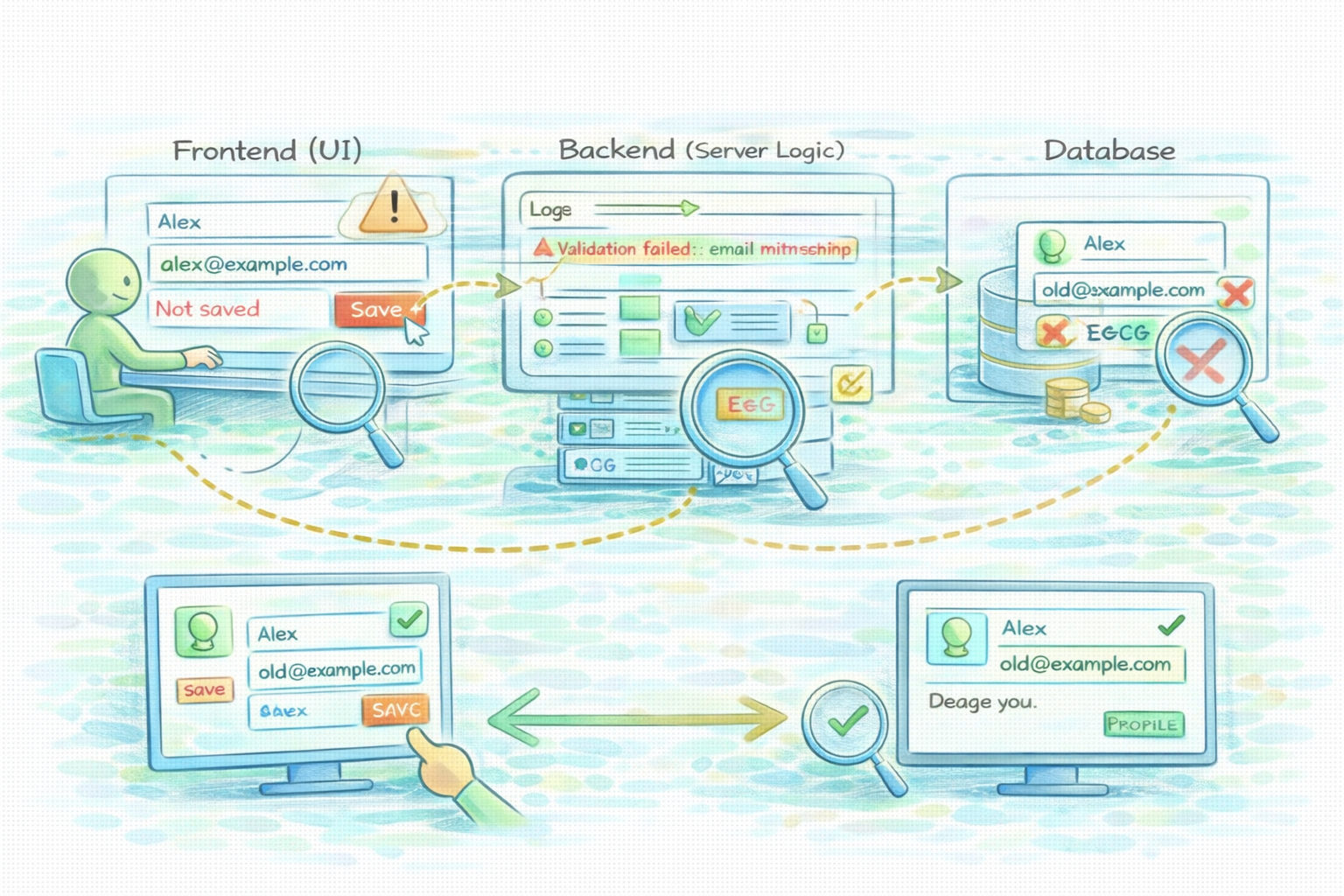
To resolve such issues, you need to trace the flow of data and behavior across the system. This involves understanding how requests are processed, how data is transformed, and where things might go wrong. It requires both technical knowledge and investigative thinking.
For example, if a user reports that their profile updates are not saving, you need to check the frontend request, the backend validation logic, and the database operation. Each step provides clues, and your ability to connect them determines how quickly you can resolve the issue.
Thinking in terms of system behavior, not just code#
As you gain experience, your focus shifts from writing code to understanding system behavior. You start thinking about performance, latency, and how users experience the application. Small decisions, such as how data is fetched or how requests are handled, can have a significant impact on the system.
This perspective is essential for building scalable and reliable applications. You need to consider how your code behaves under load, how it interacts with other components, and how it affects the overall system.
It’s not just about coding—it’s about understanding how systems behave and making decisions that improve that behavior.
Common misconceptions about full stack development#
There are several misconceptions that can make the role seem more intimidating than it actually is. One common belief is that you need to master every technology deeply. In reality, what matters more is understanding how technologies fit together and how to use them effectively.
Another misconception is that full stack developers must divide their time equally between frontend and backend. In practice, your focus may shift depending on the needs of the project. Some tasks require more backend work, while others emphasize frontend or data management.
There is also a tendency to believe that learning frameworks alone is enough. While frameworks are important, they are just tools. The real skill lies in understanding how to use them to solve problems and build systems that work in real-world conditions.
How developers grow into full stack roles over time#
Becoming a full stack developer is not something that happens overnight. It is a gradual process of expanding your understanding and taking on more responsibility across different layers of the system. You might start as a backend developer and slowly gain exposure to frontend work, or vice versa.
This growth often happens through real projects. As you encounter new challenges, you learn how different parts of the system interact and how to solve problems that span multiple layers. Debugging, feature development, and system design all contribute to this learning process.
Over time, you develop a broader perspective. You start to see the system as a whole rather than as separate components. This shift in thinking is what allows you to operate effectively as a full stack developer.
Wrapping up#
The skills required for a Java full-stack developer is in understanding how systems are built and how they behave. It’s about connecting user interaction, backend logic, and data flow into a cohesive application.
By focusing on workflows, problem-solving, and system thinking, you can develop the skills that truly matter. Instead of trying to learn everything at once, focus on building and understanding complete applications.
Happy learning!
