You’ve been invited to Airbnb’s home, not as a guest but as an aspiring host. The interview is your chance to prove you can build the systems that make millions of guests feel like they belong anywhere. Before you reach the front door, you need the right key: a rock-solid foundation in data structures and algorithms, and the ability to clearly and confidently share your solution.
The question is, what will take you to the key? Is it the streamlined and highly curated path of lists like Blind 75 and NeetCode 150, or the deeper and methodical understanding of core LeetCode coding patterns?
Grokking the Coding Interview Patterns

I created Grokking the Coding Interview because I watched too many talented engineers fail interviews they should have passed. At Microsoft and Meta, I saw firsthand what separated the candidates who succeeded from the ones who didn't. It wasn't how many LeetCode problems they'd solved. It was whether they could look at an unfamiliar problem and know how to approach it the right way. That's what this course teaches. Rather than throwing hundreds of disconnected problems at you, we organize the entire coding interview around 28 fundamental patterns. Each pattern is a reusable strategy. Once you understand two pointers, for example, you can apply them to dozens of problems you've never seen before. The course walks you through each pattern step by step, starting with the intuition behind it, then building through increasingly complex applications. As with every course on Educative, you will practice in a hands-on way with 500+ challenges, 17 mock interviews, and detailed explanations for every solution. The course is available in Python, Java, JavaScript, Go, C++, and C#, so you can prep in the language you'll actually use in your interview. Whether you're preparing for your first FAANG loop or brushing up after a few years away from interviewing, this course will give you a repeatable framework for cracking the coding interview.
In this blog, I will compare NeetCode 150 and Airbnb’s top 62 problems against the 28 LeetCode patterns from Grokking the Coding Interview Patterns. More importantly, I will show you a smarter Airbnb prep roadmap that goes beyond rote memorization, helping you practice strategically and stand out in an interview where your code must be correct and scalable.
A sneak peek at what really works for Airbnb interviews#
The truth about Airbnb interview prep is knowing what works without a structured evaluation. That is why I rely on a consistent scoring rubric introduced in the first blog, NeetCode 150 vs. LeetCode patterns, of this series to measure how much each approach contributes toward complete preparation.
The rubric is simple. To consider a pattern well covered, you need to solve 1 easy problem (1 point), 2 medium problems (4 points each), and 1 hard problem (6 points) for a total of 15 points. With 28 patterns in scope, the full benchmark adds up to 420 points.

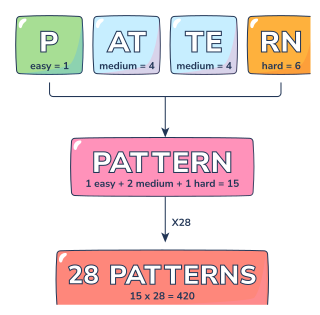
Now, let’s see how NeetCode 150 stacks up when tested against this benchmark in the context of Airbnb interviews.


The score chart above only gives a surface-level snapshot. The real insights come from looking deeper into which patterns strengthen at each stage, which gaps remain, and how the Airbnb-focused roadmap guides you toward closing those gaps. That is exactly what we will explore in this blog, so you can structure your prep to maximize your chances of stepping into an Airbnb interview fully prepared.
Overview of NeetCode 150, Airbnb top 62, and LeetCode patterns#
NeetCode 150 is a highly curated list of 150 essential coding problems from LeetCode. It is designed to cover all major algorithmic patterns and data structures tested in technical interviews, specifically MAANG coding interviews.
Airbnb top 62 is a community-driven collection of LeetCode problems that are reported to be frequently asked during Airbnb’s technical interviews. Unlike a structured curriculum, this list is a snapshot of real-world interview questions. The list is valuable for targeted, company-specific practice.
LeetCode patterns are not a specific list of questions but a classification of problems based on the underlying algorithm or data structure required for an optimal solution. Think of them as a set of blueprints for solving different coding challenges. Understanding the coding patterns allows a candidate to solve various problems by recognizing the core principle, rather than memorizing solutions for individual questions.
Is NeetCode 150 enough for cracking Airbnb coding interviews?#
NeetCode 150 is an excellent primer on the core data structures and algorithms that form the foundation of most technical interviews. However, for a company like Airbnb, which values innovation and real-world problem-solving, relying on a static list of 150 problems poses a considerable risk.
The times have changed, and so has the interview landscape. No matter how well curated, a fixed list cannot keep pace with the dynamic nature of modern interviews. With AI at their fingertips, interviewers can generate subtle variations of classic problems or new questions designed to test true understanding, not just memorization. If you only practice the problems without grasping the underlying patterns, you may struggle to handle a clever twist on a familiar question.
NeetCode 150 is a good place to start your journey, but should not be your final destination.
How do LeetCode patterns help with Airbnb coding interviews?#
LeetCode patterns provide the most adaptable framework for tackling Airbnb’s unique and evolving interview questions. Instead of memorizing solutions to a static list, learning the patterns teaches you the fundamental methods for solving entire categories of challenges. This is especially important for a company that often designs questions with real-world aspects.
Understanding the underlying patterns can translate any new problem into a familiar solution. For instance, a question about finding available dates might map to an Intervals problem, while a search feature could require knowledge of Tries. This approach ensures you are prepared for many problems that test your problem-solving skills rather than your memory.
Patterns also improve the way you explain your solution. Instead of walking the interviewer through code line by line, you can confidently frame your approach around a recognizable strategy. Saying “this is a sliding window problem” or “we can solve this with backtracking” immediately demonstrates clarity of thought and a strong grasp of fundamentals.
In short, LeetCode patterns prepare you to solve problems not just in a traditional way but also in the Airbnb way: with clarity, adaptability, and confidence.
Overview of LeetCode patterns for Airbnb coding interviews#
With 28 LeetCode patterns, it can feel overwhelming to know where to start. To make Airbnb-focused preparation more structured, I’ve organized them into four practical categories:

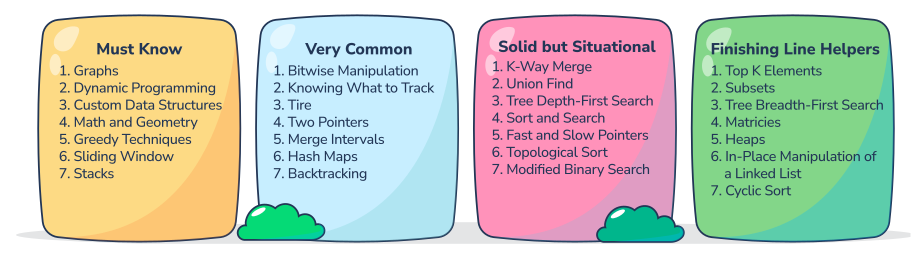
Must-know patterns: These frequently appear in Airbnb interviews and form the foundation of your preparation.
High-value patterns: These appear often enough that mastering them adds depth and helps you solve efficiency-driven problems with confidence.
Solid but situational patterns: These are less common but still important to handle unique twists when they arise.
Finishing-line helpers: These are rare in interviews, yet worth covering so that no problem type feels completely unfamiliar.
Airbnb may emphasize certain patterns more than others, but getting exposure to all 28 ensures balanced preparation and minimizes surprises.
The Airbnb-focused prep roadmap with 28 LeetCode patterns#
The key to Airbnb interview prep is not endless practice, but a roadmap that builds the right skills step by step. By structuring your preparation in stages, you can expand your coverage methodically and align with the problem-solving style Airbnb interviewers expect. Here is how NeetCode 150, Airbnb’s top 62, and the 28 coding patterns come together into a focused strategy.
Start with the NeetCode-Airbnb overlap: These shared problems give you the quickest, strong foundation. They reinforce the fundamentals while directly reflecting challenges Airbnb is likely to test.
Add the Airbnb-only set: This stage introduces problems that capture Airbnb’s distinct aspect.
Work through the rest of NeetCode 150: Covering the remainder ensures your prep is not too narrow. It broadens your fundamentals, i.e., the core knowledge expected at any top-tier company.
Fill in the missing patterns: Finally, confirm that all 28 patterns are covered. Closing these gaps reduces the risk of being surprised by an unfamiliar variation and completes your preparation.
Use the 1–2–1 rubric throughout this road map to balance your practice across easy, medium, and hard problems. This approach helps you gain a deep understanding and a broad range of skills to confidently tackle Airbnb coding interviews.


Why start with the NeetCode and Airbnb overlapping questions?#
Starting your preparation with the overlapping questions between NeetCode 150 and the Airbnb top 62 is the most strategic and time-efficient approach. These shared problems give you two advantages: they cover Airbnb’s proven question style while reinforcing the core patterns NeetCode 150 was designed to teach. This focused start gives you an immediate confidence boost, proving that your general preparation directly applies to your specific goal.
Let’s look at the problems common to NeetCode 150 and Airbnb’s top 62.
NeetCode 150 (Problem Name) | Airbnb Top 62 (Problem Name) |
Trapping Rain Water | Trapping Rain Water |
Add Two Numbers | Add Two Numbers |
Cheapest Flights Within K Stops | Cheapest Flights Within K Stops |
Regular Expression Matching | Regular Expression Matching |
Text Justification | |
Maximum Profit in Job Scheduling | |
Encode and Decode Strings | Palindrome Pairs |
. . . | . . . |
Shopping Offers | |
Making A Large Island | |
Sum of Two Integers | Shortest Path in Binary Matrix |
The table above shows only 26 problems out of 150 to avoid long scrolling. If you would like to see the complete set of problems for both NeetCode and Airbnb, click the “Show All Problems” button below.
The comparison above shows that 20 problems are common to NeetCode 150 and Airbnb’s top 62. Considering Airbnb’s list size, that is a strong start.
Let’s see what patterns this set covers and how well they are represented according to the 1–2–1 rubric. In the bar chart below, each bar represents a pattern. The length of the bar shows what percent of the full 15 points you’ve earned for that pattern, while the label highlights how many easy, medium, and hard problems went into that score.
Note: I have only considered the counts that satisfy our 1—2—1 rubric for this calculation. If a pattern has more questions than the rubric requires, I count only 1 easy, 2 medium, and 1 hard problem. For example, if Dynamic Programming has 10 medium questions, I have included just 2 in this calculation.


The chart above shows that the overlapping problems between NeetCode 150 and Airbnb’s top 62 introduce 13 new patterns, about 46%. This is an important milestone because you know nearly half the patterns.
One of these patterns is already in the green zone (well covered), while others, like Two Pointers, Sliding Window, Trie, and Graphs, are not yet fully covered and need more practice. The good part is that you can close these gaps by focusing on them through the 1–2–1 rubric.
Why should you practice the Airbnb-specific coding interview problems next?#
After you’ve built your foundational skills with the overlapping questions, the next step is to practice the remaining Airbnb-specific problems to gain a crucial edge. This phase shifts you from general knowledge to targeted application.
Practicing these problems is essential because it familiarizes you with Airbnb’s unique interview style. Solving these problems trains you to think within the company’s context and handle the twists and real-world constraints that interviewers love to add.
Let’s see which new patterns are introduced by the Airbnb-specific question set.
The list above shows that the Airbnb-only questions unlock 7 new patterns, totaling 20 out of 28 patterns (about 71%). This solid jump indicates that you are moving in the right direction. Another advantage is that you gain exposure to new patterns and strengthen the ones already introduced earlier.
Now, let’s look at how well the patterns in this set are covered using the 1–2–1 rubric. The bar chart below highlights the newly covered patterns in green on the y-axis.


The chart above shows that the coverage jumps significantly when you add the Airbnb-only problems. More patterns, including graphs and sliding windows, move into the green zone, and the number of yellow bars also increases, representing partially covered patterns. A few are underrepresented in the red zone and need targeted practice.
Why is it important to cover the complete NeetCode 150?#
Covering the complete NeetCode 150 is important because it builds a universal toolkit for your career, not just for a single interview. While the Airbnb-specific list is crucial for targeted practice, completing the full NeetCode 150 ensures you master the full breadth of essential data structures and algorithms. This prevents oversights and allows you to handle any variation an interviewer might present. The comprehensive foundation you gain from the full NeetCode 150 prepares you to succeed in both Airbnb interviews and coding interviews at any top company.
Let’s look at the patterns that the rest of NeetCode 150 brings in.
Pattern |
The list above shows that the remaining problems of NeetCode 150 introduce 8 new patterns, taking the total to 28 out of 28, a full 100%. This is an excellent milestone because you have been exposed to all 28 patterns by this stage, and your Airbnb roadmap is now complete.
Now, let’s see how well the patterns in this set are covered according to the 1–2–1 rubric.


The chart above shows that this step delivers the biggest leap on Airbnb’s roadmap. Most patterns now appear in the green zone (well-covered), giving well-rounded coverage across almost the entire spectrum of the 28 patterns. At this point, only a handful remain underrepresented.
Have you covered all 28 LeetCode patterns for Airbnb interviews by now?#
With each stage adding new strength, you might wonder if the full set of 28 patterns is finally complete. The chart below visualizes your progress against the 28 essential LeetCode patterns, giving you a powerful picture of your prep.


At this stage, the pattern coverage looks very strong. A total of 15 patterns (half) are now in the green zone, meaning they are well covered and interview-ready.
Several others are in the yellow zone, such as In-Place Manipulation of a Linked List, Top K Elements, Knowing What to Track, Bitwise Manipulation, and Math and Geometry. These are partially covered and can be completed with just one hard problem.
The rest fall in the red zone, including Subsets, Matrices, Hash Maps, Heaps, K-way Merge, Sort and Search, Fast and Slow Pointers, and Cyclic Sort. These patterns are still underrepresented and need more targeted practice. To move up, most require just two additional problems of the right difficulty.
The best part is that you are no longer missing any patterns. Every one of the 28 is on your radar now, and with the 1–2–1 rubric in hand, it is straightforward to close the remaining gaps and bring all of them to full strength.
Patterns recap for the Airbnb interview prep#
Let’s recap the pattern coverage of the Airbnb prep roadmap visually. The pie chart below provides a clear, high-level summary of your progress.


The pie chart shows how the three stages of your roadmap contribute to overall pattern coverage.
The NeetCode-Airbnb overlap contributes the most, bringing in about 46% of the patterns at the start. This gives you a strong foundation early in your prep.
The Airbnb-only set adds another 25% of the patterns, capturing the unique aspect of Airbnb’s interview style and pushing your coverage past the halfway mark.
Finally, the remaining NeetCode 150 problems add the last 28%, filling in the gaps and completing the full set of 28 patterns.
The big takeaway is that each stage plays a critical role, but the overlap carries the most weight and sets you on the right path from day one.
How much of the 420 benchmark does the Airbnb roadmap cover?#
After following the strategic Airbnb roadmap, you might wonder how your preparation stacks up against the ultimate benchmark. How much of the 420 score, which represents complete pattern coverage, have you completed? The score chart below reveals the answer and shows where this roadmap stands in raw numbers.


The score chart above shows how your preparation has progressed stage by stage. The overlap between NeetCode 150 and Airbnb’s top 62 contributes 68 points, giving you the first solid base. Adding the Airbnb-only problems boosts your score by another 101 points, which is a big jump and captures Airbnb’s unique problem style. The remaining NeetCode 150 problems add the largest share with 147 points, pushing your total to 316 points out of 420.
That leaves 104 points on the table, which can be earned by strengthening the underrepresented patterns. With the 1–2–1 rubric guiding your practice, closing these gaps and reaching the ideal benchmark is straightforward.
Final verdict: Which approach works best for Airbnb coding interviews?#
The key takeaway is clear: mastering LeetCode patterns is the most valuable skill you can build. Patterns prepare you not only for Airbnb but also for coding interviews at any top tech company. They make it easier to adapt to new problem variations, confidently communicate your thought process, and approach challenges with a structured mindset.
Regarding Airbnb interviews, the best results do not come from NeetCode 150 alone or Airbnb’s top 62 alone. The winning strategy is a blend of both, supported by the 1–2–1 rubric and strengthened through a deep understanding of patterns. This combination gives you the breadth, depth, and adaptability to handle Airbnb’s unique interview style.
Prepare with intention, practice with patterns, and stay confident in your process. With the right roadmap, you are not just getting ready for an interview; you are preparing to open the door to your next big opportunity at Airbnb.
This blog is part of a broader series where I compare NeetCode 150 and LeetCode coding patterns across different companies. If you are preparing for coding interviews at any of these, you might also find the following blogs helpful:
NeetCode 150 vs. LeetCode Patterns: Which is best for Microsoft?
NeetCode 150 vs. LeetCode patterns: Which is effective for Apple?
NeetCode 150 vs. LeetCode patterns: Which prepares you for Amazon
NeetCode 150 vs. LeetCode patterns: What works best for Netflix?
NeetCode 150 vs. LeetCode patterns: Which is better for Google?
Recommended resources to level up your interview prep#
While this blog offers a data-driven way to measure and close your prep gaps, the right learning tools can further accelerate your progress. Here are two highly effective resources to complement your study plan:
Educative’s Personalized Interview Prep: Your tailored prep companion adapts to your skill level and focuses on the 28 essential LeetCode patterns we’ve been discussing. You can work on the patterns that need attention, track progress with clear metrics, and know exactly what to tackle next. Whether it’s adding an easy problem to build confidence or a hard one to push for mastery, you’ll always be working on the right problems at the right time.
Educative’s Mock Interviews: Practicing is not just about solving problems. It is also about handling real interview pressure. Educative’s AI mock interviews let you simulate actual interview conditions, get actionable feedback, and improve in areas like problem-solving speed. This way, you are technically prepared, confident, and ready to perform under time constraints.