NVIDIA is at the forefront of cutting-edge technology. From powering AI breakthroughs like ChatGPT training to driving advancements in autonomous vehicles, gaming, and high-performance computing, its impact is hard to overstate. For ambitious engineers, the appeal is obvious: at NVIDIA, your code doesn’t just run; it shapes the future of entire industries.
That is why preparing for NVIDIA interviews feels so important. You need to be fully ready, so the question is: what helps with that? Should you work through curated problem lists like Blind 75 or NeetCode 150, or focus on mastering LeetCode patterns, which teach you to adapt to any challenge?
Grokking the Coding Interview Patterns

I created Grokking the Coding Interview because I watched too many talented engineers fail interviews they should have passed. At Microsoft and Meta, I saw firsthand what separated the candidates who succeeded from the ones who didn't. It wasn't how many LeetCode problems they'd solved. It was whether they could look at an unfamiliar problem and know how to approach it the right way. That's what this course teaches. Rather than throwing hundreds of disconnected problems at you, we organize the entire coding interview around 28 fundamental patterns. Each pattern is a reusable strategy. Once you understand two pointers, for example, you can apply them to dozens of problems you've never seen before. The course walks you through each pattern step by step, starting with the intuition behind it, then building through increasingly complex applications. As with every course on Educative, you will practice in a hands-on way with 500+ challenges, 17 mock interviews, and detailed explanations for every solution. The course is available in Python, Java, JavaScript, Go, C++, and C#, so you can prep in the language you'll actually use in your interview. Whether you're preparing for your first FAANG loop or brushing up after a few years away from interviewing, this course will give you a repeatable framework for cracking the coding interview.
In this blog, I’ll compare NeetCode 150 and NVIDIA’s top 139 problems side by side with LeetCode patterns to see how well they prepare you for NVIDIA interviews. Along the way, I’ll share a smart NVIDIA-focused prep roadmap and evaluate its effectiveness using data and a clear rubric.
A sneak peek at what really works for NVIDIA interviews#
The answer to what really works for NVIDIA coding interviews is not obvious without data. That is why I use a clear scoring rubric introduced in the first blog, NeetCode 150 vs. LeetCode patterns, of this series to measure how much an approach really contributes toward complete coding interview preparation. Let’s quickly revisit the 1–2–1 rubric that will guide the analysis.

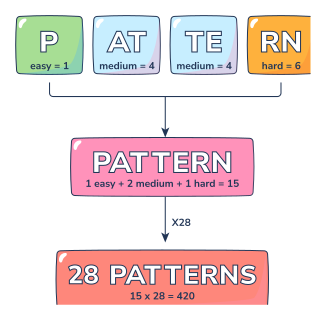
To adequately cover a pattern, you solve 1 easy problem (1 point), 2 medium problems (4 points each), and 1 hard problem (6 points) for a total of 15 points. With 28 patterns, the benchmark comes to 420 points.
Now, let’s see how NeetCode 150 and NVIDIA’s Top 139 measure up against this benchmark.


The score chart above only shows the high-level picture. You might wonder which problems and patterns actually contributed to these scores and, more importantly, what this NVIDIA-focused roadmap is and why its score comes out on top.
That is exactly what we’ll explore in this blog. The analysis goes deeper than raw numbers. You will see which patterns strengthen at each stage, how the gaps close, and how you can structure your coding interview prep to maximize your chances of walking out of an NVIDIA interview with an offer.
Quick overview: NeetCode 150, NVIDIA Top 139, and LeetCode patterns#
NeetCode 150 is one of the most popular curated lists of coding interview problems. It covers a wide range of data structures and algorithms in 150 questions, such as Arrays, Linked Lists, Binary Trees, Graphs, and Dynamic Programming. It is widely used because it provides structure and removes decision fatigue.
NVIDIA Top 139 is a hand-picked collection of problems that have been reported or observed in NVIDIA’s coding interviews. It reflects the actual question trends from NVIDIA and gives direct insight into the company’s interview style.
LeetCode patterns are 28 core problem-solving strategies that capture how most coding interview questions can be solved. These include techniques like sliding window, backtracking, dynamic programming, and graph traversals. By learning these patterns, you build the ability to tackle a wide variety of problems that share the same underlying logic.
Is NeetCode 150 enough for NVIDIA interviews?#
NeetCode 150 is a great starting point and will definitely help you strengthen your CS basics like arrays, strings, and linked lists, but on its own it is not sufficient. Let’s see why.
NeetCode 150 was created years ago, originally with MAANG coding interviews in mind. But is it still relevant in today’s world, where AI is everywhere? And more importantly, is it relevant to NVIDIA? The list has 150 problems, and practicing each one takes a significant amount of your valuable time. When preparing for interviews, the one thing every candidate wants is to spend their time on resources that actually matter and directly prepare them for the final interview.
That is where we need to look beyond static lists and see what works well for NVIDIA interviews.
Do LeetCode patterns cover what NeetCode misses for NVIDIA?#
The short answer is yes. With LeetCode coding patterns, you are not memorizing 150 answers; you are building a toolkit that prepares you for both the expected and the unexpected.
Patterns train you to recognize the underlying strategies behind problems. That flexibility matters at NVIDIA, where interviewers expect you to reason about your solution and think in terms of efficiency and scalability. These reusable frameworks apply even when the problem statement feels unfamiliar.
If you compare the total number of patterns with the size of NeetCode 150, the difference is striking. Covering 28 patterns is far less complex than grinding through 150 individual problems and still wondering if you are missing something. Once you know the patterns, you can walk into your NVIDIA interview confident that you can tackle both familiar and unfamiliar questions.
Overview of 28 patterns for NVIDIA coding interviews#
When you first see the entire list of 28 patterns, it can feel like a lot to digest. To make preparation more approachable, it helps to think of them in four simple groups.

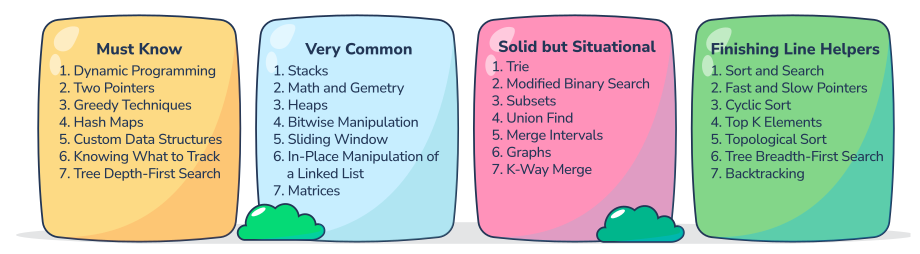
Must-knows: These are the fundamentals. NVIDIA interviewers expect you to be comfortable with them from the very beginning.
Very common, high value: This group includes the strategies that NVIDIA uses often to test not just correctness but also efficiency. They are the patterns where performance trade-offs matter most, and interviewers pay close attention to how you reason through them.
Solid but situational: These show up less frequently, but when they do, they reveal whether you have range beyond the basics. Preparing these ensures you will not be caught off guard by an unexpected twist in the interview.
Finishing line helpers: Finally, there are a handful of patterns that rarely appear, but being familiar with them can be the extra factor that sets you apart. If one shows up, you will have an edge over candidates who skipped them.
While not every group carries the same weight at NVIDIA, developing at least a working familiarity with all 28 patterns ensures your preparation feels complete and leaves no weak spots.
The NVIDIA-focused prep roadmap with 28 LeetCode patterns#
Preparing for NVIDIA interviews is not about checking off every problem list you find. The smart way is to layer your resources so each step builds on the last and moves you closer to complete coverage. Here is a practical roadmap that balances NeetCode 150, NVIDIA Top 139, and the 28 patterns.
Start with the NeetCode–NVIDIA overlap: These problems give you the best return on your time. Every question here strengthens your fundamentals and reflects NVIDIA’s real interview history.
Add the NVIDIA-only set: These highlight the kind of variations and constraints NVIDIA interviewers like to introduce.
Complete the remaining NeetCode 150: Next, work on the NeetCode problems outside of NVIDIA’s set. This ensures you are not leaving gaps in your preparation and that you have practiced all core concepts.
Close gaps with patterns: Finally, reinforce your prep by covering the 28 patterns directly. This step gives you the adaptability to solve questions you have never seen before.
Throughout this roadmap, keep the 1–2–1 rubric in mind: target one easy problem for 1 point, two mediums for 8 points (4 each), and one hard problem for 6 points per pattern. With this scoring, you reach a total of 15 points per pattern and 420 overall. Hitting this target means you are not just familiar with NVIDIA’s problem types but confident in solving them across difficulty levels. That is what complete preparation looks like.


The NeetCode-NVIDIA overlap #
Beginning with the overlap removes uncertainty from your prep. You know for sure that these questions matter because they combine widely practiced fundamentals with NVIDIA’s actual track record. It’s the most reliable way to build momentum at the start.
Let’s see how many problems are common between NeetCode 150 and NVIDIA Top 139.
NeetCode 150 (Problem Name) | NVIDIA Top 139 (Problem Name) |
Valid Sudoku | Valid Sudoku |
Trapping Rain Water | Trapping Rain Water |
Copy List with Random Pointer | Copy List with Random Pointer |
Add Two Numbers | Add Two Numbers |
Last Stone Weight | Last Stone Weight |
Special Binary String | |
Encode and Decode Strings | Minimum Operations to Reduce an Integer to 0 |
Maximum Number of Visible Points | |
. . . | . . . |
Single Number | Partition Array Into Two Arrays to Minimize Sum Difference |
Find The Original Array of Prefix Xor | |
Sum of Two Integers | Count the Number of Good Subsequences |
The table above shows only 58 problems out of 150 to avoid long scrolling. If you would like to see the complete set of problems for both NeetCode and NVIDIA, click the “Show All Problems” button below.
The list above shows that NeetCode and NVIDIA share 52 problems. This is really good because it means a large portion of your practice directly overlaps with NVIDIA’s real interview trends, giving you efficient preparation without extra effort.
Now, let’s see what patterns this set introduces and how well each is covered using the 1–2–1 rubric, with scores of 1 point for the easy, 4 points for the mediums, and 6 points for the hard. In the bar chart below, each bar represents a pattern. The length of the bar shows what percent of the full 15 points you’ve earned for that pattern, while the label highlights how many easy, medium, and hard problems went into that score.
Note: For this calculation, I have only considered the counts that satisfy our 1–2–1 rubric. If a pattern has more questions than required by the rubric, I count only 1 easy, 2 medium, and 1 hard problem. For example, if Dynamic Programming has 10 medium questions, I have included just 2 in this calculation.


The bar chart above shows that the overlap gave you a strong foundation, but with limited spread across patterns. Still, getting introduced to 25 out of 28 patterns, nearly 89%, at this early stage is a huge milestone. It means the overlap alone exposes you to almost the entire landscape of coding strategies you need for NVIDIA.
A few core patterns like Two Pointers, Tree DFS, and Dynamic Programming are already in good shape. But, the majority of patterns are below 60% coverage, and some, like Cyclic Sort and Bitwise Manipulation barely touch 7%.
The good part is that you now know these patterns. From here, you can methodically cover each one using the 1–2–1 rubric.
Why are NVIDIA-specific problems the next best step?#
After the overlap, NVIDIA-only problems are your chance to understand the company’s unique flavor. Insights that you cannot get from generic lists. These are the questions that reflect how NVIDIA interviewers think, the constraints they like to add, and the level of performance they expect. Practicing them ensures your prep is not just broad but directly aligned with NVIDIA’s real interview style.
Let’s look at the new patterns unlocked by the NeetCode-NVIDIA overlap.
Pattern |
The list above shows that the NVIDIA-only questions introduced 3 new patterns, taking the total to 28 out of 28, complete coverage. This is a huge milestone.
Now, let’s see how well each pattern in the NVIDIA-specific set is covered using the 1–2–1 rubric and scores. The bar chart below highlights the newly covered patterns in green on the y-axis.


The bar chart above shows that adding NVIDIA’s own problem set significantly changed the picture. Coverage in critical areas such as Heaps, Greedy Techniques, Math and Geometry, and Graphs shot up to 100%. Trie also strengthened, reaching 93%, and several others moved comfortably into the 60%+ range.
This was the biggest jump in the roadmap so far. NVIDIA-specific questions ensured that efficiency-driven and optimization-heavy patterns were well represented, showing how much value company-focused prep can add.
Why attempt the rest of NeetCode 150?#
The rest of NeetCode 150 might not map directly to NVIDIA’s past interviews, but it plays a critical role in filling out your preparation. These problems cover core topics and patterns that are less visible in the NVIDIA set but can still surface in an interview. By practicing them, you make sure there are no weak spots in your fundamentals and that you are prepared for curveballs outside NVIDIA’s typical style.
Let’s see what additional patterns the remaining NeetCode 150 problems bring in:
Pattern |
The list above shows that no new patterns are introduced, as all 28 are already covered. Now, let’s see how the identified patterns get strengthened further.


The bar chart above shows that bringing in the rest of NeetCode 150 closed even more gaps. At this stage, most patterns were either maxed out at 100% or comfortably in the 90s. Trie, Stacks, and Modified Binary Search, which were partially covered earlier, reached strong coverage.
By now, the coverage across 28 patterns is nearly complete. The roadmap had turned scattered progress into a well-rounded preparation strategy.
Does this roadmap make you fully NVIDIA ready?#
Let’s take a look at the overall pattern coverage so far. The bar chart below shows how well the 28 patterns are represented after following this NVIDIA-focused roadmap:


Looking at the overall chart, the progress is impressive. A large number of patterns are now in the green zone, 15 out of 28 patterns are well covered at over 90% completion. That means more than half of the entire pattern set has already been strengthened to a very high level, which is a big achievement.
At the same time, several patterns remain in the yellow and red zones. Patterns like Cyclic Sort and Fast and Slow Pointers clearly need focused attention. Others, such as K-way Merge, Union Find, and Subsets, will require more practice to reach full strength. Based on the rubric, many of these gaps can be closed by adding just a handful of targeted problems. In this context, the yellow ones require one hard problem, and the red ones require two problems, usually one easy and one hard.
The best part is that no pattern is missing. All 28 patterns are covered, which means you are not leaving any weak spots. With the foundation already this strong, the remaining work is simply about depth, completing the rubric for the underrepresented patterns, and making sure each one reaches the benchmark. That’s what will take your prep from solid to NVIDIA-ready.
Patterns recap for the NVIDIA interview prep#
Let’s break down how each stage of the roadmap contributed to overall pattern coverage.


The pie chart above shows how pattern coverage built up step by step across the roadmap. The biggest share comes from the common patterns between NeetCode 150 and NVIDIA Top 139, which account for 86% of the overall coverage. This overlap gave you the strongest push early on and covered most of the ground in one go.
The NVIDIA-only problems added about 10% more coverage, filling in important gaps and ensuring you were practicing the types of challenges NVIDIA is known to ask. Finally, the NeetCode-only problems introduced the last 3% of coverage, making sure no pattern was left untouched.
Together, these stages take you to full visibility across all 28 patterns. Clearly, the overlap carried the most weight, but the NVIDIA-only and NeetCode-only sets were critical for closing the final gaps.
What score out of 420 have you earned with this roadmap?#
Let’s look at how the score builds up across each stage of the roadmap.


The chart above shows how your score increased step by step as you layered different resources. Starting with the NeetCode-NVIDIA overlap, you earned 150 points, which gave you a strong initial push. Adding the NVIDIA-only problems boosted the score by another 105 points, the single biggest jump in the roadmap. The remaining NeetCode 150 problems added 66 points, rounding out the coverage and taking the total to 321 out of 420.
That leaves just 99 points to be filled, which is less than a quarter of the total. The good news is that this remaining gap can be closed efficiently by targeting the underrepresented patterns with the 1–2–1 rubric: one easy, two mediums, and one hard per pattern. Following this rubric ensures that each pattern is covered in depth and brings you steadily to the ideal 420-point benchmark.
Final verdict: What really gets you NVIDIA ready?#
By now, it should be clear that NVIDIA prep is not about picking sides. NeetCode 150 gives you discipline and breadth, but on its own it risks being outdated for a company pushing the boundaries of AI and high-performance computing. LeetCode patterns add what NeetCode cannot: adaptability, the ability to reason through unfamiliar problems, and the mindset NVIDIA interviewers look for when testing scalability and efficiency.
The best path forward is to connect the three: NeetCode 150, NVIDIA Top 139, and LeetCode patterns. Start with the NeetCode-NVIDIA overlap to lock in high-signal questions, add NVIDIA-specific problems to tune into the company’s unique style, expand with the rest of NeetCode 150 to ensure no gaps in knowledge, and then reinforce everything with patterns. Layered with the 1–2–1 rubric, this roadmap drives you toward the 420-point benchmark while keeping your prep lean and focused.
This approach turns a sea of questions into a structured plan that balances coverage and adaptability. And that balance is exactly what NVIDIA expects: engineers who can master the fundamentals while also innovating under pressure. Walk into your interview with this roadmap, and you are not just prepared, you are NVIDIA ready.
This blog is part of a broader series where I compare NeetCode 150 and LeetCode coding patterns across different companies. If you are preparing for coding interviews at any of these, you might also find the following blogs helpful:
NeetCode 150 vs. LeetCode Patterns: Which is best for Microsoft?
NeetCode 150 vs. LeetCode patterns: Which is effective for Apple?
NeetCode 150 vs. LeetCode patterns: Which prepares you for Amazon
NeetCode 150 vs. LeetCode patterns: What works best for Netflix?
NeetCode 150 vs. LeetCode patterns: Which is better for Google?
Recommended resources to level up#
While this blog offers you a data-driven way to measure and close your prep gaps, the right learning tools can accelerate your progress even further. Here are two highly effective resources to complement your study plan:
Educative’s Personalized Interview Prep: It’s your tailored prep companion that adapts to your skill level and focuses on the 28 essential LeetCode patterns we’ve been discussing. You can work on the patterns that need the most attention, track progress with clear metrics, and know exactly what to tackle next. Whether it’s adding an easy problem to build confidence or a hard one to push for mastery, you’ll always be working on the right problems at the right time.
Educative’s Mock Interviews: Practicing is not just about solving problems. It is also about handling real interview pressure. Educative’s AI mock interviews let you simulate actual interview conditions, get actionable feedback, and improve in areas like problem-solving speed. This way, you are not only technically prepared, but also confident and ready to perform under time constraints.
